

Free Delivery. Exclusive Deals. All Prime.
Prime members save on shipping and get first access to deals, plus Prime Video included. 30 days free.
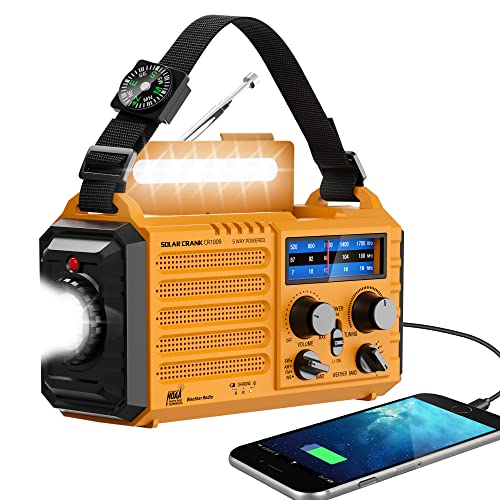
The power flickers, the lights go out, and your phone sits at 12 percent because you forgot to charge it before the storm rolled in. Battery powered emergency radios solve that gap by keeping you tuned to weather alerts and news without relying on the grid or a dying phone. After comparing 6 models, the Prunus Emergency Radio is our top pick thanks to its 3,000 mAh battery, built-in NOAA weather alerts and solar charging for days-long outages. For a simpler backup, the Baijiali Emergency Radio is our alternative pick, with a 5W speaker loud enough to fill a room.

Pros
- NOAA, AM and FM bands for weather and news updates
- 5 power options, including AA batteries, USB, solar and hand crank
- 3000mAh rechargeable battery can charge a phone in Li-ion mode
- LED flashlight, reading lamp, SOS alarm and flashing lights
Cons
- 3 AA batteries are not included
- AA batteries power the radio only and will not charge devices
- Micro USB is listed as the main charging method

Pros
- Receives FM 88 to 108 MHz, AM 530 to 1710 kHz, and SW 2.8 to 22 MHz
- Telescopic antenna for signal reception
- Clear 5W speaker for music, talk, and sports news
- Large channel tuner and volume buttons
- Runs on DC 5V USB or built-in rechargeable battery
Cons
- No weather band is listed
- USB power requires a DC 5V source
- Only gray color is listed

Pros
- 12000mAh built-in rechargeable backup battery
- 6 charging options, including hand crank and solar
- Auto-scans for NOAA weather alerts in standby mode
- 3W flashlight plus 2.5W reading lamp
- Compact 6.8 x 3.7 x 2.9 inch size
Cons
- 3 AAA batteries are not included
- IPX3 water-resistant rating, not listed as waterproof
- Battery life is not specified

Pros
- Receives NOAA, AM, and FM broadcasts
- 2000mAh rechargeable battery can charge USB devices
- Hand crank, solar panel, and rechargeable power sources
- Compact 5 x 1.8 x 2.4 inch size
- 0.49 lb body with 1W LED flashlight
Cons
- No warranty information listed
- No SAME alert feature mentioned
- Phone charging is for emergency use with 2000mAh capacity

Pros
- AM, FM and SW shortwave bands
- Runs on AC power or 4 AA alkaline batteries
- Large speaker for loud, clear sound
- 12Hr and 24Hr clock display options
- Backlit LCD shows time and station
Cons
- 4 AA batteries are not included
- No NOAA weather band listed
- Analog tuning may require manual adjustment

Pros
- AM/FM and NOAA reception with telescopic antenna
- AC power or 4 C/LR14 1.5V batteries
- Large rotary knob and analog scale
- Bass control buttons for sound adjustment
- 2.83 x 9.09 x 5.43 inch portable size
Cons
- Battery mode requires 4 C/LR14 batteries
- No hand crank or solar charging listed
- No digital tuning features listed
How We Chose These Emergency Radios for Winter Power Outages
Preparing for an ice storm or a multi day outage calls for a radio that does more than play music in the kitchen. We weighted practical survival features, like backup charging and weather alerts, over sound quality alone.
- Power sources and run time: Among our picks, battery capacities range from 2,000 mAh up to 12,000 mAh, and most add hand crank and solar charging as backups once the battery runs flat. The RunningSnail Emergency Radio sits at the lighter end of that range, with a 2,000 mAh rechargeable battery that doubles as a USB power bank for phones. Three separate power sources, hand crank, solar panel and battery, mean you are rarely stuck with a dead radio during a multi day outage.
- NOAA weather alerts: A number of our picks scan for NOAA alerts automatically, even in standby mode. The Prunus Emergency Radio covers the weather band at 162.40 to 162.55 MHz alongside AM and FM, and its SOS mode adds a flashing light and alarm for search and rescue. According to the National Weather Service, NOAA Weather Radio All Hazards runs through more than 1,000 transmitters covering all 50 states, so a radio locked onto that band keeps you informed almost anywhere in the country.
- Build and water resistance: A radio that spends a storm on a windowsill or near a leaking door needs more than a plastic shell. The Raynic Emergency Radio carries an IPX3 water resistance rating and weighs 1.2 pounds, which is a real edge if moisture is a concern in your home. Several of our other picks skip a water resistance rating entirely, so they are better suited to dry indoor use.
- Size and weight: Space is limited in a bug out bag or a kitchen drawer during a weekend without power. Weight among our picks ranges from about 0.5 pounds for the lightest crank radio up to 1.2 pounds for bulkier models with larger batteries, and the smallest units measure around 5 inches long. A compact radio slides into a glove box without taking up room you need for food and water.
- Ease of use with cold hands: Gloved or numb fingers make small buttons frustrating fast. Large rotary knobs and analog dials, found on two of our 6 picks, are easier to manage than tiny digital menus when your hands are stiff from the cold. A single crank handle you can turn without removing mittens is another detail worth checking before you buy.
We left out disposable hand warmers and boot inserts because they are single use and do nothing for power or communication during an outage. Ham radios that require a license fall outside the scope of this guide, and sleds pulled behind vehicles carrying people are excluded for safety reasons. With those out of the way, here is a look at a few more emergency radios that almost made the main list.
Other Emergency Radios Worth Considering
These are other emergency radios we looked at but did not put on our main list.
If you want a bit more battery than our top pick without stepping up to a bulkier unit, the Nitigo Emergency Radio carries a 4,000 mAh battery, about 1,000 mAh more than the 3,000 mAh cell in our top pick. It still relies on hand crank and solar backups for recharging, so the extra capacity mostly buys you more listening time between charges.
FosPower Emergency Radio‘s version lands at the other end of the scale, with a 2,000 mAh battery that is 1,000 mAh smaller than our top pick’s. That is still enough for NOAA alerts and basic phone charging, but it means more frequent trips to the hand crank during a long outage.
For families who want to cover a cabin and a car at the same time, the Leaton Emergency Radio packs a 10,000 mAh battery, more than three times the 3,000 mAh cell in our top pick. The larger battery adds bulk, so it fits a glove box better than a jacket pocket.
And if raw capacity is the whole reason you are shopping, the Roxicosly Emergency Radio tops out at 12,000 mAh, four times the battery in our top pick. That much power can keep a phone charged through several days without sun or a working outlet, though it comes with extra weight to carry.
FAQs
How long will a battery powered emergency radio run during an outage?
Battery capacities across emergency radios like the ones in this guide range from 2,000 mAh to 12,000 mAh, and hand crank or solar backups extend that once the battery drains. A smaller 2,000 mAh unit will need recharging well before a 12,000 mAh model during a multi day outage.
Do these radios work in cold weather?
Most emergency radios run on standard AA or C batteries, or a built in lithium cell, both of which lose some capacity in freezing temperatures. Keeping a radio indoors or close to your body helps, and if you are also running a space heater during a storm, the CDC recommends keeping it at least 3 feet from bedding or furniture and using one with an automatic shut off switch.
What is NOAA weather radio and why does it matter?
NOAA Weather Radio All Hazards is a nationwide network run by the National Weather Service that broadcasts official watches, warnings and forecasts 24 hours a day, 7 days a week. According to the National Weather Service, the network includes more than 1,000 transmitters covering all 50 states, Puerto Rico, the U.S. Virgin Islands and the U.S. Pacific Territories, so a radio tuned to that band gives you local alerts almost anywhere.
Can I charge my phone with an emergency radio?
Many emergency radios double as power banks once their internal battery is charged, with capacities in this guide ranging from 2,000 mAh to 12,000 mAh. A 12,000 mAh unit can typically recharge a phone several times over, while a 2,000 mAh model may only manage a partial charge.
Sources
- NOAA Weather Radio All Hazards, National Weather Service. NWS page on the NOAA Weather Radio network.
- Safety Guidelines: During & After a Winter Storm, Centers for Disease Control and Prevention. Winter heating safety for space heaters, kerosene heaters and carbon monoxide.




Write Your Review
No reviews yet. Be the first to share your experience!