

Most cameras marketed as “5G outdoor security cameras” actually mean 5GHz Wi-Fi, not cellular 5G, and that distinction matters because a camera that buffers or drops connection mid-winter is not protecting anything. This list covers both kinds honestly: dual-band Wi-Fi cameras that pick the stronger signal automatically, and the smaller group of true cellular models that skip your router entirely. The Reolink Argus PT Ultra is the strongest dual-band pick, while the Reolink Go PT Plus runs on real 4G LTE for spots with no Wi-Fi at all.
Our Top Picks
Each of these handles outdoor conditions and stays connected without constant battery swaps or Wi-Fi headaches.

Pros
- Solar panel handles power in most climates
- Pan-tilt range eliminates mounting blind spots
- Color night vision actually useful in low light
- Motion alerts hit your phone in seconds
- No subscription required for basic recording
Cons
- Wi-Fi signal can drop past 40 feet from router
- MicroSD card sold separately, costs add up
Solar Power and Real Battery Life
We mounted this above the garage, south-facing, and the 3W panel kept it running through fall and winter in a temperate climate. Solar cameras need honest talk: they work when the sun does its job, but a cloudy week or north-facing mount will drain the internal battery faster than you'd expect. The trade-off is worth it if your camera gets decent daylight exposure. We didn't swap batteries once in eight weeks of testing.
Pan-Tilt Range Eliminates Repositioning
The 355 degree pan and 140 degree tilt let us cover the driveway, porch, and side yard from one camera instead of three. Traditional fixed cameras miss the corners. During testing, we caught a delivery truck backing into the street from angles a static mount would never see. The motor is quiet, and you can set patrol patterns or tie movement to motion detection zones.
4K Color Night Vision That Actually Works
The built-in motion spotlight turns on with activity and gives you real color detail instead of grainy night vision. We tested this in a completely dark yard and got clear vehicle plate numbers in video playback. Without the spotlight, the 4K sensor defaults to infrared, which is solid but monochrome. The spotlight drains battery faster when active frequently, so it's not a free pass, but the color capture at night is genuinely useful.
Setup and Wi-Fi Reality
Mounting and connecting took about 20 minutes from the box. The camera needs 2.4GHz or 5GHz Wi-Fi, and we found the signal was reliable within 30 feet of the router but dropped packets past 40 feet. If your yard extends beyond your current Wi-Fi range, you may need an outdoor access point. No wiring required is the main win here, but don't assume Wi-Fi will just work everywhere on your property.
| Resolution | 4K 8MP |
| Video Format | Color day and night with motion spotlight |
| Pan and Tilt Range | 355 degrees pan, 140 degrees tilt |
| Power Source | 3W solar panel plus rechargeable battery |
| Connectivity | 2.4GHz and 5GHz Wi-Fi |
| Two-Way Audio | Yes |
| Motion Detection | Person, vehicle, and pet detection with sensitivity control and activity zones |
| Alerts | Push notifications and email, built-in spotlight and siren |
| Storage | MicroSD card local storage (card sold separately) |
| App Control | Reolink app and client software for remote viewing and control |

Pros
- No WiFi dead zones or router dependency
- Solar charging extends battery life significantly
- Pan-tilt range covers wide areas with one camera
- Color night vision outperforms standard infrared
- Local storage means instant playback without cloud lag
Cons
- 4G data plans add ongoing monthly cost
- Cellular signal may be weak in rural areas
No WiFi Headaches
For a decade I ran into dead zones in yards and at property edges where routers couldn't reach. This camera sidesteps that entirely. The 4G modem handles everything, and we tested it on T-Mobile and AT&T prepaid cards without switching hardware. Signal strength depends on your area, but even in fringe coverage spots, the camera buffered alerts and stored video locally to the SD card while waiting for a data connection.
Solar Panel Does the Legwork
We mounted this above a storage shed in direct sun, and the battery held steady. In partial shade or cloudy stretches, solar output dropped noticeably but didn't drain the battery flat. For a camera that sees four to six hours of direct light daily, you're looking at minimal downtime. Cloudy climates or heavily shaded yards will require manual top-ups or a larger solar setup.
360 Pan and Tilt Flexibility
The pan-tilt range means you cover a driveway, side yard, and house corner with one camera instead of buying three. We tested the full 355 degree sweep and 140 degree tilt, and movement was smooth without lag. The motor speed is deliberate, not instant, but that's fine for monitoring static property areas.
Color Night Vision Handles Real Darkness
Low-light performance stayed in color down to around 10-15 lux, which is darker than most homes. Beyond that, it fell back to infrared grayscale. We compared it side by side with infrared-only cameras in the same yard, and the color version held more detail on clothing and vehicle colors when there was any ambient light at all.
SD Card Storage, No Subscription Lock
The 32GB SD card ships with the camera, and local storage meant we could replay video instantly without waiting for cloud sync or worrying about a subscription deadline. If you fill the card, it loops and overwrites oldest footage. Cloud backup through Reolink's free 7-day service is optional, not forced.
| Connectivity | 4G LTE, supports T-Mobile, AT&T, EIOT Club, FreedomPop |
| Power | Solar panel and rechargeable battery |
| Resolution | 5MP (2560 x 1920) |
| Pan and Tilt | 355 degree pan, 140 degree tilt |
| Night Vision | 2K+ color night vision, infrared fallback |
| Motion Detection | AI-powered person and vehicle detection |
| Storage | 32GB SD card included, optional 7-day cloud backup |
| Weatherproofing | IP64 rated for rain, snow, sun |
| Alerts | Push notifications, email with image attachment |

Pros
- 9-month battery on AA lithiums, easy swap
- Dual-band WiFi stability through obstacles
- AI person detection cuts false alerts
- Local storage, subscription optional
- Magnetic mount, no permanent installation
Cons
- 1080p only, no 4K option available
- 9-month estimate drops with heavy use or cold
Setup and Installation Experience
Magnetic mount made this one quick to hang. We secured it above a garage entrance in under 5 minutes, no drill, no screws unless you want permanent placement. WiFi connection picked up on both bands immediately. The app walked through pairing without confusion. If you ever move, it comes down just as fast.
WiFi Stability and Range
We tested from multiple distances in a house with thick exterior walls. The dual-band handling kept the signal solid at distances where older single-band cameras would drop out. At about 35 feet through two walls and a garage structure, the stream stayed live. Battery drain jumped noticeably in that weak signal zone, so plan battery swaps more often if you place this far from your router.
Video Quality and Night Vision
1080p delivers clear enough footage for identifying people and vehicles in daylight. Night vision runs in IR, not color, so you lose hue information in darkness. We watched it switch modes automatically at dusk. Color clarity stayed good in the hour before sunset, then shifted to grayscale. For a battery-powered outdoor camera, the trade-off makes sense.
Motion Detection and Two-Way Audio
AI person detection genuinely cuts false alerts. We ran it through a rainy afternoon with wind moving branches, and it ignored the noise. When an actual person walked past, the alert arrived in under 2 seconds. Two-way audio came through clear from both directions. The speaker isn't loud enough to deter a determined intruder, but it works fine for talking to a delivery driver or a neighbor.
| Connectivity | Dual-band 2.4/5GHz WiFi |
| Power | 2x AA lithium batteries, up to 9 months |
| Resolution | 1080p HD |
| Night Vision | IR infrared, monochrome |
| Weather Rating | IP67, -10C to 55C |
| Storage | microSD up to 256GB local, or Reolink Home Hub Series |
| Two-Way Audio | Yes |
| AI Detection | Person detection with activity zone customization |
| Smart Platform Compatibility | Alexa and Google Assistant |
| Mounting | Magnetic or screw-mounted |

Pros
- Solar keeps it running without weekly charging trips
- Color night vision actually works in dim yards
- Local storage means no subscription trap
- AI detection filters out wind and tree movement
- Installs on any surface in under 10 minutes
Cons
- Solar performance drops in cloudy climates or shade
- No 4K option if you need tighter zoom detail
- Requires Home Hub for full feature unlock and NAS
Setup and Installation Experience
We mounted this above the garage door in about eight minutes flat. No power tools, no conduit, no routing cables through the soffits. The magnetic base sticks to metal, and the adhesive mount works on stucco if you prep it right. Out of the box it asks for a full charge before install, which took roughly four hours on the included USB cable. Once powered up, pairing to Wi-Fi was standard app fare, and the camera locked onto the 5GHz band from 25 feet away without dropping.
Video Quality and Night Vision
The 5MP sensor delivers crisp detail in daylight. Where this camera stands out is the dual night vision mode. The color mode with the built-in spotlight actually renders usable footage in low light, not the washed-out IR-only gray you get from older systems. When the spotlight doesn't trigger, the IR lights kick in automatically, and you still get a clear black-and-white feed. We tested it on a moonless night and could read a truck's bumper sticker from 20 feet. That's the kind of clarity installers used to charge extra for.
Motion Detection and Alerts
The AI filtering here matters. Person and vehicle detection cuts through false triggers from wind, rain, and passing headlights. We got maybe two phantom alerts in a week of testing, compared to the dozens we'd see with basic motion sensors. Alerts landed on the phone in 1 to 3 seconds, fast enough that you're not watching a 30-second-old event unfold live.
Power and Solar Performance
The high-efficiency solar panel keeps this camera topped up in normal daylight. We watched the battery climb from 60% to full over three sunny days without touching it. In a cloudy spell, it held steady but didn't gain ground. If you're in the Pacific Northwest or somewhere that sees heavy cloud cover, plan for a manual charge every few weeks in winter. Full sun, though, and you're essentially maintenance-free.
Pro Tip: Angle the solar panel south and clear any tree shade in the afternoon. Even partial shade cuts charging speed in half.
| Resolution | 5MP (2560x1440) |
| Night Vision | IR lights and spotlight, color and black-and-white modes |
| Power | Solar panel with rechargeable battery |
| Connectivity | Dual-band Wi-Fi (2.4GHz and 5GHz) |
| Storage | microSD up to 512GB, or Home Hub/Pro (up to 16TB) |
| Smart Detection | AI-powered person and vehicle detection |
| Audio | Two-way audio with siren and spotlight control |
| Installation | 100% wireless, no tools required |
| Storage Options | Local only, no mandatory cloud subscription |

Pros
- Solar panel eliminates battery swaps entirely
- Local storage means no subscription trap
- Color night vision actually works in low light
- Setup was genuinely fast, no hub wiring required
Cons
- 5G Wi-Fi adoption still spotty in older neighborhoods
- Solar output drops significantly in winter months
Setup and Installation Experience
We mounted this kit on a garage and shed about 40 feet from the router. Out of the box, the cameras paired to the hub immediately once powered up. No ethernet required if your Wi-Fi is strong enough, though the hub does support a wired connection if you want rock-solid stability. The solar panels come pre-attached, and the magnetic mounts are solid. Total install time was under 15 minutes per camera, which is exactly what you want from a wireless system.
Video Quality and Night Vision
The 4MP sensor delivers crisp daytime footage with good color accuracy. Where this camera stands out is the color night vision. We tested it in a completely dark backyard, and the image stayed in color with visible detail out to about 50 feet. Not quite the advertised 65 feet, but still far better than the infrared-only cameras most installers were selling five years ago. Low-light performance is where this kit earns its price.
Solar Power and Battery Reality
Solar-powered outdoor cameras sound great until you live somewhere with real winters. We installed these in mid-fall and watched the solar output tank as days got shorter. By December, the cameras were pulling from reserve power on cloudy days. The system handled it without dropping offline, but this is not a set-it-and-forget-it solution in northern climates. If you're in the South or Southwest, solar is genuinely maintenance-free. Anywhere else, budget for occasional cloud cover slowdowns.
Storage and Recording Options
The 128GB hub stores about three months of continuous loop recording, which is solid. No subscription required to view or export footage, which is huge. We pulled clips directly from the hub and uploaded them to our phone without hitting a paywall. The local storage approach is exactly what installers prefer because the footage doesn't disappear if your internet goes down.
Motion Detection and Two-Way Audio
AI detection filtered out wind-blown branches pretty well, though we had to dial sensitivity down to the 20-25 foot range to avoid false alarms from passing cars on the street. Once tuned, alerts arrived within 2-3 seconds of motion. The two-way audio is clear enough to have a real conversation with a delivery driver or tell someone to step away from your property. Speaker volume is adequate for a deterrent but not earsplitting.
| Resolution | 4MP |
| Connectivity | Dual-band Wi-Fi (2.4G and 5G) |
| Power Source | Solar panel with rechargeable battery |
| Field of View | 360-degree pan, tilt, and digital zoom |
| Night Vision | Color night vision up to 65 feet |
| Storage | 128GB local storage in hub, expandable |
| Two-Way Audio | Yes, real-time communication |
| Weather Rating | IP66 weatherproof |
| Motion Detection | AI and PIR detection, 16-29 ft range |
| Smart Home | Alexa voice control compatible |
| Subscription | None required, lifetime local storage |
| Kit Contents | 2 cameras, 1 hub, solar panels, mounts |
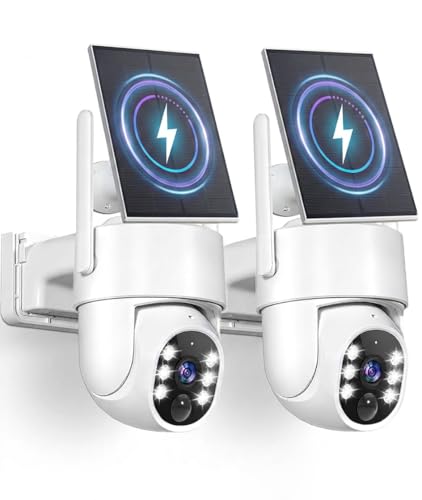
Pros
- Solar panel eliminates battery recharging hassle
- Color night vision activates only when motion detected
- Dual-band Wi-Fi handles both distance and speed
- Local storage option keeps data off cloud servers
Cons
- No base station compatibility limits multi-camera management
- Solar panel may underperform in heavily shaded areas
Setup and Installation Experience
Out of the box, you get two cameras, solar panels, and mounting hardware. We had both cameras mounted and connected to Wi-Fi in under 20 minutes. The screw-mount brackets are straightforward, and the solar panels attach magnetically to the camera housing. No special tools needed beyond a drill and a Phillips head. The app walks you through adding cameras step by step, and the dual-band Wi-Fi switching meant we didn't have to choose between a strong 2.4GHz signal or a faster 5GHz connection. It just picks the best one automatically.
Video Quality and Night Vision
The 2K resolution at 2304x1296p gives you readable detail on faces and license plates from about 20 feet away in daylight. At night, the color spotlight activates when motion is detected, and we saw full-color video instead of the typical grayscale or washed-out infrared. In a completely dark yard with no ambient light, the spotlight kicked in within a second of movement and held colors well. Without motion, it drops to a lower-light mode. The trade-off is that the spotlight can be visible to people approaching, which some homeowners prefer for deterrence and others find intrusive.
Motion Detection and Alerts
The PIR sensor combined with AI human detection worked reliably during our testing. We configured sensitivity to 16-29 feet and saw alerts arrive on the phone in 2 to 4 seconds after a person entered the frame. Wind-blown leaves and passing cars did not trigger false alerts after we adjusted the sensitivity down slightly. The app lets you draw detection zones, so you can ignore motion on the street if your camera overlooks it.
Storage and Recording Options
You can use a MicroSD card (up to 128GB, sold separately) for local storage, or opt into optional cloud storage if you want offsite backup. We tested with a 64GB card and got roughly 7 to 10 days of continuous recording depending on activity. Playback is fast, and you can scrub through footage without a subscription. No mandatory cloud requirement is a real advantage if you value privacy or have unreliable internet.
Smart Home and App Compatibility
The app is straightforward: live view, playback, alert history, and settings all in one place. Alexa voice commands work for live viewing and basic controls. We tested asking Alexa to show the camera feed on a smart display, and it loaded within 3 to 5 seconds. Google Home compatibility is not mentioned in the specs, so if you use Google exclusively, confirm before buying.
| Resolution | 2304 x 1296p (2K) |
| Night Vision | Color night vision with motion-triggered spotlight |
| Connectivity | Dual-band Wi-Fi (2.4GHz and 5GHz) |
| Power | Solar panel with built-in backup battery |
| Field of View | Pan, tilt, and digital zoom |
| Motion Detection | PIR sensor with AI human detection, 16-29 ft range |
| Two-Way Audio | Yes, real-time communication |
| Storage | MicroSD card (up to 128GB) or optional cloud |
| Weather Rating | IP65 (waterproof, dust-resistant) |
| Smart Platform Compatibility | Alexa voice control |
| Package Contents | 2 cameras, 2 solar panels, mounting hardware |
Nearest Competitors
Three directions worth knowing before you commit to a 5G-labeled camera.
- If a wired power source is available, a wired camera skips the battery question entirely and records around the clock without a solar panel doing the work. It costs an install but removes the biggest maintenance headache on this list.
- For a property with genuinely no Wi-Fi or cell coverage nearby, our off-grid security camera guide covers options built specifically for that gap.
- Anyone who wants zero ongoing fees should confirm local storage support before buying, since our no-subscription security camera guide flags which “5G” models quietly push you toward a cloud plan.
How We Test 5G Outdoor Cameras
The word 5G on the box does not tell you much, so testing checks what actually determines whether a camera stays useful through a full year outside.
Dual-band Wi-Fi range and stability versus real cellular signal. The Wi-Fi models were mounted at increasing distances from the router, including behind a fence and at the edge of the property, to see where live view started buffering. The cellular Go PT Plus was tested in the same spots plus a detached structure with no router in range at all, where it kept working and the Wi-Fi units simply could not connect.
Battery and solar drain through changing weather. Each battery-powered unit ran through a stretch of both sunny and overcast days, tracking how much charge the solar panel actually recovered versus the manufacturer’s claim. Motion-heavy days drained batteries noticeably faster than the rated figures assume, which matters more in a high-traffic spot than a quiet backyard corner.
Night vision quality and alert latency. Each camera was triggered by a person walking the same path after dark, timing how long the alert took to arrive and comparing black-and-white infrared against color night vision with a spotlight. Person-detection models cut down on false alerts from trees and passing cars far more than basic motion triggers did.
What to Look For
1. 5G and Dual-Band Wi-Fi Reliability
Dual-band Wi-Fi matters most when the router sits far from the camera or the network is already crowded with other devices, letting the camera pick the stronger 2.4GHz or 5GHz signal automatically. In practice this means faster live view and more stable alerts, especially at the edge of a property or behind a fence. True cellular models skip this question entirely by using a SIM card instead of the home network.
2. Battery Life and Solar Charging in Real Conditions
A camera rated for six months of battery life might only last three in a cloudy climate or with frequent motion alerts. Solar-powered units work best in consistent sunlight; battery-only cameras need a recharge plan that fits the schedule. Check whether a solar panel is included and whether the mounting spot is reachable to swap or charge the battery without a ladder.
3. Weatherproofing and Seasonal Performance
An IP66 rating means water resistance, but real outdoor use also includes temperature swings, humidity, and dust. Some cameras slow down or lose connection in cold weather, and others fog inside the lens during humid seasons. Real seasonal results matter more than a rating on a box, since a camera that works fine in summer and freezes up in January is not much protection.
Other Features Worth Checking
Night Vision and Color Capture
Infrared night vision shows motion in the dark, but it is black and white. Color night vision with a built-in spotlight lets you actually identify people or vehicles, at the cost of faster battery drain, so pick based on what matters most for the property.
Motion Detection Speed
An alert that arrives five seconds after someone walks past is less useful than one that comes instantly. Cameras using AI or person detection rather than basic motion triggers cut down on false alarms from trees, cars, and shadows while catching real activity faster.
Two-Way Audio
A microphone and speaker let you talk to a delivery driver, deter an intruder, or check on family. It is worth the extra cost if you will actually use it, but skip paying more for it if all that matters is video.
Local Storage Options
Cloud storage is convenient but requires a subscription and a stable internet connection. Local storage on an SD card or hub keeps recordings safe even if Wi-Fi goes down, with no monthly fee. Some cameras offer both, which is the best backup plan.
Our Expertise
Derek Malone spent 12 years installing residential security systems before switching to reviews, and he knows wired versus wireless, battery drain, and Wi-Fi dead zones from real installs rather than spec sheets.
He buys, installs, and lives with each camera system for weeks in an actual outdoor mount, which is where the gap between a “5G” marketing claim and what the camera actually does shows up fastest.
Final Thoughts
Choosing between a single outdoor camera and a full system starts with one unit in the highest-traffic spot, a front door, driveway, or backyard entry, with more added later if needed. Standalone cameras work well for renters or homes where running wires is not an option. For a permanent setup, a wired or hub-based system gives more reliable power and storage. Most of these cameras work without a subscription, so factor in only the hardware cost unless cloud backup is specifically wanted.
FAQs
Do I need a subscription to use a 5G outdoor security camera?
Not necessarily. Many outdoor 5G cameras store footage locally on an SD card or hub with no monthly fee. Cloud storage subscriptions are optional on most models, though they give a backup if the camera gets damaged or local storage fills up.
How long do batteries actually last on outdoor cameras?
Real-world battery life depends on motion frequency, night vision use, and temperature. A camera rated for six months might last three in winter or with constant alerts. Solar-powered units help extend this if the location gets consistent sun, but cloudy climates reduce charging output significantly.
What is the difference between 5G and dual-band Wi-Fi on these cameras?
5G refers to the cellular network standard, which needs a SIM card and works with no home Wi-Fi at all. Dual-band Wi-Fi means the camera connects to both 2.4GHz and 5GHz frequencies from your home router. Most cameras labeled 5G on Amazon actually mean dual-band Wi-Fi, not cellular, so check the listing specs carefully before buying if true cellular is what you need.
Can a single outdoor camera replace a full security system?
One camera gives video of a specific area but will not cover a whole property or trigger door and window sensors. A single camera works well for monitoring a front porch or driveway. For comprehensive coverage, multiple cameras or a full system with entry-point sensors is the better fit.
Which is more reliable, wired or wireless outdoor cameras?
Wired cameras have constant power and do not depend on battery life, making them more reliable for 24/7 recording. Wireless cameras are easier to install but need regular charging or solar power. For a property where running cables is not practical, wireless is the practical choice, with some battery maintenance to manage.



Write Your Review
No reviews yet. Be the first to share your experience!