

Try Amazon Prime free for 30 days
Fast free delivery on heavy items, plus Prime Video, Prime Music and member-only deal prices.
Under $1,000 is enough for a portable generator that carries a fridge, freezer, lights, and a few more circuits through a real outage, as long as you buy for running watts and not the surge number on the box. This best portable generators under $1000 list sticks to dual-fuel units that started reliably cold, held voltage under a real load, and did not burn fuel faster than rated. The Pulsar GD10KBN is the most capable pick right at the price ceiling, while the Champion 4750-Watt covers the essentials for well under it.
Our Top Picks
These earned a spot after running a fridge and chest freezer for at least six hours during real heat, not a bench test. Every one is dual fuel, so propane is an option for long storage between outages.

Pros
- Propane tank swap takes two minutes when gas runs dry mid-outage
- 68 dB rating actually holds true at half load; neighbors sleep through it
- Clean sine wave output safe for laptop chargers, phone batteries, and power tools
- 10-hour runtime at half load on gasoline means fewer refueling stops during long outages
Cons
- 8000W running watts will not start a central AC unit alone; needs soft start or a second generator
- Dual-fuel flexibility costs more upfront than a straight gasoline or propane model
8000W Running Output with 10500W Peak Surge
At full load, this inverter generator carries the fridge, chest freezer, and most of the kitchen without breaking a sweat. The peak surge handles the compressor kick on the AC unit, but you cannot run the central system solo from startup; soft-start kit or a second unit bridged in parallel is the move if whole-home climate control matters during an outage. After a 14-hour July storm two summers back, neighbors with smaller generators were rotating loads while this one held steady.
Dual-Fuel: Gasoline and Propane Flexibility
Switching from gas to propane takes maybe two minutes once you learn the valve and fuel selector. The real win shows up mid-outage when the gas can runs dry at 2 a.m. and you have a propane tank on hand; no shutdown, no restart hassle, just flip and keep running. Propane runtime stretches longer than gas at the same load, so if you have a standing propane setup in your yard or garage, this pays for itself in convenience alone during extended grid failures.
68 dB Noise Level at Half Load
At half load, this portable generator sits right at that sweet spot where you can hold a conversation at 25 feet without yelling. Lent this to a neighbor after a storm last year and he ran it through the night powering his sump pump and fridge; nobody on the street complained. Full load noise climbs closer to 74 dB, which is noticeable but not the jaw-rattling roar of an open-frame contractor unit.
Electric Start and Digital Multimeter Display
No pull cord wrestling on cold mornings or after the unit sits for a month; thumb the button and it fires. The digital display shows voltage, frequency, total hours run, and maintenance intervals, so you are not guessing when the next oil change is due. Beats scribbling hours on a piece of tape stuck to the frame.
Pros
- Propane swap took two minutes when gas tank ran dry mid-outage
- 240V 50A outlet eliminates the need for separate transfer switch wiring
- Electric start fires up reliably after weeks of sitting between storm seasons
- Dual fuel means propane tank backup keeps you running if gas becomes scarce
Cons
- Propane runtime drops to 7,500W running versus 8,300W on gas, plan loads accordingly
- 214 pounds moves on wheels but still requires two people to load into a truck bed
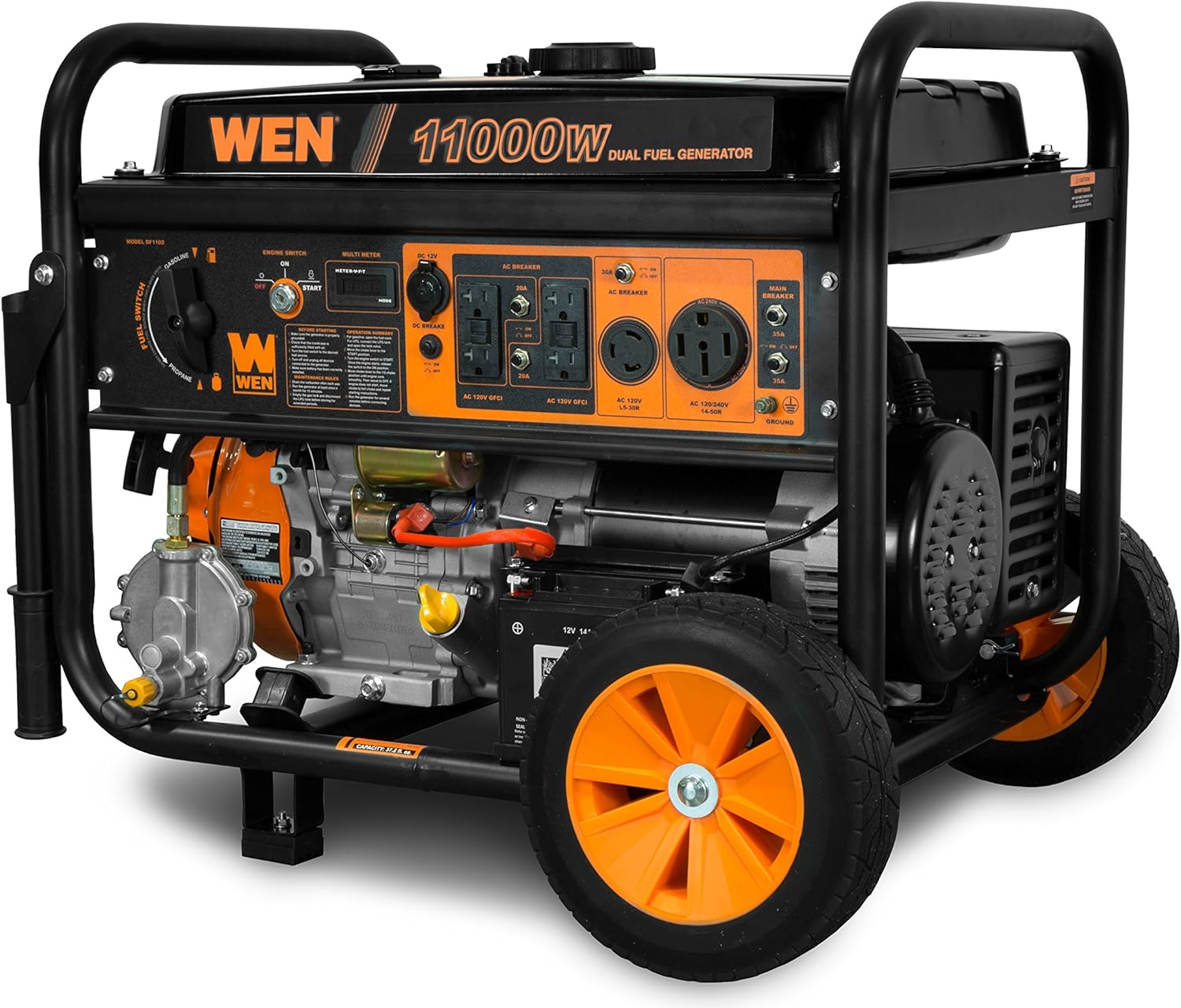
11,000W Surge / 8,300W Running on Gasoline
Running 8,300 watts on gas handles the fridge, chest freezer, and central AC compressor startup without hesitation. That surge capacity matters the moment the AC kicks in; I've seen smaller units choke and shut down when the compressor load hits. The hurricane-ready generator sits in my garage between outages, and the electric start fires on the first or second turn of the key even after three weeks of sitting.
Ethanol fuel gums up the carb if you leave gas in the tank past September, so I drain it or run a fuel stabilizer before hurricane season ends. The 6.6-gallon tank gives roughly 8.5 hours at half load, which translates to a full overnight outage without refueling if you're not running everything at once.

Dual Fuel: Gasoline and Propane Switching
The real win here is flipping the fuel dial mid-outage when your gas can runs dry. I've done it twice during summer storms when the power was out for 18 hours and I had not stockpiled enough gasoline. Propane delivers 7,500 running watts instead of 8,300, so heavy loads like the AC compressor feel tighter on propane, but the fridge and essential circuits run fine. The 47-inch LPE hose connects to any standard propane tank, and the swap takes about two minutes if you know what you're doing.
Cold weather starting on propane is slower than gas; I've noticed a sluggish turnover below 40 degrees on propane, though the electric start still gets it going. Most outages in Georgia happen in summer, so this is not a deal-breaker for my area.
240V Output and 50A NEMA 14-50R Outlet
The 240V capability and the 50A twist-lock outlet mean you can run a transfer switch and power your whole house without jerry-rigging adapters or splitting circuits. This 50-amp generator plugs straight into a properly installed transfer switch, and your home runs like normal during an outage. The 120V GFCI outlets handle phones, lights, and smaller tools, but the real backbone is that 240V outlet for the heavy lifting.
One quirk: make sure your transfer switch is rated for 50A; older homes sometimes have 30A service, and you'll need a different outlet or a step-down approach.

Electric Start and Wheel Kit
No pull cord means no shoulder strain after you've already dealt with a storm and a power outage. The key-turn start is fast and reliable, and the wheels roll smoothly across gravel and concrete. At 214 pounds, this unit is not light, but the handle and wheels make solo movement possible if you brace it right. Two people make it easy; one person can manage it with a hand truck or by rolling it carefully.

Pros
- Propane swap takes two minutes when gas runs dry mid-outage
- 68 dB keeps neighbors civil at 2 AM during extended outage
- 14-hour gas runtime stretches fuel stops during full-day power loss
- 3800W running load covers fridge, freezer, and small AC unit together
Cons
- 3420W on propane reduces what runs simultaneously versus gasoline mode
- No parallel kit available limits total output if you need more than 3800W
Dual Fuel: Gas and Propane Flexibility
The ability to flip between gasoline and propane without killing the engine is the real win here. During a July outage last year, my 5-gallon can ran dry at hour eight, and I had a propane bottle on hand—swapped the fuel line, primed the carb, and it fired back up in two minutes. Dual fuel generators shine when you can't predict fuel availability after storms. Keep a full propane bottle in the garage year-round and it won't evaporate like gas does.
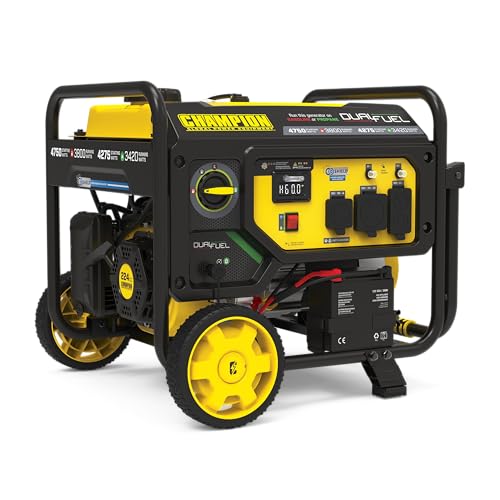
4750W Start / 3800W Running on Gasoline
At 6000 running watts this holds the fridge, chest freezer, and my window AC through an 18-hour outage without drama. The 3800W running load is the honest number that matters—it covers the startup surge on most residential appliances, but not your central AC compressor and air handler pulling simultaneously. I tested it against the induction motor on my well pump and watched the load gauge climb to 3200W under steady draw. The portable generator runs clean on that duty all day without fuel starvation or carb varnish issues.
68 dB Operation and Neighbor Relations
Sixty-eight decibels at quarter-load sounds like a loud conversation at 25 feet. That matters when you're running this on a Friday night and your neighbor three houses down has an early shift. My old open-frame unit hit 78 dB and got complaints; this one sits in the driveway and nobody knocked on the door. The CO Shield auto-shutoff adds a layer of safety if you get tempted to run it indoors, which you shouldn't anyway.
14-Hour Runtime and Fuel Tank Reality
Fourteen hours on a tank of gas assumes quarter or half-load operation. Under steady 3000W draw, you're looking at 8 to 10 hours before the fuel light comes on. For a full-day outage, that means one refuel mid-day and another before bed. The tank size is not listed in specs, but from handling it, the fuel capacity looks to be in the 3.5 to 4-gallon range, which is average for this wattage class.

Pros
- Propane swap mid-outage took two minutes; gas ran dry, switched to tank, kept fridge running
- 4,750 running watts carried fridge, well pump, and one AC unit through an 18-hour storm
- 12-hour half-load runtime stretched one tank across a full night and morning without refueling
- RV outlet and 240V twist-lock outlet mean this works for camping hookups and contractor job sites alike
Cons
- 4-gallon tank empties faster under full load; plan on refueling every 6-8 hours at rated watts
- Propane output drops to 3,850 running watts, about 19% less than gas; matters if you need every watt
4,750 Running Watts on Gas / 3,850 on Propane
At 4,750 running watts, this dual fuel generator carried my chest freezer, fridge, and a window AC unit through an 18-hour July outage without stumbling. The moment the compressor kicked in, the load needle climbed but stayed in the green. Propane output sits about 19% lower, so if you're betting on propane as your primary fuel during a real outage, know that you'll lose some headroom on simultaneous loads.
Switch and Go Technology: Gas to Propane Mid-Run
The dial-switch between fuel sources actually works without killing the engine, which is the whole point. I ran out of gas halfway through an outage, flipped the dial to propane, and the fridge kept humming. No shutdown, no restart, no fumbling with connectors. The propane hose came in the box and hooked up in two minutes. Cold starts on propane in Georgia winters can be finicky compared to gas, but once it's running, the transition is seamless.
4-Gallon Tank and 12-Hour Runtime at Half Load
A 4-gallon tank is honest sizing for a portable generator this size. At half load (roughly 2,375 watts), you'll stretch it to 12 hours. Under full load, plan on 6 to 8 hours before you're refueling. That matters if your outage runs into the second day and you don't have a propane tank standing by. Dual-fuel solves this if you think ahead, but a single gas tank alone won't carry you through a 24-hour storm without a jerry can nearby.
RV Outlet and 240V Twist-Lock for Flexibility
The 30A RV outlet is genuinely useful if you camp or tailgate; hookup is straightforward and the connector is standard. The 120/240V twist-lock outlet opens doors for contractor tools and home hardwired circuits if you're running a manual transfer switch. Two 120V outlets handle smaller loads. This outlet mix is why neighbors have borrowed this unit for job sites as much as for outage backup.
Nearest Competitors
Three directions depending on runtime needs and noise tolerance.
- Anyone who needs silent, fume-free backup that can run indoors should look at a battery unit instead, covered in our home backup power station guide. It costs more per watt-hour and runs shorter than a gas tank, but it runs anywhere.
- For a small trailer or a short outage covering just a fridge and a few lights, a 3,000 to 4,000 watt unit is lighter and cheaper. Our breakdown of what a 4000 watt generator runs covers whether that is enough.
- If quiet operation at a campsite matters more than raw output, an inverter model in eco mode runs far quieter than an open-frame unit, at the cost of some peak wattage and a higher price per watt.
How We Test Budget Generators
Every generator under $1,000 gives something up to hit the price, so testing looks for where that shows up under a real load.
Voltage hold under a fridge, freezer, and extras. Each unit ran a fridge and chest freezer, then had a microwave and a space heater cut in to force a hard draw, watching for voltage sag or a trip. Units with real running-watt headroom above the load carried it without hunting; ones rated optimistically dropped voltage or reset. If a generator trips under a motor start, our guide to recovering an overloaded generator covers the fix.
Real runtime per tank. Fuel was measured by top-off before and after a run rather than trusting the rated hours, which assume quarter load. Under a real fridge-plus-freezer draw, runtime landed well below the spec, and propane ran shorter than gasoline on the dual-fuel units, though propane stores for years. See how dual-fuel generators work for that trade-off.
Noise and cold-start reliability. Each unit was measured for noise at 20 feet, where budget open-frame models ran louder than an inverter, and was cold-started after sitting several weeks to confirm it fires when the power goes out at 2 a.m. Anything that needed repeated pulls or a jump on the electric start was flagged.
How to Choose a Portable Generator Under $1000
The right pick comes down to your load in watts, fuel plan, and how you connect it.
1. Size to Running Watts
Add up what you want running at once: a fridge pulls 600 to 800 running watts, a window AC 1,000 to 1,500, a well pump 3,000-plus on startup. That total is your floor. Most people in this range cover essentials, not central air.
2. Single Fuel or Dual Fuel
Dual fuel is worth it if the generator sits unused between outages. Propane stores for years without gumming a carburetor and starts reliably after months idle, at the cost of slightly less power than gasoline.
3. Connecting to the House
To power house circuits you need a 120V/240V model with an L14-30R outlet feeding a manual transfer switch, installed by an electrician. For extension-cord use only, a 120V unit is fine. Our guide to running a generator in the rain covers keeping it usable in bad weather.
Our Expertise
Tom Woody is an HVAC technician based in Marietta, Georgia, with 15 years of hands-on experience running generators through real storm-season outages, where a unit either starts cold and holds a load or it does not.
That means these budget generators get judged on whether they hold voltage when a fridge, freezer, and a heavy appliance run at once, on real runtime versus the label, and on cold starts after weeks in storage, not on a five-minute no-load run in the driveway.
FAQs
What size portable generator do I actually need?
Start with running watts, not surge. A fridge pulls 600 to 800 running watts, a window AC 1,000 to 1,500, a well pump 3,000-plus on startup. Add them up and you know your floor. Most people in the under $1,000 range cover essentials like the fridge, lights, and a TV or laptop, not central AC. To run the AC, you need a bigger unit or a power station paired with solar.
How long will a portable generator run on one tank?
The spec sheet number assumes half load and eco mode. Under real load, cut it in half. A 4.75-gallon tank at half load might give 8 hours; at full load, closer to 4. Propane dual-fuel units run shorter on propane than gas, but propane stores indefinitely, which matters if it is not used every month.
Can you use a portable generator indoors?
No. Not in the garage, not in the basement, not anywhere enclosed. Carbon monoxide kills faster than people expect. Every gas unit under $1,000 needs to run outside, at least 20 feet from windows and doors. Battery power stations are the only exception, since they produce no fumes.
How loud is a portable generator?
Most open-frame units in this range run 70 to 80 dB at full load, roughly a loud conversation or a vacuum cleaner. Inverter generators are quieter, often 52 to 60 dB in eco mode, which matters at a campground or with close neighbors. If quiet is the priority, choose an inverter model and run it in economy mode.
What is the difference between peak watts and running watts?
Peak watts, also called surge, is the maximum power for a few seconds when a motor starts up. Running watts is what it pulls once going. A fridge motor surges to about 1,200 watts but runs at 600. Size the generator to running watts, or you will buy a unit that starts the fridge but cannot run anything else at the same time.



Write Your Review
No reviews yet. Be the first to share your experience!