

Free Delivery. Exclusive Deals. All Prime.
Prime members save on shipping and get first access to deals, plus Prime Video included. 30 days free.
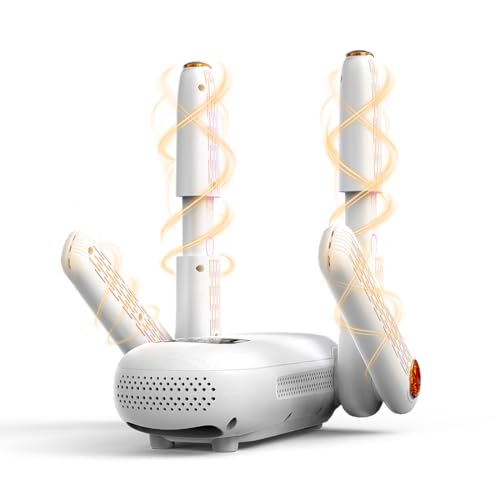
Stepping into yesterday’s soggy boots before coffee is a small household betrayal. Boot warmer dryers solve that by moving gentle warm air through footwear and gear so moisture does not sit overnight. After comparing 6 models, the Nesovi Boot Dryer is the best fit, with a 0 to 180 minute timer, 95℉ to 113℉ air and room for 2 pairs. The Lavieair Boot Dryer is the alternative pick for 36 watt silent drying.

Pros
- Warm air circulation ranges from 95℉ to 113℉
- Timer settings from 30 to 180 minutes with auto off
- Detachable 6-tube setup supports boots up to 18 inches
- Can dry 2 pairs of shoes at once
- No-slip clips help secure footwear during drying
Cons
- Timer maxes out at 180 minutes
- Only black color is listed
- No warranty details are provided

Pros
- 0 dB fanless operation for silent drying
- 36W convection heat uses less power than a standard light bulb
- Dries damp footwear in about 8 hours, wet footwear in about 12
- ETL certified with overheat and overcurrent protection
Cons
- No fan or motor, so drying is slower than forced air designs
- Dries only one pair of shoes, boots, or sneakers at a time
- Warm-up takes about 30 minutes before gentle heat is noticeable

Pros
- Dries up to 2 pairs in one cycle
- Fan plus 220W gentle heat for 1 to 4 hour drying
- Fan-only 36W mode for sensitive materials
- Safe for leather, rubber, neoprene, vinyl, canvas and synthetics
- ETL-approved and assembled in the USA
Cons
- Helmet, glove and boot extension attachments sold separately
- Warranty registration required within 10 days of purchase
- Tall boots over 11 inches need separate extensions

Pros
- Dries 1 pair of shoes, boots, or sneakers at a time
- Fanless convection heat for silent operation
- 36 watt power use for overnight drying
- Foldable design for portable storage
- Works with gloves, helmets, cleats, and sneakers
Cons
- Damp items can take 8 hours to dry
- Wet items can take 12 hours to dry
- Only handles 1 pair at a time

Pros
- Ozone deodorization rated at 20 mg/h
- Timer adjusts from 0.5 to 9 hours
- Dries 2 pairs of shoes or gloves at once
- Extendable tube reaches up to 24 inches
- Runs at around 50 dB
Cons
- Max timer setting is 9 hours
- Only grey color is listed
- Measures 12.1 x 11.6 x 23 inches

Pros
- 105 to 140 F gentle warm air drying range
- Compact 7.9 x 2.5 x 1.18 inch size
- Lightweight 0.62 lb design for travel
- 43 inch power cord for easier placement
- Works with shoes, boots, socks, and gloves
Cons
- No timer or auto shutoff listed
- Requires a 110V to 120V outlet
- Only listed in white
How We Chose Boot Dryers for Wet Boots and Gloves
Wet footwear needs more than heat. The better fit depends on how quickly the dryer moves warm air, how many items it can handle and whether the controls make sense for overnight or workday use.
- Drying or heating method and speed: We gave more weight to warm-air movement and stated drying times because soaked boots need airflow as much as heat. The Nesovi Boot Dryer uses warm air from 95℉ to 113℉, which is a gentler range than a high-heat blast. Among our picks, drying approaches range from fanless 36 watt convection to fan plus heat at 220 watts.
- Capacity and fit: Capacity matters if you are drying work boots, sneakers and gloves in the same household. Two of our picks are built to dry 2 pairs at once, while several others focus on 1 pair at a time. Tall footwear also matters, so we favored designs with stated reach, including one pick with support up to 18 inches and another with an extendable tube up to 24 inches.
- Heat settings and timer: A timer is useful because damp shoes and fully wet boots do not need the same cycle. Across the main list, timer ranges run from 0.5 to 9 hours on one model and 0 to 180 minutes on another. We also considered whether a dryer had selectable modes, including fan-only at 36 watts and fan plus heat at 220 watts.
- Noise: A boot dryer often runs in a mudroom, bedroom corner or office, so noise can be the difference between using it daily and unplugging it. Fanless models in the group advertise 0 dB operation because they use no fan or motor. One forced-air pick lists about 50 dB, which gives shoppers a real number to compare against silent convection units.
- Size and storage: Storage matters if the dryer travels to a cabin, worksite or hotel room. The smallest pick we considered measures 7.9 by 2.5 by 1.18 inches and weighs 0.62 pounds, which makes it easier to pack than a standing 2-pair base. The PEET Boot Dryer is the bigger drying-station option, with a 120V plug and a 5.25 pound build for home use.
- Safety listing: We looked for stated electrical protections, safety certifications and rated household voltage. The Mingting Boot Dryer is a 120V plastic unit with a UL listing, while another main pick is ETL approved. According to the Centers for Disease Control and Prevention, electric heaters should have automatic shut-off switches and should never be covered, which is a good reminder to keep drying gear uncovered and used as directed.
We excluded disposable hand warmers and boot inserts because single-use heat does not dry footwear over repeated cycles. We also excluded ham radio licensing because it is outside the scope of boot drying, and sleds pulled behind vehicles carrying people because that activity is unsafe.
Other Boot Dryers Worth Considering
These are other boot dryers we looked at but did not put on our main list.
If you need a vehicle-friendly setup, Xcman Boot Dryer brings a 12V format and a UL listing. That gives it a different size and feature mix than our top pick, but it is less directly suited to the household comparison around timers, pair capacity and warm-air range.
For shoppers who want more power, Aaobosi Boot Dryer is rated at 300 watts and includes thermostat control. Its rubber build and ETL listing are appealing on paper, but that power level is higher than our main list’s 220 watt fan-and-heat option, so it may be more than some overnight users need.
Dryguy Product is worth noting if thermostat control is your main requirement. It is a capable unit, but it does not match this keyword’s need as closely as the main list because the available details do not give the same clear numbers for capacity, size or timer range.
And if you want a middle-ground power rating, Forlim Boot Dryer lists 200 watts, thermostat control, a rubber build and an ETL listing. It still landed outside the main list because our picks give a broader spread of controls, including 0 to 180 minute timing and 0.5 to 9 hour timing.
FAQs
Are boot dryers safe to leave running overnight?
Some models are designed for overnight drying, but the safest answer depends on the unit’s controls and certification. Our picks include 36 watt convection models, ETL approved models and timed models that can shut off after a set cycle.
How fast should a boot dryer warm or dry wet boots?
Among our picks, stated warm-up or cycle times vary widely. One convection style lists about 30 minutes to warm up, about 8 hours for damp footwear and about 12 hours for wet footwear, while timed forced-air models can run shorter cycles.
Can one boot dryer handle gloves as well as boots?
Several models in the group are described for gloves as well as shoes or boots. Capacity still matters: some dry 1 pair at a time, while others handle 2 pairs or multiple gear pieces through several tubes.
What safety habits matter with boot warmer dryers?
Keep the dryer uncovered, place it where airflow is not blocked and follow the rated voltage, such as 120V for household models. The CDC also advises using electric heaters with automatic shut-off switches and keeping space heaters at least 3 feet from drapes, furniture or bedding.
Sources
- Safety Guidelines: During & After a Winter Storm, Centers for Disease Control and Prevention. Winter heating safety for space heaters, kerosene heaters and carbon monoxide.
- NOAA Weather Radio All Hazards, National Weather Service. NWS page on the NOAA Weather Radio network.




Write Your Review
No reviews yet. Be the first to share your experience!