

Free Delivery. Exclusive Deals. All Prime.
Prime members save on shipping and get first access to deals, plus Prime Video included. 30 days free.
A snowy boot puddle has a way of reaching the sock drawer before anyone admits they forgot the mat. Boot trays solve that by giving wet shoes, gloves and drips a contained place to land. After comparing 6 models, the Wataniya Pet Boot Tray stands out for its 16.7 x 12.8 inch footprint, plastic build and water resistant design. The tchdio Boot Tray is the alternative pick if you want a 16 x 27.5 inch rubber tray.

Pros
- Comes as a 2 pack of trays
- Each tray measures 16.7 x 12.8 x 1.2 inches
- Raised edge helps contain splashes and mud
- Made from 100% recycled polypropylene plastic
- 4 non-slip gaskets help reduce sliding
Cons
- Small tray size may not fit larger boot pairs
- Black color only
- Plastic construction may not suit every entryway style

Pros
- 100% natural rubber construction
- Raised edges help contain water, mud, and spills
- 16 x 27.5 inch size fits 3 pairs of shoes
- Rinses clean with water
- Rolls up for storage when not in use
Cons
- Only listed in black diamond color
- May be small for more than 3 pairs of shoes
- Rubber weight is about 2.8 lb
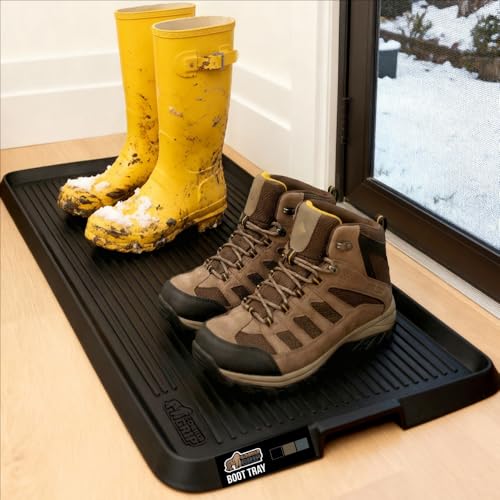
Pros
- 32 x 16 inch tray for entryways, mudrooms, or garages
- Raised .8 inch edge holds up to 20 cups of liquid
- Natural rubber construction resists tearing and staining
- Ribbed texture helps airflow around wet shoes
- Built-in side handles make it easier to move and empty
Cons
- Natural rubber may have a slight scent at first
- Black color may show dust or dried dirt
- 32 x 16 inch size may not fit larger boot setups

Pros
- 23.75 x 15.5 inch tray for shoes, boots or pet bowls
- 1.25 inch raised edge helps contain water and dirt
- Made from 100% recycled polypropylene
- Indoor or outdoor use for entryways, porches or patios
- Rinses clean or wipes with a cloth
Cons
- Only the black color is listed
- This listing is for a 1 pack
- 1.25 inch edge may not hold large spills

Pros
- 15 x 30 inch tray fits entryways and pet areas
- 1.2 inch raised edge helps contain drips and splashes
- Waterproof polypropylene protects floors from wet shoes
- Multipurpose use for boots, pet bowls, litter, and plants
- Lightweight 1.36 pound design for easy repositioning
Cons
- Only listed in black
- 15 x 30 inch size may be small for multiple pairs of boots
- No warranty details provided

Pros
- 16 x 27.5 inch size fits small entry areas
- Deep grooves help contain water, mud, and snow
- Reinforced rubber backing with slip-resistant base
- Rinses or wipes clean for indoor or outdoor use
Cons
- Single tray may be limited for larger households
- 0.8 inch height may not contain taller spill volume
What We Looked For in Boot Trays for Wet Gear
Wet footwear is not only about mud at the door. A useful tray has to contain snowmelt, give shoes enough room to sit without spilling over, and fit where people actually take their boots off.
- Drying or heating method and speed: These are passive trays, not heated boot dryers, so drying depends on containment, airflow around the footwear and how much water the tray can keep off the floor. The Gorilla Grip Boot Tray uses a rubber build and a water resistant design, with a raised edge listed at .8 inch. Its ribbed surface is meant to lift wet items slightly, which can help keep soles from sitting flat in pooled water.
- How many pairs or how large an area it fits: The smallest listed footprint among our picks is 16.7 x 12.8 inches, while the longest reaches 30 inches. The Wataniya Pet Boot Tray is the compact pick in that group, with a 16.7 x 12.8 inch size and a 1.2 inch raised edge. That makes it more suited to a tight doorway, under-sink spot or vehicle cargo area than a wide family mudroom row.
- Heat settings and timer: None of the 6 main picks lists an electric heat setting or timer, so they should be treated as containment trays rather than drying appliances. That matters because heated products add control questions that a simple 1.2 inch raised edge does not. If active heat is part of your plan, the Centers for Disease Control and Prevention says electric space heaters should have automatic shut-off switches and non-glowing elements.
- Noise: Since the main picks have no motor, fan or powered heating element listed, there is no operating noise to compare in the way there would be with a plug-in dryer. The relevant number here is capacity by footprint: our picks range from 12.8 inches deep to 16 inches deep. A passive tray is better for a quiet entryway, while a powered dryer would need a separate noise comparison.
- Size and storage: Among the main picks, lengths run from 23.75 inches to 32 inches when looking at the larger single trays. The Ottomanson Boot Tray measures 15 x 30 inches and has a water resistant design with a 1.2 inch raised edge. That longer shape can suit a row of shoes better than a short tray, but it also asks for a wider landing zone by the door.
- Safety listing: The main picks do not list electrical safety certifications, which is expected because they are non-electric trays. For any nearby heater used to dry the room or warm an entryway, the CDC recommends keeping space heaters at least 3 feet from drapes, furniture or bedding. It also says never to cover a space heater, which is worth remembering if wet gloves and boots are crowding the same area.
Disposable hand warmers and boot inserts were excluded because they are single use and do not solve the floor-protection problem. Ham radio licensing is outside the scope of a home boot tray guide, and sleds pulled behind vehicles carrying people were excluded as unsafe.
Other Boot Trays Worth Considering
These are other boot trays we looked at but did not put on our main list.
If you prefer rubber to plastic, Azadx Boot Tray is an alternative built around a rubber construction and water resistant use. Its main appeal is material rather than a more detailed size claim, so our alternative pick gives a clearer 16 x 27.5 inch footprint for comparing fit by a door.
For shoppers who want a familiar rectangular entryway size, Behero Boot Tray is another rubber alternative at 16 x 27.5 inches. That puts it in the same general footprint as our alternative pick, but the main list gives a broader spread from 12.8 inches deep to 16 inches deep for different spaces.
Yinkin Boot Tray is listed with a 15 x 1.2 inch figure, a rubber build and water resistant use. Because that size information is less complete than the 15 x 30 inch footprint of one main-list long tray, it is harder to judge how many boots it will hold before water reaches the surrounding floor.
Petabby Boot Tray is the closest alternative to the compact plastic format, with a 16.7 x 12.8 inch size and water resistant construction. It may make sense if that footprint is exactly what you need, but our top pick uses the same stated size while staying in the main group compared against 6 models.
FAQs
What size boot tray works best by a front door?
Start with the space where people naturally step out of wet shoes. Among our picks, compact trays measure 16.7 x 12.8 inches, while longer options reach 32 inches, so a narrow apartment entry needs a different footprint than a mudroom wall.
Are rubber or plastic boot trays better for wet boots?
Both materials can work if the tray is water resistant and has a raised edge. In our main list, raised edges range from .8 inch to 1.25 inches, and that lip matters more for snowmelt containment than the material alone.
Do boot trays dry boots faster?
A basic tray does not add heat or a fan, so it should not be treated like a powered boot dryer. What it can do is keep wet soles contained, and ribbed surfaces or grooves can help separate footwear from some pooled water.
Can I use a heater near a boot tray to speed drying?
Be careful with any separate heater. The CDC says space heaters should be kept at least 3 feet from drapes, furniture or bedding, should never be covered, and should have automatic shut-off switches and non-glowing elements.
Sources
- Safety Guidelines: During & After a Winter Storm, Centers for Disease Control and Prevention. Winter heating safety for space heaters, kerosene heaters and carbon monoxide.
- NOAA Weather Radio All Hazards, National Weather Service. NWS page on the NOAA Weather Radio network.




Write Your Review
No reviews yet. Be the first to share your experience!