

Free Delivery. Exclusive Deals. All Prime.
Prime members save on shipping and get first access to deals, plus Prime Video included. 30 days free.
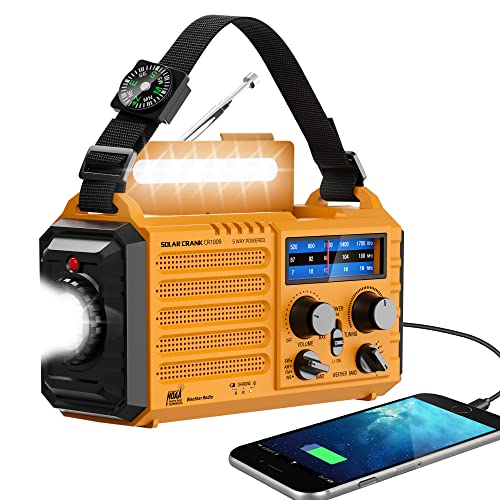
The power is out, the phone is at 12 percent, and the flashlight is somehow in the cereal cabinet again. Emergency weather radios solve that by keeping NOAA updates, light and backup power in one small device. After comparing 6 models, the FosPower Emergency Radio is the best fit for its 2,000 mAh battery, NOAA access and solar charging. The Leaton Emergency Radio is the alternative pick if you want a larger 10,000 mAh battery.

Pros
- 7400mWh (2000mAh) power bank for small devices
- 3 power sources: crank, solar, and AAA batteries
- 4 LED reading light plus 1W flashlight
- Receives NOAA emergency weather and AM/FM broadcasts
- Limited Lifetime Warranty included
Cons
- Power bank is limited to small tablets or phones
- AAA batteries are needed for one backup power option
- Only orange Model A1 color is listed

Pros
- 10000mAh internal battery with 5V/1A USB output
- NOAA, AM, and FM radio bands for weather and news
- USB-C, solar, and hand crank charging options
- 3-mode flashlight plus 1.3W reading lamp
- IPX6 splash resistance for outdoor use
Cons
- No automatic NOAA alerts or SAME technology
- Manual tuning required for NOAA stations
- No headphone jack

Pros
- Real 12000mAh built-in battery for backup power
- 8500mm² monocrystalline solar panel
- 1 minute of cranking can power calls, light, or news
- 5W adjustable-beam flashlight plus 12-LED reading lamp
- IPX6 waterproof with NOAA alerts and SOS alarm
Cons
- Only color listed is Army Green
- At 1.82 lb, it may add weight to an emergency kit
- Dimensions are 6.8 x 2.88 x 4.74 inches

Pros
- S.A.M.E. localized programming
- Alerts for over 60 weather hazards and emergencies
- Program alerts for up to 25 counties
- Color-coded indicators show alert severity
- Continuous backlighting option for the LCD
Cons
- Color listed only as white
- Battery life details are not listed
- Warranty details are not listed

Pros
- NOAA, AM/FM/WB reception with DSP tuning
- 12000mAh rechargeable battery for backup power
- 8500mm² solar panel plus hand crank charging
- 5W flashlight, reading lamp and 120dB SOS alarm
- USB-C input and AAA backup power options
Cons
- Only color listed is army green
- No runtime estimates provided
- Product data lists no warranty details

Pros
- Covers 7 NOAA weather bands
- AM 520 to 1710 kHz and FM 87 to 108 MHz
- Compact 4.7 x 2.8 x 1.2 inch size
- Runs on 2 AA batteries
- Has speaker and headphone playback modes
Cons
- No automatic NOAA alert notifications
- AA battery power requires keeping spares on hand
- Only 3 manual controls, with no digital screen
What We Looked For in Emergency Radios for Winter Outages
Winter storms change what matters in an emergency radio. A model that seems fine for a weekend campsite may be less useful when ice keeps the power out and the nearest outlet is not coming back soon.
- Power sources and run time: We gave the most weight to radios with more than 1 way to recover power when outlets are unavailable. The FosPower Emergency Radio has a 2,000 mAh battery, solar charging and a hand crank, plus AAA battery backup. That combination matters during a long outage because it does not depend on a single charging method.
- NOAA weather information: NOAA access was essential because the National Weather Service says NOAA Weather Radio broadcasts warnings, watches and forecasts 24 hours a day, 7 days a week. The Roxicosly Emergency Radio pairs NOAA alerts with a 12,000 mAh battery, solar charging and a hand crank. That makes it a stronger fit for households that want a larger power reserve along with weather updates.
- Build and water resistance: Storm gear should tolerate more than a clean kitchen counter. Among our picks, one model is listed as IPX6 waterproof, while another is described as water resistant, dustproof and shock resistant. The OnLyee Emergency Radio also includes a 12,000 mAh battery, NOAA access, solar charging and a hand crank, which gives it a broad emergency feature set for messy conditions.
- Size and weight: A radio for a go bag should not crowd out medicine, gloves or batteries. The smallest pick measures 4.7 by 2.8 by 1.2 inches and weighs 0.24 lb without batteries. Another compact pick measures about 6.3 by 3.5 by 3.1 inches and weighs about 1.1 lb, which is still reasonable for a backpack or car kit.
- Ease of use with cold hands: In a cold outage, tiny controls and hidden menus are frustrating. One pick uses only 3 controls for power, tuning and band selection. Another pick has large controls and manual tuning, while a desktop alert model can be programmed for up to 25 counties.
We excluded disposable hand warmers and boot inserts because they are single use, not information tools. Ham radio licensing is outside the scope of this guide, and sleds pulled behind vehicles carrying people are unsafe. The models here focus on receiving weather information, keeping a small amount of power available and staying manageable during outages.
Other Emergency Radios Worth Considering
These are other emergency radios we looked at but did not put on our main list.
If battery capacity is your main concern, Mesqool Emergency Radio is worth a look because it lists a 12,000 mAh battery, compared with 2,000 mAh for our top pick. It also includes NOAA weather alerts, solar charging and a hand crank, so its power setup is closer to the larger-capacity radios on our main list.
For a similar high-capacity approach, Pplee Emergency Radio also lists a 12,000 mAh battery, NOAA weather alerts, solar charging and a hand crank. That is 6 times the stated battery capacity of our top pick, but it did not replace the main selections because the listed feature set overlaps closely with other large-battery options.
Raynic Emergency Radio sits between those large-battery alternatives and our top pick with a 5,000 mAh battery. It still includes NOAA weather alerts, solar charging and a hand crank, so it may suit shoppers who want more reserve power than 2,000 mAh without moving to a 12,000 mAh model.
Prefer a different feature mix instead of chasing the largest battery number? Kaito Emergency Radio includes NOAA weather alerts, solar charging, a hand crank and water resistance. It stands out mainly for that mix, while the main list gives more weight to stated battery capacity and clearly listed winter-outage features.
FAQs
Do I need NOAA access for winter storms?
Yes, NOAA access is the main reason to own this type of radio. According to the National Weather Service, NOAA Weather Radio broadcasts official warnings, watches and forecasts 24 hours a day, 7 days a week.
How many charging methods should an outage radio have?
More than 1 charging method is useful because winter outages can last beyond a single battery charge. Among our picks, charging options include USB-C, solar, hand crank, AAA batteries and AA batteries, depending on the model.
Is a larger battery always better?
A larger battery can help if you expect to charge a phone, but capacity is only one part of the decision. Our picks range from 2,000 mAh to 12,000 mAh, while the smallest battery-powered model runs on 2 AA batteries.
What else should I keep near an emergency radio?
Keep spare batteries, a charging cable and a battery-operated carbon monoxide detector nearby. The Centers for Disease Control and Prevention also says space heaters should be kept at least 3 feet from drapes, furniture or bedding.
Sources
- NOAA Weather Radio All Hazards, National Weather Service. NWS page on the NOAA Weather Radio network.
- Safety Guidelines: During & After a Winter Storm, Centers for Disease Control and Prevention. Winter heating safety for space heaters, kerosene heaters and carbon monoxide.




Write Your Review
No reviews yet. Be the first to share your experience!