

Free Delivery. Exclusive Deals. All Prime.
Prime members save on shipping and get first access to deals, plus Prime Video included. 30 days free.
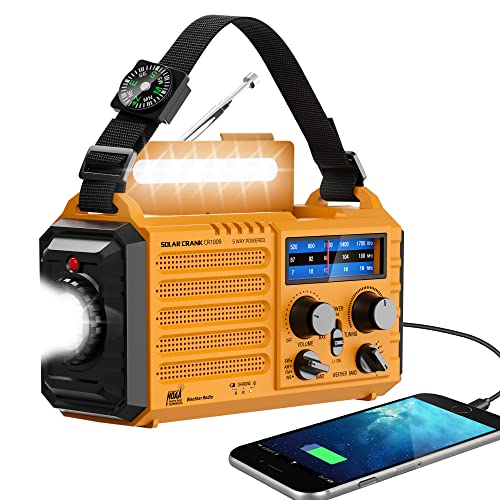
The power goes out right after you finally find the flashlight, and the batteries are, of course, in a drawer somewhere else. Emergency radios solve that problem by combining weather updates, backup power and lighting in one grab-and-go device. After comparing 6 models, the Raynic Emergency Radio stands out for its 5,000 mAh battery, NOAA weather alerts and solar charging. The Emgykit Emergency Radio is the alternative pick if you want a smaller unit with a 2,000 mAh battery and NOAA weather access.

Pros
- Auto-scans NOAA alerts in standby mode
- 6 charging options, including hand crank and solar
- 5000mAh built-in rechargeable backup battery
- 3W flashlight plus 2.5W reading lamp
- 3.5 mm headphone jack for private listening
Cons
- 3 AAA batteries are not included
- IPX3 water resistance is limited
- At 1 lb, it is not the lightest pocket radio

Pros
- AM/FM/NOAA weather band access
- 3 power options: crank, solar, Type-C
- 3W 3 LED flashlight with 140LM brightness
- SOS siren rated louder than 80 dB
- Compact 5.16 x 2.09 x 2.6 inch size
Cons
- Battery life is not specified
- Water resistance is not specified
- 2000mAh battery may offer limited phone backup

Pros
- 7400mWh (2000mAh) power bank for small devices
- 3 power sources: crank, solar, and AAA batteries
- 4 LED reading light plus 1W flashlight
- Receives NOAA emergency weather and AM/FM broadcasts
- Limited Lifetime Warranty included
Cons
- Power bank is limited to small tablets or phones
- AAA batteries are needed for one backup power option
- Only orange Model A1 color is listed

Pros
- NOAA, AM, and FM reception with extended antenna
- 12000mAh lithium battery for backup power
- 8500mm² monocrystalline solar panel
- Hand crank generator with extended crank arm
- Flashlight beam reaches up to 260 feet
Cons
- Battery should be fully charged before first use
- At 1.59 pounds, it may add weight to a go bag
- Listed dimensions are inconsistent in the product data

Pros
- 10000mAh internal battery with 5V/1A USB output
- NOAA, AM, and FM radio bands for weather and news
- USB-C, solar, and hand crank charging options
- 3-mode flashlight plus 1.3W reading lamp
- IPX6 splash resistance for outdoor use
Cons
- No automatic NOAA alerts or SAME technology
- Manual tuning required for NOAA stations
- No headphone jack

Pros
- Receives NOAA, AM, and FM broadcasts
- 2000mAh rechargeable battery can charge USB devices
- Hand crank, solar panel, and rechargeable power sources
- Compact 5 x 1.8 x 2.4 inch size
- 0.49 lb body with 1W LED flashlight
Cons
- No warranty information listed
- No SAME alert feature mentioned
- Phone charging is for emergency use with 2000mAh capacity
How We Chose Emergency Radios for Winter Outages
Winter storms put unusual pressure on an emergency radio because power can be out for hours, roads can be iced over and weather updates matter more than entertainment. We prioritized radios that can run without wall power and still remain simple enough to operate in a dark house.
- Power sources and usable backup time: A winter radio should not depend on 1 charging method. The Raynic Emergency Radio has a 5,000 mAh battery, solar charging and a hand crank, which gives it several ways to stay useful after an outage starts. Among our picks, listed battery capacities run from 2,000 mAh to 12,000 mAh, so the right choice depends on whether you mainly need radio time or emergency phone charging.
- NOAA weather access and alerts: According to the National Weather Service, NOAA Weather Radio All Hazards broadcasts warnings, watches and forecasts 24 hours a day, 7 days a week. The FosPower Emergency Radio receives NOAA broadcasts and includes a 2,000 mAh power bank, solar charging and a hand crank. That combination matters when ice takes down power lines and a phone alert may not be the only update you want to rely on.
- Build and water resistance: Cold-weather preparedness often means wet gloves, melting snow and gear that gets tossed into a car kit. The Leaton Emergency Radio is rated IPX6 for water resistance and has a 10,000 mAh battery. It also includes solar charging and a hand crank, but its NOAA reception is manual rather than automatic, so it asks more attention from the user.
- Size and weight: Emergency gear is only useful if it fits where you will actually keep it. Among our picks, stated weights run from 0.5 lb to 1.2 lb, and the listed lengths run from 5 inches to 6.8 inches. Smaller radios are easier to stash in a glove box, while larger units often make room for bigger batteries or reading lamps.
- Ease of use with cold hands: Buttons, knobs and screens matter when the heat is off and you are wearing gloves. One of our picks has a large HD LCD display and digital tuning, while another uses large controls and manual tuning for AM, FM and NOAA. For winter outages, we favored clear labels, physical controls and lighting modes that can be activated without navigating an app.
We excluded disposable hand warmers and boot inserts because single-use heat is a different problem from staying informed. Ham radio licensing is outside the scope of a home emergency-radio guide, and sleds pulled behind vehicles carrying people are unsafe. The radios here focus on weather information, backup charging and practical lighting during outages.
Other Emergency Radios Worth Considering
These are other emergency radios we looked at but did not put on our main list.
If you would rather consider a different size and feature mix, the Midland Emergency Radio is another hand-crank option. The tradeoff is that the available comparison point is its crank design, while our main picks spell out battery capacities from 2,000 mAh to 12,000 mAh.
For shoppers who want a much larger stated battery, the Roxicosly Emergency Radio lists 12,000 mAh, compared with 5,000 mAh for our top pick. It also includes NOAA weather alerts, solar charging and a hand crank, so its appeal is mainly longer reserve power on paper.
A smaller-capacity route is the yesiwtc Emergency Radio, which lists a 2,000 mAh battery versus 5,000 mAh for our top pick. It still includes NOAA weather alerts, solar charging and a hand crank, so it makes more sense if compact backup matters more than battery reserve.
And if a 12,000 mAh battery is the main reason you are shopping, the Pplee Emergency Radio is another alternative with NOAA weather alerts, solar charging and a hand crank. That stated capacity is more than double the 5,000 mAh capacity of our top pick, though capacity alone does not tell you how easy the radio is to tune in a dark, cold room.
FAQs
What should an emergency radio have for a winter power outage?
Look for more than 1 way to power it, such as a rechargeable battery, hand crank or solar panel. Our picks list battery capacities from 2,000 mAh to 12,000 mAh, which is enough range to choose between a compact radio and a larger backup-power unit.
Why does NOAA weather access matter during ice storms?
The National Weather Service says NOAA Weather Radio All Hazards broadcasts official warnings, watches and forecasts 24 hours a day, 7 days a week. Its network has more than 1000 transmitters and covers all 50 states, which makes it a useful backup when internet service is unreliable.
Is solar charging enough during a winter storm?
Solar charging is useful as a backup, but short daylight and heavy cloud cover can limit it. That is why the stronger picks combine solar with at least 1 other off-grid method, usually a hand crank or replaceable batteries.
What other winter safety gear should sit near an emergency radio?
The CDC recommends installing a battery-operated carbon monoxide detector and keeping space heaters at least 3 feet from drapes, furniture or bedding. A radio helps with weather information, but heating safety matters just as much during a long outage.
Sources
- NOAA Weather Radio All Hazards, National Weather Service. NWS page on the NOAA Weather Radio network.
- Safety Guidelines: During & After a Winter Storm, Centers for Disease Control and Prevention. Winter heating safety for space heaters, kerosene heaters and carbon monoxide.



Write Your Review
No reviews yet. Be the first to share your experience!