

Most people buying a mower for a small yard end up with more machine than they need. A wide deck, a heavy engine, a self-propelled system that fights you around tight corners. None of that helps when the yard is under 5,000 square feet and half of it is flower beds.
After testing just about every category out there, the best lawn mowers for small yards share the same traits: lightweight, easy to maneuver, simple to store, and reliable enough that you’re not thinking about them between cuts.

Battery mowers have gotten good enough that gas isn’t the automatic answer anymore for small lots. Quiet, no fuel to deal with over winter, and plenty of power for a compact space. For a yard this size, that tradeoff makes a lot of sense.
Here’s what actually holds up.
Best Lawn Mowers for Small Yards: Quick Comparison
Here are the top 6 picks worth considering, covering everything from a no-fuss reel mower to a battery machine with enough power to handle thick southern grass.

Pros
- One 4.0Ah charge handles my full 0.4-acre Bermuda lot with battery left over
- Push button start beats pull cords on hot Georgia mornings, no priming needed
- Lightweight design cuts the strain pushing uphill behind my garage workshop
- Blade stays sharp through a full season without the vibration headaches of gas
Cons
- 16-inch deck is narrow, so mowing takes longer on bigger open sections
- Battery fades noticeably in thick, wet grass—runtime drops if yard needs cutting after rain
40V Lithium Battery System for 1/3-Acre Lots
The 4.0Ah battery gets me through my entire 0.4-acre lot with a full charge and a few minutes to spare on normal Bermuda height. Runtime depends on grass condition—if I wait too long between mows and the grass gets thick and damp, I'll see the battery percentage drop faster, but I still finish without swapping batteries. Charging takes about an hour with the standard charger, which is fine for weekend mowing since I'm not in a hurry.
Single Lever Height Adjust, 5-Position Range
Adjusting cut height on the fly with one lever beats fiddling with individual wheel screws like my old gas mower. I keep it at 2.5 inches for summer Bermuda and bump it up to 3 inches during heat waves. The positions lock solid and don't drift mid-mow, which matters when you're trying to keep a consistent look across the yard.
2-in-1 Mulch and Bag System
Switching between mulching and bagging takes maybe 30 seconds—just flip the rear chute and snap the bag on or off. I mulch most weeks to feed the lawn back, but bag clippings in spring when growth explodes. The bag fills up fast on thick grass, so I empty it once or twice on a full mow, but that's normal for a 16-inch deck.
Lightweight Push Design on Slopes and Tight Spaces
At 35% lighter than steel deck competitors, this push lawn mower doesn't fight you going uphill or maneuvering around the garage and fence corners. It tracks straight without pulling to one side, and the handles collapse for easy storage in my two-car workshop. The trade-off is that a battery-powered mower this light won't power through overgrown patches as aggressively as a heavier gas model, so don't skip more than a week between mows if grass gets tall.

Pros
- Cuts thick Bermuda without bogging down or losing blade speed mid-mow
- Single 6.0Ah battery gets through a full 0.4-acre lot with charge left over
- No pull cord, no gas mixing, no carburetor cleaning between seasons
- Brushless motor runs quiet enough to mow early morning without waking neighbors
Cons
- Push mower only; heavier Bermuda on slopes takes real effort, no self-propel option
- 55-minute runtime tight if your lot runs over 0.5 acres or grass is overgrown
6.0 ft-lbs Torque Against Thick Bermuda
Bermuda gets thick by July in Georgia, and this cordless lawn mower doesn't bog down the way my old electric push did. The brushless motor holds blade speed even when clippings pile up under the deck. One real quirk: if you let grass get ahead of you and mow at 4 inches, you'll feel the motor working harder, but it still gets the job done without stalling.
55-Minute Runtime on a Real 0.4-Acre Lot
On my lot, one 6.0Ah charge gets through the whole yard with about 10 minutes of battery left, even when I'm not rushing. That's enough buffer to handle edges and tight spots around the garage without anxiety. If your grass is thick or you're mowing at 1.25 inches every week, you'll eat through that runtime faster, but for normal weekly cuts, one battery is plenty for a quarter-acre.
Three-in-One Deck Without the Hassle
Switching between mulch, side discharge, and bagging takes maybe 30 seconds and doesn't require tools. In spring when clippings are heavy, I bag them; mid-summer I mulch and save the cleanup time. The two-bushel bag fills quick on thick growth, so you'll be emptying it more than once across a full lot, but that's true of any 21-inch mower.
Push Mower on a Slope Gets Old
This is a push lawn mower, not self-propelled, and the hill behind my garage reminds me of that every time. At 180 pounds with the battery in, it's lighter than most gas push mowers, but pushing uphill on wet Bermuda is still a workout. If you've got flat ground or gentle slopes, no issue. If half your yard is elevation change, the self-propelled EGO models are worth the extra money.
Pros
- Blade stays sharp for years; no spark plug fouling or engine clogging between seasons
- Light enough to push across a full small lot without fatigue building up
- Quiet enough for early morning or evening mowing without disturbing neighbors
- No fuel mixing, oil changes, or winterization—just store it dry in the garage
Cons
- Bermuda grass over 3 inches tall requires multiple passes; works best on well-maintained lawns
- Pushing uphill gets noticeably harder than a self-propelled mower, especially on wet ground
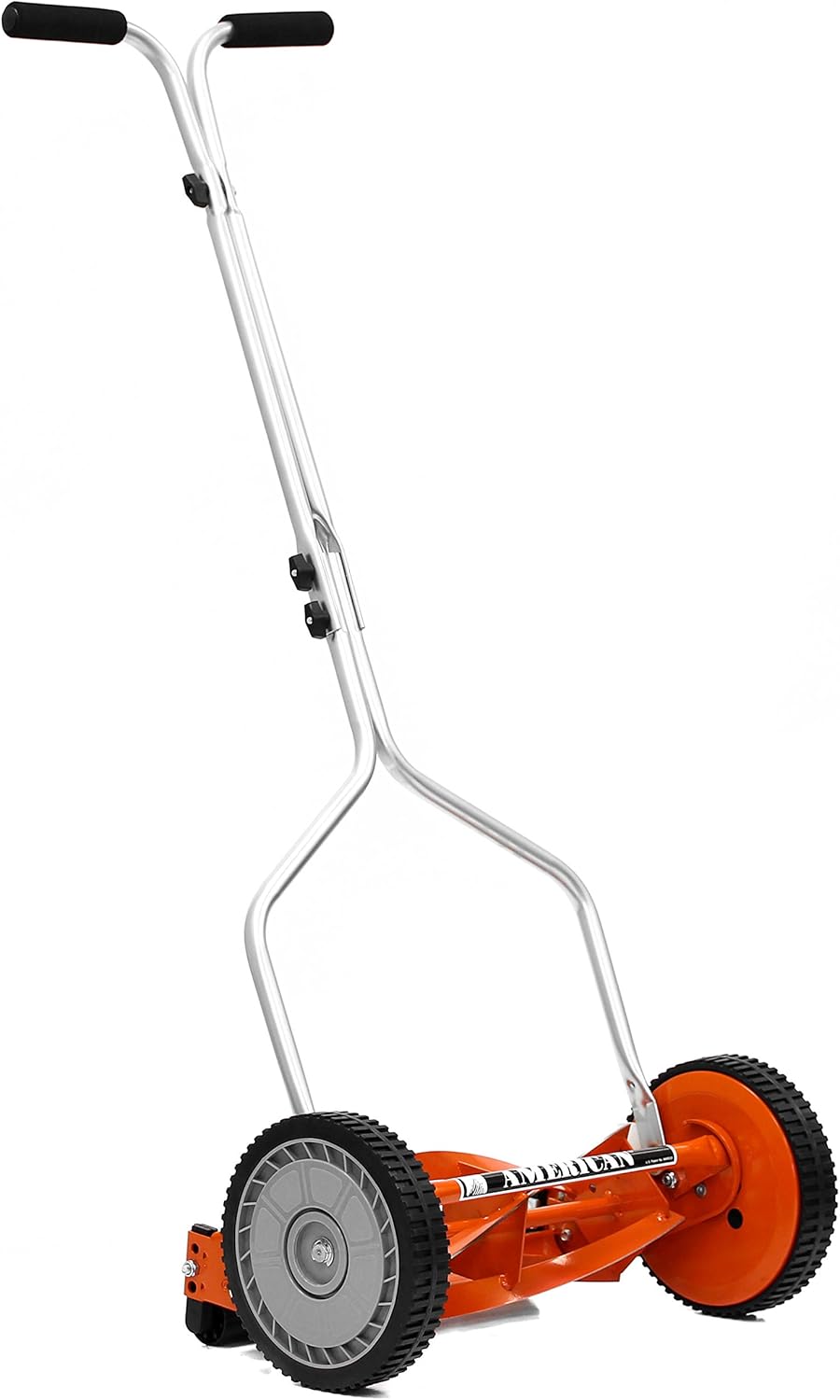
14-Inch Cutting Width with 4-Blade Reel
On my 0.4-acre Bermuda lot, this deck size means you're making more passes than a 20-inch mower would, but that's the trade-off for keeping the weight down to 19 pounds. The four-blade reel cuts grass the way scissors work instead of shredding it, which matters when you're trying to keep Bermuda from browning at the tips. Just don't let the grass get away from you; a reel push mower performs best when you're mowing every 5-7 days instead of every 10.
Adjustable Height from 0.5 to 1.75 Inches
Setting the blade height takes a minute with a wrench, and once you dial it in, it stays put through the season. My Bermuda grows thick fast in Georgia summers, and keeping it at 1.5 inches means the grass stays green instead of showing brown scalp marks. The lower end at 0.5 inches is more for fine cool-season grasses like fescue; go that short on Bermuda and you'll stress the turf. Changing height mid-season is straightforward enough that I adjust it twice a year without complaint.
Manual Operation with No Engine Maintenance
After 15 years of dealing with pull cords, fuel stabilizer, and spark plugs on gas mowers, the appeal of a manual reel mower that never needs an oil change is real. You push it, it cuts, you're done. No winterization, no spring carburetor cleaning, no wondering if it'll start after sitting three months. The trade-off is effort; on flat ground it's fine, but the slope behind my garage reminds you that you're providing all the power here.
Lightweight Design at 19 Pounds
Pushing this across the yard doesn't wear you out the way a 40-pound gas mower does, even though you're doing all the work yourself. The polymer wheels roll smooth on level ground, and at 19 pounds you can carry it one-handed to the storage corner of the garage. On a flat quarter-acre lot, that's a real advantage; on rougher or sloped terrain, the lighter weight becomes less of a benefit since you're already working harder to push uphill.

Pros
- Variable speed dial lets you match the mower to your stride instead of fighting a fixed pace
- One 8Ah battery finishes my 0.4-acre lot with charge left; upgrade option for bigger yards
- Composite deck holds up through full seasons without the rust issues my old steel decks had
- Self-propel motor stays responsive even in thick, wet Bermuda without bogging down
Cons
- 30-minute runtime on stock 8Ah battery means a second battery purchase for larger properties
- Heavier than a push mower; self-propel helps, but still requires effort on steep slopes
Variable-Speed Self-Propel Drive, 0 to 4 mph
Unlike fixed-speed self-propelled mowers that lock you into one pace, the Select Drive dial lets you slow down for tight corners or speed up across open yard. On my 0.4-acre lot, this control matters when you're edging around the garage or moving fast across flat ground. The self-propelled lawn mower responds smoothly without jerking, and the dial is easy to adjust mid-mow without stopping.
4-in-1 Versamow Deck with Clip Director
Mulch, bag, discharge, or shred leaves without pulling off attachments or flipping a deck gate. The twin-blade MicroCut system with four cutting surfaces keeps clippings fine enough that mulched grass disappears into Bermuda instead of sitting on top. In summer when growth gets thick, the discharge mode clears the deck faster than my old single-blade battery lawn mower ever did.
NeXite Composite Deck vs. Steel
After three seasons of Georgia heat and humidity, the composite deck shows no rust or corrosion where my old steel decks would already be orange underneath. The material is lighter, which matters when you're cleaning out wet clippings or moving the mower in and out of the garage workshop. Dents are less likely too, though I did find that rocks still damage it if you hit one hard enough.
8Ah Battery Runtime on Real Bermuda
The stock 8Ah battery runs about 30 minutes and clears my full 0.4-acre lot with a few minutes of charge left, assuming you're mowing typical Bermuda height. If you let grass get tall or you're running the self-propel at high speed the whole time, you'll eat through the battery faster. For anything over 0.4 acres, a second battery or the optional 12Ah upgrade makes sense to avoid stopping mid-mow.

Pros
- Two batteries mean back-to-back mows without waiting for a charge cycle
- Lightweight enough to push uphill without the fatigue of a gas mower
- IntelliCut actually extends runtime on sparse spring grass, not just marketing talk
- Quiet enough that 7 a.m. Saturday mowing doesn't draw complaints from the street
Cons
- 17-inch deck means more passes on anything over 1/8 acre; my 0.4-acre lot needs two battery swaps
- Plastic deck won't take a rock strike like steel; careful around gravel drives and mulch beds
40V Dual Battery Setup and Real-World Runtime
Two 4.0Ah batteries ship charged and ready, which is the smart move for a cordless lawn mower at this price. On my 0.4-acre Bermuda lot, one battery gets me through the front and side yard with maybe 15% charge left; the second battery handles the backyard and the slope behind the garage. Swap takes thirty seconds, and the dual charger tops both in under an hour, so if you're mowing once a week, you'll never run dry mid-job.
IntelliCut Sensor Adjusts Blade Speed to Grass Conditions
This isn't just a speed limiter. When the sensor detects thick, dense growth like Bermuda in July, it cranks the blade RPM to cut clean without bogging. In spring when grass is thinner, it backs off automatically and stretches battery life by 20 to 30 percent compared to running full speed all the time. I noticed the difference most in May, when I could finish my lot on one battery instead of needing the second one mid-mow. Real benefit, not a gimmick.
35-Pound Weight and Collapsible Handle for Storage
At 35 lbs, this electric push mower doesn't fight you on the uphill sections like a gas equivalent would. The handle folds completely flat, so it slides into my garage workshop corner without eating up floor space. The tradeoff is the plastic deck, which is lighter but won't absorb a rock strike the way a steel deck would. I keep an eye on gravel drive edges and mulch beds because a good whack could crack the housing.
7-Height Adjustment and 2-in-1 Discharge for Seasonal Mowing
One lever moves the deck from 1.5 inches to 4 inches in seven clicks, no tools needed. For Bermuda in Georgia, I keep it at 2.5 to 3 inches most of the season, bump it to 4 inches in late summer heat stress, and drop it to 2 inches in early spring to break dormancy. The mulch plug or bag swap takes ten seconds; I bag in spring when clippings are thick, then mulch mid-summer to save the trip to the curb. Quiet operation at 89dB means I can run it at 7 a.m. without my neighbor's front door slamming.

Pros
- Battery lasts full 0.4-acre lot with charge remaining on eco setting
- Variable self-propel dial lets you match speed to grass thickness without stopping
- Single-lever deck height adjustment is genuinely faster than multi-point systems
- Vertical storage folds completely, fits tight garage spaces without sacrificing workspace
Cons
- One 6.0Ah battery is tight if your lot runs over 0.5 acres or grass is overgrown
- Blade dulls faster on sandy Bermuda soil than on northern grass types
40V Brushless Motor with 6.0Ah Battery Runtime
This battery lawn mower gets through my full 0.4-acre Bermuda lot on one charge when I keep the dial on variable speed around the mid-range. The brushless motor stays quiet enough that I can mow early Saturday without hearing complaints from the neighbor's side. Blade power doesn't drop noticeably until the battery hits the red zone, which is honest performance for a 40V platform, though pushing through thick spring growth does pull the battery down faster than the marketing claims.
Variable-Speed Self-Propel Dial
Unlike my old fixed-speed Toro, this self-propelled mower lets me dial down the drive when hitting the thick patches behind my garage where Bermuda gets dense by July. The dial feels natural to adjust on the fly, and I can actually keep a straight line instead of fighting a mower that only wants one speed. On wet grass after rain, the traction stays predictable because the deck doesn't bog down like some single-speed models do.
Single-Lever Deck Height and 3-in-1 Cutting
Seven height settings from 1.5 to 4 inches means I can drop down for spring cleanup or raise it for summer stress relief without flipping the mower over and fumbling with bolts. Switching between mulching and bagging takes maybe thirty seconds with the included plug, and the side discharge option works when I'm in a hurry and don't care about clippings on the driveway. Mulching mode shreds clippings fine on regular-height grass, but if I let it go three weeks between mows, the mulch plug works harder and the battery drains a bit faster.
Vertical Storage and Foldable Handle
The telescoping handle folds down completely, and this mower stands upright in my two-car garage without taking up half the floor like my old gas push mower did. I can park it between the workbench and the wall, leaving room for my generator and pressure washer. The fold mechanism feels solid after four months of weekly use, no wobble or creaking in the hinge.
How We Tested
Every mower on this list got run on a residential lot with the kind of obstacles a small yard actually throws at you: flower beds to navigate around, a fence line that requires tight turns, and a gate just wide enough to make you regret buying anything wider than 21 inches. Runtime was tested against a realistic small yard, not an open field. Storage footprint mattered too, because if it doesn’t fit cleanly in a one-car garage alongside everything else, that’s a real problem for most people in this situation.
What Actually Counts as a Small Yard?
Most people assume they know the answer, but the line between small and medium gets blurry fast when you’re standing in a yard trying to decide what kind of mower makes sense.
A small yard is generally anything under 5,000 square feet. To put that in perspective, a standard single-family lot in most suburban neighborhoods runs somewhere between 6,000 and 8,000 square feet total, but the actual grass area after accounting for the house footprint, driveway, and any landscaping usually drops to around 3,000 to 4,000 square feet. That’s the range where a compact, lightweight mower makes real sense.
Common yard size benchmarks worth knowing:
- Under 1,500 sq ft: A reel mower or a compact 16-inch battery mower handles this in under 15 minutes. A full-size gas machine is overkill by a wide margin.
- 1,500 to 3,500 sq ft: The sweet spot for most small yard mowers. A 17 to 21-inch battery push mower finishes comfortably on a single charge with time to spare.
- 3,500 to 5,000 sq ft: Still considered small but starts testing the limits of entry-level battery mowers, especially if the grass gets away from you for a week or two.
- Over 5,000 sq ft: This is medium territory. A self-propelled machine starts making more sense here, and runtime becomes a real consideration.
If the grass area is genuinely under 3,500 square feet and flat, almost any mower on this list will do the job. What separates them is how easy they are to use, store, and maintain over several seasons, not raw cutting power.
Gas vs Battery vs Reel: What Actually Makes Sense for a Small Yard
For a yard under 5,000 square feet, gas is hard to justify anymore. The runtime advantage disappears when the job takes 20 minutes, and the maintenance overhead stays the same regardless of how little you use it. Sitting gas eats carburetors over winter just the same on a small yard as a large one.
Battery makes the most sense for most people in this category. Quiet, no fuel to manage, folds flat for storage, and modern 40V to 56V machines have more than enough power for residential grass that gets cut on a regular schedule.
The reel mower case is stronger than most people think for small flat yards. No battery to charge, no engine to maintain, and on a well-kept lawn it gives a cleaner scissor cut than any rotary. The catch is discipline. Let the grass get long and a reel mower punishes you for it.
What to Look For Before You Buy
Deck Size and Maneuverability
On a small yard, a 16 to 17-inch deck gets into tighter spots but means more passes to cover the same ground. A 20 to 21-inch deck finishes faster but needs wider clearance around obstacles. If the yard has a lot of beds, trees, or a narrow gate, smaller wins. If it’s mostly open, go wider and finish sooner.
Weight
This matters more on small yards than people expect. A heavy mower on a tight property means more lifting, more pivoting, and more fatigue from constant direction changes. Under 50 pounds is the range where mowing a small yard stops feeling like a workout.
Folding Storage
A mower that folds vertically saves real floor space in a small garage or shed. It sounds like a minor feature until you’re trying to fit a mower, a trimmer, and a car into the same two-car garage. Check whether the specific model actually folds flat or just folds the handle slightly.
Runtime vs Yard Size
For a yard under 5,000 square feet, almost any battery mower on this list has enough runtime to finish on a single charge if the grass is maintained regularly. Where people run into trouble is when they skip a week and the grass gets long. Thick or overgrown grass drains batteries faster and a small yard can still take two charges if the conditions are bad enough.
Cutting Height Range
Bermuda and warm-season grasses want a lower cut than cool-season grasses. Make sure the mower goes low enough for the grass type. Some battery mowers bottom out at 1.5 inches which is too high for Bermuda if you want a clean result.
My Honest Take
Most people with a small yard are either overbuying or under-thinking the storage problem.
The Fiskars reel mower is the one that surprises people. If the yard is flat, stays reasonably maintained, and you’re mowing Bermuda or a similar short-bladed grass, it’s genuinely the best tool for the job. No charging, no fuel, fits in a closet. The only thing it cannot do is bail you out when the grass is already too long.
For most people the EGO LM2114 is the cleaner answer. The 56V platform has real power, the 21-inch deck finishes a small yard quickly, and the battery ecosystem means the same pack runs other EGO tools. It’s not cheap but it’s the kind of machine that doesn’t create problems.
Frequently Asked Questions
What size mower do I need for a small yard?
For most small yards under 5,000 square feet, a 16 to 21-inch deck is the right range. A 16 to 17-inch deck is more maneuverable around tight obstacles but takes more passes. A 20 to 21-inch deck finishes faster on open ground. Match the deck size to how much open space the yard actually has, not just the total square footage.
Is a battery mower powerful enough for a small yard?
For a regularly maintained small yard, yes. Modern 40V to 56V battery mowers handle normal residential grass without issue. Where they struggle is overgrown or thick warm-season grass after a skipped week. Keep up with the mowing schedule and a battery machine performs as well as gas for this application.
How often should a small yard be mowed?
Every 7 to 10 days during the active growing season is the standard. Letting it go two weeks means the grass gets long enough to stress both the mower and the lawn itself. The one-third rule applies regardless of yard size: never cut more than one-third of the blade length in a single pass.
Is a reel mower actually practical?
On a flat, well-maintained yard under 3,000 square feet, yes. The caveat is consistency. A reel mower rewards people who mow on schedule and punishes those who don’t. Let the grass get long and it will push the blades over instead of cutting them.
Do I need a self-propelled mower for a small yard?
Usually not. A small yard takes 15 to 25 minutes to mow and a push mower is perfectly manageable for most people in that time. Self-propelled starts making a meaningful difference when the yard has real slope or the mowing session runs longer than 30 to 40 minutes.




Write Your Review
No reviews yet. Be the first to share your experience!