

Free Delivery. Exclusive Deals. All Prime.
Prime members save on shipping and get first access to deals, plus Prime Video included. 30 days free.
Cold tile has a way of turning a quick tooth-brushing into a tiptoe relay race. Small plug in heaters for bathroom use solve that by adding directed heat without claiming floor space. After comparing 2 models, the Minetom Space Heater is the top pick because it has 450 watts, a 350-watt low setting and coverage up to 100 square feet. The Good Housekeeping Wall Heater is the alternative pick for its 750-watt output and adjustable thermostat.

Pros
- 350W, 120V low wattage design
- Digital thermostat adjusts from 60°F to 90°F
- 1 to 12 hour timer in 1 hour increments
- Heats rooms up to 100 sq ft
- Compact 6.5 x 2.8 x 4.3 inch size
Cons
- Best for small spaces up to 100 sq ft
- Low wattage suits mild climates, not whole-home heat
- Wall outlet design requires a 3-prong receptacle
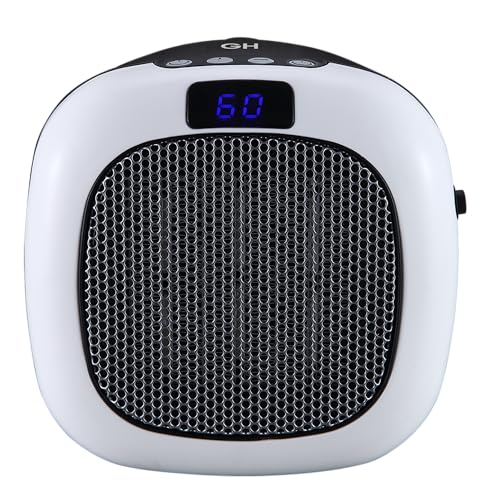
Pros
- 750-watt plug-in wall mount heater with 2 heat settings
- Digital display with adjustable thermostat for temperature control
- 12-hour timer in 1-hour increments for scheduled heating
- Safety overheat protection with side-accessed power safety button
- Cool-touch housing and compact 0.77-pound design
Cons
- No stated square footage or room size coverage, likely best for small spaces
- No oscillation or remote control mentioned for hands-free adjustment
- Mounts directly into a wall outlet, limiting placement away from outlets
What Matters in Small Bathroom Heaters
A bathroom heater has a harder job than a desk heater because the room is tight, the floor may be damp and the outlet may be close to a sink. The better fit is usually a compact plug-in unit that keeps cords off the floor and gives you enough control to warm the room without leaving heat running longer than needed.
- A safe design for bathroom use: For this kind of room, a wall outlet design has a practical advantage because it avoids a cord across tile. The Minetom Space Heater mounts directly at the receptacle and is described as ETL listed, which matters because the U.S. Consumer Product Safety Commission says shoppers should choose a heater certified by a nationally recognized testing laboratory. Its 180-degree rotating plug also helps align the heater with the outlet rather than forcing an awkward position.
- Wattage for a small room: Among our picks, heating output runs from a 350-watt low setting to 750 watts. That range is more appropriate for a small enclosed room than a large-room heater that draws 1,500 watts. The top pick is listed for up to 100 square feet, which is more room than many bathrooms need and keeps the focus on short, localized comfort.
- Tip-over and overheat protection: Safety language matters more than marketing language here. The U.S. Consumer Product Safety Commission says an automatic cut-off is required to shut off electric or kerosene heaters if they tip over, and the U.S. Fire Administration says portable heater fires were 3 percent of home heating fires in one period but accounted for 41 percent of fatal home heating fires. Our alternative pick lists overheat protection, and both main picks avoid the corded floor placement that can create a tripping hazard in a small room.
- Thermostat and timer: Both main picks include adjustable thermostats, so you can set a target instead of only choosing a simple low or high mode. Timer control also matters in a bathroom because the heater may only be needed for a short shower routine. The top pick lists a thermostat range from 60 to 90 degrees, while both picks include a 12-hour timer in 1-hour increments.
- Size and outlet placement: A plug-in heater has to work with the outlet you already have, not the outlet you wish had been installed. The top pick measures 4.3 by 2.8 by 6.5 inches, so it is compact enough to leave nearby floor space open. Both main picks use a 180-degree rotating grounded plug, which helps when the outlet is upside down, sideways or partly constrained by a vanity.
We excluded central furnaces and whole-house systems because they need professional installation. We also left out water heaters and heated blankets because they solve different problems, and we avoided unvented fuel heaters without an indoor rating because carbon monoxide is a serious indoor risk.
Other Bathroom Heaters Worth Considering
These are other bathroom heaters we looked at but did not put on our main list.
If you want a much higher-output bathroom heater, the Lasko CD08200 is rated at 1,500 watts and is ETL certified. That is more than triple the wattage of our top pick, so it may be better suited to a colder room, but its 3.4-pound body is not the same compact outlet-mounted approach.
For a wall-focused design with less output than a full 1,500-watt unit, the GiveBest Wall Heater lists 800 watts and a 400-watt low setting. It is rated for up to 100 square feet and lists 38 dB, so on paper it aims at the same small-room use case as our top pick with a higher maximum wattage.
Prefer a conventional ceramic space heater with stronger heat? The Amazon Basics Ceramic Heater offers 1,500 watts with a 900-watt low setting, plus an adjustable thermostat. It also lists tip-over and overheat protection, but compared with our top pick, the higher low setting may be more heat than needed for a short bathroom warm-up.
FAQs
Are plug-in bathroom heaters safe near sinks?
They need careful placement. The U.S. Fire Administration says to keep anything that can burn at least 3 feet from space heaters, and the Centers for Disease Control and Prevention says space heaters should have automatic shut-off switches and non-glowing elements.
How much wattage is enough for a small bathroom?
Our main picks range from a 350-watt low setting to 750 watts. For a small enclosed room, that lower range can make more sense than a 1,500-watt heater if the goal is taking the chill off before a shower.
Should a bathroom heater have a timer?
A timer is useful because bathro om heat is often needed for a routine, not all evening. Our picks include timer controls up to 12 hours in 1-hour increments, which lets you set a limit instead of relying on memory.
What placement is best for a small bathroom heater?
A wall outlet style keeps the heater off the floor, which helps in a room with towels, bath mats and wet feet. The Consumer Product Safety Commission also advises placing heaters on a level, hard, nonflammable surface when using portable models, not on rugs or carpets.
Sources
- CPSC Offers Tips to Prevent Home Fires From Space Heaters, U.S. Consumer Product Safety Commission. Fire-safety tips and required safety features for space heaters.
- Heating Fire Safety, U.S. Fire Administration. Home heating fire statistics and prevention messages.
- Safety Guidelines: During & After a Winter Storm, Centers for Disease Control and Prevention. Winter heating safety for space heaters, kerosene heaters and carbon monoxide.


Write Your Review
No reviews yet. Be the first to share your experience!