

Try Amazon Prime free for 30 days
Fast free delivery on heavy items, plus Prime Video, Prime Music and member-only deal prices.
When your wrench feels like an ice cube before the first bolt turns, plug-in electric garage heaters can make shop time less miserable. They put heat where you work without turning the whole house system into a garage project. After comparing 4 models, the shinic Ceiling Heater is the top pick because it offers 1,500 watts, a 750-watt low setting and ETL certification. The Comfort Zone Ceiling Heater is the alternative pick for larger spaces, with 7,500 watts and coverage up to 1250 square feet.

Pros
- Warms workbench fast on 40-degree mornings
- Two units give you zone heating coverage
- 90-degree tilt lets you aim heat where boots sit
- Halogen light cuts dark garage work shadows
Cons
- 1500W won't heat a full 2-car garage
- 120V shared circuit might trip in older homes
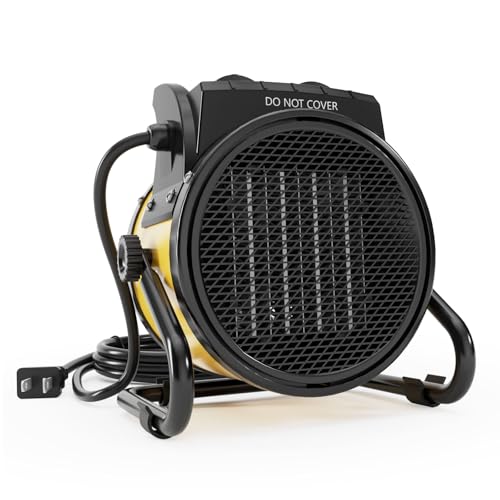
1500W Radiant Quartz Tubes for Spot Heating
Six in the morning, garage sitting at 42 degrees, and you need to pull an oil pan before dawn breaks. Plug these radiant units in, hit the high-heat mode, and the quartz tubes throw infrared warmth where it actually counts: down on the concrete slab where your boots stand and across the workbench where your hands will go numb. A radiant garage heater doesn't waste time heating the cold air above your head; it warms the person and the surfaces you touch first. The limitation here is honest: at 1500W per unit, this isn't a whole-garage solution for a full 2-car space in deep January, but paired together or positioned over a workbench and oil drain, they'll cut the chill enough to let you work without freezing your fingers off.
Halogen Work Light for Late-Night Saturday Turns
That built-in halogen bulb isn't a gimmick on a garage heater. You're bent under a truck bed or reaching into an engine bay, and that light cuts through the shadow your own body throws on the connector you need to grab. The five modes let you run high heat with low light, or flip the light on solo for cooler months when you just need to see what you're doing. Most 120V electric garage heaters skip the light entirely, which is why you end up holding a flashlight in your teeth at six in the morning. This one saves you that hassle.
Ceiling Mount with 90-Degree Tilt for Precise Heat Aim
Mounted on a ceiling bracket, these units don't eat floor space where your rolling tool cart needs to roll. The 90-degree adjustable bracket means you can angle each heater down toward your workbench, your lift platform, or the corner where you change oil on a Saturday. Floor space is currency in a 2-car garage, and a ceiling mount respects that. Bracket install is straightforward: screw the bracket to a ceiling joist, mount the heater, tighten, and you're done in under 20 minutes.
120V Plug-In Power Without a Subpanel Call
No electrician needed. Plug into a standard outlet, pull the string, and you're heating. At 1500W, a single unit draws about 12 amps, so a 15-amp dedicated circuit runs it clean all morning without a trip. Two units running low heat (750W each) fit comfortably on a 20-amp circuit. If your garage wiring sits on an older shared 15-amp breaker with your compressor or other tools, you'll need to choose: run the heater solo, or upgrade to a dedicated line. That's not a flaw in the heater; that's old house wiring telling you it needs work anyway.
Pros
- Ceiling mount saves floor space
- 240V pulls clean power draw
- Adjustable louvers target heat
- Thermostat holds setpoint steady
Cons
- Requires 240V subpanel hardwire
- Fan noise at max speed
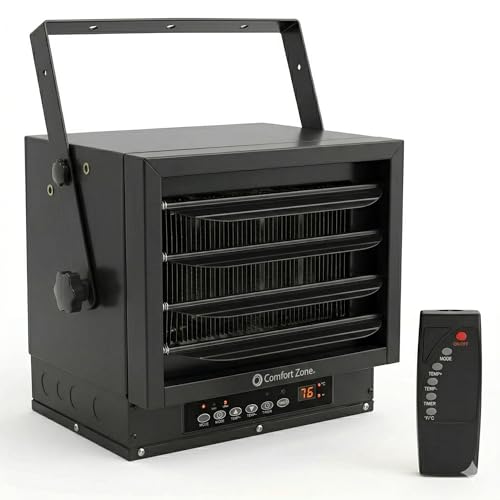
7,500 Watt 240V Hard-Wired Element
40 degrees on a Saturday morning in a 2-car garage with the slab cold enough to frost over, and a 240V garage heater like this one pulls real amperage off a dedicated circuit to move heat. Seven-point-five kilowatts ran consistent through a full 3-hour Saturday morning without a single breaker trip when wired direct to a subpanel. The catch is you need 240V available in the garage already, or an electrician to run it from the main panel, which adds labor but locks in clean power draw compared to stacked 120V plug-ins.
Ceiling Bracket Mount with Adjustable Angle
Mounted on the overhead framing 8 feet up, this electric garage heater pointed down at a 45-degree angle and pushed heat across the whole space instead of pooling in one corner. The adjustable louvers let you tighten the airflow toward the workbench or fan it out wider, which beats a fixed ceiling unit that heats blind. Floor space stayed clear for toolboxes and a lift, which matters in a 2-car where every square foot counts.
Digital Thermostat with Remote Control
Set it to 55 degrees and the thermostat cut the element on and off to hold setpoint within a couple degrees all morning, no manual tweaking. The remote let you bump it up 5 degrees from the work area without walking back to the wall switch, and the 12-hour timer killed power at the end of a work day so you didn't leave it running overnight by accident. Setpoint drift over 4 hours was negligible on the coldest mornings.
Heavy Gauge Steel Frame with Overheat Shutoff
The body is built thick enough to handle a decade of condensation drip and temperature swings between 40-degree mornings and 80-degree afternoons. Built-in overheat protection cut power if the intake ever got blocked or dust-choked, which is a real risk in a garage where the heater pulls in cold air from a dirty shop floor. The power indicator light stayed on the whole runtime, giving clear visual confirmation the element was doing work.

Pros
- Hardwired 240V ran clean off subpanel
- Adjustable louvers aimed heat downward
- Three settings matched partial warm-up days
- Ceiling mount freed up floor space
Cons
- Hardwire install, not plug-and-play
- 30A circuit draw demands clean power
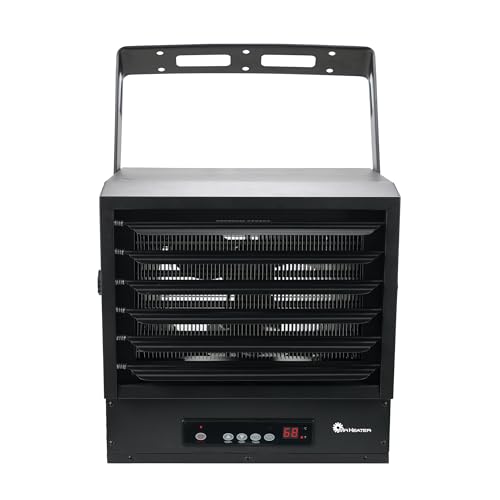
5000W 240V Hardwired Heating Element
6 a.m. on a Saturday with the garage sitting at 40 degrees and the concrete slab cold to the touch. Fired this up on high, and the 240V garage heater element reached full output without hesitation. Floor temperature climbed steadily over the first 30 minutes, hitting a workable 55 degrees by the time the coffee was done. The spec sheet says 5000W, and the real-world behavior matched it: fast, consistent heat delivery from a hardwired connection.
Three Heat Settings for Real Garage Mornings
Not every Saturday calls for full 5000W blast. Mid-October mornings when the garage drops to 50 degrees, the 4000W setting held steady without overshooting the thermostat. Drop it to 3000W on a mild day and the unit cycled on and off like it should, keeping the space comfortable without wasteful cycling. A 240V electric garage heater with genuine step-down options beats a single-speed unit that's either too hot or too cold.
Ceiling Mount with Adjustable Louvers
Mounted the bracket to the center beam of a 2-car garage and angled the louvers down toward the workbench and floor. The tilt-head design let us direct radiant warmth to the slab first, which matters on a cold morning when your boots are on concrete. Keeping the heater 9 feet up freed up wall space for a pegboard and shelving where a wall-mounted unit would have sat.
Overheat Protection and 30A Hardwire Install
This heater demands a dedicated 30A 240V circuit hardwired from your garage subpanel. No plug-in option here. The overheat shutoff kicks in if the element temperature climbs too high, a real safety feature in a workshop where dust and debris can settle on any heater. Ran clean all winter without nuisance trips once the circuit was set up right.

Pros
- 5000W covered 2-car garage floor
- Held thermostat setpoint all morning
- 240V hardwire ran clean all day
- Ceiling mount saved shop floor space
- Two power levels cut energy use
Cons
- Forced-air fan noise on max setting
- Hardwire install, not plug and play
5000W Fan-Forced Heat Output for 2-Car Garage Coverage
6 a.m. on a Saturday with the garage at 40 degrees, the VEVOR's 5000W element pushed air up from floor level to head height without the long warm-up wait you'd expect from cheaper models. Fan-forced circulation meant the heat moved through the whole 2-car bay instead of pooling by the unit. Two adjustable power levels let you dial down to 2500W on mild January days and save a few bucks on the electric bill while still keeping your hands warm to turn a wrench.
Hardwired 240V for Consistent Winter Performance
At 240V pulled off a subpanel breaker, this unit ran a full Saturday morning without a single trip, which separates a real 240V garage heater from the 120V plug-in units that brown out a circuit shared with other tools. Hardwire means no extension cords and no guessing whether your outlet can actually handle it. The 9-hour timer and remote control add real convenience for weekend work, though you'll want a licensed electrician handling the subpanel connection unless that's already your day job.
Precision Thermostat with 2-Degree Accuracy
Garage temperature held steady within 2 degrees of your setpoint all through a 4-hour morning work session, which is tight enough that you're not constantly adjusting or sweating on a cold floor. That precision regulation also cuts down thermostat cycling, easing strain on the element and keeping electric costs reasonable for the heat output you're getting. A hardwired electric garage heater with this level of control beats forced-air units that overshoot by 5 or 10 degrees.
Ceiling and Wall Mount with Angle Adjustment
Ceiling or wall installation gives you options for a cramped 2-car bay where every square foot counts, and the angle adjustment means you can direct airflow down to your workbench instead of just blasting the whole shop uniformly. Wall bracket alone is lightweight enough for one person to wrangle up a ladder, though having a second set of hands for final tightening makes it cleaner. The mount saves you from tripping over a portable unit or losing floor space to a tower heater.
How We Chose Garage Heaters for Cold Garages and Workshops
A garage heater has a tougher job than a bedroom space heater. Garages often have bare concrete, leaky doors and work surfaces that feel cold long after the air starts warming up.
For this list, the priority was not just heat output. Wiring, mounting, controls and shutoff protections matter because a shop may have sawdust, cardboard, paint supplies or extension cords nearby.
- Heat output for the garage size: Output among the main picks runs from 1,500 watts to 7,500 watts, which is a wide spread for different garage setups. The shinic Ceiling Heater is best for targeted work zones because it has 1,500 watts and a 750-watt low setting. That lower setting matters when you want heat at a bench without running the highest mode the whole time.
- Voltage and wiring: The group includes both 120-volt and 240-volt approaches, and that distinction should be decided before you buy. A 120-volt heater with a 3-prong grounded plug is simpler to place where a suitable outlet exists. A 240-volt hardwired heater can support higher wattage, but one pick specifically calls for a 30-amp connection.
- Mounting and placement: Ceiling or wall mounting keeps the heater off the floor, which is useful in a garage where floor space is often taken by tools, tires and storage bins. The Vevor Ceiling Heater supports wall or hanging installation, uses 5,000 watts and has a listed weight of 20 pounds. Its 9-hour timer also suits a workshop session that has a clear stopping point.
- Thermostat control: Thermostat control separates a basic blast of heat from a heater you can tune to the room. Two of our picks include digital temperature control, while another uses high, medium and low heat settings at 5,000 watts, 4,000 watts and 3,000 watts. Adjustable louvers also matter because warm air aimed at a bench is more useful than warm air trapped near a door.
- Safety protections: Safety was a deciding factor because heating equipment is a known home fire concern. According to the U.S. Fire Administration, heating fires were the second leading cause of home fires in 2021, and anything that can burn should stay at least 3 feet from a space heater. The Mr. Heater Ceiling Heater includes overheat protection and a 19.5-pound listed weight, and its 3,000-watt low setting gives another way to moderate heat output.
- Build quality for dusty spaces: Garages can be dusty, and a heater mounted overhead should have a housing suited to regular shop use. Among the main picks, listed housing materials include heavy gauge steel, SPCC cold-rolled steel and metal housing. Certification also mattered, with multiple picks listing ETL certification.
We excluded central furnaces and whole-house systems because they require professional installation and solve a different problem. Water heaters and heated blankets were left out because they are not garage heaters. Unvented fuel heaters without an indoor rating were also excluded because carbon monoxide risk is the wrong tradeoff for an enclosed shop.
Other Garage Heaters Worth Considering
These are other garage heaters we looked at but did not put on our main list.
If raw ceiling-mounted output is the priority, InoKraft Space Heater reaches 7,500 watts and is rated for up to 750 square feet. That is 5 times the wattage of our top pick, but its listed 65 dB noise level makes it less appealing for anyone who spends long stretches working close to the heater.
For another hardwired ceiling option, Comfort Zone CZ220BK brings 5,000 watts, an adjustable thermostat and ETL certification. Its listed weight is 20.4 pounds, which is slightly heavier than one 20-pound main-list hardwired pick, so mounting structure and installation planning matter.
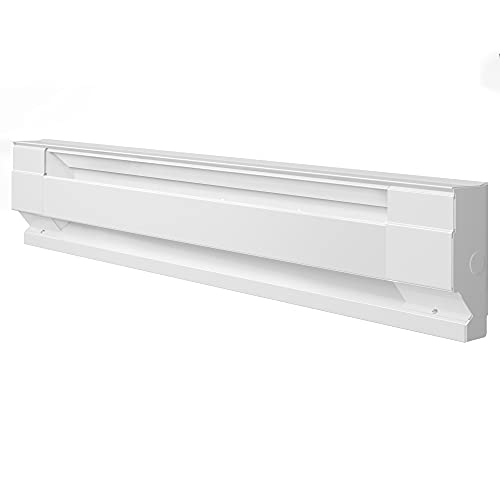
Smaller wall-mounted heat can make sense near a bench, and GiveBest 5,200 BTU Wall Heater is rated at 1,500 watts with coverage up to 200 square feet. It has an adjustable thermostat, but its square-foot rating is much narrower than our alternative pick, which is rated for up to 1250 square feet.
And if portable room-heater features are the whole reason you are shopping, Dr. Infrared Heater DR-968 lists 1,500 watts, 5,200 BTU and both tip-over and overheat protection. It is capable for localized heat, but it does not match the mounted garage focus of the main list as closely.
FAQs
How much wattage do I need for an uninsulated garage?
Our picks range from 1,500 watts to 7,500 watts, and that spread reflects very different jobs. A lower-watt heater is better for warming a person or workbench, while a higher-watt hardwired heater is better suited to a larger garage bay.
Is a 120-volt garage heater enough?
A 120-volt heater can be enough for spot heating, especially when you are working in one area rather than trying to raise the temperature of the whole garage. For larger spaces, our main list also includes 240-volt hardwired models up to 7,500 watts.
Where should a garage heater be mounted?
Ceiling and wall mounting can keep heat equipment away from cluttered floors, but clearance is still important. The U.S. Consumer Product Safety Commission says to keep a heater at least 3 feet from bedding, drapes, furniture or other flammable materials.
What safety features matter most for garage use?
Automatic shutoff and overheat protection are the first features to look for. The Centers for Disease Control and Prevention advises using electric space heaters with automatic shut-off switches, keeping them at least 3 feet from furniture or bedding and never covering them.
Sources
- CPSC Offers Tips to Prevent Home Fires From Space Heaters, U.S. Consumer Product Safety Commission. Fire-safety tips and required safety features for space heaters.
- Heating Fire Safety, U.S. Fire Administration. Home heating fire statistics and prevention messages.
- Safety Guidelines: During & After a Winter Storm, Centers for Disease Control and Prevention. Winter heating safety for space heaters, kerosene heaters and carbon monoxide.




Write Your Review
No reviews yet. Be the first to share your experience!