

Try Amazon Prime free for 30 days
Fast free delivery on heavy items, plus Prime Video, Prime Music and member-only deal prices.
When the coffee mug feels warm but the floor feels like a skating rink, propane heaters for tiny house living start to make sense. They add heat without relying on household electricity, which matters during a power outage. After comparing 6 models, the Mr. Heater 10,000 BTU Propane Radiant Heater stands out for its 10,000 BTU output, up to 300 square feet of coverage, and 14.5 pound weight. The Camplux Enjoy Outdoor Life BW422 is the alternative pick if hot water matters too, with 110,000 BTU output.

Pros
- 10,000 BTU/HR radiant heater warms spaces up to 300 sq ft
- Piezo ignition allows simple lighting without matches
- 2 heat settings let you adjust warmth level
- No electricity required, useful during power outages
- Weighs 14.46 pounds for easy portability
Cons
- Heating area limited to about 300 sq ft, not for larger rooms
- Restricted for use above 4500 ft elevation
- Runs on liquid propane, requiring a fuel supply on hand

Pros
- 110,000 BTU/hour for fast, powerful heating
- 4.22 GPM of instant hot water output
- 6-in-1 safety protection including flame failure and overheat shutoff
- LED display with ECO/FULL knob for temperature control
- Weighs 27 pounds for easier transport to camp or cabin
Cons
- Built for outdoor use, so it is not suited for indoor installation
- Needs water pressure between 4.0 and 110 PSI to activate
- Must be fully drained before cold storage to avoid freeze damage

Pros
- Delivers up to 4 GPM flow and 98,500 BTU for strong multi-point hot water output
- Maintains temperature within +/-0.5 degrees F for consistent comfort
- Compact 18.5 x 12.2 x 6.38 inch design fits tight spaces like closets and cabinets
- Uses AI-powered noise reduction technology for quieter tankless operation
- Supports two showers and a kitchen faucet running at the same time
Cons
- Runs on propane, so it needs a fuel supply and tank setup rather than just electricity
- No specific decibel rating is given, so actual sound levels may vary by installation
- Rated for households of 3 to 4 people, which may limit larger or high-demand homes
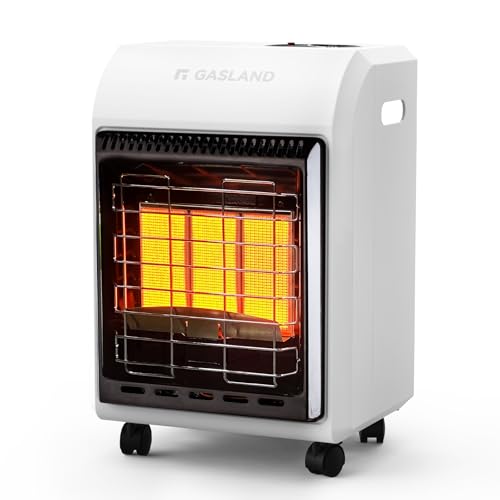
Pros
- 18,000 BTU output heats up to 450 sq ft
- 3 heat modes, High, Medium and Low
- Tip-over and low oxygen shut-off
- Rolling wheels and Easy-Carry handle
- Uses a 20 lb propane cylinder, no electricity needed
Cons
- Requires a 20 lb liquid propane cylinder
- For ventilated garages, offices, workshops and outdoor uses
- 450 sq ft max heating area may not suit larger spaces
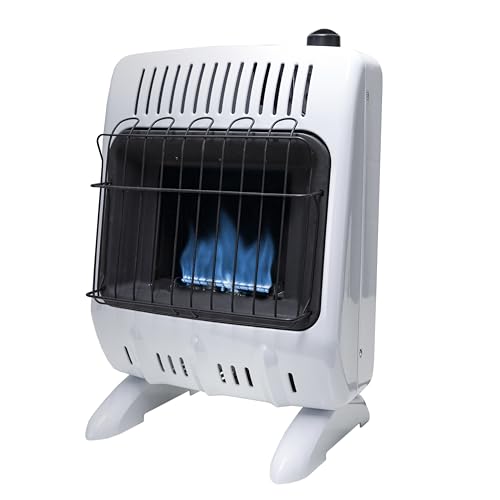
Pros
- 10,000 BTU/HR output for supplemental heat
- Heats spaces up to 300 sq. ft.
- Piezo ignition for quick lighting without matches
- 2 heat settings for adjusting output
- No outdoor electricity required, runs on propane
Cons
- No thermostat is listed, so temperature control is limited to 2 settings
- Runs on propane, so you need a fuel supply and proper ventilation
- At 13.44 pounds it is heavier than compact electric space heaters

Pros
- Dual 4,000 or 9,000 BTU settings for adjustable heat output
- Rated to heat spaces up to 225 sq. ft.
- Runs up to 5.4 hours on a 1 lb. propane tank
- Up to 108 hours of runtime with an optional 20 lb. cylinder setup
- Includes low oxygen shutoff and tip-over shut-down safety features
Cons
- Indoor use is not approved in Canada or Massachusetts
- Requires propane tanks or cylinders, adding ongoing fuel needs
- At 7.1 lbs it is heavier than some small electric space heaters
What We Looked For in Propane Heaters for Tiny House Use
A tiny house can warm up quickly, but it can also concentrate combustion byproducts quickly. That makes output, room size, oxygen monitoring, and clearances more important than they might be in a draftier garage.
- Heat output and covered area: We prioritized heaters whose BTU ratings matched compact living spaces instead of oversized equipment. The Mr. Heater 10,000 BTU Propane Radiant Heater gives 10,000 BTU and is rated for up to 300 square feet, which fits many tiny house floor plans without jumping to a larger 18,000 BTU cabinet heater. Its 14.5 pound weight also keeps it more manageable than heavier wall style units.
- Indoor rating and oxygen depletion sensor: Indoor use calls for more than heat output. According to the U.S. Consumer Product Safety Commission, unvented gas heaters should have an oxygen depletion sensor that shuts the heater off if oxygen drops too low. Among the main picks, indoor oriented models are rated for spaces from 225 to 300 square feet, while the larger cabinet style option reaches 450 square feet.
- Ventilation and carbon monoxide precautions: Propane heat still requires a carbon monoxide plan, especially in a sealed small home. The Centers for Disease Control and Prevention says to install a battery-operated carbon monoxide detector and use only the fuel type the heater is designed to use. The main heat picks range from 9,000 to 18,000 BTU, so ventilation planning should scale with both room size and output.
- Fuel type, tank size, and run time: We gave extra attention to models that state their propane setup clearly. The portable radiant pick in the group runs up to 5.4 hours on a 1 pound propane tank, or up to 108 hours with a 20 pound cylinder when paired with the optional hose and fuel filter. That difference matters if the heater is used for backup heat rather than a short morning warmup.
- Ignition and safety shutoffs: Piezo ignition is useful because it avoids dependence on an outlet, and 2 heat settings make it easier to avoid overheating a small room. The Mr. Heater Buddy combines 9,000 BTU output, coverage up to 225 square feet, and tip-over protection. At 7.1 pounds, it is also the lightest featured heater in this section.
- Size and portability: A tiny house heater has to fit real floor space, not just a product page. The Gasland MHA18W reaches 18,000 BTU and is rated for up to 450 square feet, so it suits larger small-space zones better than a 10,000 BTU heater. Its tip-over protection is important because portable cabinet heaters can be moved from room to room.
We excluded central furnaces and whole-house systems because they require professional installation. We also left out water heaters and heated blankets because they do a different job, and we avoided outdoor-only patio heaters because they are not rated for enclosed spaces.
Other Propane Heaters Worth Considering
These are other propane heaters we looked at but did not put on our main list.
If you need more output than our top pick, ProCom ML200HBA moves up to 20,000 BTU and is rated for up to 950 square feet. That is double the 10,000 BTU output of our top pick, so it may be too much heater for a very compact tiny house unless the space is unusually open or poorly insulated.
For a closer match to our top pick, ProCom 10,000 BTU Propane Heater stays at 10,000 BTU and is rated for up to 300 square feet. Its adjustable thermostat and oxygen depletion sensor give it a different control setup at the same heat output, but it does not separate itself enough from the main list on coverage.
Prefer a small step up in coverage rather than a jump to a much larger heater? Comfort Glow 11,000 BTU Propane Wall Heater is rated for up to 350 square feet, compared with 300 square feet for our top pick. Its 28 pound weight makes placement feel more deliberate than a lighter portable model.
At the lower-output end, Comfort Glow DVP08 delivers 8,000 BTU and is rated for up to 250 square feet. That is 2,000 BTU less than our top pick, which may be useful in a very tight room, but its 23 pound weight is high for a smaller-output option.
FAQs
How many BTUs do tiny house propane heaters need?
Among our main heater picks, output runs from 9,000 to 18,000 BTU for space heating. The right size depends on the square footage, with listed coverage ranging from 225 to 450 square feet.
Are vent free propane heaters safe in a tiny house?
Safety depends on the heater rating, the room, and ventilation. The U.S. Consumer Product Safety Commission says unvented gas heaters should have an oxygen depletion sensor, and the CDC recommends a battery-operated carbon monoxide detector.
How much clearance should a propane heater have?
The U.S. Fire Administration says to keep anything that can burn at least 3 feet from space heaters. That includes bedding, drapes, furniture, and other items that are easy to crowd into a tiny house.
Can a propane heater run during a power outage?
Several propane heaters use ignition and heat systems that do not require household electricity. The CDC still says to use only the fuel the heater is designed to use, and a carbon monoxide detector should be part of the backup plan.
Sources
- CPSC Offers Tips to Prevent Home Fires From Space Heaters, U.S. Consumer Product Safety Commission. Fire-safety tips and required safety features for space heaters.
- Safety Guidelines: During & After a Winter Storm, Centers for Disease Control and Prevention. Winter heating safety for space heaters, kerosene heaters and carbon monoxide.
- Heating Fire Safety, U.S. Fire Administration. Home heating fire statistics and prevention messages.


Write Your Review
No reviews yet. Be the first to share your experience!