

Try Amazon Prime free for 30 days
Fast free delivery on heavy items, plus Prime Video, Prime Music and member-only deal prices.
When the socket set feels like it spent the night in a freezer, propane torpedo heaters can make a cold garage or work bay usable again. This type of heater solves the problem by pushing directed, fuel-fired heat across a ventilated space. After comparing 6 models, the Rovsun 120,000 BTU Propane Forced Air Heater is our top pick because it reaches 120,000 BTU, covers up to 3000 square feet and is CSA certified. The Mr. Heater 170,000 BTU Propane Forced Air Heater is the alternative pick for larger areas, with 170,000 BTU and coverage up to 4250 square feet.

Pros
- Delivers 75K to 120K BTU of forced air heat for up to 3,000 sq ft
- CSA certified with flame-failure thermocouple and high-limit overheat switch
- Adjustable 30 to 45 degree output angle plus stepless heat knob control
- Electronic push-button ignition, no matches needed
- Includes 10 ft propane hose, regulator, carry handle and leveling feet
Cons
- Runs on propane from a 20 lb tank, so it needs a well-ventilated space
- Steel forced air construction and 120K BTU output make this a bulky, heavy-duty unit, not a compact indoor heater
- Requires a 120V grounded outlet in addition to propane, limiting placement options

Pros
- Heats spaces up to 4,250 sq. ft.
- Up to 17 hours on a full tank
- Compatible with 100 lb. propane tanks minimum
- Overheat safety shut-off
- 20.13 lb. weight
Cons
- Requires a 100 lb. propane tank minimum
- Fuel heaters need proper ventilation
- 26.5 x 11.5 x 16.75 inch size needs storage space

Pros
- 125,000 BTU forced air propane heat
- Heats spaces up to 3,125 sq. ft.
- Up to 11.5 hours on a single tank
- Works with 40 lb propane tanks minimum
- Variable heat output for adjustable performance
Cons
- Requires a 40 lb propane tank or larger
- Fuel heater type needs proper ventilation
- 17.33 lb weight may be less convenient to move

Pros
- 60,000 BTU output for heating work areas up to 2,000 sq ft
- Thermostat adjusts from 25 to 120°F for more consistent warmth
- Adjustable tilt lets you direct airflow toward the work zone
- ETL certified with 80°C overheat auto shutoff for added protection
- Includes 10FT hose and regulator for propane connection, weighs 15.7 lbs
Cons
- Requires a properly ventilated area and is not intended for indoor use
- Propane tank is not included, so you will need to supply your own
- 60,000 BTU output may be more than needed for small rooms or indoor spaces
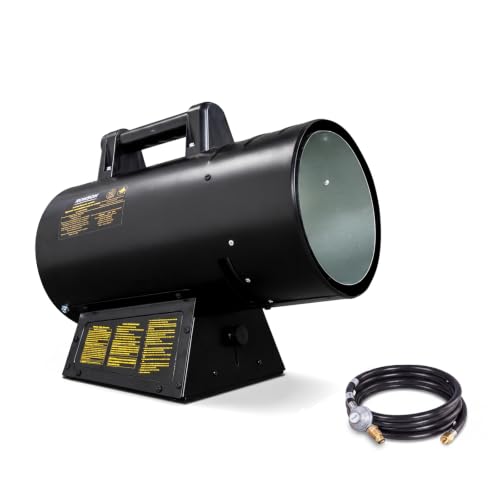
Pros
- 40K to 58K BTU output for directed jobsite heat
- Heats up to 1,400 sq ft in well ventilated spaces
- CSA certified with flame failure and overheat shutoff
- 30° to 45° adjustable output angle
- Includes 10 ft propane hose and regulator
Cons
- Requires a 20 lb propane tank and 120V grounded outlet
- Fuel heater needs well ventilated spaces
- No thermostat listed in the product data

Pros
- 150,000 BTU forced air propane heater
- Quiet Burner Technology reduces noise by up to 50%
- Recessed controls help reduce job site damage risk
- 22.53 lb weight with 26 x 11.75 x 16 inch size
- Split barrel design supports easier cleaning
Cons
- Requires propane fuel and well ventilated areas
- Not stated as rated for indoor home room use
- No thermostat or coverage area listed
How We Chose Propane Heaters for Torpedo-Style Heat
A forced-air propane heater is not a gentle living-room appliance. It is a high-output tool for garages, workshops, barns, jobsites and other ventilated spaces, so output, fuel setup and safety features matter as much as raw warmth.
- Heat output and coverage: The strongest picks in this group range from 58,000 BTU to 170,000 BTU, with rated coverage from 1400 square feet to 4250 square feet. For the main pick, the Rovsun 120,000 BTU Propane Forced Air Heater hits 120,000 BTU and is rated for up to 3000 square feet. That balance makes sense for a two-car garage, workshop or jobsite bay where a smaller heater may run near its upper limit.
- Indoor rating and oxygen depletion sensing: Propane forced-air heaters should be treated as equipment for properly ventilated spaces, not sealed rooms. According to the U.S. Consumer Product Safety Commission, unvented gas heaters should have an oxygen depletion sensor that shuts the heater off if oxygen drops too low. Among the products compared, certifications such as CSA or ETL help separate heaters built to recognized safety standards from unverified options.
- Ventilation and carbon monoxide precautions: The Centers for Disease Control and Prevention says to install a battery-operated carbon monoxide detector and use only the fuel type a heater is designed to use. The U.S. Fire Administration also says anything that can burn should stay at least 3 feet from space heaters. Those rules matter here because our picks use high BTU combustion, and carbon monoxide risk rises when a fuel-burning heater is used in a poorly ventilated area.
- Fuel type, tank size and run time: These are propane heaters, and the tank requirement changes with output. One pick is compatible with a 40 lb propane tank as the minimum, while the larger alternative pick calls for a 100 lb propane tank as the minimum. Claimed run time also varies, with one mid-output pick listed for up to 11.5 hours and the larger alternative pick listed for up to 17 hours on a full tank.
- Ignition and safety shut-offs: Push-button or continuous ignition reduces cold-morning fuss compared with match lighting, and high-limit or flame-failure shut-offs add important backup protection. The Specraft 60,000 BTU Propane Forced Air Heater pairs 60,000 BTU output with coverage up to 2000 square feet, and its thermostat range runs from 25 to 120°F. Its listed protection includes tip-over and overheat shutoff, which is the kind of safety layering worth looking for in a work area.
- Size and portability: Torpedo heaters are often moved between a garage, barn, trailer or jobsite, so weight and handles affect how often a heater actually gets used. The Mr. Heater 125,000 BTU Propane Forced Air Heater is rated at 125,000 BTU, covers up to 3125 square feet and weighs 17.3 pounds. That weight is a practical point if you need more output than a 60,000 BTU unit but do not want the largest heater in the group.
We excluded central furnaces and whole-house systems because they require professional installation, along with water heaters and heated blankets because they solve different problems. Outdoor-only patio heaters were also left out because they are not rated for enclosed workspaces.
Other Propane Heaters Worth Considering
These are other propane heaters we looked at but did not put on our main list.
If you need a smaller unit for short work sessions, the Vevor 60,000 BTU Propane Forced Air Heater is rated for up to 1400 square feet and weighs 13.7 pounds. Its 60,000 BTU output is half of our top pick, so it makes more sense for a compact work zone than for a larger garage or barn.
For a similar output with a stronger safety claim, the Flame King 60,000 BTU Propane Forced Air Heater adds tip-over protection and CSA certification. Its 1500 square-foot coverage is slightly above the 1400 square-foot Vevor alternative, but it still trails our top pick by 60,000 BTU.
A step up in heat output brings the InoKraft MH68 to 68,000 BTU, with rated coverage up to 1600 square feet. That gives it 8000 more BTU than the 60,000 BTU alternatives, though it remains well below the 120,000 BTU output of our top pick.
When coverage matters more than minimum size, the Vevor 100,000 BTU Propane Forced Air Heater reaches up to 2400 square feet and weighs 19 pounds. It narrows the gap to our top pick, but it is still 20,000 BTU lower and covers 600 fewer square feet.
FAQs
How many BTU do I need for a garage or workshop?
Our picks range from 58,000 BTU to 170,000 BTU, with rated coverage from 1400 square feet to 4250 square feet. A smaller garage may not need the largest output, but a drafty shop or open jobsite bay can justify moving into the 120,000 BTU range.
Can a propane torpedo heater be used indoors?
These heaters are intended for properly ventilated spaces, not sealed rooms. The CDC says to install a battery-operated carbon monoxide detector, and the CPSC says unvented gas heaters should have an oxygen depletion sensor that shuts the heater off if oxygen drops too low.
What safety features matter most on a propane forced-air heater?
Look for certification from a nationally recognized testing laboratory, automatic shutoff features and flame-failure protection where available. The CPSC says heaters should sit on a level, hard, nonflammable surface, and the U.S. Fire Administration says to keep anything that can burn at least 3 feet away.
What tank size should I expect to use?
Tank needs rise with BTU output. Among our picks, one 125,000 BTU heater lists a 40 lb propane tank as the minimum, while the 170,000 BTU alternative pick lists a 100 lb propane tank as the minimum.
Sources
- CPSC Offers Tips to Prevent Home Fires From Space Heaters, U.S. Consumer Product Safety Commission. Fire-safety tips and required safety features for space heaters.
- Safety Guidelines: During & After a Winter Storm, Centers for Disease Control and Prevention. Winter heating safety for space heaters, kerosene heaters and carbon monoxide.
- Heating Fire Safety, U.S. Fire Administration. Home heating fire statistics and prevention messages.


Write Your Review
No reviews yet. Be the first to share your experience!