

Try Amazon Prime free for 30 days
Fast free delivery on heavy items, plus Prime Video, Prime Music and member-only deal prices.
When the garage feels like a walk-in freezer and the wrench is colder than the bolt, vented propane wall heaters can make a hard job tolerable. A direct-vent model brings combustion air from outside and sends exhaust back outdoors, which matters in enclosed spaces. After comparing 6 models, the Comfort Glow DVP08 is our top pick because it delivers 8,000 BTU, covers up to 250 square feet and weighs 23 pounds. The Comfort Glow 11,000 BTU Propane Wall Heater is the alternative pick for its 11,000 BTU output and 350-square-foot rating.

Pros
- 8,000 BTU output heats up to 250 sq. ft.
- Direct vent design needs no chimney
- No electricity needed for operation
- Sealed burn system with safety pilot
- Includes vent kit for 4.5 to 10 inch walls
Cons
- Limited to rooms up to 250 sq. ft.
- Requires a minimum 20 lb. propane tank
- Needs a two stage low pressure regulator
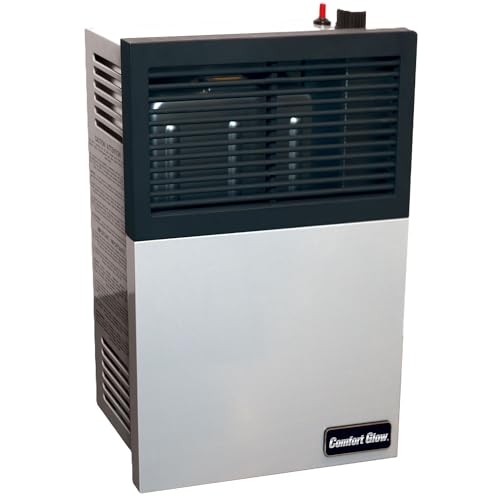
Pros
- 11,000 BTU output heats up to 350 sq. ft.
- Thermostatic heat control for adjustable warmth
- Direct vent design needs no chimney
- No electricity required for operation
- Includes professional vent kit
Cons
- Requires minimum 100 lb. propane tank
- Needs two-stage low-pressure regulator
- Limited to rooms up to 350 sq. ft.

Pros
- 11,000 BTU liquid propane wall heater
- Heats up to 375 sq ft
- Sealed burn system for bedrooms and living spaces
- Safety pilot stops gas if pilot is extinguished
- Includes heat shield, air intake pipe, and connecting rod
Cons
- For liquid propane only
- 375 sq ft coverage limits it to compact spaces
- 40 lb weight may make installation harder

Pros
- 17,000 BTU output rated to heat up to 570 sq ft
- Direct vent design with complete vent kit included for setup
- Safety pilot with pressure regulator stops gas flow if pilot goes out
- Matchless Piezo ignition for quick startup
- Stainless steel ported burner for quiet on and off operation
Cons
- Requires liquid propane fuel and a direct vent installation, not a plug in unit
- At 58 pounds it is not easily portable between rooms
- Limited to around 570 sq ft, not suited for larger or open floor plans

Pros
- 25,000 BTU output heats up to 750 sq. ft.
- Thermostatic heat control for adjustable warmth
- Direct vent design works without electricity during outages
- Approved for bedrooms, bathrooms, HUD, mobile and modular homes
- Stainless steel burner for quiet, noise free operation
Cons
- Requires a minimum 100 lb. propane tank with two-stage regulator
- Weighs 60 pounds, so wall mounting needs secure installation
- Installation is limited to wall thicknesses of 4.5 to 10 inches

Pros
- Produces up to 8,000 BTUs for spaces up to 300 sq ft
- Operates without electricity, suited to power outages or off-grid use
- Matchless piezo ignition for startup without external power
- Direct-vent sealed burn system vents exhaust outdoors
- Includes mounting bracket and full vent kit for installation
Cons
- Requires a minimum 100 lb propane tank, sold separately
- Needs direct-vent installation through a wall, not a plug in option
- Top control knob only sets heat level until pilot is lit manually
How We Chose Direct-Vent Wall Heaters for Backup Heat
Propane heat is useful when electricity is unreliable, but a wall heater has to match the room and the fuel setup. The right choice starts with BTU output, then moves quickly to venting, shut-offs and clearance from anything that can burn.
- Heat output and coverage: Small rooms do not need the same burner size as a garage or open cabin. Among our picks, output runs from 8,000 BTU to 25,000 BTU, while stated coverage runs from 250 square feet to 750 square feet. The Comfort Glow DVP08 sits at the low end with 8,000 BTU for up to 250 square feet, which makes the most sense for tighter rooms where oversizing can be uncomfortable.
- Indoor rating and oxygen safety: Indoor use calls for more than heat output, because combustion and room air are safety issues. The U.S. Consumer Product Safety Commission says unvented gas heaters should have an oxygen depletion sensor that shuts the heater off if oxygen drops too low. These picks are direct-vent models, and coverage ratings range from 250 square feet to 750 square feet, so room size still matters even when exhaust is routed outdoors.
- Ventilation and carbon monoxide precautions: A sealed, direct-vent design is the reason these wall heaters belong in this comparison. The Centers for Disease Control and Prevention recommends installing a battery-operated carbon monoxide detector and using only the fuel a heater is designed to use. The U.S. Fire Administration also says anything that can burn should stay at least 3 feet from space heaters, a clearance rule that matters in crowded cabins and workshops.
- Fuel type, tank size and runtime planning: All main picks are liquid propane models, not natural gas models, so the fuel supply has to match the appliance. Some of our picks call for a minimum 20-pound propane tank, while others call for a minimum 100-pound tank. The Comfort Glow 25,000 BTU Propane Wall Heater is the high-output pick with 25,000 BTU for up to 750 square feet, and its 60-pound weight makes it a planned installation rather than something to move often.
- Ignition and safety shut-offs: Ignition matters during an outage, especially when a heater does not rely on household electricity. Our picks include piezo ignition and electronic ignition, and the product information for the group repeatedly notes a safety pilot with a built-in pressure regulator. That safety system is meant to stop gas flow if the pilot goes out, which is a key feature for propane appliances used indoors.
- Size and portability: Wall heaters save floor space, but weight still affects installation and seasonal removal. The Ashley 8,000 BTU Propane Wall Heater weighs 17 pounds and is rated for up to 300 square feet, so it is the lightest main-list option while still using an adjustable thermostat. Across the group, heater weights run from 17 pounds to 60 pounds, which is a meaningful spread if one person is handling the mounting work.
We excluded central furnaces and whole-house systems because they need professional installation. We also left out water heaters and heated blankets because they solve a different problem, and outdoor-only patio heaters because they are not rated for enclosed spaces.
The Competition
These are other wall heaters we looked at but did not put on our main list.
If natural gas is already piped to the room, the Comfort Glow 17,000 BTU Natural Gas Wall Heater may look appealing. It is rated for up to 500 square feet and weighs 43 pounds, but it does not match the propane-focused need as closely as our main picks.
For larger spaces, Ashley Hearth 25,000 BTU Wall Heater offers 25,000 BTU and a stated 825-square-foot coverage rating. The trade-off is its 86-pound weight, which is 26 pounds heavier than our largest main-list Comfort Glow pick and less convenient for a cabin or workshop installation.
Maximum output is the draw with the Rinnai 36,500 BTU Propane Heater. Its 36,500 BTU rating is higher than every main pick, but its 108-pound weight makes it 48 pounds heavier than the heaviest pick on our main list.
And if light weight is the whole reason you are shopping, the Mr. Heater 18,000 BTU Propane Radiant Heater is only 20.7 pounds and is rated for up to 700 square feet. It remains off the main list because the main picks focus on direct-vent wall heaters, while this option does not line up as closely with that vented-wall-heater requirement.
FAQs
How many BTU do I need for a vented propane wall heater?
Start with the room size, then match it to the heater’s stated coverage. Our picks range from 8,000 BTU for smaller rooms to 25,000 BTU for spaces up to 750 square feet.
Do direct-vent propane wall heaters still need carbon monoxide protection?
Yes. Direct venting sends exhaust outdoors, but the CDC still recommends a battery-operated carbon monoxide detector when using fuel-burning heat. That is especially important during power outages, when windows may be closed and generators or other fuel-burning equipment may also be nearby.
Can a vented propane wall heater run during a power outage?
Several picks are described as operating without electricity, and ignition types include piezo and electronic systems. If outage use is the goal, confirm the ignition setup and propane tank requirement, which ranges from a minimum 20-pound tank to a minimum 100-pound tank among the models compared.
What clearances matter for propane wall heaters?
The U.S. Fire Administration says anything that can burn should stay at least 3 feet from space heaters. The CPSC gives the same 3-foot clearance for bedding, drapes, furniture and other flammable materials.
Sources
- CPSC Offers Tips to Prevent Home Fires From Space Heaters, U.S. Consumer Product Safety Commission. Fire-safety tips and required safety features for space heaters.
- Safety Guidelines: During & After a Winter Storm, Centers for Disease Control and Prevention. Winter heating safety for space heaters, kerosene heaters and carbon monoxide.
- Heating Fire Safety, U.S. Fire Administration. Home heating fire statistics and prevention messages.


Write Your Review
No reviews yet. Be the first to share your experience!