

Try Amazon Prime free for 30 days
Fast free delivery on heavy items, plus Prime Video, Prime Music and member-only deal prices.
When a wrench feels like an ice cube before the first bolt turns, portable propane heaters for garage use can make a cold workspace tolerable without wiring in permanent heat. After comparing 6 models, the Gasland 125,000 BTU Propane Heater stands out for its 125,000 BTU output, up to 3100 square feet of coverage and CSA certification. The Mr. Heater Big Buddy is the alternative pick for smaller spaces, with 18,000 BTU and coverage up to 450 square feet.

Pros
- Adjustable 75,000 to 125,000 BTU output for flexible heat control
- Rated to heat spaces up to 3,100 sq ft
- 10 ft propane hose and regulator included for tank hookup
- CSA certified with overheat detection and thermo-electric safety valve
- Lightweight at 13 pounds for a forced air heater
Cons
- Intended for well-ventilated spaces like garages, barns, and job sites, not sealed indoor rooms
- No thermostat for precise temperature setting, only adjustable BTU levels
- Runs about 5 hours on low with a 20 lb propane tank, so refills are needed for longer use
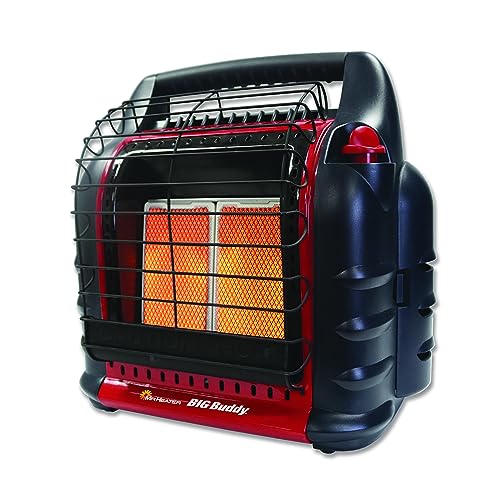
Pros
- 18,000 BTU max output heats spaces up to 450 square feet
- Three heat settings: 4,000, 9,000, and 18,000 BTU for low, medium, high
- Dual heating system blends radiant heat with convection air flow
- Built-in fan helps circulate warm air
- Runs up to 216 hours on two 20lb propane tanks on low setting with optional hose
Cons
- Requires propane tanks and a hose, so fuel supply and ventilation must be managed
- No thermostat is listed, so temperature control relies on the three preset settings
- At 14.11 pounds and 18.5 x 18 x 11.4 inches, it is not the most compact option to move around
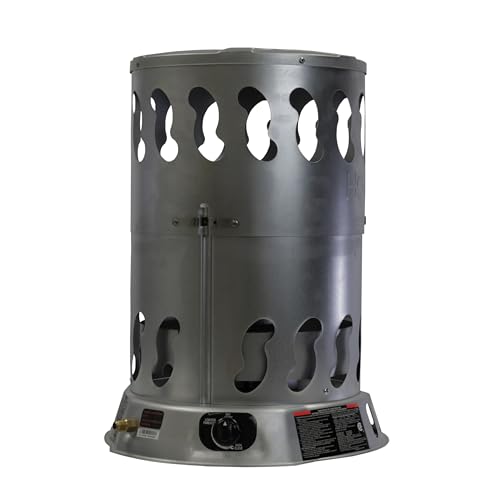
Pros
- Two heat settings at 80,000 and 30,000 BTU for flexible output
- Rated to heat spaces up to 2,000 sq ft
- 360 degree cylindrical convection design for even heat spread
- Thermo-electric safety valve shuts off gas if the flame goes out
- Light at 13.4 pounds for a heater of this output
Cons
- Needs a well ventilated area such as a barn, warehouse or workshop
- No thermostat setting mentioned, only high and low heat levels
- Dimensions of 16.7 x 15.9 x 21.8 inches make it bulky to store

Pros
- 3 heat settings, 6000, 12000, and 18000 BTU
- Heats spaces up to 450 sq ft
- Runs up to 69 hours on low with a 20 lb propane tank
- ODS and tip-over protection shutoffs
- Folds to 15 cm thin with 4 swivel casters
Cons
- For outdoor and well-ventilated indoor use only
- Requires a standard 20 lb propane tank
- Disconnect gas hose before folding for storage
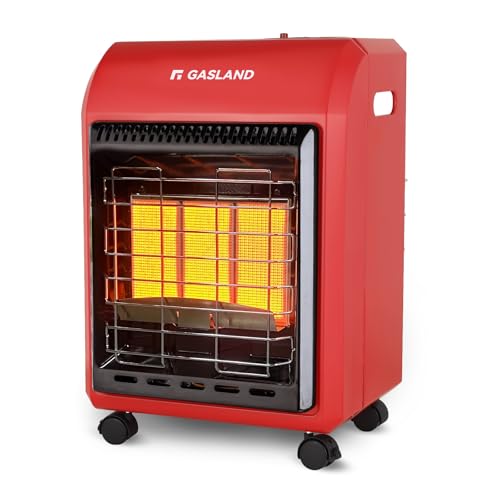
Pros
- Delivers up to 18,000 BTU with 3 heating modes (High/Medium/Low)
- Heats spaces up to 450 square feet, suited for garages or patios
- CSA certified with tip-over and low-oxygen shut-off safety features
- Runs on a 20lb propane cylinder, no electricity needed during outages
- Built-in rolling wheels and carry handle for easy mobility
Cons
- Intended for ventilated areas only, not built for enclosed indoor rooms
- Relies on a 20lb propane cylinder, adding ongoing fuel and refill needs
- Cabinet measures 17.5 x 15 x 21.7 inches, bulky for indoor storage
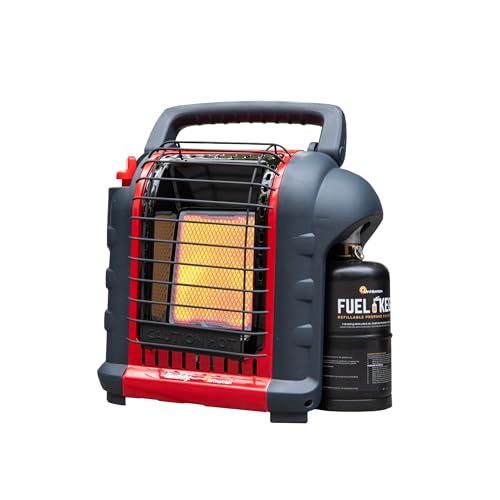
Pros
- 4,000 or 9,000 BTU/hr radiant heat
- Heats up to about 225 sq ft
- Indoor and outdoor approved
- Low oxygen safety system
- 7.1 lb portable design
Cons
- Runs 2.4 hours on high with a 1 lb propane cylinder
- 225 sq ft coverage may not suit larger areas
- No thermostat listed, only low and high settings
What Matters in Portable Propane Heaters for Garage Heat
A garage heater has to do two jobs at once: put out enough heat for a drafty space and do it with safety limits that match propane use. BTU output matters, but so do oxygen sensors, ventilation rules, fuel setup and how easily the heater can be moved out of the way.
- Heat output and coverage: Among our picks, maximum output ranges from 9,000 BTU to 125,000 BTU. The Gasland 125,000 BTU Propane Heater has the highest ceiling, with 125,000 BTU and a rated coverage area of up to 3100 square feet. That makes it the most appropriate match on paper for large garages, workshops or construction-style spaces where smaller radiant heaters may not move enough air.
- Indoor rating and oxygen sensing: For enclosed or partly enclosed areas, an oxygen depletion sensor is not just a convenience feature. The U.S. Consumer Product Safety Commission says unvented gas heaters should have an oxygen depletion sensor that shuts the heater off if oxygen drops too low. The Welluck 18,000 BTU Propane Heater includes an oxygen depletion sensor and tip-over protection, and it is rated for up to 450 square feet.
- Ventilation and carbon monoxide precautions: Propane heat still requires careful airflow, especially in a garage where doors may be cracked only a little on very cold days. The Centers for Disease Control and Prevention says to install a battery-operated carbon monoxide detector and use only the type of fuel the heater is designed to use. The U.S. Fire Administration also says to keep anything that can burn at least 3 feet from space heaters.
- Fuel type, tank size and run time: These heaters run on propane, but their tank setups are not all alike. Among our picks, some connect to a 20 lb propane cylinder, while one small radiant model runs for 5.4 hours on low with a 1 lb cylinder. Another cabinet-style pick lists up to 69 hours on low when connected to a 20 lb tank.
- Ignition and safety shut-offs: Look for a heater that does not rely only on careful attention from the person working nearby. The Gasland MHA18R is CSA certified, has tip-over protection and is rated up to 18,000 BTU for spaces up to 450 square feet. Across the list, safety features include overheat detection, thermo-electric shutoff, low oxygen shutoff and tip-over protection.
- Size and portability: Portability is not only about carrying the heater from shelf to floor. One featured forced-air model is listed at 13 pounds, while cabinet-style designs use rolling wheels or folding frames to make storage easier. Smaller radiant units trade lower BTU output for easier placement near a workbench or open bay.
We excluded central furnaces and whole-house systems because they require professional installation. We also left out water heaters and heated blankets because they solve a different problem, and outdoor-only patio heaters because they are not rated for enclosed spaces.
Other Propane Heaters Worth Considering
These are other propane heaters we looked at but did not put on our main list.
If quiet operation matters as much as raw heat, the Jocoevol 18,000 BTU Propane Heater lists a 30 dB noise level and coverage up to 450 square feet. Its 18,000 BTU output is far below the 125,000 BTU ceiling of our top pick, so it makes more sense for a smaller work area than a large open garage.
For a forced-air format with less output than our top pick, the Vevor 60,000 BTU Propane Forced Air Heater is rated for up to 1400 square feet and weighs 13.7 pounds. The 60,000 BTU rating is a middle ground, but it still gives up a large amount of heating capacity compared with our top pick.
That same smaller-space category includes the Avenger A00, which is rated at 18,000 BTU and up to 450 square feet. It includes both an oxygen depletion sensor and tip-over protection, but its heat output matches our alternative pick rather than the higher-output models on the main list.
And if a larger forced-air heater is the reason you are shopping, the Remington 60,000 BTU Propane Forced Air Heater is rated for up to 1500 square feet. Its 60,000 BTU output is useful for bigger work zones, though our top pick still offers more than twice the BTU rating.
FAQs
How many BTU do I need for a garage propane heater?
Our picks range from 9,000 BTU to 125,000 BTU, with rated coverage from 225 square feet to 3100 square feet. A smaller insulated garage can often use a lower-output radiant heater, while a large drafty shop generally points toward a forced-air or convection model with much higher BTU output.
Can I use a propane heater inside a garage?
Only use a heater in the type of space the maker specifies, and pay close attention to ventilation. The CDC says to install a battery-operated carbon monoxide detector, and the CPSC says unvented gas heaters should have an oxygen depletion sensor.
What safety features matter most for garage use?
For propane heat, oxygen depletion shutoff and tip-over protection are high-priority features. The CPSC also says to choose a heater certified by a nationally recognized testing laboratory and place it on a level, hard, nonflammable surface.
How far should a propane heater be from tools, boxes and other items?
The CDC and U.S. Fire Administration both say to keep space heaters at least 3 feet from drapes, furniture, bedding or anything that can burn. In a garage, that means leaving clearance from cardboard boxes, fuel containers, sawdust, rags and stored seasonal items.
Sources
- CPSC Offers Tips to Prevent Home Fires From Space Heaters, U.S. Consumer Product Safety Commission. Fire-safety tips and required safety features for space heaters.
- Safety Guidelines: During & After a Winter Storm, Centers for Disease Control and Prevention. Winter heating safety for space heaters, kerosene heaters and carbon monoxide.
- Heating Fire Safety, U.S. Fire Administration. Home heating fire statistics and prevention messages.




Write Your Review
No reviews yet. Be the first to share your experience!