

Try Amazon Prime free for 30 days
Fast free delivery on heavy items, plus Prime Video, Prime Music and member-only deal prices.
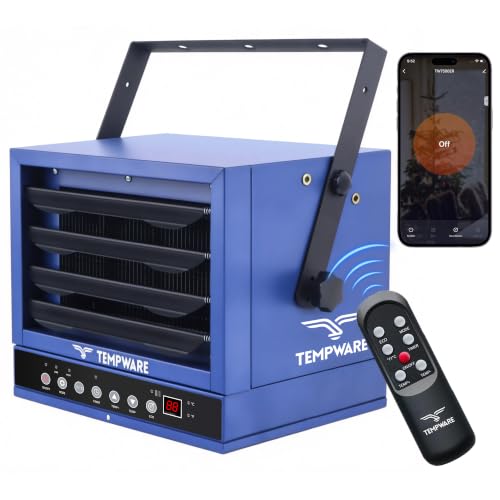
When your wrench feels like it spent the night in a freezer, a garage project gets old fast. The right heaters to heat a garage add targeted warmth where insulation and open concrete floors fall short. After comparing 5 models, the Tempware 25,590 BTU Space Heater stands out for 7,500 watts, a 5000-watt low setting and up to 1250 square feet of coverage. The Mr. Heater 50,000 BTU Propane Heater is the alternative pick for 50,000 BTU and up to 1667 square feet.
Pros
- 5,000W to 7,500W adjustable power
- 25,590 BTU output, covers up to 1,250 sq. ft.
- Digital thermostat range from 45°F to 95°F
- WiFi app, remote, and touch controls
- 12-hour timer and overheat protection
Cons
- Requires 240V hardwired installation by an electrician
- Power cord is not included
- Ceiling mount is less portable than plug-in heaters

Pros
- 50,000 BTU covers large garage
- Thermostat setpoint stays true
- Ceiling mount saves floor space
- Dual fuel, propane or natural gas
Cons
- Needs 10 ft minimum ceiling height
- Forced air fan noise on high
50,000 BTU Forced-Air Coverage for a Full 3-Car Garage
On a 40-degree January morning, mounting this unit overhead and firing it up gets the whole garage warm instead of just the corner where you're standing. The forced-air propane heater pushes warm air across the full floor plan, and because it's ceiling-mounted, you're not losing heat to floor drafts like you do with a portable unit sitting on the slab. Real-world heat moves fast enough that you can have both bay doors cracked for air flow and still stay comfortable, though the fan noise on high does carry if you're trying to hear a customer on the phone.
Thermostat Control Holds Your Setpoint All Morning
Wire this to a 24-volt thermostat (or the newer Wi-Fi models, sold separate) and the unit cycles on and off to keep your garage at exactly 65 degrees while you're turning wrenches. Unlike a simple on-off toggle, a garage heater with thermostat control means you're not walking back to the unit every hour to bump the heat up or down. The flame sensor cuts gas immediately if the pilot dies, so you don't end up with unburned fuel pooling in a cold shop.
Dual Fuel Flexibility: Propane Tank or Natural Gas Line
Run it off a standard 20-lb propane tank for portable seasonal heat, or hardwire it to an existing natural gas line if your shop is already plumbed. This flexibility means you can set it up however your garage is already configured without ripping walls apart or running new utility lines. Propane gives you the option to move the heat between the garage and a shed if you're seasonal, while natural gas locks in lower per-BTU cost if you're running it all winter.
High-Temperature Shutoff and Flame Safety Sensor
The built-in overheat shutoff kills the flame if internal temps spike, and the gas shutoff sensor ensures no raw fuel escapes into a closed garage if the pilot goes out. On a poorly ventilated shop or a morning when you've got the bay doors shut tight, these two features work together to keep CO and unburned fumes from creeping up on you. Real garages don't always have perfect ventilation, so having the heater cut itself off rather than push bad air at your chest is worth the hardware cost alone.

Pros
- 3 heat settings, 6,000, 12,000, and 18,000 BTU
- Warms areas up to 450 sq.ft
- Low oxygen, tip-over, and flameout protection
- Runs on a standard 20 lb propane cylinder
- 5 casters, including 2 with brakes
Cons
- 20 lb propane cylinder is not included
- Fuel heater needs proper ventilation and safe placement
- Outdoor patio heater, not stated as indoor rated

Pros
- 45,000, 36,000, and 30,000 BTU heat settings
- Mounts directly to a 20 lb propane tank
- Tip-over safety shut-off switch
- About 9.5 hours run time on high with a 20 lb tank
- 5.62 lb weight for portability
Cons
- Outdoor use only
- Requires a 20 lb propane tank
- No thermostat listed

Pros
- 60,000 BTU forced air output for spaces up to 1,500 square feet
- Weighs just 11 pounds for easy transport between job sites
- Variable heat settings and adjustable height for custom warmth
- Electronic ignition with 10-foot LP hose and regulator included
- Safety features include thermocouple, high-temp limit shutoff, flame-out fuel cutoff
Cons
- Requires a separate 20-pound propane tank, not included
- Built for open work areas like garages and barns, not small rooms
- Steel construction and open-flame heating mean surfaces get hot during use
What Matters Most in Garage Heaters for Cold Workspaces
A garage heater has to do more than warm a small corner. Garages often have concrete floors, large doors and uneven insulation, so output, placement and safety features matter more than they would in a finished room.
- Heat output for the garage size: Output is the first filter, because our picks range from 18,000 BTU to 60,000 BTU. The Tempware 25,590 BTU Space Heater is the most balanced electric pick, with 7,500 watts, a 5000-watt low setting and 25,590 BTU for up to 1250 square feet. That makes it suited to a larger garage or workshop where a small 1,500-watt heater would lag far behind.
- Voltage and wiring: A 240V hardwired heater can deliver more sustained output than a small plug-in unit, but it also requires the right circuit. Among our picks, the main electric model is a 240V hardwired unit and does not include a power cord. That means the electrical work should be planned before buying, especially if the garage currently has only standard outlets.
- Mounting and placement: Placement affects both heat distribution and floor safety. Ceiling-mounted models keep the unit out of the way, while tank-top and cabinet-style propane heaters need stable floor or tank placement. The Mr. Heater 45,000 BTU Propane Radiant Heater weighs 5.6 pounds and mounts to a 20 lb tank, so it is easier to move than a fixed unit but still needs clearance from traffic and combustible materials.
- Thermostat control: Controls matter if the heater will run while you work for more than a quick warm-up. Across our picks, controls range from an adjustable digital thermostat to simple high, medium and low regulator settings. A thermostat with a set range of 45°F to 95°F gives finer control than a fixed-output burner when the goal is steady shop comfort rather than a short blast of heat.
- Safety protections: The U.S. Consumer Product Safety Commission says heaters should be kept at least 3 feet from flammable materials, and it notes that tip-over cutoffs are required for electric or kerosene heaters. The Jocoevol 18,000 BTU Propane Heater lists 18,000 BTU output, coverage up to 450 square feet and tip-over protection. Its listing also states a noise level under 30 dB, which can matter in a smaller shop where the heater sits nearby.
- Build quality for dusty spaces: A garage heater may sit near sawdust, dirt, cardboard, tool carts and seasonal storage. Steel housings and jobsite-style construction are more appropriate for that setting than light-duty housings meant only for finished rooms. Among our picks, outputs reach 60,000 BTU, so the housing, shutoff system and placement all need to match the heat being produced.
We excluded central furnaces and whole-house systems because they move beyond a portable or shop-focused purchase and require professional installation. We also left out water heaters and heated blankets because they solve a different problem, and we avoided unvented fuel heaters without an indoor rating because carbon monoxide is a serious risk indoors.
Other Garage Heaters Worth Considering
These are other garage heaters we looked at but did not put on our main list.
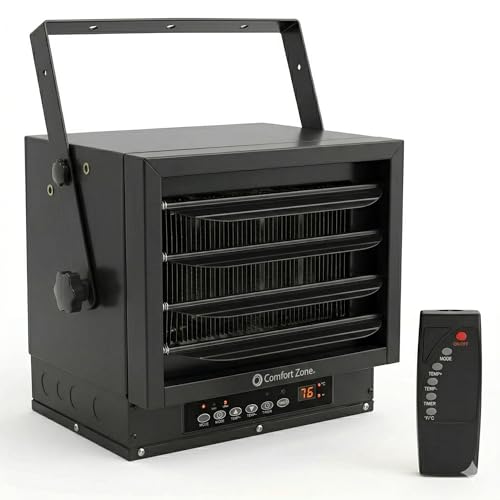
If you want a ceiling-mounted electric unit with a simpler output level, Comfort Zone Ceiling Heater is worth a look. It provides 5,000 watts and has an adjustable thermostat, but that is less than the 7,500 watts available from our top pick. At 20.4 pounds, it also calls for a secure mounting spot rather than casual placement.
For a smaller electric ceiling heater, shinic Ceiling Heater steps down to 1,500 watts and includes a 750-watt low setting. That lower ceiling makes it better aligned with spot heat than with warming a larger garage. It is ETL certified, but its output does not match the stronger garage-focused models on the main list.
Wall mounting can be useful when floor space is tight, and GiveBest 5,200 BTU Wall Heater is built around that idea. It produces 1,500 watts and 5,200 BTU, with coverage rated up to 200 square feet. That can help a small work area, but it is far below the output of our propane and 240V electric picks.
And if living-room style portability is the whole appeal, Dr. Infrared Heater DR-968 brings 1,500 watts, 5,200 BTU and an adjustable thermostat. It also lists tip-over and overheat protection, which are important on a garage floor. Even so, its output is closer to a room heater than to a garage heater meant for a cold shop or larger bay.
FAQs
How much heat does a garage usually need?
The right output depends heavily on square footage, insulation and how often the garage door opens. Among our main picks, stated coverage runs from 450 square feet to 1667 square feet, which is why matching the heater to the space matters more than choosing by size alone.
Is electric or propane better for a garage?
Electric models avoid fuel tanks and can offer thermostat control, but a high-output unit may require 240V hardwiring. Propane models in our picks range from 18,000 BTU to 60,000 BTU, which can deliver fast heat, but fuel handling and ventilation deserve close attention.
Where should a garage heater be placed?
The U.S. Fire Administration says anything that can burn should stay at least 3 feet from space heaters. Ceiling-mounted heaters can preserve floor space, while portable heaters should sit on a level, hard, nonflammable surface and away from rugs, boxes and stored materials.
What safety features matter most in a garage heater?
Look for shutoff features tied to tip-over, overheating, flameout or low oxygen, depending on the fuel type. The CDC also recommends electric space heaters with automatic shut-off switches and says space heaters should never be covered.
Sources
- CPSC Offers Tips to Prevent Home Fires From Space Heaters, U.S. Consumer Product Safety Commission. Fire-safety tips and required safety features for space heaters.
- Heating Fire Safety, U.S. Fire Administration. Home heating fire statistics and prevention messages.
- Safety Guidelines: During & After a Winter Storm, Centers for Disease Control and Prevention. Winter heating safety for space heaters, kerosene heaters and carbon monoxide.



Write Your Review
No reviews yet. Be the first to share your experience!