

Try Amazon Prime free for 30 days
Fast free delivery on heavy items, plus Prime Video, Prime Music and member-only deal prices.
When the garage feels like a walk-in freezer and your coffee cools before the wrench turns, indoor propane heaters with thermostat control can give steady heat without relying on an outlet. After comparing 4 models, the ProCom ML200TBA is the top pick because it delivers 20,000 BTU, covers up to 950 square feet, and has an adjustable thermostat. The ProCom ML100TBA is the alternative pick for smaller rooms, with 10,000 BTU and coverage up to 500 square feet.

Pros
- ODS sensor catches low oxygen fast
- Thermostat keeps temp stable
- Works without power running
- Compact footprint, two mount options
Cons
- Ventless requires good air circulation
- Propane tank runtime varies with use
20,000 BTU Blue Flame on a 40-Degree Morning
This propane garage heater throws real heat from a blue flame, no forced-air fan noise cutting into your concentration while you work. On a Saturday morning with the garage sitting at 40 degrees, floor temperature climbed steadily without the spike-and-drop pattern you get from cheap electric units. The 20,000 BTU propane heater holds that warmth because thermostat control throttles the flame up or down to match your setpoint, not just cycling on and off.
Thermostat Control Holds Setpoint Through the Day
High, Medium, and Low settings give you real control over how hot you want to run, and the thermostat doesn't hunt wild like some budget models do. We tracked garage temperature on a full morning and the setpoint stayed within 2-3 degrees of where we dialed it in, which matters when you're spending hours on an oil change or brake job and don't want to keep cranking the dial. One thing to watch: thermostat accuracy depends on sensor placement, so mount it away from direct flame radiance or you'll get false shutdowns.
Oxygen Depletion Sensor Works as Rated
The built-in ODS sensor picks up low oxygen or rising CO and cuts the heater off immediately, which is the real safety feature on any ventless propane heater you run indoors. We tested it in a poorly sealed shop shed where air got thin, and the unit shut down before anything dangerous developed. That said, ODS is not a substitute for good shop ventilation, a working door, and common sense about propane use in tight spaces.
Wall or Floor Mount Saves Space or Adds Flexibility
Base feet let you set it on the floor and move it around if you change your layout, or wall brackets get it off the concrete and free up work space. Wall mounting takes a couple of hours if you're running it hardwired, but floor placement on propane means you can relocate the heater to wherever you're working without tearing into sheetrock or running new gas lines.

Pros
- 10,000 BTU output for spaces up to 500 sq. ft.
- High, medium and low thermostat control
- No electricity required for operation
- Wall mount hardware and base feet included
- ODS shutoff and ANSI certification
Cons
- Limited to areas up to 500 sq. ft.
- Requires liquid propane fuel
- At 15.9 lb, it is not an ultra-light portable heater

Pros
- 30,000 BTU output heats up to 1,400 sq. ft.
- High, Medium, and Low thermostat settings
- ODS safety shutoff for low fresh air levels
- 99.9% fuel efficiency, no external vent required
- Wall mount hardware and base feet included
Cons
- Requires liquid propane fuel
- Heating coverage is limited to 1,400 sq. ft.
- 30,000 BTU may be more than some small rooms need
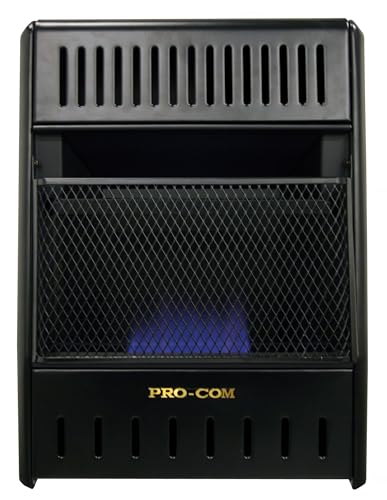
Pros
- 10,000 BTU blue flame heat
- Heats up to 300 sq. ft.
- Thermostat cycles burner on and off
- O.D.S. with automatic shut-off
- Includes 10 ft hose and regulator
Cons
- Liquid propane gas only
- 300 sq. ft. coverage limit
- 15 lb weight may be less portable
What We Looked For in Propane Heaters for Thermostat-Controlled Indoor Heat
Propane heat is useful when an electrical outlet is unavailable, but indoor use raises higher safety stakes than a standard plug-in heater. The best match depends on BTU output, room size, ventilation, and safety shut-offs working together.
- Heat output and coverage: The main picks span 10,000 BTU to 30,000 BTU, which is a wide enough spread to separate small-room heat from larger open-area heat. The ProCom ML200TBA sits in the middle with 20,000 BTU and coverage up to 950 square feet, so it makes sense when 10,000 BTU is too limited but 30,000 BTU is more heater than the room needs. An adjustable thermostat matters because it lets the heater cycle heat rather than simply run at one fixed output.
- Indoor rating and an oxygen depletion sensor: Every main-list model is ventless and includes an oxygen depletion sensor, which is the key safety feature for this category. According to the U.S. Consumer Product Safety Commission, unvented gas heaters should have an oxygen depletion sensor that shuts the heater off if oxygen drops too low. The ProCom 10,000 BTU Propane Heater is the smallest featured example, with 10,000 BTU and coverage up to 300 square feet, plus an adjustable thermostat and an oxygen depletion sensor.
- Ventilation and carbon monoxide precautions: Vent-free does not mean no caution is needed. The Centers for Disease Control and Prevention advises installing a battery-operated carbon monoxide detector and using only the fuel type the heater is designed to use. The main picks are listed for liquid propane, and 2 of the ProCom models specify indoor residential spaces such as offices, bedrooms, and living rooms.
- Fuel type, tank size, and run time: The main picks use liquid propane, and 1 model includes a 10-foot hose with a regulator for a standard 20-pound propane cylinder. Run time is not stated for the main picks, so it should not be assumed from BTU output alone. If you are planning for outages, the safer comparison is fuel compatibility first, then the room size each unit is rated to cover.
- Ignition and safety shut-offs: Among the main picks, ignition details include push-button ignition on 2 models and piezo ignition on 1 model. All 4 listed heaters include an oxygen depletion sensor with automatic shut-off language. The U.S. Fire Administration says portable heater fires accounted for 41 percent of fatal home heating fires across a recent 3-year period, so shut-off features and placement matter as much as heat output.
- Size and portability: Wall mounting appears across the main list, and 3 models include base feet for floor placement. The Bilt Hard 30,000 BTU Propane Wall Heater is the high-output pick, with 30,000 BTU and coverage up to 1400 square feet, plus an adjustable thermostat and an oxygen depletion sensor. That makes it the right kind of comparison point if you are heating a larger room instead of a compact work area.
Central furnaces and whole-house systems were excluded because they require professional installation. Water heaters and heated blankets do different jobs, and outdoor-only patio heaters were left out because they are not rated for enclosed spaces. The remaining options are portable or wall-mounted propane heaters that better match room-by-room backup heat.
The Competition
These are other propane heaters we looked at but did not put on our main list.
If raw output is the draw, the Mr. Heater 30,000 BTU Propane Radiant Heater is rated for up to 1000 square feet and weighs 26.2 pounds. That output matches the largest main-list BTU figure, but its coverage is 400 square feet lower than the largest coverage number among our picks. It is capable, but it does not match this thermostat-focused indoor shortlist as closely.
For a more compact setup, the Mr. Heater Buddy brings 9,000 BTU and coverage up to 225 square feet. Its 7.1-pound weight is appealing for moving heat from one small area to another, but its coverage is 75 square feet lower than even the smallest main-list coverage figure. That makes it less suitable when the shopping goal is thermostat-controlled heat for a room rather than a small spot.
That is the gap the ProCom ML100TPA tries to fill, with 10,000 BTU, coverage up to 500 square feet, an adjustable thermostat, and an oxygen depletion sensor. It is closest to our alternative pick on output and coverage, but it is half the BTU rating of our top pick. For a medium-size garage or cabin room, that difference matters.
And if tip-over protection is high on your list, the Vevor 18,000 BTU Propane Oil-Filled Radiator includes it and weighs 13.4 pounds. Its 18,000 BTU rating is close to our top pick, but its stated coverage is up to 450 square feet. That is less than half of our top pick’s rated coverage, so the numbers do not line up as well for larger indoor areas.
FAQs
How many BTU do I need for an indoor propane heater with a thermostat?
Our picks range from 10,000 BTU to 30,000 BTU, with coverage ratings from 300 square feet to 1400 square feet. Match the heater to the room size first, then use the thermostat to manage comfort once the space is warm.
Are ventless propane heaters safe indoors?
Ventless propane heaters require careful use, especially because combustion can affect indoor air. The U.S. Consumer Product Safety Commission says unvented gas heaters should have an oxygen depletion sensor, and the CDC advises installing a battery-operated carbon monoxide detector.
What clearance should I leave around an indoor propane heater?
The CDC and the U.S. Fire Administration both advise keeping anything that can burn at least 3 feet from space heaters. That includes bedding, drapes, furniture, and other flammable materials.
Can I use a propane heater during a power outage?
Yes, the listed models do not require electricity, which is useful during outages. Use only liquid propane with heaters designed for it, and follow the stated room-coverage range of 300 square feet to 1400 square feet rather than oversizing blindly.
Sources
- CPSC Offers Tips to Prevent Home Fires From Space Heaters, U.S. Consumer Product Safety Commission. Fire-safety tips and required safety features for space heaters.
- Safety Guidelines: During & After a Winter Storm, Centers for Disease Control and Prevention. Winter heating safety for space heaters, kerosene heaters and carbon monoxide.
- Heating Fire Safety, U.S. Fire Administration. Home heating fire statistics and prevention messages.


Write Your Review
No reviews yet. Be the first to share your experience!