

Try Amazon Prime free for 30 days
Fast free delivery on heavy items, plus Prime Video, Prime Music and member-only deal prices.
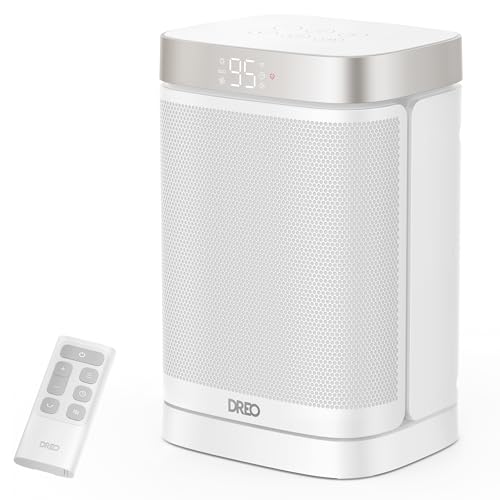
The diaper change goes faster when the room is not doing its best impression of a walk-in freezer. Space heaters for nursery use can add targeted warmth without changing the whole home thermostat. After comparing 2 models, the Dreo Space Heater is our top pick because it has 1,500 watts, an adjustable thermostat and tip-over plus overheat protection. The Dreo Atom One is our alternative pick because it also delivers 1,500 watts with an adjustable thermostat.

Pros
- 1500W PTC heating system
- 41 to 95°F thermostat in 1°F steps
- 34 dB noise rating
- ETL certified with tip-over and overheat protection
- Remote, 12-hour timer, child lock and memory
Cons
- No square-foot heating area is listed
- Electric space heaters are for supplemental room heat
Pros
- 1500W PTC ceramic heater reaches desired temperature in seconds
- 70-degree wide-angle oscillation spreads heat across the room
- Digital thermostat adjustable from 41 to 95F in 1F increments
- ETL-listed with tip-over and overheat protection, UL94 V-0 materials
- Includes remote control and 12-hour timer, weighs 4.4 pounds
Cons
- No square footage or BTU rating given, likely best for small to medium rooms
- Not intended to replace whole-house heating, only supplemental warmth
- No stated noise level in dB, so quiet operation cannot be confirmed from data
What Matters in Space Heaters for a Nursery
A nursery heater needs a narrower set of priorities than a general basement or garage heater. Warmth matters, but so do shutoffs, low noise and controls that let you avoid big temperature swings.
- Heat output for the room: Among our picks, both heaters use 1,500 watts, which is a common ceiling for plug-in electric space heaters. That output is meant for focused room heating rather than whole-home heating. For a nursery, the safer question is not just how much heat it can make, but whether it can hold a steady setting without running unchecked.
- Safety shutoffs and certification: The Dreo Space Heater lists tip-over protection, overheat protection and ETL certification, all important for a room where bedding, curtains and furniture may be nearby. The U.S. Consumer Product Safety Commission says an automatic cut-off is required to turn off electric or kerosene heaters if they tip over. It also advises choosing a heater certified by a nationally recognized testing laboratory and keeping it at least 3 feet from flammable materials.
- Thermostat range and controls: Across our picks, the thermostat range runs from 41 to 95 degrees, with adjustment in 1-degree increments. That level of control is useful when a nursery feels chilly during a feeding but should not become overheated after the door is closed. Both main picks also include a 12-hour timer, which gives caregivers a clear limit instead of relying on memory alone.
- Noise level: Noise is not just about comfort in a nursery, it can affect whether a heater is practical during naps. Our top pick lists a 34 dB noise level, which is the quieter number available among the main picks. For comparison, one other option in this guide lists 43 dB, so the difference is meaningful if the heater will sit near a crib or changing area.
- Oscillation and heat spread: Heat spread matters because a nursery often has cold corners near windows and warmer areas near vents. Our alternative pick lists 70-degree oscillation, while our top pick uses a heat funnel design described as reaching up to 200 percent farther than traditional heaters. A wider sweep can help even out warmth, but the heater still needs open clearance around it.
- Portability and placement: Both main picks are portable room heaters, and portability matters because placement changes with the season, the crib layout or the safest outlet. The key placement number is 3 feet: the U.S. Fire Administration says to keep anything that can burn at least 3 feet from space heaters. The CPSC also says to place a heater on a level, hard, nonflammable surface, not on rugs or carpets.
We excluded central furnaces and whole-house systems because they need professional installation and solve a different problem. We also left out water heaters and heated blankets because they are not room heaters, and we avoided unvented fuel heaters without an indoor rating because carbon monoxide risk is the wrong tradeoff for a nursery.
Other Space Heaters Worth Considering
These are other space heaters we looked at but did not put on our main list.
If you want a basic ceramic model, Amazon Basics Ceramic Heater offers 1,500 watts and a 900-watt low setting. It also lists an adjustable thermostat, tip-over protection and overheat protection. The main drawback for nursery use is sound: its listed 43 dB noise level is higher than the 34 dB listed for our top pick.
For shoppers who care most about air movement, Jibufi Space Heater brings 70-degree oscillation and 1,500 watts. It is also rated for up to 200 square feet, which gives a clearer room-size reference than many compact heaters provide. Compared with our main list, the appeal is the oscillation, but the available nursery-relevant safety detail is thinner because only tip-over protection is specified here.
FAQs
Are space heaters safe to use in a nursery?
They require careful placement and supervision. The U.S. Fire Administration says portable heater fires were only 3 percent of home heating fires in one multiyear period but accounted for 41 percent of fatal home heating fires, so clearance and shutoffs matter. Keep anything that can burn at least 3 feet away and turn the heater off when leaving the room or going to bed.
What safety features matter most for a nursery space heater?
Look for automatic shutoff features, especially tip-over protection and overheat protection. The CDC advises using electric space heaters with automatic shut-off switches and non-glowing elements. Certification by a nationally recognized testing laboratory is also recommended by the CPSC.
How much heat output is enough for a nursery?
Our picks use 1,500 watts, which is intended for room-level supplemental heat. A nursery heater should warm the immediate room rather than replace a central heating system. A thermostat range of 41 to 95 degrees helps fine-tune comfort without leaving the heater on one fixed high setting.
Where should a space heater go in a nursery?
Place it on a level, hard, nonflammable surface with at least 3 feet of clearance from bedding, drapes and furniture. The CPSC specifically warns against placing heaters on rugs or carpets. Never cover a space heater, even briefly.
Sources
- CPSC Offers Tips to Prevent Home Fires From Space Heaters, U.S. Consumer Product Safety Commission. Fire-safety tips and required safety features for space heaters.
- Heating Fire Safety, U.S. Fire Administration. Home heating fire statistics and prevention messages.
- Safety Guidelines: During & After a Winter Storm, Centers for Disease Control and Prevention. Winter heating safety for space heaters, kerosene heaters and carbon monoxide.


Write Your Review
No reviews yet. Be the first to share your experience!