

Free Delivery. Exclusive Deals. All Prime.
Prime members save on shipping and get first access to deals, plus Prime Video included. 30 days free.
The first pass down a snowy driveway should not feel like pushing a wet mattress with a broom. Wide snow pushers solve that by moving snow forward instead of making you lift it. After comparing 5 models, the Brewin Tools Snow Pusher stands out for its 36-inch blade, poly construction, and ergonomic handle. The Vevor Snow Pusher is the alternative pick for shoppers who want a 30-inch plastic blade.

Pros
- 36 inch blade clears wider paths
- UHMW-PE blade for wear and impact resistance
- Aluminum alloy shaft helps keep weight to 5.95 lb
- Curved ergonomic shaft is designed to reduce back stress
- Non-slip D handle supports a firm grip
Cons
- 36 inch width may be bulky in narrow areas
- Made as a pusher, not a scoop-style shovel
- Warranty is limited to 1 year
Pros
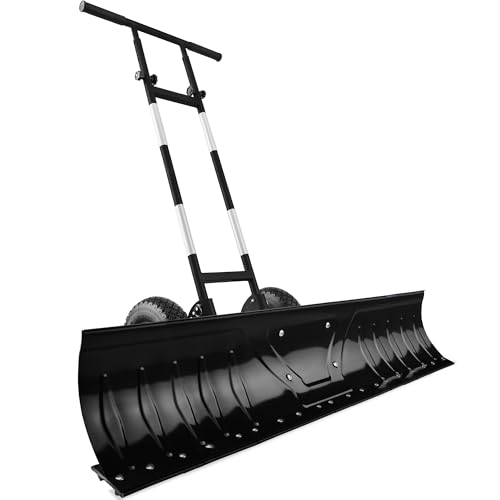
- 48 in wide blade covers driveways, walkways, and sidewalks
- 2 wheels help the plow roll smoothly
- Adjustable blade angle for directing snow
- Handle height adjusts from 33.5 to 51 in
- Reflective tape included for low light visibility
Cons
- 27.5 lb weight may be hard for some users to move
- 10 in blade height may limit very deep passes
- No warranty details provided

Pros
- 30 inch wide snow pusher blade
- Comes as a 4 pack
- Virgin UHMW polyethylene nonstick blade
- Patented TUFFBRACE handle and brace connector
- Made in the USA
Cons
- Listed weight is 30 pounds
- Designed for pushing, not lifting or scooping
- Only yellow color is listed

Pros
- 36 inch wide metal blade for large snow areas
- 7 position adjustable shovel head directs snow
- Handle has 3 height settings and 6 angle settings
- 10 inch inflatable wheels with anti-slip texture
- Exchangeable bottom strip can be flipped when worn
Cons
- 25 lb weight may be heavy for some users
- Assembly required with numbered parts
- 36 x 21 inch footprint still needs storage space

Pros
- 30 inch wide blade clears larger areas in one pass
- HDPE blade resists wear, tearing, and deformation
- Metal edge reinforcement helps protect against bending
- Textured anti-slip grip reduces hand and wrist pressure
- Detachable segmented handle supports compact storage
Cons
- 30 inch width may be bulky for narrow steps or tight spots
- 8.66 inch blade height is not designed as a deep snow scoop
- Segmented handle requires assembly and disassembly for storage
What Matters in a Wide Snow Pusher
A wide snow pusher is best judged by how much snow it can move without forcing you to lift every load. Blade width, edge design, handle shape, and storage all matter when the same path may need several passes after a storm.
- Blade width and material: A wider blade clears more pavement with each pass, but the material determines how it slides and wears. The Brewin Tools Snow Pusher uses a 36-inch poly blade, which gives homeowners a broad clearing path while keeping the build focused on pushing rather than scooping. Among the main picks, blade widths run from 30 inches to 48 inches, so the right size depends on whether you are clearing steps, walks, or a full driveway.
- Wear strip or edge: A reinforced edge helps a pusher survive repeated contact with concrete, blacktop, and packed snow. Two of the main picks call out a reversible or reinforced edge, which is useful because the scraping surface takes the most abrasion. A 30-inch blade with edge reinforcement may be easier to control on narrow walks, while a 48-inch blade covers more pavement but asks for more steering room.
- Handle design, bent shaft, or wheels: Ergonomics matter because snow removal is repetitive work, not a single clean push. Nationwide Children’s Hospital reports an average of 11,500 snow shoveling related injuries and medical emergencies treated in U.S. Emergency departments each year, and the lower back was the most frequently injured region at 34 percent. The Best Choice Products Wheeled Snow Pusher uses wheels with a 48-inch blade and an adjustable handle height from 33.5 inches to 51 inches, so it is built around pushing from an upright position instead of lifting.
- Weight: Weight affects both control and fatigue, especially when turning at the end of a driveway. The lighter main picks center on 30-inch to 36-inch blades, while the wheeled steel model is heavier at 27.5 pounds. That added weight can help a broad wheeled pusher track forward, but it is less convenient if you need to carry it up steps or hang it between storms.
- Durability in cold: Cold weather performance depends on the blade material and frame construction. One main pick uses UHMW poly, another uses HDPE plastic, and one uses steel construction, giving buyers different tradeoffs in sliding, impact resistance, and heft. The Snowplow style option in the main group uses virgin UHMW polyethylene and a 30-inch blade, which is aimed at abrasion resistance on concrete, blacktop, pavers, decks, and similar surfaces.
- Storage: A wide pusher is useful outside, but it still has to live somewhere indoors. Among the main picks, storage features include a detachable segmented handle, upright handle storage, and compact overall dimensions on a wheeled model. For small garages, a 30-inch blade is easier to tuck away than a 48-inch blade, but the wider blade can reduce the number of driveway passes.
Snow blowers and snow shovels were left out because they are covered by different shopping needs, and vehicle-mounted plows belong to a different job and budget. Kitchen ice crushers and shavers were also excluded because they are not tools for clearing snow and ice from pavement.
Other Snow Pushers Worth Considering
These are other snow pushers we looked at but did not put on our main list.
If you prefer a lighter manual tool, The Snowplow “The Original Snow Pusher” Snow Pusher keeps the formula simple with a 30-inch blade and plastic construction. Its 8-pound weight is easier to move around than a wheeled steel pusher, but the 30-inch blade gives up 6 inches of width compared with our top pick.
For shoppers who want extra hand comfort, True Temper Snow Tool brings poly construction, an ergonomic handle, and a built-in glove. The built-in glove is unusual, but the available information does not give it the same wide-blade case as our main list, where blade widths are central to the ranking.
Narrower paths are where Suncast Snow Tool makes more sense, since its 20-inch blade can fit places a 36-inch pusher may not. That narrower blade is the tradeoff, because it needs more passes than our top pick to clear the same driveway width.
And if simple poly construction is the priority, Emsco Group Snow Tool stays focused with a 21-inch blade and poly build. It is still much narrower than our top pick, so it fits this category less closely when the goal is covering broad pavement quickly.
FAQs
How wide should a snow pusher be for a driveway?
For driveways, the main picks range from 30 inches to 48 inches wide. A 36-inch blade is a practical middle ground because it covers more pavement than a 30-inch blade without becoming as bulky as a 48-inch wheeled pusher.
Are wheeled snow pushers easier on your back?
Wheels can reduce the amount of lifting because the tool is designed to roll and push snow forward. Nationwide Children’s Hospital notes that pushing snow instead of lifting is the better way to clear it, and ergonomically designed shovels reduce bending and heavy lifting.
Is poly or metal better for a wide snow pusher?
Poly and plastic blades tend to be lighter and can help snow slide off, while metal construction can add strength and weight. In the main group, blade materials include UHMW poly, HDPE plastic, and steel, so the best match depends on whether you prioritize lower weight or a heavier wheeled frame.
Can I use a wide snow pusher on decks or roofs?
Deck use depends on the blade edge and the surface, but roofs call for more caution. OSHA says to clear ice and snow without going on the roof whenever possible, and it warns not to use a snow rake or shovel while on a ladder because that greatly increases fall risk.
Sources
- New National Study Finds 11,500 Emergency Department Visits, Nearly 100 Deaths Related to Snow Shoveling Each Year, Nationwide Children’s Hospital. Study of snow shoveling injuries treated in US emergency departments from 1990 to 2006.
- Falls and Other Hazards to Workers Removing Snow from Rooftops and Other Elevated Surfaces, Occupational Safety and Health Administration. OSHA hazard alert on removing snow from roofs.




Write Your Review
No reviews yet. Be the first to share your experience!