

Free Delivery. Exclusive Deals. All Prime.
Prime members save on shipping and get first access to deals, plus Prime Video included. 30 days free.
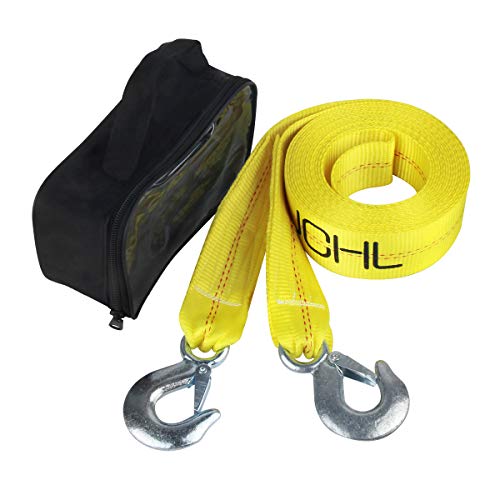
Your tires are spinning, the snow shovel is missing, and the helpful neighbor has already said, “I think it needs a pull.” Tow straps give a second vehicle a controlled way to help free a stuck car, truck, ATV or SUV. After comparing 6 models, the JCHL Tow Strap is the pick for its nylon build, 20-foot length and 20,000-pound break strength. The Rhino USA Tow Strap is the alternative pick, with a 20-foot polyester build for flat recoveries.
Pros
- 20,000 lbs towing capacity handles most vehicles and recovery needs
- 2 forged safety hooks with retaining clips for secure attachment
- Zinc-coated hooks provide three times more corrosion resistance
- 2 inch width and 20 feet length suit various towing applications
- Includes storage bag for organized transport and protection
Cons
- 20 foot length may be too short for some recovery situations
- No information provided about UV resistance or long-term durability
- High tensile strength nylon can fray if cut or damaged during use

Pros
- 3-inch width and 20-foot length suitable for flat surface vehicle recovery
- Polyester construction with weather-resistant properties for outdoor durability
- Triple-reinforced loop ends designed to resist wear and abrasion
- Lifetime replacement warranty covers defects and damage
Cons
- Flat surface use only; not suitable for angled or off-ground recovery
- 4.6-pound weight adds bulk to emergency kit storage

Pros
- 35,000 lbs break strength polyester strap rated for heavy-duty recovery
- D-ring shackles rated 45,000 lbs capacity with galvanized coating
- 4-in-1 kit includes strap, 2 shackles, and storage bag
- Weather-resistant design maintains integrity in rain, snow, and ice
- 3 inch width and 20 foot length suitable for trucks, SUVs, and ATVs
Cons
- 20 foot length may be limiting for certain recovery scenarios
- Orange color may be difficult to locate in snow or low-light conditions
- D-ring shackle electro galvanized coating durability not specified

Pros
- 36,000 lbs lab-tested break strength for trucks, SUVs, and ATVs
- Includes two 3/4 inch D-ring shackles with protective bumpers
- 30-foot length provides reach for various recovery scenarios
- Complete kit with storage bag for organization and portability
- Electro-galvanized shackle finish resists corrosion
Cons
- 30-foot length may be limiting for some distant recovery situations
- Yellow color visibility advantage not mentioned in specifications
- No information provided about strap material durability over time

Pros
- 35,000 LBS break strength handles heavy recovery tasks
- 30 feet length provides reach for various recovery situations
- Includes hitch receiver and two 3/4 D Ring shackles
- Lifetime warranty backs the product
- Nylon construction resists wear at connection points
Cons
- 3 inch width may limit versatility for smaller vehicles
- 30 foot length requires storage space in vehicle
- No user reviews provided to verify real-world performance
Pros
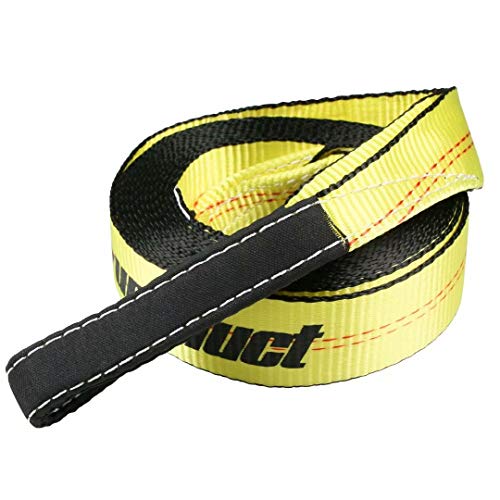
- 20,000 lbs breaking strength rated capacity for heavy-duty recovery
- 2 inch wide strap with 20 feet of length for versatile vehicle recovery
- Double-web reinforced eye loops resist abrasion at connection points
- Weather-resistant polyester material withstands moisture and heat
- Works with multiple attachment types including D rings and shackles
Cons
- No hooks included; requires separate attachment hardware to use
- Yellow color may fade over time with sun exposure during storage
- 20 feet length may be insufficient for certain deep-snow or terrain recoveries
What We Looked For in Tow Straps for Snow, Ice and Mud
A recovery strap for winter driving has to be judged by more than the biggest number on the package. Length, material and connection points matter when one vehicle is stuck and the other has only a limited angle to work from.
- Working load and break strength: We prioritized straps with stated break-strength numbers because recovery gear should be chosen with a clear safety margin. Among our picks, stated break strength runs from 20,000 pounds to 36,000 pounds. The lowest figure is still aimed at cars, SUVs, ATVs and pickups, while the higher figures better suit larger trucks and heavier off-road recoveries.
- Material and length: Material affects how a strap behaves under load, and length affects how much room the recovery vehicle has to gain traction. The JCHL Tow Strap uses a nylon build and measures 20 feet long, which keeps the setup compact while still giving space between vehicles. Across the main list, lengths run from 20 feet to 30 feet, so drivers can choose between tighter storage and more distance in mud or snow.
- Ease of use with cold hands or gloves: Cold weather makes small hardware and stiff fabric harder to manage, so we favored kits with large loops, hooks or shackles that do not require delicate finger work. The Metoware Tow Strap pairs a 20-foot polyester strap with 2 D-ring shackles, giving gloved hands more to grab than a bare loop alone. Its strap is 3 inches wide, which also makes it easier to see and handle in snow.
- Storage size and weight: A tow strap is useful only if it is in the vehicle when the tires dig in. Four of our picks include a storage bag, which helps keep wet or muddy webbing separate from the rest of a trunk or cargo area. The shorter 20-foot picks take up less room than the 30-foot picks, while the longer options give more reach when the recovery vehicle cannot park close.
- Hooks, loops or traction pattern design: Connection design determines whether the strap works with the recovery points already on a vehicle. Some picks use hooks, some use reinforced eye loops, and several include 3/4-inch D-ring shackles. Reinforced loop ends are especially useful because the highest wear often happens at the connection points, not in the middle of the strap.
- Vehicle or trailer fit: The right fit depends on vehicle weight, recovery point design and the distance between vehicles. The Horusdy Tow Strap has a 30-foot nylon build and a 35,000-pound break strength, making it one of the longer and stronger choices in the main list. That extra length can help when the pulling vehicle needs to stay on firmer ground instead of entering the same mud or snow.
We excluded jump starters and battery chargers because they solve electrical problems, not stuck-vehicle recoveries. We also left out permanent vehicle-mounted accessories that require shop installation, along with cargo tie-down straps, because securing cargo is a different job than vehicle recovery.
Other Tow Straps Worth Considering
These are other tow straps we looked at but did not put on our main list.
If you want a longer strap with a different material, Daydoor Tow Strap offers a 30-foot polyethylene build. That length matches the longer choices on our main list, but polyethylene is a different material choice than the nylon build used by our top pick.
For a shorter recovery setup, All-Top Tow Strap uses a 20-foot nylon build. That puts it in the same length class as our top pick, but its different size and feature mix kept it outside the main list.
Drivers who prefer polyester may want to compare Pilida Tow Strap, which has a 30-foot polyester build and is described as water resistant. It gives the same longer reach as two of our main picks, but it swaps away from nylon rather than matching our top pick’s material.
And if water resistance is a major concern, Vevor Tow Strap combines a 30-foot length with a silicone build. That is a less common material choice than nylon or polyester in the main group, so it is worth treating as an alternative rather than a direct match.
FAQs
What length tow strap is best for snow or mud?
Our picks range from 20 feet to 30 feet. A 20-foot strap is easier to store and control, while a 30-foot strap can let the recovery vehicle stay farther from deep snow, ice or mud.
How much break strength should a tow strap have?
Among our picks, break strength ranges from 20,000 pounds to 36,000 pounds. Choose a strap with a clear margin above the vehicle and load involved, and use only rated recovery points rather than bumpers or suspension parts.
Are hooks or loops better on tow straps?
Hooks can be quick to attach, especially when the strap includes retaining clips. Reinforced loops are useful with 3/4-inch shackles and can reduce wear at the connection point when the vehicle has proper recovery hardware.
What should I check before a winter recovery?
Before running a vehicle in deep snow, check that the tailpipe is clear. According to the Centers for Disease Control and Prevention, a blocked tailpipe can cause carbon monoxide to build up quickly inside the vehicle.
Sources
- Clear Snow from Tailpipes, Centers for Disease Control and Prevention. CDC warning about snow-blocked vehicle tailpipes.
- Safety Guidelines: During & After a Winter Storm, Centers for Disease Control and Prevention. Winter heating safety for space heaters, kerosene heaters and carbon monoxide.





Write Your Review
No reviews yet. Be the first to share your experience!