

Free Delivery. Exclusive Deals. All Prime.
Prime members save on shipping and get first access to deals, plus Prime Video included. 30 days free.
The driveway always seems longer when the first scoop of ice melt lands in one sad clump by the garage. Tow behind salt spreaders help cover more ground with steadier flow and fewer stops. After comparing 6 models, the Agri-Fab Walk-Behind Salt Spreader stands out for its 130 lb capacity, 10 to 12 ft spread width, and 1 in steel tubing. The HVDI Walk-Behind Salt Spreader is the alternative pick with a 130 lb hopper and 12 ft spread width.

Pros
- 130 lb hopper covers up to 25,000 sq ft
- 10 ft to 12 ft spread width reduces passes
- Universal hitch fits most riding mowers and tractors
- Works with seed, fertilizer, salt, and ice melt
- 13 in x 4 in pneumatic tires
Cons
- Needs a riding mower or lawn tractor to pull it
- 130 lb capacity may be more than small areas need
- 29.4 lb weight is not handheld friendly

Pros
- 130 lb hopper reduces refilling on large areas
- 12 ft spreading width for broad coverage
- 5 adjustable discharge ports for flow control
- Universal hitch fits most tractors, ATVs, and UTVs
- 12.5 inch pneumatic tires for grass, gravel, mud, and snow
Cons
- Tow behind design requires a compatible tow vehicle
- Fits most, not all, tractors, ATVs, and UTVs
- No warranty information is listed

Pros
- 130 lb rust-resistant poly hopper
- Adjustable flow with 0 to 10 ft coverage
- 10 in pneumatic tires for uneven terrain
- Includes waterproof cover and sieve
- Tow bar connects to lawn tractor, ATV, or UTV
Cons
- Requires a lawn tractor, ATV, or UTV for towing
- 24.13 x 22.44 x 15.47 in. size needs storage space
- Spread width is limited to 10 ft
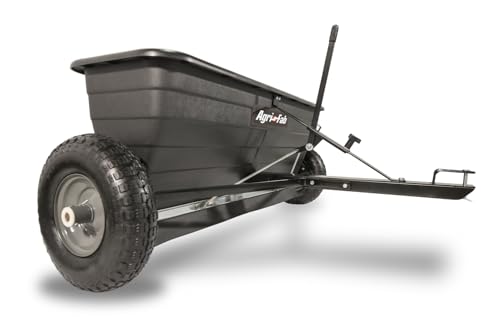
Pros
- 175 lb capacity reduces refill stops
- 42 in controlled spread width
- Covers about 40,000 sq ft or up to 1 acre
- Rustproof poly hopper resists corrosion
- Works with seed, fertilizer, salt, and ice melt
Cons
- Tow behind design requires a lawn or garden tractor
- 50.5 lb weight may be bulky to move or store
- 33 x 50 x 28 in size needs storage space

Pros
- 130 lb hopper reduces refill stops
- Spreads up to 12 ft wide
- Five adjustable discharge ports
- Universal hitch fits most mowers, ATVs, UTVs and tractors
- 12.5 inch pneumatic tires for uneven or snowy surfaces
Cons
- Assembly is required
- Hopper should not be filled too full
- Requires a tow vehicle for operation

Pros
- 130 lb rust-resistant poly hopper
- Powder-coated steel frame resists corrosion
- 10 inch pneumatic tires for uneven terrain
- Adjustable flow covers 0 to 10 ft wide
- Includes waterproof cover and sieve
Cons
- Requires a lawn tractor, ATV, or UTV for towing
- 27.12 lb weight may be bulky to move by hand
- Tow-behind design is not for narrow hand spreading
What Matters in a Tow Behind Salt Spreader for Ice Melt
Salt and ice melt are harder on equipment than grass seed or fertilizer, so the right salt spreader has to meter material cleanly and resist corrosion. For long driveways, the practical differences come down to how much the hopper holds, how wide it throws, and whether the frame and tires can keep moving over winter surfaces.
- Spreader type: For winter driveway work, tow behind and pull behind designs make the most sense when the job is too large for a handheld unit. The main list focuses on models that connect to lawn tractors, riding mowers, ATVs, or UTVs, rather than handheld, tailgate, or in-bed spreaders. The Agri-Fab Walk-Behind Salt Spreader uses a universal hitch and covers up to 25,000 sq ft, which is the kind of scale that separates it from small walk routes.
- Hopper capacity: Among our picks, the hoppers run from 130 lb to 175 lb. A 130 lb hopper is common in the group and suits larger residential driveways because it reduces refill stops without moving into truck-mounted equipment. The largest hopper in the main list reaches 175 lb, which can matter if the same machine is also used for seed or fertilizer over about 1 acre.
- Spread width and flow control: The main picks range from a controlled 42 in drop pattern to broadcast widths up to 12 ft. A wider throw means fewer passes, but it also makes flow control more important near garage doors, planted edges, and parked vehicles. The AugFir Walk-Behind Salt Spreader pairs a 130 lb hopper with 5 discharge ports and a spread width up to 12 ft, giving it numbers that fit broad salt and ice melt coverage.
- Wheels and frame: Pneumatic tires are useful because winter surfaces are rarely smooth, and our picks include tire sizes from 10 in to 13 in. Larger tires can help the spreader roll over gravel, packed snow, and uneven lawn edges while being towed. Frames in the group include steel tubing, powder-coated steel, and other steel construction, all of which matter when the hopper is carrying 130 lb or more.
- Rust resistance: Salt is corrosive, so poly hoppers and coated frames carry real value. Several picks use rust-resistant poly hoppers, while others combine steel frames with protective finishes. The Garvee Walk-Behind Salt Spreader has a 130 lb poly hopper and a powder-coated steel frame, a useful pairing for repeated ice melt and sand use.
- Power source for 12V models: None of the main picks are described as 12V powered models, so this comparison favors towable mechanical spreaders rather than electric tailgate units. That keeps the setup tied to the towing vehicle and the spreader controls, not a separate wiring harness. If you are comparing 12V spreaders elsewhere, look for the stated voltage and connector requirements before assuming it will work with your vehicle.
Snow blowers and snow shovels were excluded because they do a different job from spreading salt or ice melt. Vehicle-mounted plows were also left out because they involve a different budget and use case, and kitchen ice crushers or shavers are not made for snow and ice management.
Other Salt Spreaders Worth Considering
These are other salt spreaders we looked at but did not put on our main list.
If you want something close to the main group but a little smaller, the Brinly Walk-Behind Salt Spreader has a 125 lb capacity and poly construction. That is 5 lb less than our top pick, so it gives up a small amount of hopper volume while staying in the same general residential category.
For shoppers focused on steel construction, the Vevor Walk-Behind Salt Spreader lists a 130 lb capacity and steel construction. Its stated reach is 10 ft, compared with 12 ft for our top pick, so wider driveways may require more passes.
Prefer a lighter-corrosion material note over maximum capacity? The Yard Commander Walk-Behind Salt Spreader has a 125 lb capacity, aluminum construction, and a 1-year warranty. Its hopper is 5 lb smaller than our top pick, but the warranty term gives a concrete comparison point if service coverage matters to you.
When storage space and smaller jobs matter more than long passes, the Idealhouse Walk-Behind Salt Spreader has an 85 lb capacity and poly construction. That is 45 lb less than our top pick, which makes it less appealing for long driveways but easier to think about for shorter walks and smaller paved areas.
FAQs
What capacity should a tow behind salt spreader have for a long driveway?
For the models compared here, hopper capacity ranges from 130 lb to 175 lb. A 130 lb hopper is the common size among our picks and should mean fewer refill stops than smaller 85 lb or 125 lb alternatives.
Is a broadcast or drop spreader better for salt and ice melt?
A broadcast spreader covers wider paths, with our picks reaching up to 12 ft. A drop spreader is more controlled, and the drop-style pick uses a 42 in spread width for areas where you want less side throw.
Why does corrosion resistance matter so much for salt spreaders?
Salt and ice melt can accelerate corrosion on exposed metal parts. That is why poly hoppers, powder-coated steel frames, and enclosed gear housings are worth comparing, especially when capacities reach 130 lb or more.
Can spreading salt reduce the need for shoveling?
Salt spreaders manage ice and traction, but they do not remove deep snow. According to Nationwide Children’s Hospital, an average of 11,500 snow shoveling-related injuries and medical emergencies were treated in US emergency departments each year, so reducing heavy lifting and slip risk is still worth taking seriously.
Sources
- New National Study Finds 11,500 Emergency Department Visits, Nearly 100 Deaths Related to Snow Shoveling Each Year, Nationwide Children’s Hospital. Study of snow shoveling injuries treated in US emergency departments from 1990 to 2006.
- Falls and Other Hazards to Workers Removing Snow from Rooftops and Other Elevated Surfaces, Occupational Safety and Health Administration. OSHA hazard alert on removing snow from roofs.




Write Your Review
No reviews yet. Be the first to share your experience!