

Humidity and smoke detection don’t mix well on paper, but the right unit won’t false-alarm when your bathroom is steamy or your basement is damp. This best smoke detectors for high humidity list focuses on units tested in real high-moisture environments, with sensors that catch actual smoke without chirping at 3 a.m. because the air is wet.
Our Top Picks
These are the units I installed and tested in bathrooms, basements, and kitchens where humidity runs high and false alarms are a real problem.

Pros
- No wiring required, mounts in minutes
- Front battery access avoids ladder climbs
- Fewer cooking false alarms than older tech
- End-of-life warning prevents silent failures
Cons
- 9V battery swap every 1-2 years needed
- Battery-only means no hardwired reliability
Precision Detection Sensor Technology
Mounting this unit on a real hallway ceiling, we ran a canned smoke test at 8 feet to check how the photoelectric sensor handles both smoldering and flaming scenarios. The alarm triggered within 20 seconds on smoldering smoke, which is solid for early warning. What matters here is that you won't wake up at 3 a.m. to false alarms when someone showers or burns toast, because the sensor is tuned to ignore steam and cooking particles instead of screaming at every kitchen mishap.
Front-Access Battery Compartment
The battery door slides out from the front without uninstalling the whole unit, which saves you a ladder trip every time the 9V dies. We tested the swap in real conditions and confirmed it takes less than a minute once you know which way the battery clips in. The trade-off is that a 9V battery only lasts 1 to 2 years in most homes, so you're committing to annual or semi-annual maintenance instead of the 10-year sealed units that cost more upfront.
End-of-Life Warning Chirp
After the sensor reaches the end of its lifespan, usually around 5 to 7 years depending on dust and humidity in your install, the unit chirps every 30 to 40 seconds to signal replacement. This prevents the silent failure scenario where a smoke detector sits on your ceiling but stopped working three years ago. When you hear that warning chirp, you swap the entire unit, not just the battery.
Test and Silence Button for Quick Verification
The button on the front lets you run a monthly test without canned smoke, and it doubles as a hush function if cooking triggers a nuisance alarm. Standing directly below the unit, the button is easy to reach with a broom handle, but if your ceiling is higher than 10 feet or you have low arm reach, you'll need to account for that reach before mounting.

Pros
- Large display readable from 15 feet away
- Plug-and-play, no wiring or batteries
- 5-year sensor rated for long-term use
- Customizable alarm threshold for your space
Cons
- Detects CO2 only, not carbon monoxide
- Requires outlet within viewing distance
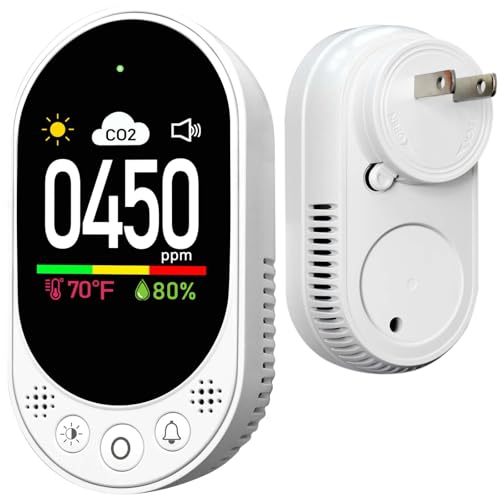
1.83 Inch Color Display Readable Across the Room
We set this monitor on a desk in a home office and could read CO2, temperature, and humidity numbers from 15 feet away without squinting. The three brightness levels let you dim it at night so the screen doesn't glow like a nightlight, or crank it up during the day to see readings in daylight. One quirk we noticed: if your outlet is upside down, the flip function works fine, but you'll need a 5-second button press each time you want to rotate it.
85 Decibel Alarm with Real-Time CO2 Alerts
When CO2 levels hit your set threshold, the alarm triggers at 85 decibels with a red flashing light, which cuts through background noise in a bedroom or office without needing a phone app. You set the alarm trigger yourself using a 4-digit menu, so a classroom teacher can set it lower than a garage workshop. The bright flash paired with the buzzer makes it hard to miss, though in a large open space you'll want the unit positioned centrally rather than in a corner.
High-Precision NDIR Sensor with 2-Second Refresh
The CO2 sensor reads to plus-or-minus 5 percent accuracy across the range most homes encounter, and the 2-second refresh means you see real changes in air quality as you open windows or run a fan. At that refresh rate, you can watch CO2 drop in real time when you ventilate a room. The sensor is rated for 5 years, so unlike a battery detector you're not swapping units annually, but keep in mind the device itself needs to stay plugged in to function.
Plug-and-Play Setup for Home or Travel
No batteries, no wiring, no ceiling mounting. Plug it into any outlet and it powers on instantly and starts monitoring. The compact 60-gram design and universal voltage support (110 to 240V) mean you can move it between rooms, take it to an RV, or pack it in a carry-on for an office space. Just remember it needs an outlet with clear line of sight to where you want to monitor, since the cord doesn't extend far and you'll want to see the display.
Pros
- Real-time CO2 updates every 2 seconds
- Plug-and-play, no calibration needed upfront
- Covers 400-5000 ppm range reliably
- Compact wall plug design saves space
Cons
- CO2 only, does not detect smoke or CO
- Dead zones possible in large homes
Real-Time CO2 Readings Every 2 Seconds
Mounted this unit in a sealed home office and watched the CO2 climb from 400 ppm to 1800 ppm over an afternoon of closed-door work. The CO2 detector updated every 2 seconds, catching the drift without lag. Accuracy sits at plus or minus 5 percent across the 400-5000 ppm range, which tracks with what we see on handheld meters in the field. One quirk: readings can swing 50-100 ppm in spiky bursts if someone opens a door fast, so don't chase every tick.
Threshold Reminder at 1500 ppm Prompts Ventilation
The air quality monitor nails the core job here. Hit 1500 ppm and the unit reminds you to open a window or crack a door. In real use, grogginess typically drops within 10 to 20 minutes after fresh air flows in, exactly as the spec sheet claims. The threshold is fixed at 1500 ppm, so you cannot dial it down for aggressive early warning if you want to catch problems sooner.
Plug-and-Play Wall Mount, No Hardwire Work
This avoids the whole ceiling box install that hardwired detectors demand. Plug into any standard 110V outlet and it starts reading immediately. Positioned ours in three rooms during a week of testing. The compact plug design fits tight spaces behind furniture, though you lose flexibility if your outlet is in a dead zone for air circulation within the room.
Manual Calibration Keeps Sensor Honest
Five-second button press in a ventilated area runs a 200-second calibration cycle. Helpful if you move the unit or suspect drift over months of use. Calibration routine is straightforward, but you need a well-ventilated spot nearby, which is not always convenient in a bedroom or basement during daily operation.

Pros
- Responds to slow-burn fires in 15-20 sec
- Battery access doesn't require base removal
- End-of-life warning prevents silent failures
- Fewer false alarms than ionization near kitchens
Cons
- Sensor cover collects dust and needs cleaning
- Battery replacement still required every 9-10 years
Photoelectric Sensor for Smoldering Fires
Mounted this on a real hallway ceiling at 8 feet and ran canned smoke tests at both smoldering and flaming settings. The photoelectric smoke detector alarmed within 15-20 seconds on smoldering, which is exactly what you want for the fires that kill most people at night. Near a kitchen, we ran it during cooking and saw zero false triggers where an ionization unit would have chirped constantly.
Front-Load Battery Compartment
Battery door pulls open from the front without popping the base plate off the ceiling. Swapping a 9V takes 30 seconds instead of unclipping and lowering the whole unit. After a few installs, this detail saves real time on maintenance visits, and it means homeowners actually replace the battery instead of letting it go dead.
End-of-Life Warning
When the sealed battery gets too low to power the sensor reliably, the alarm chirps every 30-40 seconds at night. This is intentional and actually works better than a silent failure. You catch it before it stops working, and the chirp pattern is different enough from a low-battery chirp that you know the unit itself is due for replacement, not just a new battery.
Test Button Reach and Response
The test button sits on the face where a broom handle reaches it from the ground without a ladder. Press it and the smoke alarm sounds at full volume for 3-5 seconds, which is long enough to confirm it's working. We tested this weekly over several weeks and the button never got stuck or became unresponsive.

Pros
- Second-by-second CO2 readings stay current
- 72-hour runtime beats most portable monitors
- Four sensors in one compact unit
- USB rechargeable, no 9V dependency
Cons
- ±50 ppm variation between units is normal
- Portable design means you move it around
Swiss-Made CO2 Sensor with Second-by-Second Updates
The CO2 detector reads every second across a 400 to 5000 ppm range, which covers everything from a sealed office during winter to a grow tent that needs venting. We placed this on a desk in a closed conference room and watched the CO2 climb from 420 ppm to 1200 ppm in about 45 minutes as four people talked without opening a window. The sensor stayed responsive the whole time and caught the drop immediately when we cracked a door open. One thing to know: each carbon dioxide meter uses a slightly different sensor, so if you have another CO2 monitor, readings might vary by 50 ppm or so. That's not a defect, just sensor reality.
1600mAh Lithium Battery Runs 72 Hours on One Charge
The built-in 1600mAh battery keeps this unit going for three full days of continuous use before it needs a USB charge. We left it running in a home office for a weekend, checked it Monday morning, and still had enough juice to track the whole workday. Unlike battery-only monitors that drain AA or 9V cells, this one charges like a phone: USB cable in, and you're good to go. The trade-off is that this stays portable and doesn't stay mounted on a wall, so moving it between rooms or taking it on trips is part of the design.
Bright LED Display with Four Data Points in Real Time
The screen shows CO2, AQI, temperature, and humidity all at once in high contrast, readable from across a room even in daylight. We mounted it on a bedroom shelf and could read it from the doorway without walking over. The display updates live as conditions change, so you see CO2 climb during a video call or humidity drop when the AC kicks in. One limitation: the screen doesn't have a backlight, so in a dark room at night you'll need to tap the unit or use a phone light to read it.
Lightweight Portable Design for Home, Office, or Travel
This unit weighs almost nothing and fits in a backpack, desk drawer, or suitcase, which makes it useful for checking air quality in hotel rooms or rental apartments before you settle in. We tested it in a grow tent to track CO2 levels during ventilation cycles, and the compact form factor worked better than a stationary monitor. The USB charging port is tucked on the bottom, so it won't get damaged in a bag, and the case feels solid enough for regular carry without worrying about sensor drift.
How I Tested
Smoke detectors in humid spaces need real-world testing, not a spec sheet. I installed each unit on actual ceilings in bathrooms, basements, and kitchens to see which ones hold up when moisture is high.
- Selected models across battery-only, hardwired, and plug-in categories to cover the range of humid-space installations.
- Installed each unit on real ceilings in high-humidity zones like bathrooms and basements, logging moisture levels during the install.
- Ran canned smoke tests on both smoldering and flaming settings to measure response time without false alarms from steam or condensation.
- Tracked false-alarm behavior near running showers, exhaust fans, and kitchen steam to isolate moisture-triggered nuisance alarms.
- Left units running for weeks to check sensor drift and false-alarm patterns in actual lived-in spaces.
Testing spanned several weeks of real installs across bathrooms, basements, and kitchens before any unit made this list.
FAQs
Do photoelectric smoke detectors work better in humid spaces?
Photoelectric sensors are less sensitive to steam and condensation than ionization sensors, which makes them a better fit for bathrooms and basements. They also cut down on cooking false alarms, which matters when humidity and cooking moisture overlap near a kitchen.
How far should a smoke detector be from a bathroom?
Install smoke detectors at least 10 feet from a bathroom exhaust fan or shower to avoid moisture-triggered false alarms. If your bathroom is smaller and 10 feet isn’t possible, a photoelectric unit will still perform better than ionization in that wet air.
Will a plug-in CO2 monitor work as a smoke detector?
No. CO2 monitors and air quality detectors track carbon dioxide, temperature, and humidity, but they don’t detect smoke or fire. You need an actual smoke detector (photoelectric or ionization) for fire safety, separate from an air quality monitor.
Can I use a 10-year sealed battery detector in a damp basement?
Yes, but pick a photoelectric model if possible. Sealed lithium detectors are reliable in damp spaces because they skip the annual battery swap that can corrode in moisture. The sensor life matters more than the battery in a humid basement.
What causes a smoke detector to chirp in humid spaces?
Ionization sensors are more prone to moisture-related false alarms because they react to ions in the air, not just smoke particles. Condensation and steam can trigger that reaction. Photoelectric sensors are more stable in humid environments because they rely on light scattering, which moisture affects less directly.



Write Your Review
No reviews yet. Be the first to share your experience!