

Try Amazon Prime free for 30 days
Fast free delivery on heavy items, plus Prime Video, Prime Music and member-only deal prices.
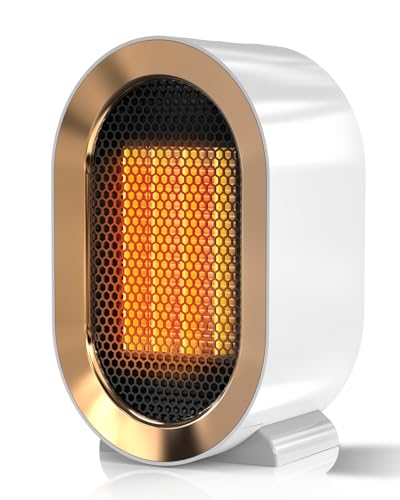
Stepping onto cold tile before coffee can make a normal morning feel like a tiny punishment. Small heaters for bathroom use solve that by adding quick, local heat where central heat often lags. After comparing 6 models, the QQT Ceramic Heater stands out with 1,200 watts, tip-over and overheat protection, and a 2-pound build. The Dreo Atom One is the alternative pick, with 1,500 watts and an adjustable thermostat.
Pros
- 1200W power with two heat settings, low and high
- 45 degree tip-over protection shuts off the heater if it falls
- Overheat protection stops airflow and shuts the unit down
- Quiet operation rated under 30 decibels for bedrooms or offices
- Compact and lightweight at 2 pounds with a hidden carry handle
Cons
- No thermostat or temperature display for precise climate control
- No oscillation or remote control, so coverage is limited to one spot
- Compact size points to a smaller heating area, not whole rooms
Pros
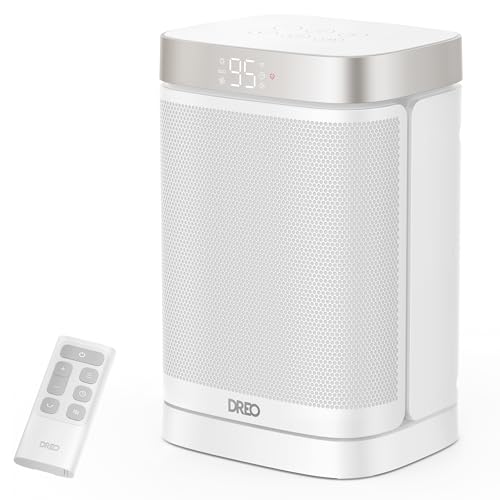
- 1500W PTC ceramic heater reaches desired temperature in seconds
- 70-degree wide-angle oscillation spreads heat across the room
- Digital thermostat adjustable from 41 to 95F in 1F increments
- ETL-listed with tip-over and overheat protection, UL94 V-0 materials
- Includes remote control and 12-hour timer, weighs 4.4 pounds
Cons
- No square footage or BTU rating given, likely best for small to medium rooms
- Not intended to replace whole-house heating, only supplemental warmth
- No stated noise level in dB, so quiet operation cannot be confirmed from data

Pros
- 500W ceramic coils heat quickly
- Compact 5.9 x 3.2 x 6 inch size
- Lightweight 1.43 lb design
- 48dB noise rating
- Tip-over protection shuts heater off
Cons
- 500W output is best for small spaces
- 48dB noise may be noticeable on a desk
- Safety features list tip-over protection only
Pros
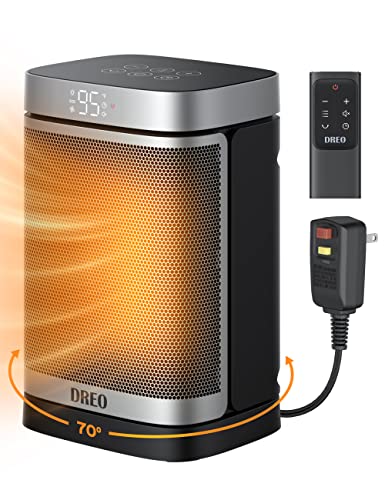
- ALCI safety plug allows safer use in bathrooms with water nearby
- 1500W PTC ceramic heating with 5 modes (900W, 1300W, 1500W, Eco, Fan Only)
- Quiet operation rated down to 36.5 dB for bedrooms or offices
- Tip-over and overheat protection with 24h auto shut off
- 70 degree oscillation and 1-12h timer for flexible heating
Cons
- Compact 10.3-inch size may not suit heating large open rooms
- No remote control mentioned, so settings must be adjusted by hand
- Cord length is not specified, which may limit placement options

Pros
- PTC ceramic heat for spaces up to 200 sq ft
- 2 heat modes, 1000W high and 700W Eco
- 40dB operation for low noise
- Auto shut-off at 45° tilt or overheating
- UL-certified for USA safety standards
Cons
- Best for personal spaces up to 200 sq ft
- 4 ft cord may limit placement
- No thermostat range listed

Pros
- 800W heater with 400W, 800W and ECO modes
- Heats spaces up to 100 sq ft
- 60°F to 90°F thermostat with ±1°F control
- Remote control and 12 hour timer
- ETL-certified with overheat protection
Cons
- Limited to small rooms up to 100 sq ft
- Wall-plug design depends on outlet location
- No tip-over protection listed
What Matters Most in Small Bathroom Heaters
A bathroom heater has a harder job than a desk heater. It has to warm a small room quickly, avoid crowded floor space, and make sense near outlets, towels, rugs and moisture.
- A safer design for bathroom use: Bathroom use calls for extra caution because the room combines moisture and tight clearances. Among our picks, only one listing specifically calls out an ALCI safety plug for bathroom use, while another uses a wall-plug design that keeps the heater off the floor. According to the U.S. Consumer Product Safety Commission, portable heaters should sit on a level, hard, nonflammable surface and stay at least 3 feet from flammable materials.
- Wattage for a small room: The QQT Ceramic Heater uses 1,200 watts, which is enough for quick personal warmth without stepping up to the highest wattage in this group. Its 2-pound weight also matters in a bathroom, where a unit may need to move from a vanity area to storage after a shower. Across the main list, the heat settings range from 500 watts to 1,500 watts.
- Tip-over and overheat protection: Tip-over protection is especially relevant in a room with bath mats, laundry baskets and narrow walkways. The BZGG Space Heater lists tip-over and overheat protection, plus a 1,000-watt high setting and a 700-watt low setting. Its listing also rates coverage up to 200 square feet, which is more than many bathrooms need but useful for a larger dressing area.
- Thermostat and timer: A thermostat helps avoid the cycle of turning a heater on too high, then shutting it off when the room gets stuffy. The Dreo Space Heater gives you 1,500 watts, a 900-watt low setting and a 12-hour timer. Its 70-degree oscillation can spread heat across a sink and shower zone rather than pointing at one cold corner.
- Size and outlet placement: Bathroom floor space is often measured in inches, not feet, so footprint and cord routing matter. The smallest main-list unit measures 5.9 by 3.2 by 6.0 inches, while a wall-plug pick removes cord clutter and uses a 180-degree rotating plug. Those numbers matter if the only outlet is near a vanity, a towel bar or a door swing.
We excluded central furnaces and whole-house systems because they need professional installation. We also excluded water heaters and heated blankets because they solve different problems, and unvented fuel heaters without an indoor rating because carbon monoxide is a serious indoor risk.
Other Bathroom Heaters Worth Considering
These are other bathroom heaters we looked at but did not put on our main list.
If you only need a very small burst of heat, Asnug Ceramic Heater keeps the power draw to 500 watts and includes tip-over and overheat protection. That is far below the 1,200 watts of our top pick, so it is better suited to very close personal warming than taking the edge off a chilly bathroom.
For a higher-output alternative, Garvee Ceramic Heater reaches 1,500 watts and includes a 750-watt low setting. It also lists an adjustable thermostat, tip-over protection and overheat protection, but the 45 dB noise figure is worth noting if you want a very quiet pre-shower routine.
Prefer more heat but still want a portable unit? Takywep Ceramic Heater also runs at 1,500 watts and has a 750-watt low setting, which gives it a wider heating range than our top pick. At 3.1 pounds, it is heavier than the 2-pound top pick, so it may be less convenient if you plan to move it in and out of the bathroom each day.
FAQs
What safety features matter most for a bathroom heater?
Look for automatic shut-off features, especially tip-over protection and overheat protection. The U.S. Consumer Product Safety Commission says an automatic cut-off is required to turn off electric or kerosene heaters if they tip over.
How much power is enough for a small bathroom?
Our picks range from 500 watts to 1,500 watts, with several models offering lower settings for milder mornings. A compact bathroom may not need the highest setting, but a 900-watt or 1,000-watt mode can be useful when you want warmth without running full power.
Where should a bathroom heater be placed?
Place it on a hard, level, nonflammable surface, not on a rug or bath mat. The U.S. Fire Administration says to keep anything that can burn at least 3 feet from space heaters and to turn them off when leaving the room or going to bed.
Is a wall-plug heater better for a tight bathroom?
A wall-plug design can help when floor space is limited, especially if it uses a rotating plug that adjusts up to 180 degrees. A corded heater can still work well, but you need enough clearance to keep the cord and heater away from wet areas and flammable materials.
Sources
- CPSC Offers Tips to Prevent Home Fires From Space Heaters, U.S. Consumer Product Safety Commission. Fire-safety tips and required safety features for space heaters.
- Heating Fire Safety, U.S. Fire Administration. Home heating fire statistics and prevention messages.
- Safety Guidelines: During & After a Winter Storm, Centers for Disease Control and Prevention. Winter heating safety for space heaters, kerosene heaters and carbon monoxide.




Write Your Review
No reviews yet. Be the first to share your experience!