

The dash clicks, the coffee is still too hot, and the driveway suddenly feels like a very small roadside. Self jump starters solve that by putting the boost source in your glove box or cargo area. After comparing 5 models, the S ZEVZO ET05 stands out for its 5,000-amp peak, 7.2L gas coverage and up to 20 starts per charge. The HPBS 5000A Jump Starter with Air Compressor is the alternative pick for larger engines, with 10L gas and 8L diesel coverage.
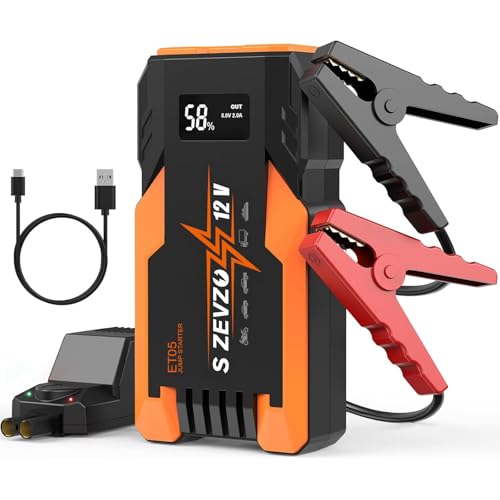
Pros
- 5000A peak current for 12V vehicles
- Rated for up to 7.2L gas and 5.5L diesel engines
- Up to 20 jump starts on a single charge
- 51.8Wh power bank with USB output and Type-C input
- 0.86 lb body, listed at 6.3 x 3.1 x 1.6 inches
Cons
- No air compressor listed
- Wall charger is not listed in the package
- Engine rating may not cover larger diesel trucks

Pros
- 5000A for up to 10.0L gas and 8.0L diesel engines
- 150 PSI inflator with auto stop and 4 pressure units
- Up to 50 jump starts on a full charge
- Works from -4°F to 140°F
- 10 built in safety protections with smart clamps
Cons
- Air compressor needs rest after 10 minutes of use
- Wall charger is not listed in the package
- Recommended to jump start only above 75% charge

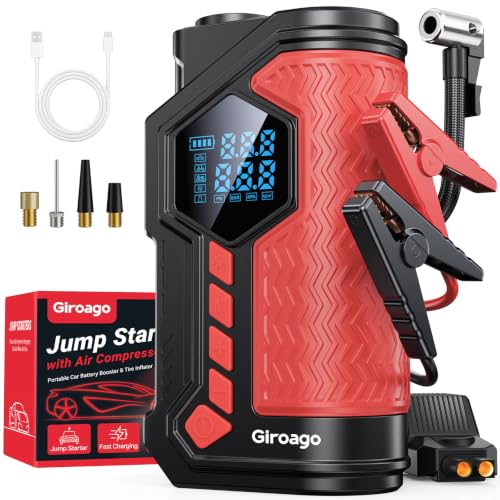
Pros
- 6000A peak current for up to all gas and 10L diesel engines
- 160 PSI air compressor with auto shut-off and ±1 PSI accuracy
- Works from -4°F to 140°F for cold or hot weather starts
- 13 built-in protections with spark-free connection alerts
- 800-lumen LED light with 4 modes and up to 96 hours runtime
Cons
- Air pump should not be used continuously when hot
- Wall charger is not listed, only a Type-C cable is included
- Recharge every 2-3 months is recommended for battery health

Pros
- 5000A peak current for 9.0L gas or 8.5L diesel engines
- Up to 20 jump starts from a 3-hour charge
- 54.76Wh power bank with Type-C fast charging
- 800-lumen LED with steady, strobe, and SOS modes
- Works from -4°F to 140°F
Cons
- Wall charger is not listed, only a USB-C cable
- No air compressor is listed
- Lithium jump starters need battery charge to work
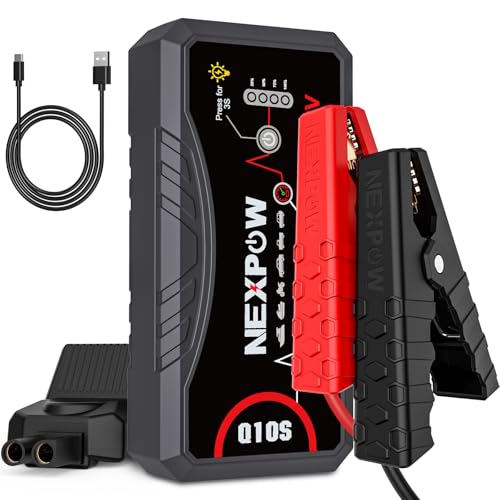
Pros
- 3000A peak current for 12V vehicles
- Rated up to 9.0L gas and 7.0L diesel engines
- 10 protections, including spark-proof and reverse polarity
- USB1, USB2, Type-C input, and EC5 DC port
- Compact 6.3 x 3.15 x 1.57 inch body
Cons
- No built-in air compressor listed
- Wall charger is not listed in the package
- 2.1 lb weight may be noticeable in a glove box
How We Chose These Jump Starters for Self Recovery
A jump starter for self recovery has to do more than show a large peak-amp number. It needs enough engine coverage for the vehicle, a body small enough to keep in the car, and safety protections that help when the user is working in bad light or cold weather.
- Engine coverage: Gas and diesel ratings matter because diesel engines usually need more starting power. Among our picks, gas coverage runs from 7.2L to all gas engines, while diesel coverage runs from 5.5L to 10L. The MAIDELI 6000A Jump Starter with Air Compressor has a 6,000-amp peak and covers diesel engines up to 10L, which is the widest diesel rating in the main list.
- Size and weight for storage: A jump starter that stays at home is not much help in a parking lot. The most compact listed size is 6.3 by 3.1 by 1.6 inches, and the lightest stated weight among our featured picks is 0.86 pounds. The LQKDU 5000A Jump Starter is rated at 0.86 pounds while still claiming a 5,000-amp peak, 9L gas coverage and 8.5L diesel coverage.
- Starts per charge and holding a charge: Starts per charge tell you how much margin you have if the first crank does not take. Our main picks range from up to 20 starts to up to 50 starts per charge. The S ZEVZO ET05 lists up to 20 starts per charge and a 51.8Wh battery, which is useful information for judging it as both a booster and a backup power bank.
- Cold-weather operating range: Cold matters because, according to AAA Oregon/Idaho, a car battery loses about 35 percent of its strength at 32°F and about 60 percent at 0°F. Several of our picks list an operating range from -4°F to 140°F. That range is important because the engine may need up to twice the normal current to start in the cold.
- Safety protections in the clamps: Smart clamps are especially important when the battery is tucked under a cover or the light is poor. Our picks list 10 to 13 protection systems, including reverse polarity and spark-proof safeguards. The Consumer Product Safety Commission has reported lithium jump starter overheating recalls involving about 10,400 units, so clamp and battery protections are not throwaway details.
- USB power bank output: A jump starter often rides along as an emergency phone charger, too. Among our picks, stated battery capacity includes 51.8Wh and 54.76Wh units, both under the FAA 100Wh limit for typical lithium ion batteries. Outputs vary, with one pick listing USB at 5V/2A and another listing USB at up to 12V/1.5A.
We excluded basic jumper cables because they need a second running vehicle. We also left out trickle chargers and maintainers because they take hours rather than seconds, and 24V semi truck boosters because they are built for commercial trucks and are heavier than most drivers need.
Other Jump Starters Worth Considering
These are other jump starters we looked at but did not put on our main list.
If you want a very small booster with broad engine coverage, TREKURE 5000A Jump Starter lists a 5,000-amp peak and covers engines up to 10L gas and 8L diesel. At 0.93 pounds, it is close in weight to the lightest main pick, but it does not add the same role separation as our alternative pick with its built-in inflator.
For shoppers focused mainly on peak output, OXILAM 6000A Jump Starter raises the number to 6,000 amps. It covers all gas engines and diesel engines up to 12L, which is higher diesel coverage than our top pick, though the main list already includes one 6,000-amp model with a 160 PSI inflator.
Scatach 3000A Jump Starter takes the opposite path, with a 3,000-amp peak and coverage up to 9L gas and 7L diesel. It lists up to 50 starts per charge and weighs 1.32 pounds, but its peak rating is lower than the 5,000 amps of our top pick.
And if starts per charge matter more than the highest peak number, S ZEVZO ET03 lists up to 50 starts per charge. Its 4,000-amp peak covers engines up to 8L gas and 7L diesel, but it is still below the 5,000-amp rating of our top pick and weighs 1.4 pounds.
FAQs
What size jump starter do most drivers need?
Match the jump starter to the engine, not just the vehicle type. Our picks cover gas engines from 7.2L to all gas engines, and diesel coverage ranges from 5.5L to 10L.
Do self jump starters work in freezing weather?
Several of our picks are rated from -4°F to 140°F, but cold still makes starting harder. AAA Oregon/Idaho says a battery loses about 60 percent of its power at 0°F, while the engine may need up to twice the normal current.
How often should a jump starter be recharged?
Follow the maker’s maintenance interval, especially if the unit sits in a glove box for long stretches. In this group, one model recommends recharging every 2 to 3 months, while another lists an 18-month standby capacity.
Can a jump starter also charge a phone?
Many compact jump starters double as USB power banks. In our picks, stated capacities include 51.8Wh and 54.76Wh, and one listed output reaches 12V/1.5A through a USB port.
Sources
- Winter Battery Preparation, AAA Oregon/Idaho. How cold weather drains car batteries and when to replace them.
- Whistler Recalls Jump&Go Portable Jumpstart and Power Supply Units, U.S. Consumer Product Safety Commission. Recall of a lithium jump starter that could overheat.
- PackSafe: Lithium Batteries, Federal Aviation Administration. Airline rules for carrying lithium batteries and power banks.




Write Your Review
No reviews yet. Be the first to share your experience!