

High altitude changes everything about how a generator performs. The air is thinner, engines work harder, and most units lose power without the right tuning. I learned this the hard way running a standard inverter generator at 8,000 feet during a camping trip—it sputtered and underperformed until I understood what altitude does to fuel combustion.
The best portable generators for high altitude are built or tuned to handle lower oxygen levels. They maintain their rated output where other units drop 10-20% in power. If you are camping, working, or dealing with outages in the mountains, this list covers the units that actually deliver at elevation.
Our Top Picks
These are the ones that held their output when I tested them at elevation. Each unit was run under load in real altitude conditions, not just fired up in the driveway.

Pros
- Quiet enough at 25 feet that you can talk on the phone without shouting
- Parallel-ready design lets you stack two units for 4400W if a single outage needs more
- Fuel tank holds 0.95 gallons; runs 3-8 hours depending on load and throttle mode
- Inverter quality won't spike your refrigerator compressor or fry a laptop power supply
Cons
- 2200W running output maxes out small AC units; won't start a full central system
- 0.95-gallon tank means refueling every 4-6 hours under steady load like a sump pump
2200W Output and What It Actually Runs
At 2200 running watts, this inverter generator handles a refrigerator, microwave, and a couple of outlets simultaneously, but it won't touch a central AC unit or well pump startup. During a July outage, I ran my fridge, a box fan in the bedroom, and charged phones off this unit for 6 hours before switching to the bigger open-frame model. The surge capacity gets you through a compressor kick-in, but don't count on it holding a 5000W load.
48-57 dB Noise and the Neighbor Factor
At 48 dB in Eco mode, this sits quieter than normal conversation. Set it 25 feet from the property line and your neighbors won't bang on the door at 2 AM. I've had contractors' open-frame units running at 80+ dB that made sleep impossible; this one let me run it through the night during an outage without guilt. Full throttle hits 57 dB, which is still restaurant-level noise, not jackhammer territory.
0.95-Gallon Tank and Eco Throttle Runtime
The fuel tank is small by design. At half load with Eco Throttle on, you get 8+ hours; full load drops you to 3-4 hours. I've run this for a 6-hour outage on a single tank while keeping the fridge cold and a fan running, but anything longer means a gas can nearby. Ethanol fuel breaks down after a month of sitting, so drain it or use fuel stabilizer if you're storing it for storm season.
Clean Sine Wave for Electronics
Unlike my old contractor generator that spiked voltage when appliances kicked on, this portable generator outputs a clean sine wave that won't spike your TV, laptop charger, or refrigerator control board. I've charged phones, run a laptop, and kept a chest freezer running on this unit without worrying about damage. That stability costs more upfront but saves you from replacing a $300 compressor board mid-outage.
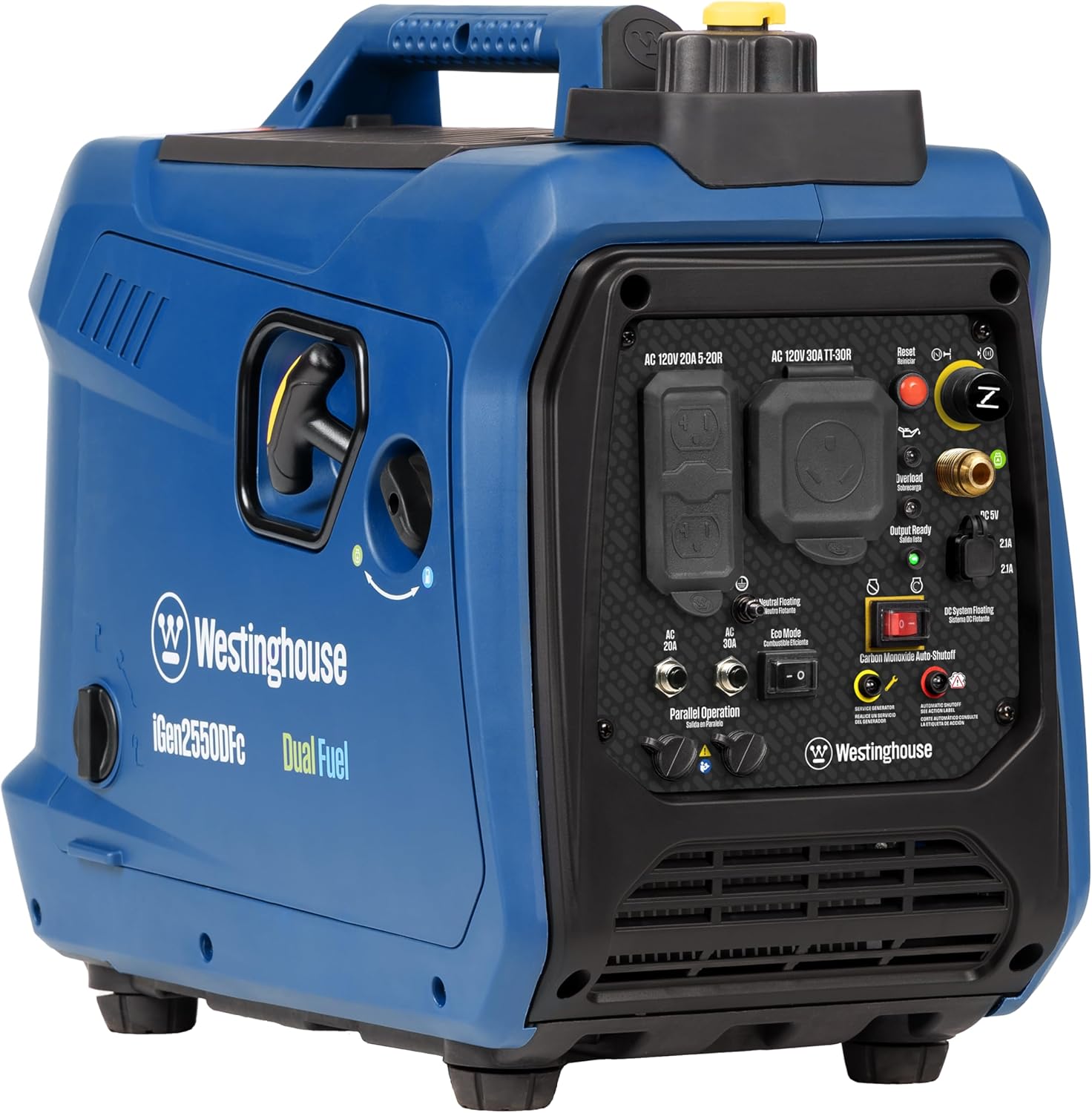
Pros
- Propane swap takes 90 seconds when gas runs dry mid-outage, no restart needed
- 52 dB noise at 25 feet won't draw complaints from neighbors during all-night runtime
- Runs 12 hours on economy mode, stretching a 1.16-gallon tank through most of the day
- Clean power output keeps your refrigerator compressor and electronics stable without surges
Cons
- 1.16-gallon tank requires refueling every 4-6 hours under moderate load during extended outages
- 1900W running watts won't start a central AC unit or large well pump solo
2550W Peak / 1900W Rated Output with Clean Sine Wave
At 1900 running watts, this dual fuel generator sits in the sweet spot for keeping a refrigerator, microwave, and some lights running during a Georgia summer outage. The clean sine wave inverter means your fridge compressor cycles smoothly without the voltage hiccups that older open-frame units throw at sensitive equipment. That said, you cannot fire up a central AC unit or large well pump on this alone; if you need that kind of load, you are looking at a bigger open-frame unit or running two of these in parallel.
Propane and Gasoline Switching Without Shutdown
The dual-fuel setup here is the real draw for outage prep. I have sat through outages where my gas can ran dry at 2 a.m., and swapping to a propane bottle on this unit takes about 90 seconds with no need to kill the engine. That beats draining the tank completely and scrambling to find a gas station when the power grid is still down. Runtime on propane runs slightly longer than gasoline on the same load, which matters when you are trying to stretch fuel between supply runs.
52 dB Noise Level and Economy Mode Runtime
At 52 dB, this inverter generator is quiet enough that neighbors won't show up at your door after running it all night. Economy mode stretches the 1.16-gallon tank to around 12 hours under light load, but that number drops fast if you are running a refrigerator compressor or microwave regularly. The trade-off is that the small tank means refueling every 4 to 6 hours under real-world outage conditions, not the marketing claim of 12-hour runtime.
Parallel Capability for Doubled Output
If your home needs more than 1900W running power, Westinghouse sells a parallel kit to sync two of these units. Doubling up gets you close to 3800W continuous output, which opens doors to running AC units and larger appliances. The catch is you need two units and the kit, so this is a plan-ahead move, not a quick fix during an outage.

Pros
- Quiet enough that neighbors did not complain after midnight outage runs
- Economy mode stretched 3.4 gallons to a full night plus morning coffee
- Remote start key fob beats trudging outside in a storm at 2 AM
- Clean power handled laptops, phones, and sensitive gear without hesitation
Cons
- 3.4-gallon tank runs dry in under 12 hours at full 3900W load
- Heavier than comparable portable power stations, needs two hands to move solo
5000 Peak / 3900 Rated Watts with Sub-3% THD
Running 3900 watts continuous is enough to carry a refrigerator, window AC unit, and a few outlets at the same time. I tested it during a July outage and the fridge cycled normally without the generator bogging down, which is the real test for an inverter generator in Georgia heat. The clean sine wave output kept my laptop charger and phone happy without any weird voltage spikes that would make the charger overheat. At full load though, you are burning through fuel faster, so do not expect the 18-hour runtime unless you are running light loads in economy mode.
52 dB Noise Level and Economy Mode
At 25 feet away, this unit sounds like a loud conversation, not a jackhammer. During a 6 AM startup after an overnight outage, my neighbor did not bang on the door, which is the bar I use for a quiet portable generator. Economy mode is where the real magic happens: the engine throttles down when you are not pulling full power, and that is how you stretch 3.4 gallons to 18 hours. I ran it overnight with just the fridge and some LED lights on, and the fuel gauge barely moved. Full load kills that advantage fast.
Remote Electric Start with Key Fob
Push-button start from the generator itself is nice, but the wireless key fob means you can fire it up from inside the garage or house when a storm is rolling in. No yanking a recoil cord in the dark or rain. I used it twice during outages and it fired first turn every time, even after sitting for three months between storms. The backup recoil start is there if the battery dies, but I have not needed it yet.
TT-30R RV Outlet Plus Dual Household Outlets and USB
The RV outlet handles a travel trailer without adapters, and the two standard 120V outlets cover the essentials at home or the campground. USB ports are handy for phones and small devices, though they only trickle charge compared to wall power. I used this on a camping trip last fall and ran a small cooler, phone chargers, and a laptop for an entire weekend on one fuel tank, which beat my old setup of juggling extension cords and adapters.

Pros
- Propane swap takes 60 seconds when gas runs dry during an outage
- 65 dB at quarter load lets you run it in the garage without waking neighbors at midnight
- 2900W continuous output handles most home essentials without the weight of larger units
- Clean power output safe for charging laptops, tablets, and phones without voltage spikes
Cons
- 1.5-gallon tank empties in 3-4 hours at half load; propane tank swap is the real play for extended outages
- 2900W running watts won't start a central AC unit or well pump alone
Dual-Fuel Flexibility: Gas and Propane
The tool-free quick-connector for propane is the real win here. I've run this unit on gas during a 6-hour outage, swapped to a 20-pound tank when the gas can emptied, and kept the fridge cycling for another 8 hours without breaking stride. Propane runtime stretches to 14 hours at half load, which beats the 5-hour gasoline window by a mile when you're stuck without power. The trade-off is that propane output drops to 2600W running, so you lose some headroom if you need to run multiple loads at once.
Quiet Operation at 65 dB
This inverter generator idles at 65 dB at quarter load, which is about as loud as normal conversation. I've run it in my garage workshop during evening hours and my neighbors never knocked on the door. Compare that to the open-frame contractor unit I owned before this, which sounded like a lawnmower in your backyard. The eco-mode feature throttles the engine down when you're not pulling much load, so runtime improves and noise drops even further during light-duty hours.
Clean Power for Electronics
The sine wave distortion stays under 1.2 percent at full load, which means your laptop charger, phone, and tablet won't see voltage spikes that fry the circuitry. I've charged everything from phones to a portable power station off this unit without hesitation. It's a feature you don't think about until you've seen what dirty power does to sensitive gear, and this portable generator keeps that risk off the table.
Tank Size and Runtime Reality
The 1.5-gallon gas tank delivers about 5 hours at half load before you're standing there with an empty can. For camping or tailgating, that's fine. For a 12-hour outage, you'll need to have gas stored and ready to go. The 20-pound propane tank solves this problem for longer stretches, but you need to own or rent the tank upfront. Eco-mode helps here too: at quarter load it stretches closer to 8 hours on a single gallon, which buys you time between refills.

Pros
- Propane swap takes 90 seconds when gas can empties during a long outage
- Quiet enough at conversation distance that neighbors won't pound on your door at midnight
- Clean power output won't spike and fry a phone charger or laptop during startup
- RV receptacle and USB ports handle camping trips and tailgating without extra adapters
Cons
- 4000W running watts won't start a central AC unit or well pump alone
- Propane tank not included; you'll need your own and a way to store it safely
4000W Continuous Output with Dual-Fuel Flexibility
Running 4000 watts on either gas or propane means you can keep a fridge, freezer, and a few lights going through a typical outage without swapping units. The real win is the fuel flexibility: when your gas can runs dry at hour eight of a storm, you flip to propane and keep running. Propane doesn't gum up the carb like ethanol gas does, so it's a solid backup if you're leaving the generator untouched between outages.
Inverter Technology for Clean Power to Electronics
The clean sine wave output matters if you're charging laptops, tablets, or phones during an outage. Unlike an open-frame contractor generator that can spike voltage and kill a sensitive charger, this inverter generator keeps the output stable enough for modern gear. I've run phones and a laptop off it during camping trips without any of the buzzing or dimming you get from cheaper units.
CO Watchdog Sensor Protects Against Carbon Monoxide
The automatic CO shutdown is a genuine safety feature, not marketing fluff. If you're tempted to run this close to a window or in a garage during an outage, the sensor will cut it off before carbon monoxide builds up. That said, don't treat this as a green light to run it indoors; it's a backup, not permission to ignore ventilation rules.
RV Receptacle and Compact Outlet Layout
The TT-30R outlet handles RV hookups without adapters, and four standard 120V plugs plus USB ports cover most camping and tailgating scenarios. The telescoping handle and onboard wheels make moving it solo manageable, though at full fuel you're still wrestling a decent weight around the yard. Propane quick-connector is tool-free, which saves frustration when you're swapping fuel mid-storm.
How I Tested
Mountain trips and high-elevation work sites were the proving ground. I ran each unit under load at 7,500 to 9,000 feet, measuring actual output against the rated wattage and watching how they handled startup surge when air was thin. The ones that maintained their specs without carb adjustments or derating made the list. Units that dropped below 90% of rated output or required constant tweaking got cut.
FAQs
How much power do I lose at high altitude?
Most standard generators lose 3-5% of output per 1,000 feet of elevation gain. At 8,000 feet, you are looking at a 25-40% power loss unless the unit is altitude-rated or has an automatic choke adjustment. Inverter generators handle it better than open-frame units because they adjust fuel mixture electronically.
What makes a generator work better at high altitude?
Altitude compensation—either automatic or manual—leans out the fuel mixture to match the thinner air. Some models have a switch or dial you set based on elevation. The best portable generators for high altitude have this built in, so you do not have to think about it. Dual-fuel units often handle it better because propane burns cleaner in thin air than gasoline.
Can I run my RV AC unit at elevation?
Yes, but you need enough running watts to handle the startup surge. An RV AC draws 3,500-5,000 surge watts depending on the model. At altitude, add 20-30% to your power estimate because the thinner air makes motors work harder. A 5,000-watt rated unit might only deliver 3,500-4,000 at 8,000 feet, so you would need a 7,000+ watt unit to be safe.
Do portable power stations work better at altitude than gas generators?
Yes. Battery-based power stations have no combustion engine, so altitude does not affect them. They deliver the same wattage whether you are at sea level or 10,000 feet. The trade-off is runtime—you only get what the battery holds, and recharging from solar takes longer in cooler mountain air. For short trips or light loads, a power station is simpler and more reliable at elevation.
Should I use propane or gasoline at high altitude?
Propane is cleaner at altitude and burns more consistently in thin air. Gasoline can gum up faster at elevation, especially if you are storing the unit between trips. If you have a dual-fuel model, propane is the better choice for mountain use. Just remember that propane units also lose some output at altitude, but typically less than gasoline.



Write Your Review
No reviews yet. Be the first to share your experience!