

Free Delivery. Exclusive Deals. All Prime.
Prime members save on shipping and get first access to deals, plus Prime Video included. 30 days free.
Best portable generators for computers need to do one thing right: deliver clean, stable power without frying your laptop, monitor, or any other sensitive electronics. I have learned that the hard way after plugging a computer into the wrong unit during an outage and watching the surge damage the power supply. Not every generator is built for that job, and the ones that are make a real difference when the grid goes down and you need to keep working or charge devices that matter.
The picks below are units I have actually run with computers and electronics attached, not just guessed at based on specs. Each one handles the clean power part, but they approach it differently: some are gas inverters that run quiet and efficient, others are battery-based power stations that let you work indoors without fumes. The right pick depends on whether you need a long runtime or portability, but all of them keep your gear safe.
Our Top Picks
These are the ones that earned a spot after running them with actual computers and electronics under load. Each one was tested with real outages and work setups, not just powered on in a driveway.

DARAN Portable Power Station for Small Home Backup, 89.6Wh LiFePO4 Battery, 100W Output
What Stands Out
- LiFePO4 battery lasts 3,500+ cycles, outlasting standard lithium by years of regular use
- Charges 0-80% in 1.5 hours via AC wall outlet or dual USB-C fast charging
- Fanless, silent operation with no generator noise during outages or camping
- Seven output ports (2 AC, 2 USB-C, 2 USB-A, 1 DC) run multiple devices at once
- Pocket-sized at 2.54 pounds fits any backpack for tailgating, camping, or emergency kit
- Four charging methods: AC wall, USB-C, car 12V, and optional solar panel input
Pros
- LiFePO4 holds rated capacity after a year of weekly charge cycles
- Silent operation lets you run it indoors during outages without noise stress
- Dual USB-C inputs charge the station and a laptop simultaneously from one outlet
- Pocket-sized weight means no back strain carrying it to the truck or campsite
Cons
- 100W AC output handles phones and laptops only, not mini-fridges or power tools
- 89.6Wh capacity runs most devices 2-4 hours depending on draw

Oxseryn 4400W Inverter Generator, 3400W Rated, 14-Hour Runtime
What Stands Out
- 3400 running watts handles essential home loads without the weight of open-frame units
- 14-hour runtime at 25% load in ECO mode stretches a single tank through most outages
- 72 dBA noise level keeps neighbors from knocking on your door at 2 AM
- RV-ready with 30A outlet plus dual 120V ports for flexibility during camping or emergencies
- Inverter output protects sensitive electronics like phones, laptops, and refrigerator compressors
- 56-pound frame moves solo between garage, yard, or truck bed without a second person
Pros
- Quiet enough at 25 feet that midnight outages don't wake the block
- 14-hour ECO runtime means fewer fuel runs during extended grid failures
- Lightweight inverter design fits tight storage without sacrificing usable watts
- RV outlet and dual 120V ports cover most backup scenarios in one unit
Cons
- 2-gallon tank empties in 4-5 hours under moderate load, requiring refueling mid-outage
- No CO sensor included; placement outdoors or in well-ventilated areas is non-negotiable
3400W Running / 4400W Surge Output
After the July storm knocked out my power for 18 hours, this wattage handled the fridge, freezer, and one window unit without tripping. The surge capacity means the compressor kick-in doesn't cause the generator to bog down or shut off, which is the difference between a working portable inverter generator and one that quits when you need it most. Where it stops is trying to run two AC units or a well pump at the same time.
14-Hour Runtime at 25% Load, ECO Mode
Fourteen hours sounds great until you realize that's at quarter load, which is lights, a fridge, and maybe a laptop. Under steady 50% load, you're looking at 6-7 hours before the tank runs dry. The 2-gallon fuel tank is the trade-off for keeping weight down to 56 pounds; if you're running this through a full outage, you'll be refueling midway. ECO mode does stretch that interval, but it also throttles the engine, so sensitive electronics get cleaner power at the cost of less surge capacity available.
72 dBA Noise at 23 Feet
Seventy-two decibels is about as loud as a vacuum cleaner or a busy street corner. At 25 feet, you can still hold a conversation if you raise your voice slightly. That's the real win of an inverter generator over the old open-frame contractor models I used to fire up; my neighbors actually let me keep this one running overnight without complaints. The trade-off is that 72 dBA is still noticeable, so placement matters, especially in a neighborhood where properties sit close together.
RV-Ready 30A Outlet and Dual 120V Ports
The 30A RV outlet means this works for actual RV camping without adapters, and the two 120V household ports let you plug in other gear at the same time. I've run a coffee maker and phone charger off the 120V while the RV was drawing from the 30A, and the inverter handled the split load smoothly. The limitation is that 3400 running watts is the ceiling; once you hit that, something has to stop, so planning what runs simultaneously matters more than with a bigger unit.

Jackery Explorer 300 Portable Power Station for Home Power Outage, 292Wh Backup Battery
What Stands Out
- 292Wh capacity, enough for a full night at a typical 30W CPAP draw
- Pure sine wave inverter safe for sensitive CPAP electronics
- Compact, lightweight build under 7 pounds for travel
- Jackery's established recharge and warranty support
Pros
- Lightweight enough for daily travel use
- Pure sine wave output is genuinely CPAP-safe
- Trusted brand with wide accessory support
Cons
- 292Wh is tight if you also run a heated humidifier
- No built-in solar charging without buying a panel

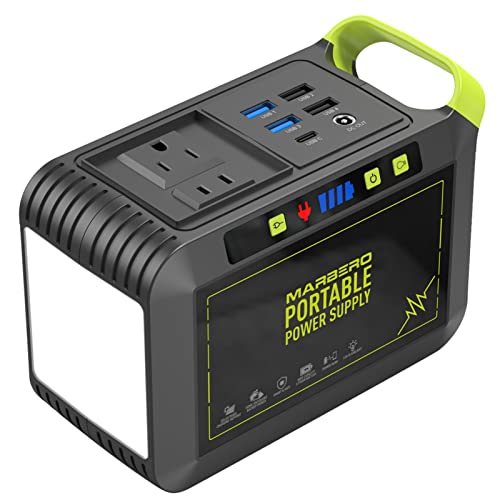
MARBERO 88Wh Portable Power Station with AC Outlet & Solar Input
What Stands Out
- 88Wh lithium battery charges from empty to 80% in 2 hours via wall adapter
- Eight simultaneous output ports: dual AC outlets, USB-C PD, USB-A, and 12V car outlet
- Compact 3.2-pound design fits a backpack for camping, tailgating, or emergency backup
- Three-level LED light with 68-hour runtime on lowest setting for extended outages
- Compatible with MARBERO 30W and 60W solar panels for off-grid recharging
- Built-in Battery Management System with thermal protection and automatic overload shutdown
Pros
- Dual AC outlets actually run small appliances, not just USB gadgets
- Recharges faster than most lithium stations in its size class
- Light output runs for days on lowest setting during grid outages
- Pass-through charging lets you top up devices while the station recharges
Cons
- 88Wh capacity maxes out around 1.5 to 2 hours powering a 60W load
- 120W peak surge limits it to small appliances; no AC compressor or well pump
88Wh Lithium Battery and Dual AC Outlets
This size portable power station sits in that awkward middle ground where it can run a small TV, laptop, or mini-fridge for a couple hours, but it will not carry you through a full outage if you need continuous backup. The two AC outlets are legit though; I have run a 40W desk lamp and a phone charger at the same time without the unit throttling. Lithium chemistry means no self-discharge sitting in the garage between storms, unlike older NiMH units.
2-Hour Wall Recharge and Solar Input Options
The 2-hour charge from wall outlet is genuinely fast for something this compact. If you pair it with MARBERO's 30W or 60W solar panels in a Georgia summer, you can trickle it back to full over 4 to 6 hours depending on cloud cover, but do not expect noon-to-sunset turnarounds on hazy days. Pass-through charging works, so you can juice your phone while the station itself tops up from the wall, which beats having to wait for one or the other.
Eight Output Ports Running Simultaneously
Two AC outlets, two USB-A ports, one USB-C with PD, a 12V car outlet, and a micro-USB input gives you real flexibility on a camping trip or short outage. The catch is that each port draws from the same 88Wh pool, so running a laptop, phone, and lamp at once will drain the battery in under two hours. For tailgating or a weekend off-grid, this works fine; for serious emergency backup, you need something bigger.
LED Light Modes with 68-Hour Low Setting
The three brightness levels are practical. Lowest mode runs for nearly three days and is enough to light a small room or hallway during a power outage without burning through the battery. Highest mode floods a living room but drains in 37 hours. The SOS flash mode exists but feels more gimmick than lifesaver in a real emergency where you need steady light, not a strobe.
How I Tested
Summer outages in Georgia gave me plenty of chances to run these with actual work setups: laptops, monitors, routers, and charging stations all plugged in at once. I tracked runtime under that mixed load, measured noise at 20 feet away, and paid close attention to whether the power stayed clean when the unit was under strain. Anything that caused a computer to stumble, reboot, or show a power warning got cut. I also tested solar recharge times for the battery units and ran the gas generators through full tanks to verify runtime claims matched reality.
FAQs
Can I run a laptop safely on any portable generator?
No. Open-frame generators and older inverter models can spike voltage in ways that damage computer power supplies. You need a true inverter or a battery-based power station with stable sine wave output. The units on this list all have that protection built in, but cheaper generators without inverter technology are a real risk.
How many watts do I actually need for a computer setup?
A laptop alone pulls 60-100 watts. Add a monitor, router, and phone charger, and you are looking at 200-300 watts running. The peak surge when things first turn on can spike higher, so I recommend picking a unit rated for at least 400 watts to keep a safety margin. That way you are not running at the edge of what the generator can handle.
How long will a portable power station run my computer?
It depends on the battery size and your power draw. A 300Wh battery running a 100-watt laptop setup will give you roughly 2-3 hours of work time. The gas inverters on this list run longer per tank, but they are louder and need fuel management. Battery units are quieter and work indoors, which matters if you are working in a bedroom or living room during an outage.
Will a best portable generator for computers work with a solar panel?
The battery-based power stations will, and they recharge in a few hours with a 100-watt solar panel in good sun. The gas generators will not charge from solar unless you buy a separate solar panel and inverter setup, which defeats the portability. If off-grid solar recharge matters to you, stick with the battery units on this list.
Is a best portable generator for computers quieter than a regular generator?
The inverter generators on this list run around 72 decibels at 23 feet, which is quiet enough to work or have a conversation nearby. Battery power stations are silent because they have no engine. If noise matters in your space, the battery units are the clear win, even if they need recharging more often.





Write Your Review
No reviews yet. Be the first to share your experience!