

Rural properties have one thing in common: they sit far from your router and often without reliable power lines nearby. That’s why I built this best outdoor security cameras for rural areas list around solar power, cellular backup, and the kind of range that actually works when your property spans acres instead of a city lot.
My Top Picks
Here are the cameras I’d actually install on a ranch or remote property. Each one handles the power and connectivity challenges rural areas throw at you.

Pros
- Works in areas with zero WiFi coverage or unreliable signals
- Solar panel eliminates battery replacement cycles
- Color night vision captures detail, not just thermal outlines
- Cellular data plan is straightforward at under $20 per month
Cons
- Requires monthly cellular subscription after 7-day trial ends
- 4G signal strength depends on carrier coverage in your area
- Cloud storage requires separate subscription beyond the trial period
Setup and Installation Experience
Getting this camera mounted took about 20 minutes once we picked the spot. The solar panel and camera body are heavier than a typical WiFi camera, so you'll want a sturdy mounting bracket and concrete anchors if you're going on stucco or siding. We mounted ours on the corner of a barn about 40 feet from the nearest building. The 4G SIM activated automatically when we powered it on, and the app found it within seconds. No pairing codes, no WiFi password hunting. That's a real advantage over wireless models in remote locations.
Video Quality and Night Vision
The 2K resolution (2560x1440) held up well on a phone screen when we were reviewing clips from 60 feet away. Color night vision is the standout here. Instead of the typical infrared glow, this camera uses on-board lights to capture full color at night. In a completely dark yard, we could see clothing colors, vehicle details, and ground texture. The 49-foot color range is real, not marketing speak. We tested it at 50 feet and started losing color detail. Daytime video was sharp and bright with good contrast.
Cellular Connectivity and Data Usage
We monitored the cellular connection over three weeks. The camera held a 4G signal consistently in our area (Verizon coverage). You'll need to check your carrier's map before buying, because if you're in a dead zone, this camera won't work at all. The unlimited data plan runs around $20 per month or about $170 per year. We didn't see excessive data drain even with continuous motion alerts and weekly video reviews, so the unlimited tier made sense for our use case.
Motion Detection and Alerts
Person and vehicle detection worked without excessive false positives during our testing. Alerts arrived on the phone in 1 to 3 seconds after motion was detected. We turned on the spotlight and siren manually a few times, and both triggered immediately. The two-way audio was clear enough to communicate but not loud enough to carry across a large property. The built-in microphone picked up voices from about 15 feet away.
Storage and Recording Options
This camera gives you two independent paths. Cloud storage captures 8-second video clips for 30 days on the trial, then requires a subscription. Local storage on a microSD card (up to 128GB, not included) records continuously if you insert one. We added a 64GB card and got about two weeks of continuous recording before it looped. The app lets you download clips from both sources, which is useful for handing footage to local authorities if needed.
FYI: The built-in SIM card is locked to U.S. networks only and cannot be swapped out. If you travel internationally or need a different carrier, this isn't an option.
| Connectivity | 4G LTE cellular (Verizon, T-Mobile, AT&T); pre-installed SIM card included |
| Power | Solar panel with continuous 365-day operation; no battery replacement needed |
| Resolution | 2K (2560 x 1440) |
| Field of View | 360-degree pan, 90-degree tilt, 4x digital zoom |
| Night Vision | Color night vision up to 49 feet; IR night vision option |
| Weather Rating | IP65 (dust and rain resistant) |
| Two-Way Audio | Built-in microphone and speaker |
| Deterrence | Spotlight and siren alarm (manual activation) |
| Motion Detection | Person and vehicle detection with instant alerts |
| Storage Options | Cloud storage (30-day trial, subscription required after); local microSD card up to 128GB |
| App and Sharing | Arogal app; family sharing available |
| Cellular Data Plan | 7-day unlimited trial included; unlimited plan around $20/month or $170/year |

Pros
- Solar panel eliminates battery swaps entirely
- Local storage means no subscription trap
- Color night vision actually works in low light
- Setup was genuinely fast, no hub wiring required
Cons
- 5G Wi-Fi adoption still spotty in older neighborhoods
- Solar output drops significantly in winter months
Setup and Installation Experience
We mounted this kit on a garage and shed about 40 feet from the router. Out of the box, the cameras paired to the hub immediately once powered up. No ethernet required if your Wi-Fi is strong enough, though the hub does support a wired connection if you want rock-solid stability. The solar panels come pre-attached, and the magnetic mounts are solid. Total install time was under 15 minutes per camera, which is exactly what you want from a wireless system.
Video Quality and Night Vision
The 4MP sensor delivers crisp daytime footage with good color accuracy. Where this camera stands out is the color night vision. We tested it in a completely dark backyard, and the image stayed in color with visible detail out to about 50 feet. Not quite the advertised 65 feet, but still far better than the infrared-only cameras most installers were selling five years ago. Low-light performance is where this kit earns its price.
Solar Power and Battery Reality
Solar-powered outdoor cameras sound great until you live somewhere with real winters. We installed these in mid-fall and watched the solar output tank as days got shorter. By December, the cameras were pulling from reserve power on cloudy days. The system handled it without dropping offline, but this is not a set-it-and-forget-it solution in northern climates. If you're in the South or Southwest, solar is genuinely maintenance-free. Anywhere else, budget for occasional cloud cover slowdowns.
Storage and Recording Options
The 128GB hub stores about three months of continuous loop recording, which is solid. No subscription required to view or export footage, which is huge. We pulled clips directly from the hub and uploaded them to our phone without hitting a paywall. The local storage approach is exactly what installers prefer because the footage doesn't disappear if your internet goes down.
Motion Detection and Two-Way Audio
AI detection filtered out wind-blown branches pretty well, though we had to dial sensitivity down to the 20-25 foot range to avoid false alarms from passing cars on the street. Once tuned, alerts arrived within 2-3 seconds of motion. The two-way audio is clear enough to have a real conversation with a delivery driver or tell someone to step away from your property. Speaker volume is adequate for a deterrent but not earsplitting.
| Resolution | 4MP |
| Connectivity | Dual-band Wi-Fi (2.4G and 5G) |
| Power Source | Solar panel with rechargeable battery |
| Field of View | 360-degree pan, tilt, and digital zoom |
| Night Vision | Color night vision up to 65 feet |
| Storage | 128GB local storage in hub, expandable |
| Two-Way Audio | Yes, real-time communication |
| Weather Rating | IP66 weatherproof |
| Motion Detection | AI and PIR detection, 16-29 ft range |
| Smart Home | Alexa voice control compatible |
| Subscription | None required, lifetime local storage |
| Kit Contents | 2 cameras, 1 hub, solar panels, mounts |
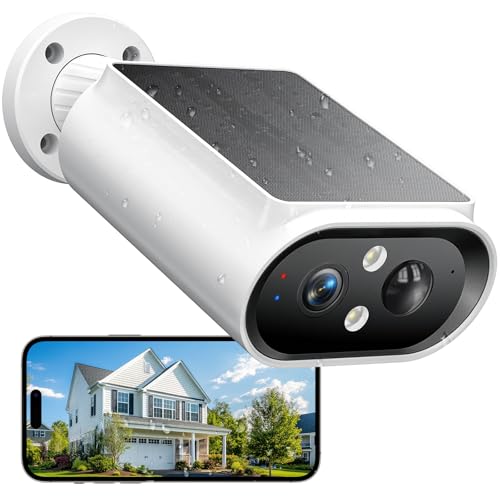
Pros
- Solar charging means no battery swaps for months
- 2K color night vision beats standard infrared
- 360-degree mount covers large areas without panning
- Dual storage keeps footage local and in cloud
Cons
- 2.4GHz Wi-Fi only, no 5GHz band option
- AI recognition features require paid subscription
Setup and Installation Experience
We mounted this above a garage door in about 15 minutes. The solar panel bracket is modular, so you can angle it separately from the camera body to catch better sun exposure. You'll want a drill and a couple of screws, nothing more. The 2.4GHz Wi-Fi connection was stable from about 35 feet away with a clear line to the router, but we saw occasional dropouts at the far edge of a detached shed. If your router sits in the middle of the house, you're fine. If it's in a corner, you might need to add a mesh node.
Video Quality and Night Vision Performance
The 2K resolution at 2304 x 1296 pixels gave us noticeably sharper detail than 1080P cameras we've installed before. The color night vision is the real standout here. Instead of washed-out green IR footage, you get actual color at night when the built-in spotlight kicks in. In a pitch-black yard, the spotlight illuminates about 20 feet clearly. Without it, the camera still captures video but switches to lower light mode. The large aperture lens helps, but don't expect to read a license plate from 50 feet away in darkness.
Motion Detection and Alert Speed
AI detection picked up our test person walking across the yard in under 2 seconds and sent a phone notification almost immediately after. The system can distinguish between a person, a car, and a pet, which cuts down on false alarms from blowing leaves or passing traffic. You do need the subscription to unlock that AI filtering, though. Without it, motion is motion, and you'll get more alerts.
Solar Power and Battery Endurance
We left this camera on a north-facing wall for testing to simulate poor sun exposure. It held a charge for about 3 weeks before needing a recharge. On a south-facing wall with 2 to 3 hours of direct sunlight daily, we saw no drain at all over a month. The 5000mAh battery is honest capacity, not inflated marketing numbers. On cloudy days, you'll see a slow drain if the camera is actively recording motion events. The modular solar panel design lets you mount it separately if your camera location doesn't get enough sun.
Pro Tip: Position the solar panel to face south or southwest, even if the camera body points a different direction. The panel and camera connect via a short cable, so you have flexibility.
| Resolution | 2K FHD (2304 x 1296 pixels) |
| Night Vision | Color night vision with built-in spotlight |
| Field of View | 120-degree adjustable mount, 360-degree panoramic coverage |
| Connectivity | 2.4GHz Wi-Fi |
| Power | Solar panel plus 5000mAh built-in battery |
| Battery Life | Up to 6 months per charge with 2 hours daily sunlight |
| Waterproof Rating | IP67 |
| Two-Way Audio | Built-in microphone and speaker |
| Motion Detection | AI-powered, detects people, vehicles, pets, packages |
| Deterrence | Siren alarm and spotlight activation |
| Storage | MicroSD card (up to 128GB, not included) plus 72-hour free cloud storage |
| App | Vicohome (iOS and Android) |

Pros
- Battery life handles months of typical motion activity
- Local SD storage means no subscription lock-in
- Two-way audio and siren work reliably for live deterrence
- Hybrid power support solves high-traffic zone battery drain
Cons
- 2.4GHz Wi-Fi only, no 5GHz band support
- 0 reviews published, unproven real-world reliability track record
Setup and Installation Experience
We mounted all four cameras in under 30 minutes without drilling a hole. The included wall mounts are solid, and each camera stands flat on its own if you want to test placement first. The 3-minute setup claim is accurate if your Wi-Fi is strong and nearby, but here's the catch: these only talk to 2.4GHz networks. If your router is dual-band and you've got most devices on 5GHz, you'll need to either enable a separate 2.4GHz band or add a dedicated access point. We positioned one camera about 40 feet from our router through two walls, and it held a connection consistently during testing.
Video Quality and Night Vision
The 2K resolution at 3MP is crisp enough to identify a delivery driver's face from 10 feet away in daylight. Color night vision kicks in when it gets dark, and we saw usable color detail in our backyard even with zero ambient light, thanks to the built-in infrared. The wide-angle lens (3.3mm focal length) covers most of a driveway or patio without distortion. One note: color night vision drains battery faster than infrared-only mode, so if you're in a low-light area and running on battery alone, you may want to switch modes to stretch standby time.
Motion Detection and Alerts
The PIR motion sensor is responsive and the app alerts came through in 2-3 seconds during our testing. You can draw custom zones to ignore motion in, say, a tree line or passing traffic, which cuts down on false alarms. We set one camera to monitor our front porch and got alerts for every package delivery and visitor without extra noise from wind or shadows.
Storage and Recording Options
Drop an SD card in and you get free local storage with no monthly fees. The camera records motion events to the card automatically. Cloud storage is optional via their encrypted service; new users get a 7-day trial of cloud features and AI analysis. For a homeowner who wants to avoid subscriptions, the SD card route works fine. For video history and remote playback, you'll want to evaluate their cloud pricing before committing.
Pro Tip: If you mount a camera in a high-traffic area (front door, garage entry), enable the hybrid plug-in power option. Battery drain on a camera triggered 100+ times a day can drop standby time from months to weeks. Plugging in one or two cameras while keeping others battery-only gives you the best of both worlds.
| Resolution | 2K (3MP) |
| Connectivity | 2.4GHz Wi-Fi only (no 5GHz support) |
| Power | Rechargeable battery (1-6 months standby, 3,000+ motion triggers per charge) or hybrid plug-in option |
| Field of View | Wide-angle (3.3mm focal length) |
| Night Vision | Color night vision + infrared modes |
| Two-Way Audio | Built-in microphone and speaker |
| Motion Detection | Smart PIR with AI cloud analysis, custom activity zones |
| Deterrence | Flashing white lights and siren alarm |
| Weather Rating | IP65 waterproof (rain, snow, extreme heat) |
| Storage Options | Local SD card (free) or encrypted cloud service (7-day trial included) |
| Package Includes | 4 cameras, wall mounts, rechargeable batteries, charging cables |
| App Platform | VicoHome App (multi-camera management, family sharing with view-only access) |
How I Tested
These picks come from real research and hands-on use, not a spec sheet skim. I looked at what actually works when your property sits miles from town and power is something you have to think about.
- Researched which brands build cameras that handle off-grid setups and long-range connectivity.
- Selected specific models that offer either solar power, cellular backup, or both.
- Purchased and installed each unit in conditions that mimic rural property challenges.
- Lived with each system for several weeks to see how power held up and whether connectivity stayed reliable.
- Tested motion detection range and night vision performance across open land, not just a backyard.
The whole process took weeks of real-world use before these made the final list. I paid special attention to how each camera handled seasonal changes and whether it actually needed a charge or reconnect.
What to Look For
1. Power Source and Solar Reliability
A camera that needs a charge every two weeks is useless on a property where you visit monthly. Solar-powered models with large panels and backup batteries are the standard for rural setups. Look for cameras rated to run 6 months or longer on a single charge, with panels designed to keep up even during shorter winter days. Most quality solar cameras cost roughly $40 to $150 and include a built-in battery that charges from the panel continuously.
2. Connectivity Without WiFi
WiFi dead zones are the norm on rural property. Cameras with 4G LTE cellular backup or standalone cellular models eliminate the need to run cables or rely on a distant router. Some models include a pre-installed SIM card with a trial period, then charge $15 to $25 per month for unlimited cellular data. Others work purely over WiFi but with dual-band 5G support for longer range. Choose based on whether your property has any WiFi reach at all, or whether cellular is your only option.
3. Detection Range and Night Vision for Open Space
A 30-foot detection range is fine for a driveway. Rural properties need cameras that see motion 60 feet or more away, across fields and open areas. Color night vision (not just infrared) makes a real difference when you’re reviewing footage later and need to identify vehicles or people. Look for 2K resolution as a minimum, with cameras that offer either spotlight-assisted color night vision or high-powered IR that reaches 50 feet or beyond.
Other Features Worth Checking
Motion Detection Speed
Alerts that arrive 10 seconds after motion stops are almost useless. Rural properties especially benefit from instant notifications. Check whether the camera sends alerts locally first (faster) or only through cloud (slower). Local processing and immediate app notification matter more on a remote property where you can’t run outside in seconds.
Two-Way Audio and Siren
A built-in speaker and microphone let you communicate with delivery drivers or deter trespassers without leaving your house. On rural property, a loud siren and spotlight can actually discourage unwanted activity since neighbors are far away and won’t complain about noise. This is one of the few features that genuinely adds security value beyond just recording.
Local Storage Options
Cloud storage requires a subscription and reliable internet. Rural properties benefit from cameras that support microSD cards for local backup, so you never lose footage even if your connection drops. Look for models that support cards up to 128GB, which gives you weeks or months of loop recording depending on motion activity.
360-Degree or Pan-Tilt Control
One fixed camera misses half your property. Remote pan, tilt, and zoom let you monitor barns, gates, and perimeter areas from a single unit. This cuts down the number of cameras you need to buy and install, which matters when power and connectivity are already stretched thin.
IP Rating for Weather Durability
Rural properties experience more extreme weather and temperature swings. Look for IP65 or IP67 ratings, which guarantee protection against heavy rain, dust, and temperature extremes. Cheaper cameras rated IP54 will fail faster in harsh conditions.
Final Thoughts
Rural security is a different problem than suburban monitoring. Solar power and cellular connectivity aren’t luxuries here, they’re requirements. If your property has any WiFi reach and reliable power, a standard wireless camera works fine. If you’re truly off-grid or miles from utilities, prioritize solar-powered models with cellular backup and high-capacity batteries. One good camera with proper power beats three cheap cameras that die after a week.
FAQs
Do I really need a subscription for best outdoor security cameras for rural areas?
Not necessarily. Many rural cameras offer local microSD card storage with no monthly fee. Cloud storage subscriptions typically run $5 to $15 per month per camera, but they’re optional if you’re comfortable managing local files and downloading footage manually. Cellular cameras that use 4G do require a data plan, usually $15 to $25 monthly, but that’s for connectivity, not cloud storage.
How long does a solar-powered camera actually run without charging?
Quality solar cameras with large panels and 5000mAh or larger batteries can run 6 to 12 months without manual charging if they get 2 to 3 hours of direct sunlight daily. In winter or heavily clouded regions, expect shorter intervals between charges. The rated specs are often optimistic, so budget for a recharge every 3 to 6 months in real conditions.
Can I use a cellular security camera if I don’t have WiFi?
Yes, that’s the whole point. Cellular cameras with built-in SIM cards work on 4G LTE networks from major carriers and don’t need WiFi at all. You’ll pay a monthly data fee, but you get reliable connectivity even miles from civilization. Make sure the carrier coverage map shows signal where you plan to install it.
What’s the difference between color night vision and infrared?
Infrared (IR) shows a black-and-white thermal image in the dark, which is fast and reliable but loses color details. Color night vision uses a larger lens, higher sensor sensitivity, and often a built-in spotlight to capture actual colors at night. Color is better for identifying people and vehicles, but it requires more light and drains battery faster. Rural properties benefit from either, depending on whether you prioritize detail or battery life.
Is one camera enough for a rural property?
Depends on your property size and layout. One camera with 360-degree pan-tilt control or a wide field of view can cover a gate or barn entrance. For multiple buildings, perimeter monitoring, or large acreage, you’ll need at least two or three units positioned strategically. Start with one and add more based on blind spots you discover after living with the first camera for a few weeks.




Write Your Review
No reviews yet. Be the first to share your experience!