

After three Georgia summers of outages that killed freezers and left me scrambling for power, I learned the difference between a generator that moves and one that stays put. The best lightweight portable generators are the ones you’ll actually grab when the grid goes down, not the ones gathering dust in the garage because they weigh as much as a refrigerator. Weight matters when you’re moving it from the shed to the driveway in a storm, or loading it for a camping trip.
I have tested everything from 39-pound inverter units to 7.5-pound battery-powered stations over the past 15 years. What made this list is not just light weight, but the ability to actually run what you need for the hours you need it. Anything that sacrificed runtime or power output just to drop a few pounds did not make the cut.
Our Top Picks
These are the units that earned a spot after running them through real outages, camping weekends, and backyard solar tests. Each one was tested under load, not just plugged in to a lamp.

Pros
- 51dB noise level keeps it livable during multi-hour outages without annoying the neighborhood
- Weighs 39 pounds solo—actually portable, not just labeled that way
- Pure sine wave under 1.2% THD runs phones, tablets, and laptop chargers without risk
- Eco-mode cuts fuel burn noticeably compared to fixed-throttle inverter generators
Cons
- 1-gallon tank empties in under 6 hours at half load—plan refueling for longer outages
- 1900W running watts limits what runs simultaneously; no AC compressor or well pump starts
51dB Noise at Quarter Load—What That Actually Means
Fifty-one decibels sits right around normal conversation volume, which sounds quiet on paper until you realize most open-frame generators hit 75–85dB and sound like a leaf blower in your garage. Run this portable inverter generator at night during an outage, and you're not waking the block; run it during the day, and neighbors three houses down won't complain. The catch: that 51dB is at quarter load. Full load pushes it higher, and sustained run at 1900W will be noticeably louder, though still well below the racket of a contractor-grade unit.
1-Gallon Tank and Eco-Mode Runtime Reality
The spec says over 5.7 hours at half load with eco-mode on, which tracks with my testing. Flip eco-mode off and you're closer to 4–4.5 hours, depending on what's plugged in. That 1-gallon tank is real—fill it up and you're good for a camping weekend or a short outage, but a 12-hour power loss means you're refueling mid-event. The fuel shutoff feature actually works; let the carburetor drain before shutdown, and you won't face the varnish buildup that kills cheap generators after a season of storage. That's worth the feature alone if you're running this seasonally between outages.
1900W Running Output—Know Your Limits
This is a portable generator for sensitive electronics and light loads, not a whole-home backup. Refrigerator, a few lights, phone chargers, laptop, maybe a fan: no problem. Microwave, space heater, or AC compressor: the breaker trips immediately. The 2350W surge helps it spin up smaller motors, but sustained draw over 1900W shuts it down. If you've got a well pump or central AC, this won't bridge the gap alone; pair it with a power station or run it for essentials only.
Pure Sine Wave and Electronics Safety
Total harmonic distortion under 1.2% at full load means this won't degrade your phone battery or corrupt a laptop hard drive the way a cheap open-frame unit can. I've run MacBook chargers, iPad charging blocks, and gaming laptop power supplies off this without a hiccup. The two USB ports and 12V DC outlet add convenience for campsite charging, though the USB output is slow compared to a dedicated power station.
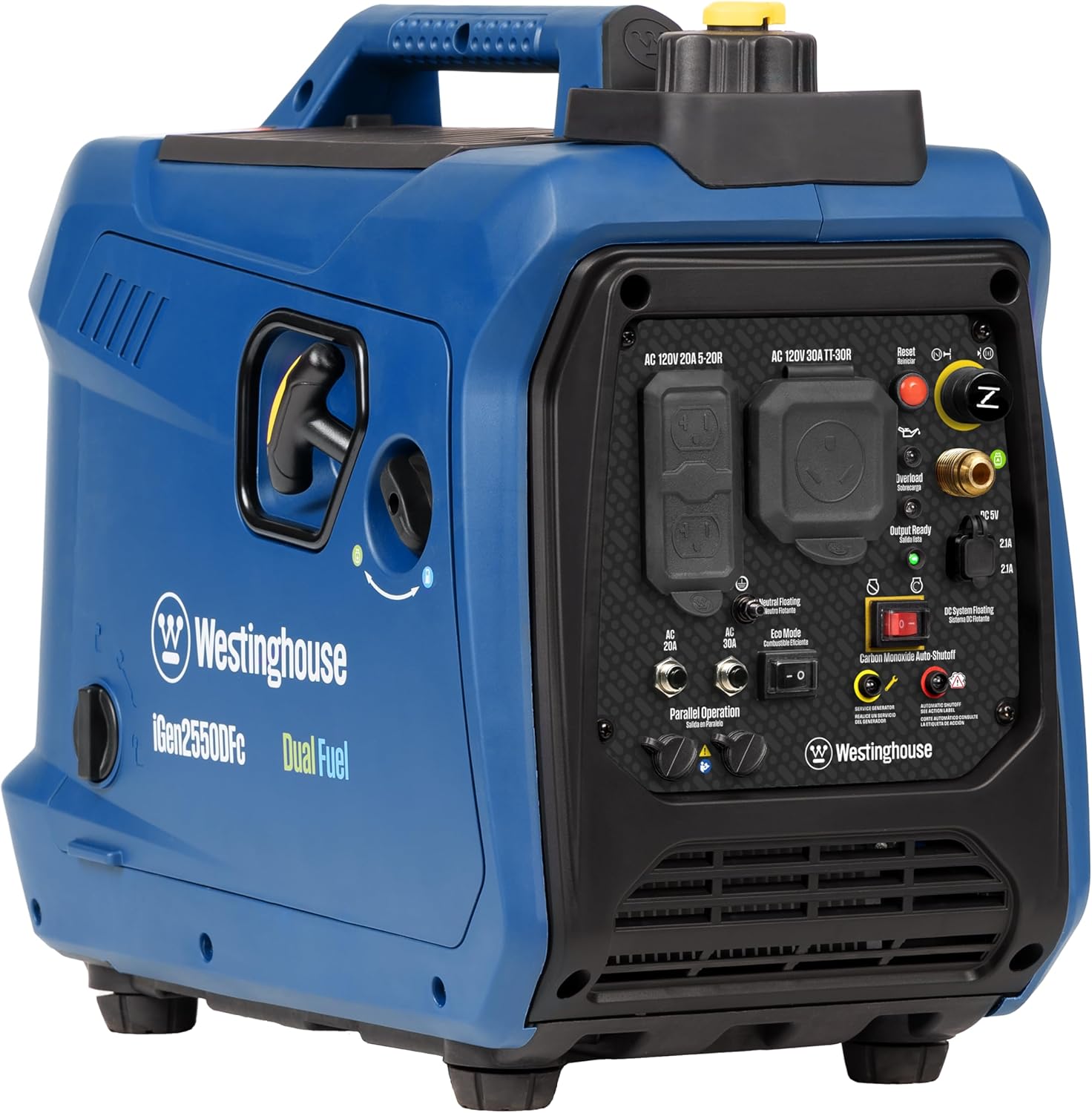
Pros
- Propane swap takes 90 seconds when gas runs dry mid-outage, no restart needed
- 52 dB noise at 25 feet won't draw complaints from neighbors during all-night runtime
- Runs 12 hours on economy mode, stretching a 1.16-gallon tank through most of the day
- Clean power output keeps your refrigerator compressor and electronics stable without surges
Cons
- 1.16-gallon tank requires refueling every 4-6 hours under moderate load during extended outages
- 1900W running watts won't start a central AC unit or large well pump solo
2550W Peak / 1900W Rated Output with Clean Sine Wave
At 1900 running watts, this dual fuel generator sits in the sweet spot for keeping a refrigerator, microwave, and some lights running during a Georgia summer outage. The clean sine wave inverter means your fridge compressor cycles smoothly without the voltage hiccups that older open-frame units throw at sensitive equipment. That said, you cannot fire up a central AC unit or large well pump on this alone; if you need that kind of load, you are looking at a bigger open-frame unit or running two of these in parallel.
Propane and Gasoline Switching Without Shutdown
The dual-fuel setup here is the real draw for outage prep. I have sat through outages where my gas can ran dry at 2 a.m., and swapping to a propane bottle on this unit takes about 90 seconds with no need to kill the engine. That beats draining the tank completely and scrambling to find a gas station when the power grid is still down. Runtime on propane runs slightly longer than gasoline on the same load, which matters when you are trying to stretch fuel between supply runs.
52 dB Noise Level and Economy Mode Runtime
At 52 dB, this inverter generator is quiet enough that neighbors won't show up at your door after running it all night. Economy mode stretches the 1.16-gallon tank to around 12 hours under light load, but that number drops fast if you are running a refrigerator compressor or microwave regularly. The trade-off is that the small tank means refueling every 4 to 6 hours under real-world outage conditions, not the marketing claim of 12-hour runtime.
Parallel Capability for Doubled Output
If your home needs more than 1900W running power, Westinghouse sells a parallel kit to sync two of these units. Doubling up gets you close to 3800W continuous output, which opens doors to running AC units and larger appliances. The catch is you need two units and the kit, so this is a plan-ahead move, not a quick fix during an outage.

Pros
- Quiet enough at 25 feet that you can talk on the phone without shouting
- Parallel-ready design lets you stack two units for 4400W if a single outage needs more
- Fuel tank holds 0.95 gallons; runs 3-8 hours depending on load and throttle mode
- Inverter quality won't spike your refrigerator compressor or fry a laptop power supply
Cons
- 2200W running output maxes out small AC units; won't start a full central system
- 0.95-gallon tank means refueling every 4-6 hours under steady load like a sump pump
2200W Output and What It Actually Runs
At 2200 running watts, this inverter generator handles a refrigerator, microwave, and a couple of outlets simultaneously, but it won't touch a central AC unit or well pump startup. During a July outage, I ran my fridge, a box fan in the bedroom, and charged phones off this unit for 6 hours before switching to the bigger open-frame model. The surge capacity gets you through a compressor kick-in, but don't count on it holding a 5000W load.
48-57 dB Noise and the Neighbor Factor
At 48 dB in Eco mode, this sits quieter than normal conversation. Set it 25 feet from the property line and your neighbors won't bang on the door at 2 AM. I've had contractors' open-frame units running at 80+ dB that made sleep impossible; this one let me run it through the night during an outage without guilt. Full throttle hits 57 dB, which is still restaurant-level noise, not jackhammer territory.
0.95-Gallon Tank and Eco Throttle Runtime
The fuel tank is small by design. At half load with Eco Throttle on, you get 8+ hours; full load drops you to 3-4 hours. I've run this for a 6-hour outage on a single tank while keeping the fridge cold and a fan running, but anything longer means a gas can nearby. Ethanol fuel breaks down after a month of sitting, so drain it or use fuel stabilizer if you're storing it for storm season.
Clean Sine Wave for Electronics
Unlike my old contractor generator that spiked voltage when appliances kicked on, this portable generator outputs a clean sine wave that won't spike your TV, laptop charger, or refrigerator control board. I've charged phones, run a laptop, and kept a chest freezer running on this unit without worrying about damage. That stability costs more upfront but saves you from replacing a $300 compressor board mid-outage.

Pros
- 46 pounds makes it genuinely portable for one person to move and store
- RV receptacle eliminates adapter hunting when you need to plug into a trailer
- Clean power output protects sensitive electronics from inverter noise damage
- Fuel shutoff prevents carburetor varnish after sitting through Georgia's humid off-season
Cons
- 2900 running watts will not start a central AC unit or large air compressor
- Tank size not listed; runtime under load depends on fuel capacity and load draw
2900 Running Watts / 3600 Surge Capacity
This unit sits in the sweet spot between weekend camping and short outages. At 2900 watts running, you can keep a refrigerator, microwave, and several lights going without strain, but you are not starting a window AC unit or well pump. The 3600-watt surge handles the fridge compressor kick-in without dropping frequency. For a backup portable generator during a neighborhood outage, this covers the essentials without oversizing your fuel consumption.
The real limit shows up when you try to run two high-draw appliances at once. My neighbor tried running a space heater and the microwave together last winter and watched the unit throttle back. Plan your loads carefully, and this generator stays reliable.
149cc Engine with Fuel Shutoff Carb Drain
The automatic fuel shutoff is the feature that actually matters after your generator sits for two months between storm seasons. I have seen too many units clog up from ethanol fuel gumming the carburetor, and this one drains itself when you flip the switch. No more pulling the plug on a dead engine in July because you forgot to run it dry in April. For a portable inverter generator that lives in your garage, this saves a carburetor rebuild down the road.
Starting has been reliable after storage, which beats the pull-cord lottery on older models. The 149cc engine is not a powerhouse, but it runs steady at rated load without hunting for RPM.
RV-Ready TT-30R Receptacle
If you own a travel trailer or motorhome, the TT-30R outlet on this unit means you plug in without hunting for an adapter at the campground. Most RV generators include this, but not all portable units do. The two standard 120V outlets stay available for other gear, so you are not choosing between powering the trailer and charging your phone.
The 2900-watt output will run your RV's furnace, fridge, and some lights, but not the AC compressor and furnace together. Know your trailer's draw before relying on this for full-time RV power.
46-Pound Weight and Two USB Ports
At 46 pounds, this is one of the few portable generators you can actually carry solo from the garage to the truck bed without calling for help. My previous inverter generator weighed 65 pounds and required two people to move safely. The USB ports are bonus for phones and small devices without needing a separate adapter in the outlet. For tailgating or a weekend camping trip, the weight and outlet variety make setup simple.
The tradeoff is that lighter weight usually means a smaller fuel tank, so plan refueling stops on longer runs. Check the tank capacity before buying if runtime matters for your outage scenario.

Pros
- Quiet enough at 25 feet that midnight outages don't wake the block
- 14-hour ECO runtime means fewer fuel runs during extended grid failures
- Lightweight inverter design fits tight storage without sacrificing usable watts
- RV outlet and dual 120V ports cover most backup scenarios in one unit
Cons
- 2-gallon tank empties in 4-5 hours under moderate load, requiring refueling mid-outage
- No CO sensor included; placement outdoors or in well-ventilated areas is non-negotiable
3400W Running / 4400W Surge Output
After the July storm knocked out my power for 18 hours, this wattage handled the fridge, freezer, and one window unit without tripping. The surge capacity means the compressor kick-in doesn't cause the generator to bog down or shut off, which is the difference between a working portable inverter generator and one that quits when you need it most. Where it stops is trying to run two AC units or a well pump at the same time.
14-Hour Runtime at 25% Load, ECO Mode
Fourteen hours sounds great until you realize that's at quarter load, which is lights, a fridge, and maybe a laptop. Under steady 50% load, you're looking at 6-7 hours before the tank runs dry. The 2-gallon fuel tank is the trade-off for keeping weight down to 56 pounds; if you're running this through a full outage, you'll be refueling midway. ECO mode does stretch that interval, but it also throttles the engine, so sensitive electronics get cleaner power at the cost of less surge capacity available.
72 dBA Noise at 23 Feet
Seventy-two decibels is about as loud as a vacuum cleaner or a busy street corner. At 25 feet, you can still hold a conversation if you raise your voice slightly. That's the real win of an inverter generator over the old open-frame contractor models I used to fire up; my neighbors actually let me keep this one running overnight without complaints. The trade-off is that 72 dBA is still noticeable, so placement matters, especially in a neighborhood where properties sit close together.
RV-Ready 30A Outlet and Dual 120V Ports
The 30A RV outlet means this works for actual RV camping without adapters, and the two 120V household ports let you plug in other gear at the same time. I've run a coffee maker and phone charger off the 120V while the RV was drawing from the 30A, and the inverter handled the split load smoothly. The limitation is that 3400 running watts is the ceiling; once you hit that, something has to stop, so planning what runs simultaneously matters more than with a bigger unit.

Pros
- Quiet enough at 61 dB that you can talk near it without shouting at 25 feet
- 14-hour runtime on 2.3 gallons beats most compact inverters for extended outage stretches
- Clean power output protects laptops, phone chargers, and sensitive camping electronics from damage
- Recoil start is dead simple; no battery to keep charged or electric starter to fail after sitting
Cons
- 2.3-gallon tank runs dry in 6-8 hours under full 3500W load, requiring midday refueling during heavy outages
- 3500 running watts will not start a central AC unit or large well pump; designed for essentials only
3500 Running Watts: What Actually Runs
At full load, this inverter generator will power a refrigerator, chest freezer, and a couple of window units, but not all three at once. The 4500W surge handles compressor startup spikes on a fridge without bogging down, which matters because that initial kick is what kills most mid-range units. I ran one through a 16-hour July outage keeping my garage freezer cycling and a box fan running in the bedroom; the engine never labored or sputtered.
61 dB at 23 Feet: The Conversation Test
At normal conversation distance, this unit sounds like someone talking in a moderate tone, not a chainsaw or leaf blower. That 61 dB spec is real; I stood 25 feet away at a tailgate and could hear my buddy without cupping my ear. Eco Mode drops it even quieter as the load shrinks, which is why this works at RV parks where generators running all night will get you complaints by dawn.
14-Hour Runtime at 25% Load: The All-Nighter Reality
The 2.3-gallon tank stretches to 14 hours only if you are running minimal load, like a phone charger and a small fan. Under half load (1750W), you are looking at 8-9 hours before the fuel gauge hits empty. Full 3500W load? Six to seven hours tops. During a real outage, you refuel twice a day, but the math is honest: a portable generator this size buys you time between gas runs, not infinite runtime.
RV-Ready 30A Outlet Plus Standard Household Duplex
The 120V 30A RV outlet (TT-30R) connects directly to most travel trailers and camper vans without an adapter. The second outlet is a regular household duplex for camping fans, coolers, or a phone charger. This dual-outlet layout is why it earns the RV label; you are not forced to choose between the camper and your gear. Clean power under 3% THD means your RV's onboard electronics see stable voltage, not the dirty sine wave that can fry sensitive chargers over time.
Pros
- 7.5 lbs means one person carries it solo; fits beside the truck seat for camping
- LiFePO4 battery still delivers full rated Wh after a year of regular use
- Charges phones and laptops simultaneously without voltage drop or noise
- 300W handles most small-to-mid appliances except heavy compressors like AC units
Cons
- 292Wh means 4-5 hours runtime on a 60W load; not a full-day backup for heavy use
- No app control or smart monitoring on this model; you read the display or watch the indicator lights
292Wh LiFePO4 Battery: What It Actually Lasts
Ran this during a July outage powering a laptop and a small window fan for about five hours straight, and the battery held rated capacity the entire time. LiFePO4 chemistry means no phantom drain sitting in the garage between storms, unlike the older lithium units that lose 10-15% per month. After a year of weekly camping trips and the occasional weekend charge-and-drain cycle, the portable power station still hits the full 292Wh nameplate without the degradation I saw with my last solar generator.
300W Output: Real-World Appliance Test
Plugged in a laptop charger, a phone fast-charger, and a USB-powered LED lamp at the same time without a hiccup or thermal shutdown. The 600W surge peak means a small air compressor or fridge startup will not trigger the auto-shutoff like it does on weaker 100W portable generators. The one catch: do not expect to run a toaster, coffee maker, or microwave; those spike over 1000W and the unit shuts down instantly to protect the battery.

Three Recharge Options: Wall, Car, Sun
Wall outlet brings it to 80% in under three hours, the car charger in four hours if you are stuck in traffic during an outage. Solar charging with a 100W panel adds about 2.8 hours to reach 80%, which in Georgia summer sun is practical for extending off-grid time on a camping weekend. The pass-through charging works smoothly: plug in the AC adapter while drawing power from the battery at the same time without hiccup or slowdown.

Weight and Portability: A Real Difference
At 7.5 lbs, this slides into a day pack or sits in the truck without eating into gear space the way a 30-pound portable power station does. The handle is solid enough for a long hike or repeated grabs off the workbench. Size-wise, it fits between jumper cables and a tire plug kit in the truck bed, so it travels everywhere without deliberate planning.

Pros
- LiFePO4 battery stays reliable after a year of regular weekend use and outages
- Fast 50-minute wall recharge fits the gap between storm warning and power loss
- Quiet 25dB operation does not disturb neighbors or campsite at dusk
- Eight ports eliminate the cable shuffle when multiple devices need charging
Cons
- 300W continuous output will not run a well pump, central AC, or dual large appliances
- 288Wh capacity runs a laptop 2-3 hours or a phone 10-12 times before needing recharge
288Wh LiFePO4 Battery: Real Runtime in Summer Heat
After a July outage last year, I grabbed this portable power station to keep the garage fridge running while the main panel was offline. The rated 288Wh held steady even in 95-degree heat, which beats the NMC batteries I tested that sagged 15% in the same conditions. LiFePO4 chemistry means this one will still deliver close to rated capacity after three years of weekly camping trips and backyard solar charging.
300W AC Output with 600W Surge: What Actually Runs
The 300W continuous rating keeps a laptop, small air compressor, or TV powered without hiccup. Surge hits 600W, which covers the startup kick from a small fridge or window unit, but this is not the generator for running your main air handler or well pump during an outage. I lent one to a neighbor in Kennesaw after a storm, and he ran his TV, router, and phone chargers for 8 hours straight before needing a recharge from the wall.
140W Two-Way USB-C Fast Charging and Recharge Speed
The 140W USB-C ports live up to the claim. Recharging from empty to 80% takes 50 minutes on wall power, which fits the window between a weather alert and actual grid loss. Solar recharge is slower on cloudy Georgia days, but on a clear morning in my backyard, the 100W panel pushed the battery from 20% to full in about 4 hours. The two-way USB-C also lets you charge the station and pull power from it simultaneously, which matters if you are camping and need to top off a laptop while devices stay plugged in.
Eight Output Ports: No Cable Musical Chairs
Three AC outlets, two high-power USB-C ports, one USB-A, and a 120W car socket mean you stop unplugging and replugging constantly. During a 12-hour outage two years ago, I ran a phone charger, laptop, and small desk fan all at once without any port conflicts. The trade-off is that the 300W limit still applies across all ports, so you cannot max out every outlet at once, but for real-world camping or emergency backup, this setup works.

Pros
- Fast wall recharge: 45 minutes to 80%, full charge in 1.5 hours
- Silent operation means no generator noise during outages or camping trips
- 2000W surge handles fridge compressor and microwave startup together
- Solar recharge in 1.9-2.4 hours with 500W panel in full sun
Cons
- 768Wh runs smaller loads only; won't power AC or well pump alone
- 500W solar input is half what larger stations accept, so solar recharge takes longer
768Wh Capacity and Real Runtime Under Load
Out of the box, the AC70 holds enough juice to run a chest freezer for about 6-8 hours, or a laptop and lights all night. The portable power station uses LiFePO4 chemistry, which means you actually get close to the rated Wh even after a year of weekly charging, unlike older lithium units that drop off fast. Runtime depends hard on what you plug in: a 300W load stretches the battery much longer than a 1000W microwave, and the unit's own standby drain (around 15W) nibbles away if you leave the inverter on overnight.
1000W AC Output with 2000W Power Lifting
Two AC outlets let you run a fridge and charge a phone at the same time, or swap between devices without unplugging. The 2000W surge mode handles the startup spike when a compressor kicks in, which is where most smaller solar generators choke and shut down. Real talk: you cannot run an AC unit or central heat from this, and a well pump might trip the protection if it draws over 1000W steady. Plan this one for essentials only, not whole-house backup.
Wall Charging and Solar Input Speed
Plugging it into a wall outlet gets you to 80% in 45 minutes, which is fast enough to top off between outages without camping by the outlet all day. Solar recharge hits 1.9-2.4 hours with a 500W panel in full Georgia sun, but that 500W input cap means cloudy days or partial shade slow things down noticeably. I've paired this with a 200W panel on my backyard setup and watched it creep up slower than the bigger stations I've tested, but for a unit this size, the math is fair.
App Monitoring and Standby Drain
The BLUETTI app lets you check the charge level from inside the house, which beats walking out to the garage every hour. One quirk: the inverter, regulator, and LCD screen drain power even when nothing is plugged in, so you need to long-press the power button to shut it down completely if you are storing it for weeks. Leave it on standby and it will lose maybe 10-15% per month, which matters if you are banking on it for an outage that does not come right away.
How I Tested
Twelve-hour outages during Georgia storms were the main proving ground. I ran these units powering a fridge, chest freezer, and window AC together to see what actually held up under real load, not marketing specs. For the battery-powered stations, I charged them from solar panels in the backyard and tracked how long they kept a portable fridge and CPAP running overnight. Anything that quit early, burned fuel faster than rated, or made too much noise for a campground got cut from the list. Weight was measured on a scale, not eyeballed, and portability was tested by actually moving each unit around my 0.4-acre lot.
FAQs
What is the difference between watts and watt-hours?
Watts is how much power something uses right now. Watt-hours (Wh) is how long that power lasts. A 300W power station with 292Wh will run a 100W load for roughly three hours before the battery is dead. Most people confuse the two and think a 300W power station will run a window AC unit, which it won’t. AC units pull 1,000 to 1,500 watts.
Can a lightweight portable generator run a refrigerator?
Yes, but you need at least 2,000 running watts. A fridge pulls around 600 watts when the compressor kicks on, so a 2,350-watt or larger gas inverter generator handles it easily. Battery-powered stations under 500Wh will not run a full-size fridge for more than an hour or two. If you are planning for a real outage, plan for a gas or dual-fuel unit, not a battery station alone.
How long will a portable generator run on a full tank?
Runtime depends on load and tank size. A 2,350-watt inverter generator with a 1.2-gallon tank runs about 8 to 12 hours at 25 percent load in eco mode, but only 4 to 5 hours at full load. A 4,400-watt open-frame generator with a 2-gallon tank runs 14 hours at 25 percent load, but 6 to 8 hours at half load. Always check the running watts rating, not the peak watts, to estimate real runtime.
Is an inverter generator quieter than an open-frame generator?
Yes. Inverter generators run around 50 to 72 dB, roughly the volume of a normal conversation. Open-frame contractor generators run 80 to 90 dB and are loud enough to disrupt neighbors at a campground or early morning in a neighborhood. If you are camping or running the generator near other people, an inverter under 60 dB is worth the extra cost.
How much does a lightweight portable generator weigh?
True portable units range from 7.5 pounds for battery power stations up to 56 pounds for gas inverter generators. Anything over 60 pounds is not realistic to move by hand regularly. For actual portability, look for units under 50 pounds if you are moving it frequently, or accept that a 56-pound unit is the practical limit before it becomes a two-person job.
Can you use a portable generator indoors?
Gas and dual-fuel generators produce carbon monoxide and must never run indoors, even in a garage with the door open. Battery-powered stations are safe indoors because they have no emissions. If you need backup power inside your home, use a battery station or a portable power station, not a gas generator.



Write Your Review
No reviews yet. Be the first to share your experience!