

The dashboard clicks, the tire looks soft, and the gas station air hose is somehow out of order again. Jump starters with tire inflator solve that two-problem morning by pairing a 12V battery booster with a built-in compressor. After comparing 6 models, the Joltekon 6000A Jump Starter with Air Compressor stands out for its 6,000-amp peak, all-gas coverage, 10L diesel rating, and 150 PSI inflator. The MAIDELI 6000A Jump Starter with Air Compressor is the alternative pick, with a 6,000-amp peak and 10L diesel coverage.

Pros
- 6000A peak output for all gas and 10L diesel engines
- 150PSI inflator with 45L/min airflow
- 37Wh capacity charges phones up to 3 times
- Works from -4°F to 140°F
- 10 safety protections with spark-proof cables
Cons
- Wall charger is not listed among included items
- 37Wh capacity is modest for extended device charging
- No jump starts per charge are listed

Pros
- 6000A peak current for up to all gas and 10L diesel engines
- 160 PSI air compressor with auto shut-off and ±1 PSI accuracy
- Works from -4°F to 140°F for cold or hot weather starts
- 13 built-in protections with spark-free connection alerts
- 800-lumen LED light with 4 modes and up to 96 hours runtime
Cons
- Air pump should not be used continuously when hot
- Wall charger is not listed, only a Type-C cable is included
- Recharge every 2-3 months is recommended for battery health

Pros
- 5000A peak current for 9.0L gas and 8.0L diesel engines
- 150 PSI air compressor with 35 L/min airflow
- Starts in temperatures from -4°F to 140°F
- 800 lumen light with flashlight, strobe, warning, and SOS modes
- 10 safety protections, including spark and reverse polarity protection
Cons
- Needs over 50% battery power before vehicle start up
- Inflator needs cooldown after 10 minutes of continuous use
- Wall charger is not listed in the included accessories

Pros
- 6000A jump starter for up to 10L gas or 14L diesel engines
- 160 PSI air compressor with preset pressure and auto shutoff
- 14 safety protections, including reverse polarity and spark-proof
- 1.2 lb body, 2.95 x 3.74 x 7.09 inches
- LED light has solid, strobe, and SOS modes
Cons
- Needs cooling every 10 to 15 minutes during continuous use
- Wall charger is not listed in the included package
- Starts per charge are not specified
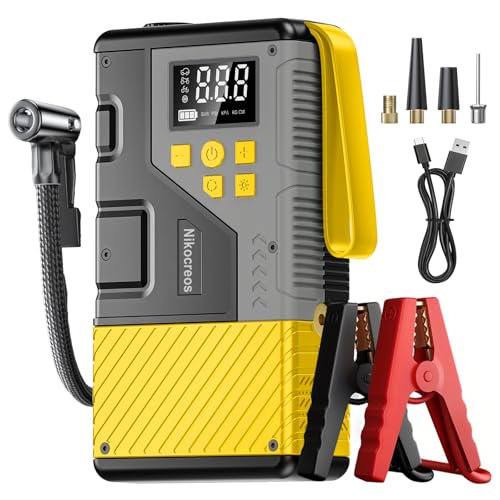
Pros
- 3000A peak current rating
- Supports up to 12L gas and 10L diesel engines
- Built in inflator rated to 150 PSI and 35 L/min
- 12,000mAh battery with USB device charging
- Compact 4.17 x 1.77 x 7.71 inch body
Cons
- No jump starts per charge listed
- No safety protection details listed
- Cold weather rating only goes down to -4°F

Pros
- 5000A for 12V vehicles
- Rated for 9L gas and 8L diesel engines
- Up to 60 jump starts on one charge
- 150 PSI air compressor with auto shutoff
- Dual USB outputs and 3 LED light modes
Cons
- Power should be above 50% before jump starting
- Recommended recharge every 2 to 3 months in storage
- Adapter is not included
How We Chose Jump Starters for Battery Boosting and Tire Inflation
A roadside unit has to do two hard jobs well: deliver enough current to wake a dead 12V battery and move enough air to bring a low tire back into a usable range. We gave the most weight to models that pair clear compressor ratings with stated engine coverage, battery capacity, safety protections, and easy controls.
- Air compressor rating: A useful combo unit needs enough pressure for passenger tires and an auto-stop function so you are not hovering over the valve stem. Among our picks, maximum compressor ratings run from 150 PSI to 160 PSI, and several include preset inflation with shutoff. The Joltekon 6000A Jump Starter with Air Compressor pairs a 150 PSI inflator with pressure memory and a stated accuracy of plus or minus 1 PSI, which matters when you want repeatable tire pressure instead of guesswork.
- Jump-starting coverage: Peak current matters most when the battery is badly discharged or the engine is large. Our picks range from 3,000 amps to 6,000 amps, and diesel coverage ranges from 8L to 14L. The YaberAuto 5000A Jump Starter with Air Compressor lists a 5,000-amp peak and covers engines up to 9L gas and 8L diesel, a sensible middle ground for many cars, pickups, boats, and lawn equipment.
- Battery capacity for both jobs: A combo unit has to reserve energy for clamps, compressor use, lighting, and USB charging. Listed capacity formats vary, so we looked for concrete battery figures where available, including 37Wh on one pick and 12,000 mAh on another. The Nikocreos 3000A Jump Starter (12,000 mAh) lists a 12,000 mAh battery, a 3,000-amp peak, and 150 PSI inflation, which gives it a defined energy figure for shoppers who want capacity stated plainly.
- Size and weight: The best roadside tool is the one that actually stays in the vehicle, so weight matters when it lives in a glove box, trunk organizer, or under-seat bin. Among our picks with stated weights, the range runs from 0.7 pounds to 1.54 pounds. That is light enough to keep with jumper clamps, an air hose, and nozzles without turning the emergency kit into luggage.
- Safety protections: Lithium jump starters deserve careful attention to protection circuitry, clamp design, and heat control. According to the U.S. Consumer Product Safety Commission, one recalled lithium jump starter had a battery that could overheat, melt, and catch fire, and the recall covered about 10,400 units. Our picks list safety packages ranging from 10 protections to 14 protections, including reverse-polarity, spark-proof, and short-circuit safeguards.
- Display and controls: A roadside display should show what matters quickly, especially battery level and tire pressure. Across the main list, screens include LCD or sunlight-readable displays, and pressure units include PSI, BAR, and KPA on multiple picks. We also favored units with preset inflation modes, because a 150 PSI or 160 PSI compressor is easier to manage when the tool can stop at the target pressure.
We excluded jumper cables because they need a second running vehicle, which may not be available in a parking lot or driveway. We also left out trickle chargers and maintainers because they take hours rather than seconds, and 24V semi truck boosters because they are built for commercial trucks and are heavier than most drivers need.
Other Jump Starters Worth Considering
These are other jump starters we looked at but did not put on our main list.
If you want a similar-size alternative with a higher compressor ceiling, Carzip 6000A Jump Starter with Air Compressor lists a 6,000-amp peak and a 160 PSI inflator. Its 1.61-pound weight keeps it close to the lighter end of the main group, but our top pick combines its 6,000-amp peak with explicit all-gas and 10L diesel coverage.
For shoppers focused on peak current, BRPOM 8000A Jump Starter with Air Compressor raises the rating to 8,000 amps. It also lists all-gas coverage, diesel engines up to 12L, and a 160 PSI inflator, though its 2.65-pound weight is noticeably above the stated weights for the lighter main picks.
Giroago 6000A Jump Starter with Air Compressor takes a more limited engine-coverage approach while keeping a 6,000-amp peak and 150 PSI inflator. Its stated coverage tops out at 7L gas and 6L diesel, which is below the 10L diesel rating of our top pick and alternative pick. The listed operating range of minus 4°F to 122°F is also narrower at the hot end than models rated to 140°F.
And if battery capacity is the detail you watch first, Xiauodo 4000A Jump Starter (8,000 mAh) lists an 8,000 mAh battery with a 4,000-amp peak. It covers all gas engines and diesel engines up to 10L, and its 160 PSI inflator matches the higher compressor ceiling among the alternatives. The tradeoff is peak current, since 4,000 amps is lower than the 6,000 amps on our top pick.
FAQs
How much compressor pressure do I need in a jump starter with inflator?
Our picks range from 150 PSI to 160 PSI, which is well above typical passenger-car tire pressures. The more useful feature is auto-stop, because it lets you set a target pressure and reduces the chance of overinflating a tire.
Why does cold weather matter for a 12V jump starter?
According to AAA Oregon/Idaho, a car battery loses about 35 percent of its strength at 32°F. At 0°F, it loses about 60 percent of its power, and an engine may need up to twice the normal current to start.
Is peak amperage the only number that matters?
No. Our main picks range from 3,000 amps to 6,000 amps, but engine coverage, diesel-liter rating, compressor pressure, and battery capacity all matter. A lower-amp unit can still be useful if its stated gas and diesel coverage matches your vehicle.
How often should a combo jump starter be recharged?
Several models in the main group advise recharging every 2 to 3 months if the unit is stored for a long time. That schedule helps preserve battery activity so the jump starter is ready for both clamps and compressor use.
Sources
- Winter Battery Preparation, AAA Oregon/Idaho. How cold weather drains car batteries and when to replace them.
- Whistler Recalls Jump&Go Portable Jumpstart and Power Supply Units, U.S. Consumer Product Safety Commission. Recall of a lithium jump starter that could overheat.



Write Your Review
No reviews yet. Be the first to share your experience!