

Try Amazon Prime free for 30 days
Fast free delivery on heavy items, plus Prime Video, Prime Music and member-only deal prices.
When the living room feels chilly but the thermostat debate is already at a stalemate, infrared fireplace heaters can add targeted warmth and a firelike glow without smoke. After comparing 4 models, the RealSmart 5,118 BTU Infrared Heater stands out for its 1,500 watts, 1,000 watt low setting, and 5,118 BTU output. The Duraflame 5,200 BTU Infrared Heater is the alternative pick, with 5,200 BTU and coverage rated up to 1,000 square feet.

Pros
- 5118 BTU infrared output for supplemental room heat
- Two heat settings, 1000W and 1500W, plus thermostat from 50 to 90°F
- Automatic shutoff if overheated or tipped over, TUV certified for North America
- Timer adjustable from 1 to 12 hours with remote control
- Compact and light at about 10.47 lbs for easy moving between rooms
Cons
- 5118 BTU output suits smaller spaces, not large or open rooms
- Flame effect relies on resin logs and embers rather than real wood look
- No mention of oscillation, so heat is directional from the front vents

Pros
- 5,200 BTU supplemental heat for up to 1,000 sq ft
- Infrared quartz heat helps maintain room humidity
- 3D flame effect has 5 brightness levels
- Flame effect works with or without heat
- Adjustable thermostat for room temperature control
Cons
- Supplemental zone heat, not a whole-home heating system
- Requires attaching the legs before first use
- 15.38 lb weight is less portable than small space heaters

Pros
- 1500W infrared electric fireplace stove
- 19 inch freestanding design weighs 10.1 pounds
- 3-sided view with LED flame effect
- Flame can run separately from heat
- Dual overheat protection and CSA certified
Cons
- Heating area is not specified
- No timer or remote listed
- Electric fireplace style is for small spaces
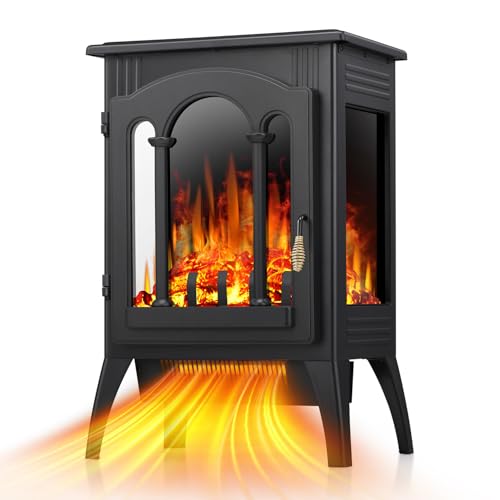
Pros
- 1000W and 1500W heat modes
- Adjustable thermostat from 32°F to 185°F
- Overheat protection with auto shutoff
- Cool-touch exterior for homes with kids or pets
- Compact 11.5 x 16.4 x 22.8 inch freestanding design
Cons
- Heating coverage area is not specified
- No remote control or timer listed
- 14.74 lb weight may be less convenient to move often
What Matters Most in an Infrared Heater for Room Heat
An infrared heater has to do two jobs at once: warm the room and behave safely in a busy home. The best fit depends less on fireplace styling and more on heat output, shutoff features, controls, and whether the unit is practical to move.
- Heat output for the room size: The RealSmart 5,118 BTU Infrared Heater is our top pick because it combines 1,500 watts with a 1,000 watt low setting. Its 5,118 BTU output is close to the highest figure among our picks, while the lower mode gives you a way to reduce heat when the room is already comfortable. Among the main picks, the stated BTU outputs run from 5,118 to 5,200 where listed.
- Tip-over and overheat protection: Safety matters because portable heaters are often used near furniture, bedding, and foot traffic. According to the U.S. Consumer Product Safety Commission, portable or fixed local heaters were associated with about 10,900 residential fires and about 190 deaths in a recent year. Among our picks, safety features include overheat protection, automatic shutoff, and North American safety certifications. A unit with a certified design and a shutoff system is a better match for bedrooms and living rooms than one with heat output alone.
- Thermostat range and controls: The Electactic Infrared Heater gives shoppers a wide stated thermostat range from 32°F to 185°F. It also has 1,500 watt and 1,000 watt heat settings, which makes it easier to choose between faster warming and a gentler setting. The controls are simple rather than app based, with knobs and switches for heat, flame brightness, and power.
- Noise level: Only one of our main picks gives a specific sound figure, with operation listed below 48 dB. That number matters if the heater is going near a bed, desk, or TV area. For the others, the absence of a stated decibel figure means noise should not be treated as a proven advantage.
- Oscillation and heat spread: None of the main picks lists oscillation, so heat spread comes mainly from infrared output and the viewing design. Three of the main picks use a 3 sided view, which helps the flame effect look less flat when the unit is placed at an angle. For warmth, the stronger comparison is output: the listed BTU figures for the two highest stated models differ by only 82 BTU.
- Size, weight, and portability: The Turbro TS17Q weighs 10.1 pounds, making it one of the easier main picks to move between rooms. One compact model measures 11.5 by 16.4 by 22.5 inches, which is small enough for bedrooms or tight living room corners. Across the group, portability is helped by freestanding designs and 4 support legs on two models.
We excluded central furnaces and whole-house systems because they need professional installation. We also left out water heaters and heated blankets because they solve a different problem. Unvented fuel heaters without an indoor rating were excluded because carbon monoxide risk is a serious indoor concern.
The Competition
These are other infrared heaters we looked at but did not put on our main list.
If heating a larger room is the main concern, Duraflame Space Heater is rated for up to 1,000 square feet and includes an adjustable thermostat. The drawback is fit for this specific search: at 28.6 pounds, it is much heavier than our most portable main pick and less fireplace-stove focused than the main list.
FAQs
How much heat should an infrared fireplace heater provide?
For the models compared here, the common high setting is 1,500 watts. Where BTU output is listed, the main picks range from 5,118 to 5,200 BTU, which is a useful band for supplemental zone heat rather than whole-house heating.
Are infrared fireplace heaters safe to use in bedrooms?
They can be reasonable bedroom heaters if they have automatic shutoff features and are placed correctly. The U.S. Fire Administration says to keep anything that can burn at least 3 feet from space heaters and to turn space heaters off when leaving the room or going to bed.
Do these heaters dry out the air?
Infrared quartz heat is often chosen because it is designed to maintain more natural humidity than some forced-air heat. Among our picks, several models specifically use infrared or infrared quartz heating elements, and one lists 3 infrared quartz elements.
What controls are worth paying attention to?
Look for more than an on and off switch. Among our picks, useful controls include 1,000 watt and 1,500 watt heat modes, adjustable thermostats, flame-only operation, and timers up to 12 hours.
Sources
- CPSC Offers Tips to Prevent Home Fires From Space Heaters, U.S. Consumer Product Safety Commission. Fire-safety tips and required safety features for space heaters.
- Heating Fire Safety, U.S. Fire Administration. Home heating fire statistics and prevention messages.
- Safety Guidelines: During & After a Winter Storm, Centers for Disease Control and Prevention. Winter heating safety for space heaters, kerosene heaters and carbon monoxide.




Write Your Review
No reviews yet. Be the first to share your experience!