

Free Delivery. Exclusive Deals. All Prime.
Prime members save on shipping and get first access to deals, plus Prime Video included. 30 days free.
When the heat kicks on and every doorknob feels like a tiny prank, humidifiers for forced air furnace systems can add moisture through the home instead of one dry room at a time. After comparing 6 models, the Digi Mister Whole House Humidifier stands out for coverage up to 3,500 square feet, 1 to 5 nozzles and 8 UVC LEDs. The GeneralAire Whole House Humidifier is the alternative pick because it is rated for homes up to 2,800 square feet.

Pros
- Covers homes and offices from 1000 to 3500 sq. ft.
- 1 to 5 fine mist nozzles allow flexible capacity
- 8 UV-C LED lamps turn on when powered
- No drain, water pad, steam canister or power fan required
- Digital controls for humidity and duct air temperature
Cons
- Requires certain HVAC expertise to install
- 24VAC transformer or installation kit is required
- Adequate water pressure over 30 psi is needed

Pros
- For homes up to 2,800 sq ft
- 17 gallons per day at 120 F plenum temperature
- Includes 120V transformer for 24V operation
- Reversible right or left 6 inch duct connection
Cons
- Requires furnace mounting and plenum opening
- Replacement pad needed once or twice per season
- Use only GeneralAire 990-13 replacement pads

Aprilaire 500 Whole-House Humidifier, 12 GPD, Up to 3,600 Sq. Ft.
What Stands Out
- Automatic dual-sensor system maintains 40-60% humidity day and night without manual adjustment
- 12 gallons per day capacity covers whole homes up to 3,600 square feet with one unit
- Furnace-integrated design runs only when needed, cutting water waste and operating costs
- Digital display shows real-time humidity, maintenance alerts, and blower settings at a glance
- USA-made evaporative design skips the mineral dust and cartridge replacements of ultrasonic models
- Keeps optimal humidity for respiratory health, allergy relief, and protecting wood furniture from dry-air damage
Pros
- Dual sensors auto-adjust humidity 24/7
- Covers 3,600 sq ft without zones
- Runs only when furnace runs
- No filter cartridges to replace
- USA-made evaporative technology
Cons
- Requires furnace installation and ductwork
- Water panel replacement adds annual cost
Automatic Dual Sensors Keep 40-60% Humidity Around the Clock
Set the target humidity once and the system monitors both indoor moisture and outdoor temperature to dial in the right level without you checking a hygrometer every morning. A whole-house humidifier with true automation means the bedroom stays at 45 percent whether it's a dry January night or a warmer February, which is exactly the range doctors recommend for cutting respiratory infections and allergy flare-ups. The blower activation switch lets you run it continuously or only when the furnace cycles, so you're not wasting water in spring and fall when you don't need it.
12 Gallons Per Day Coverage Across 3,600 Square Feet
This is a furnace-mounted whole-house humidifier, not a bedroom unit, so it distributes mist through your ductwork to every room on one charge without the bucket-and-refill cycle of portable models. A 12-gallon-per-day output in a tightly built home means you won't watch humidity crater by afternoon or need a weekend refill ritual. The capacity is real for homes with moderate to tight construction; homes with loose air sealing or very large square footage may need supplemental portable units in the driest rooms.
Evaporative Design Skips Mineral Dust and Cartridge Costs
Unlike ultrasonic humidifiers that spray white mineral powder all over dark furniture during hard-water seasons, this evaporative system pulls air through a water panel where moisture naturally evaporates, leaving minerals behind in the panel itself rather than floating into your bedroom. You replace the water panel once or twice a year depending on water hardness, not every month like some models, and the furnace fan does the work of moving mist so there's no separate motor to wear out or clean around.
Digital Display Tells You When Maintenance is Needed
The control panel lights up to show current humidity percentage, whether the humidifier is running, when to swap the water panel, and if service is required, so you're never guessing whether it's still working or just sitting idle. This matters in winter when you can't feel humidity swings the way you can temperature, and it beats pulling out a hygrometer every week to verify your system is actually raising moisture levels in the home.

Pros
- Furnace humidifier for indoor air moisture
- Manual control listed in product title
- 14-pound listed weight
- Research Products Corporation brand
Cons
- No coverage area listed
- No output or capacity details listed

Pros
- Covers 2021 to 2026 outlook period
- Focuses on non-electric gas forced warm air furnaces
- Includes humidifiers with 150,000 BTU output and under
Cons
- Paperback book, not a humidifier or furnace
- No listed features or performance specifications
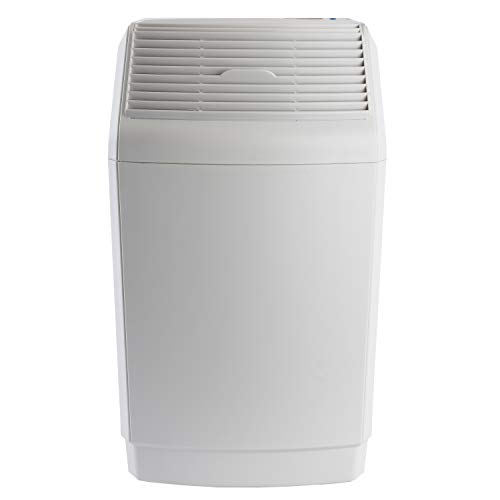
Pros
- Covers up to 2,700 sq ft
- 6 gallon humidifier listed in title
- Digital controls with auto humidistat
- Shuts off when set humidity is reached or tank is empty
- Includes first 1043 Super Wick
Cons
- 17.5 x 12.5 x 22.5 inch size needs floor space
- Weighs 14 lb before water is added
- Requires 1043 Super Wick
How to Choose Whole House Humidifiers for Furnace Air
A furnace can move dry air through every supply register, so the right humidifier has to match the duct system, the house size and the amount of maintenance you will actually do. The main tradeoffs are not cosmetic, they are about design, water use, control and installation.
- Design type: Whole house humidifiers generally fall into bypass, fan powered or steam style designs. According to the EPA, evaporative units transmit moisture invisibly by using a fan, while steam vaporizers create steam by heating water. A bypass model depends on furnace airflow, while a fan powered unit can move air through its own housing. Steam designs can add moisture without relying as much on warm supply air, but they also bring different electrical and service requirements.
- Output for the home size: Coverage is the first number to check because dry air in a larger home needs more moisture than dry air in a small zone. The Digi Mister Whole House Humidifier is rated for up to 3,500 square feet, which puts it near the upper end of the main list. Its 1 to 5 nozzle setup also lets the installer adjust output to the system rather than treating every house the same. Among the main picks, stated coverage runs from 600 square feet to 3,500 square feet.
- Furnace or heat pump compatibility: A duct mounted humidifier has to fit the available plenum space and work with the air temperature your system provides. One main pick lists a 24 Volt setup and includes a 120V transformer, which matters if the furnace board or nearby power source will be part of the installation. Another main pick specifies a 6 inch duct connection, a practical detail for bypass routing. For heat pump homes, lower supply air temperature can matter because output numbers often assume warmer furnace air.
- Water and drain hookup: Some furnace mounted units need a water line and may send excess water to a drain, while some designs try to avoid runoff. The Aircare Whole House Humidifier uses a 6 Gallon tank, is rated for up to 700 square feet and has a built in humidistat, so it avoids the same duct and drain decisions as a hard piped bypass unit. That convenience comes with a different routine: the tank has to be refilled. EPA guidance says portable humidifiers should be emptied, wiped dry and refilled daily.
- Control and maintenance: Automatic humidistats are helpful because too much moisture can create its own problems. The EPA says indoor humidity should stay below 60 percent relative humidity, ideally between 30 and 50 percent, and another EPA humidifier guide says not to exceed 50 percent. The Aprilaire Whole House Humidifier pairs a 12 gallons tank figure with coverage up to 600 square feet, giving shoppers a clear capacity number to compare against the smaller end of the main list. Pad based units add another schedule item, and one main pick calls for replacing its pad once or twice per season.
- Installation difficulty: A furnace mounted model is not just a plug in appliance. One main pick calls for a 9 1/2 H by 13 5/8 W plenum opening, which is the kind of cutout that should be planned before ordering parts. Another main pick says certain HVAC expertise is needed, and that a 24VAC transformer is required unless a compatible kit is used. If that sounds beyond your comfort level, budget time for an HVAC contractor rather than treating installation as a quick weekend task.
We excluded dehumidifiers because they remove moisture instead of adding it. Essential oil diffusers were also left out because their output is too small for whole room humidification, and medical thermometers and meat thermometers do a different job entirely.
The Competition
These are other whole house humidifiers we looked at but did not put on our main list.
If you are considering Fresh Headquarters Humidifier, the main issue is fit for the furnace focused job. It is described as a capable whole house humidifier, but the available information did not give the same kind of square foot rating or duct details used to sort the 6 main picks.
For a room based approach, Levoit Evaporative Humidifier is rated for up to 600 square feet and can run up to 40 hours per fill. Its 19 dB noise level and top fill tank are useful numbers for a bedroom or living area, but that is a different need than adding humidity through a forced air system. Compared with our top pick, its coverage number is 2,900 square feet lower.
FAQs
What humidity level should a forced air home stay under?
The EPA recommends keeping indoor humidity below 60 percent relative humidity, with an ideal range between 30 and 50 percent. For humidifier use specifically, the EPA also says not to exceed 50 percent indoor relative humidity.
Do whole house humidifiers need a drain?
Some furnace mounted designs use a water line and drain, while tank based units avoid that hookup but require refilling. Among our picks, capacity and coverage figures range from a 6 Gallon tank setup to duct mounted options rated up to 3,500 square feet.
How much coverage should I look for?
Start with the square footage the humidifier is rated to serve, then compare it with the part of the home served by the furnace. Among our picks, stated coverage ranges from 600 square feet to 3,500 square feet, so undersizing can leave distant rooms dry.
How often do portable humidifiers need cleaning?
The EPA says portable humidifiers should be emptied, wiped dry and refilled daily. It also recommends cleaning them every third day, which is especially relevant for tank based units rather than duct mounted models.
Sources
- Use and Care of Home Humidifiers, U.S. Environmental Protection Agency. EPA guidance on humidifier types, minerals, cleaning and safe humidity levels.
- A Guide to Mold, Moisture and Your Home, U.S. Environmental Protection Agency. EPA guide to controlling indoor moisture and mold.


Write Your Review
No reviews yet. Be the first to share your experience!