

Try Amazon Prime free for 30 days
Fast free delivery on heavy items, plus Prime Video, Prime Music and member-only deal prices.
Every drafty house has one room where the hallway thermostat insists everything is fine while your toes file a complaint. Electric baseboard heaters fix that by putting quiet convection heat along the wall where cold air settles. After comparing 6 models, the Comfort Zone CZ600 is the best fit for most rooms, with 1,500 watts, two heat settings and both tip-over and overheat shutoffs. For a hardwired install, the Stelpro AB51252W delivers 1,250 watts and is rated for up to 125 square feet.

Pros
- 1,500W convection baseboard heater for medium-sized rooms
- Two heat settings with an adjustable thermostat
- Tip-over switch shuts off heater if knocked over
- Overheat protection sensor shuts off heater if too hot
- Stay-cool body and dent-proof end panels, 4.78 pounds
Cons
- Designed for a single medium-sized room, not whole-house heating
- No digital display, remote, or timer mentioned
- Low-profile design means limited heat settings versus a full thermostat range

Pros
- 1250W at 240V covers up to 125 sq ft of living space
- Silent one-piece steel cabinet construction reduces ticking and popping sounds
- Overheat protection cuts power if airflow is blocked
- Recessed front grille and rounded corners for added durability and safety
- 5-year warranty on the baseboard with lifetime coverage on the heating element
Cons
- Requires a separately sold external thermostat for operation
- Hardwired installation only, not a plug-in unit, so setup needs wiring
- Limited to about 125 sq ft at 240V, less at 208V, so not suited for large rooms
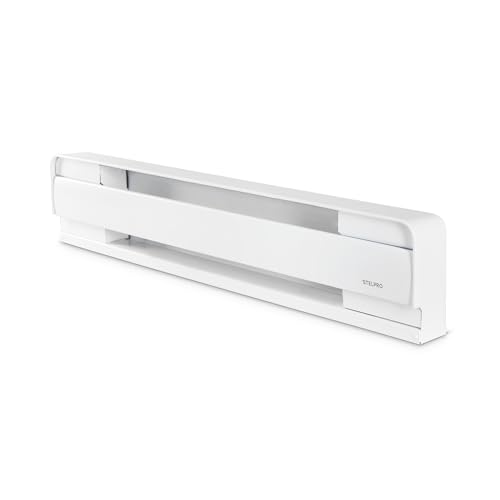
Pros
- 500W output covers up to 50 sq ft of space
- One-piece steel cabinet reduces ticking and popping noise
- Overheat protection cuts power if airflow is blocked
- Rounded corners help protect children and pets
- Backed by a 5-year warranty plus lifetime element coverage
Cons
- Requires a separately sold thermostat since none is included
- Hardwired installation only, not a plug-in unit
- Needs a dedicated 120V circuit and professional wiring setup

Pros
- 48 inch convection baseboard heater covers 400 sq ft area
- Three adjustable heat settings for custom comfort
- LED touch panel plus full remote control for on/off, temperature and timer
- Tip-over protection and child lock for added safety
- 12-hour timer lets you schedule heating in advance
Cons
- No stated wattage or BTU output, so overall heat strength is unclear
- Requires combustible objects to be kept at least 3 ft away from the unit
- Relies on natural convection with no fan, so heat spreads without oscillation

Pros
- Dual 1500W/750W heat settings for quick or steady warmth
- Digital thermostat with timer for automatic shut-off
- Tip-over and overheat protection plus child lock
- Rated at 30 decibels for quiet operation
- Lightweight at 5.51 pounds for easy placement
Cons
- No stated square footage or BTU rating, so room coverage is unclear
- No remote control, adjustments are made directly on the unit
- Dent-proof panels suggest floor use, not a fixed wall-mounted baseboard install
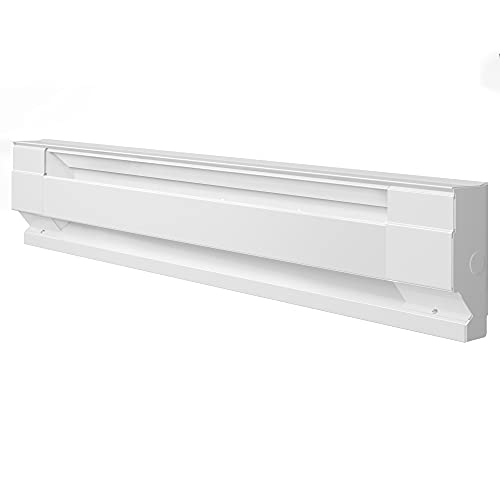
Pros
- Delivers 2560 or 1925 BTU depending on the 240V or 208V setting
- Multi-watt capability of 750 or 563 watts for flexible output
- Convection heat design circulates warm air through the room
- Simple setup with universal wiring and pre-punched knockouts
- Backed by a limited lifetime warranty
Cons
- No thermostat, timer or remote control is listed for this model
- Runs on 240/208 volt wiring, so professional installation may be needed
- Fixed 36 inch baseboard unit cannot be moved between rooms like portable heaters
How We Chose Electric Baseboard Heaters for Whole-Room Heat
A heater that lives along a wall for years has to match the room, the circuit and the way you control it. That makes the details matter more here than with a grab-and-go space heater.
- Wattage and room size: Among our picks, output runs from 500 to 1,500 watts. The Stelpro AB0501W sits at the low end with 500 watts rated for up to 50 square feet, the right scale for a small bedroom, office or condo den. Its 240-volt sibling, our alternative pick, stretches the same design to 125 square feet. One plug-in pick claims coverage of 400 square feet, a figure best read as an upper limit rather than a promise.
- 120V versus 240V wiring: Two of our picks need a 240-volt circuit, and both lose output on 208 volts, which is common in apartment buildings. Our alternative pick drops from 1,250 watts to about 938 watts on 208 volts. A 36-inch hardwired pick behaves the same way, falling from 750 watts to 563 watts. The other four run on 120 volts or plug in, which saves you from running a dedicated high-voltage line.
- Thermostat accuracy and controls: A built-in thermostat holds a set temperature instead of running flat out all day. The shinic Baseboard Heater adds a digital panel for dialing in a specific temperature, plus a timer and a choice of 1,500 or 750 watts, so it can idle at the lower draw once the room is warm. Two of our hardwired picks have no onboard control and need a wall or add-on thermostat sold separately. One plug-in pick adds a remote and a 12-hour timer.
- Installation type: Three of our picks are hardwired, with pre-punched knockouts and universal wiring so the power feed can come in from either end. The other three plug in, and the two lightest weigh 4.8 and 5.5 pounds, so moving them between rooms is easy. Hardwired models sit flush along the wall for years, while plug-in models trade that permanence for a setup with no electrician.
- Safety protections: According to the U.S. Consumer Product Safety Commission, electric heaters need an automatic cut-off that shuts them off if they tip over. The agency also advises choosing a heater certified by a nationally recognized testing laboratory. The Comfort Zone CZ600 meets the tip-over point with a dedicated switch and adds an overheat sensor, all in a 1,500-watt body that weighs 4.8 pounds. All three plug-in picks list tip-over shutoff, and two of our hardwired picks cut power if airflow is blocked.
- Surface temperature: The Centers for Disease Control and Prevention recommends electric space heaters with non-glowing elements and a 3-foot gap from drapes, furniture and bedding. Our top pick has a stay-cool body, and two of our hardwired picks use a recessed front grille with rounded corners that keeps feet and furniture off the element. Those details matter most at floor level, where kids and pets meet the heater first.
We left out central furnaces and whole-house systems because they need professional installation, which is a bigger project than adding heat to one room. Water heaters and heated blankets do a different job, so they were out too. Unvented fuel heaters without an indoor rating were also excluded, since they carry a carbon monoxide risk indoors. A couple of other models came close, though.
Other Baseboard Heaters Worth Considering
These are other baseboard heaters we looked at but did not put on our main list.
If you want a plug-in unit from a brand better known for hardwired heat, the Cadet Baseboard Heater pairs 1,500 watts with an adjustable thermostat and UL certification. That matches the 1,500-watt output of our top pick, so the choice comes down to a different design and feature mix rather than more heat.
Prefer heat that sweeps across the room instead of rising off the wall? The Dreo Wall Heater oscillates 120 degrees, and its thermostat runs from 41 to 95°F. At 9.2 pounds it is nearly double the 4.8 pounds of our top pick, and it fits the low-profile, room-by-room baseboard role less closely than our main list.
FAQs
How many watts does a baseboard heater need for one room?
Our picks range from 500 to 1,500 watts. The two hardwired models with room ratings work out to about 10 watts per square foot, covering 50 square feet at 500 watts and 125 square feet at 1,250 watts. Use that ratio as a starting point and size up for drafty rooms.
Do I need an electrician to install a baseboard heater?
For a hardwired model, usually yes, especially if it runs on a 240-volt circuit you do not already have. Three of our picks are hardwired and three plug into a standard outlet, so the plug-in group is the route if you want to skip wiring.
How far should furniture and curtains be from a baseboard heater?
The U.S. Consumer Product Safety Commission, the U.S. Fire Administration and the CDC all point to at least 3 feet from bedding, drapes and furniture. The CPSC also says to place a portable heater on a level, hard, nonflammable surface rather than a rug or carpet.
Can I leave a plug-in baseboard heater running overnight?
The U.S. Fire Administration advises turning space heaters off when you leave the room or go to bed. It notes that portable heaters caused only 3 percent of home heating fires but 41 percent of fatal ones. Two of our plug-in picks include timers, one reaching 12 hours, which makes an automatic shutoff easy to set.
Sources
- CPSC Offers Tips to Prevent Home Fires From Space Heaters, U.S. Consumer Product Safety Commission. Fire-safety tips and required safety features for space heaters.
- Heating Fire Safety, U.S. Fire Administration. Home heating fire statistics and prevention messages.
- Safety Guidelines: During & After a Winter Storm, Centers for Disease Control and Prevention. Winter heating safety for space heaters, kerosene heaters and carbon monoxide.




Write Your Review
No reviews yet. Be the first to share your experience!