

Prime Big Deal Days: October 6 - 7, 2026
Members only: two days of exclusive deals across Amazon. A 30-day free trial unlocks the same prices and fast free delivery.
Every cold room has the same ritual: someone cranks the heat, someone else opens a window, and the thermostat war starts again. Electric baseboard heaters with thermostat control end that fight by holding one room at a set temperature without heating the rest of the house. After comparing 6 models, the Comfort Zone CZ650B is our top pick for its 1,500 watts, digital adjustable thermostat and two safety cut-offs for tipping and overheating. The Stelpro AB41002W is our alternative pick, a hardwired 1,000-watt unit rated for up to 100 square feet.

Pros
- 1500-watt convection heating element for medium-sized rooms
- Two heat settings plus digital adjustable thermostat with clear display
- Safety tip-over switch automatically shuts off the unit if knocked over
- Overheat protection sensor monitors temperature during use
- Stay-cool body and dent-proof end panels for durable, safe operation
Cons
- No remote control or timer feature is mentioned for scheduling
- Only two heat settings limit fine-tuned temperature control
- Fixed baseboard design offers less placement flexibility than portable heaters

Pros
- 1000W heat for spaces up to 100 sq ft
- 750W alternate rating at 208V
- Built-in 2-pole thermostat included
- Silent natural convection operation
- 5-year heater warranty, lifetime element warranty
Cons
- Hardwired installation, not a plug-in heater
- Coverage limited to spaces up to 100 sq ft
- Thermostat electronics warranty is 3 years

Pros
- Dual 1500W/750W heat settings for quick or steady warmth
- Digital thermostat with timer for automatic shut-off
- Tip-over and overheat protection plus child lock
- Rated at 30 decibels for quiet operation
- Lightweight at 5.51 pounds for easy placement
Cons
- No stated square footage or BTU rating, so room coverage is unclear
- No remote control, adjustments are made directly on the unit
- Dent-proof panels suggest floor use, not a fixed wall-mounted baseboard install
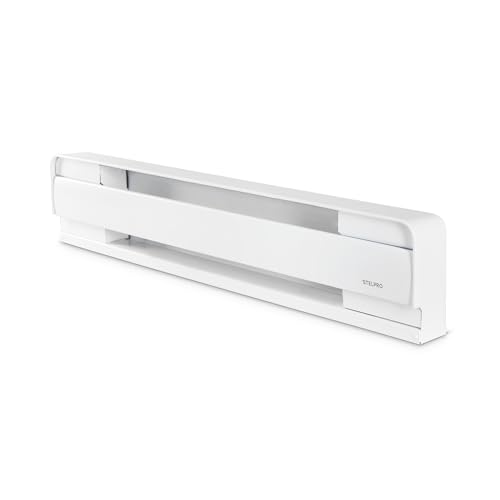
Pros
- 500W output covers up to 50 sq ft of space
- One-piece steel cabinet reduces ticking and popping noise
- Overheat protection cuts power if airflow is blocked
- Rounded corners help protect children and pets
- Backed by a 5-year warranty plus lifetime element coverage
Cons
- Requires a separately sold thermostat since none is included
- Hardwired installation only, not a plug-in unit
- Needs a dedicated 120V circuit and professional wiring setup

Pros
- 1,500W convection baseboard heater for medium-sized rooms
- Two heat settings with an adjustable thermostat
- Tip-over switch shuts off heater if knocked over
- Overheat protection sensor shuts off heater if too hot
- Stay-cool body and dent-proof end panels, 4.78 pounds
Cons
- Designed for a single medium-sized room, not whole-house heating
- No digital display, remote, or timer mentioned
- Low-profile design means limited heat settings versus a full thermostat range

Pros
- 1500/1125-Watt output at 240/208 Volt for zone heating
- 72-Inch length baseboard design for broad room coverage
- 25 Gauge steel construction with powder coated junction box
- UL Listed heater for added assurance
- 20 Gauge all metal junction box with ground
Cons
- Requires a separate thermostat, not included with the unit
- Hardwire installation needed, not a plug in unit
- No stated tip-over or overheat protection in the listing
What We Looked For in Baseboard Heaters With a Thermostat
A baseboard heater that holds a room steady has to match the room’s size, the home’s wiring and the way you want to control it. A heater that is too weak runs nonstop, and one on the wrong circuit may not run at all.
- Wattage and room size: Among our picks, output runs from 500 to 1,500 watts. The Stelpro AB0501W sits at the low end with 500 watts, rated for up to 50 square feet, which suits a small bedroom, home office or condo bathroom. Stelpro’s own ratings work out to about 10 watts per square foot. By that math, the four 1,500-watt picks point toward rooms of roughly 150 square feet.
- 120V versus 240V wiring: Two of our picks are built for 240V circuits, and the rest work at 120V. Voltage changes output: our alternative pick delivers 1,000 watts at 240V but drops to 750 watts on a 208V supply. Check the circuit before you order, because a 240V heater will not run from a standard wall outlet.
- Thermostat accuracy and controls: The Comfort Zone CZ650B pairs a digital adjustable thermostat and clear temperature display with 2 heat settings. It does this at 1,500 watts in a 4-pound body that is easy to move between rooms. Two of our picks, both hardwired, ship with no thermostat at all and need a wall unit or clip-on kit sold separately. Our alternative pick avoids that extra purchase by bundling a 2-pole thermostat that mounts directly on the heater.
- Installation type: Three of our picks are hardwired and three are portable units that need no electrician. The hardwired models range from 47 1/8 inches long on our alternative pick to 72 inches on the largest unit. Housing gauge matters for a fixture that stays on the wall for years: our alternative pick uses 22-gauge steel, while the 72-inch model uses thinner 25-gauge steel.
- Safety protections: According to the U.S. Consumer Product Safety Commission, an automatic cut-off is required to turn off electric heaters if they tip over. The shinic Baseboard Heater adds tip-over and overheat shut-offs plus a child lock. It runs at 1,500 watts with a 750-watt low setting, and its 5.5-pound body is light enough to carry from room to room. All three portable picks include a tip-over switch, and the 500-watt hardwired unit cuts power if its airflow is blocked.
- Surface temperature: Two of our picks advertise a stay-cool body to reduce the risk of burns. The CDC recommends electric heaters with non-glowing elements and keeping them at least 3 feet from drapes, furniture or bedding. Both Stelpro picks also use rounded corners, which matters in a room with kids or pets.
We left out central furnaces and whole-house systems, since they need professional installation and solve a bigger problem than one cold room. Water heaters and heated blankets do a different job. Unvented fuel heaters without an indoor rating were excluded because they carry a carbon monoxide risk indoors. A few other baseboard models came close, too.
The Competition
These are other baseboard heaters we looked at but did not put on our main list.
Want a heater that sits higher on the wall instead of at floor level? The Dreo Wall Heater matches our top pick at 1,500 watts and adds a thermostat that runs from 41 to 95°F. At 9.2 pounds it weighs more than twice our 4-pound top pick, and its 120-degree oscillation is a feature a baseboard-style room heater does not need, so it stayed off the main list.
Small rooms are where the Cadet 1,925 BTU Baseboard Heater makes its case, with 563 watts of output. That is only slightly more than the 500-watt hardwired unit on our list, yet it weighs 7 pounds against that unit’s 5. No thermostat is listed for it, so it matches this search less closely than our main picks.
FAQs
How many watts does a baseboard heater need for my room?
A useful starting point is about 10 watts per square foot, which is how Stelpro rates its heaters. Our picks range from 500 watts for about 50 square feet up to 1,500 watts for larger rooms. Rooms with poor insulation or many windows may need more.
Can I plug a baseboard heater into a regular outlet?
Only if it is a portable model. Three of our picks plug in, while the other three are hardwired, and two of those need a 240V circuit. Hardwired units are usually installed by an electrician.
Do hardwired baseboard heaters come with a thermostat?
Not always. Two of our hardwired picks require a separately sold wall thermostat or a built-in kit, while one ships with a 2-pole thermostat already bundled. Factor that part into your plans before you buy.
How far should furniture be from a baseboard heater?
The U.S. Fire Administration and the CPSC both advise keeping anything that can burn at least 3 feet away. The U.S. Fire Administration also notes that portable heaters were 3 percent of home heating fires but 41 percent of fatal ones. Turn portable units off when you leave the room or go to bed.
Sources
- CPSC Offers Tips to Prevent Home Fires From Space Heaters, U.S. Consumer Product Safety Commission. Fire-safety tips and required safety features for space heaters.
- Heating Fire Safety, U.S. Fire Administration. Home heating fire statistics and prevention messages.
- Safety Guidelines: During & After a Winter Storm, Centers for Disease Control and Prevention. Winter heating safety for space heaters, kerosene heaters and carbon monoxide.




Write Your Review
No reviews yet. Be the first to share your experience!