

Try Amazon Prime free for 30 days
Fast free delivery on heavy items, plus Prime Video, Prime Music and member-only deal prices.
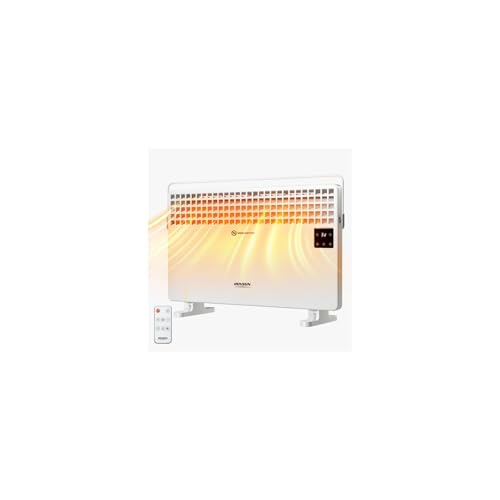
You nudge the hallway thermostat up again, yet the back bedroom still feels like a walk-in fridge, and someone ends up wearing a parka to bed. Convection panel heaters fix that by warming the air in one room quietly, with no fan pushing dust around. After comparing 6 models, the pasapair Panel Heater is the best fit: 1,500 watts of heat, a thermostat from 41 to 99°F, and tip-over and overheat cutoffs. On a tighter budget, the G-Ocean Wall Heater also tops out at 1,500 watts and drops to a 500-watt low setting.
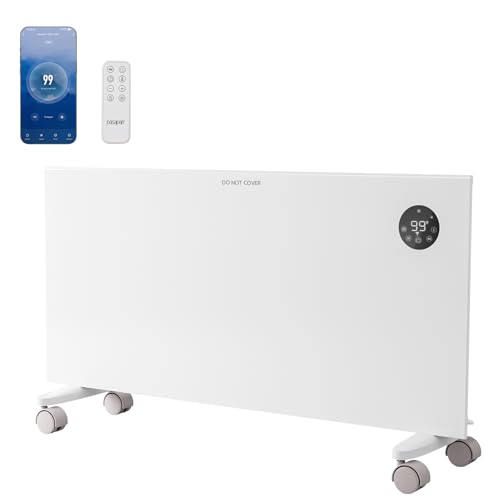
Pros
- 1500W heating element warms in as little as 10 seconds
- Thermostat adjusts from 41°F to 99°F
- ECO Mode switches between P1 and P2 power levels
- App, remote, Alexa and Google Assistant control
- IP24 splash-proof with tip-over and overheat protection
Cons
- No heating area or room size rating provided
- Convection heat may feel gentler than fan-forced heat
- 32 x 16 x 4.7 inch panel needs wall or floor space
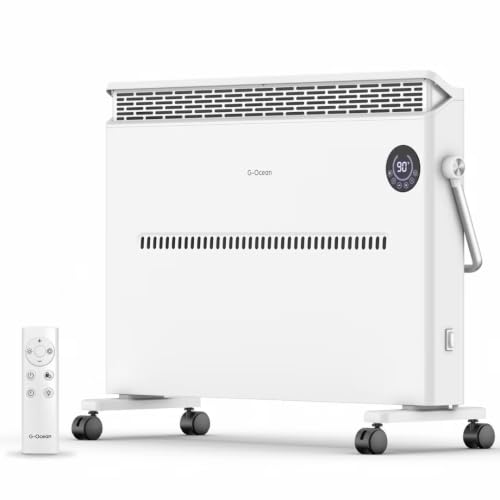
Pros
- 1500W, 1000W, and 500W heat settings
- Thermostat range from 60°F to 90°F
- 25 to 30 dB quiet convection operation
- 12H timer and remote control
- Tip-over protection and overheat shutoff
Cons
- No square footage heating area is listed
- Convection heat may feel slower than fan-forced heat
- Large 29.49 x 23.43 inch panel needs wall or floor space

Pros
- 1500W mica infrared convection panel heater
- Heats 250 sq ft, can boost warmth in over 500 sq ft
- 2.4G WiFi, Tuya app, Alexa and Google Assistant support
- Tip-over and overheat protection, ETL, FCC and CE certified
- Wall mount or freestanding setup, 12 lb body
Cons
- Whole-room warmth can take 1 to 2 hours
- App control requires 2.4G WiFi
- Alexa voice control is limited to basic features
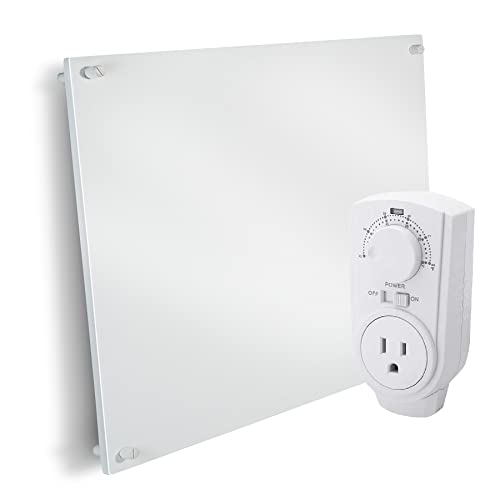
Pros
- 250 watts for lower power use
- Ideal for rooms up to 100 sq ft
- Thermostat range is 41 to 86 °F
- IP44 splashproof for bathroom placement
- No fan for quiet convection heat
Cons
- Limited to 100 sq ft rooms
- Exterior feels warm, safe for adults only
- Must be kept 12 inches away from water
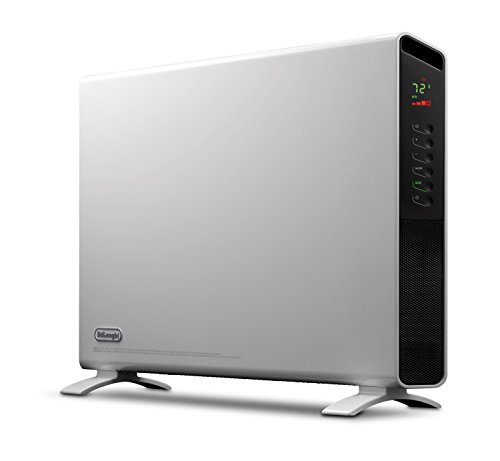
Pros
- 1500W heat for medium to large rooms
- Floor use or wall mounting with included kit
- ECO PLUS adjusts heat and power settings
- 24-hour delayed on/off timer
- Tip-over switch and thermal shutoff
Cons
- 18.3 lb weight may be less convenient to move
- Electric heater only warms the room it is used in
- Wall mounting requires installation

Pros
- 1500W X-shaped aluminum heating element
- LED touch panel and backlit remote
- 1 to 24 hour timer with memory function
- ECO mode with NTC temperature sensing
- Overheat protection and IP24 splash protection
Cons
- 19.43 lb weight may be less easy to carry
- 33.9 inch wide body needs floor space
- Heating coverage area is not specified
What We Looked For in Wall-Mounted Panel Heaters
A panel heater that hangs on a wall or stays in one room all winter has to match your circuit, your floor area and the people who walk past it. These six points decided which models made the list.
- Wattage and room size: Five of our picks run at 1,500 watts, the usual ceiling for a heater on a standard household outlet. The sixth draws just 250 watts and is sized for a room of about 100 square feet, such as a bathroom. The Manastin Infrared Heater makes the biggest coverage claim, rated for up to 500 square feet at 1,500 watts. Its listing names a 250-square-foot main room as the comfortable target, so treat the larger figure as a boost for an open living area rather than a promise.
- 120V versus 240V wiring: We favored units built for ordinary household power over 240-volt models, which usually need a dedicated circuit and an electrician. The one pick that lists its electrical draw outright runs on 120 volts at 2.08 amps, and it can also be hardwired for a clean, permanent install. At 1,500 watts, the other five are best kept on a circuit that is not already feeding a microwave or hair dryer.
- Thermostat accuracy and controls: A built-in thermostat is what keeps a panel heater from cooking a small room. The pasapair Panel Heater lets you set a target anywhere from 41 to 99°F. Its ECO mode shifts between two power levels to hold about 73°F, and a sleep mode dims the display while the heater runs at around 30 dB. Elsewhere on the list, the smallest panel holds 41 to 86°F, while our alternative pick covers 60 to 90°F.
- Installation type: Four of our picks ship with both a wall kit and feet or wheels, so you can try a spot on the floor before you drill. One is wall-only and just 0.40 inch thick, and one is a floor model that rolls on built-in wheels. Among the dual-mode units, depth runs from 3.5 inches on our alternative pick to 4.5 inches on the widest model, which measures 32.5 inches across.
- Safety protections: According to the U.S. Consumer Product Safety Commission, electric heaters need an automatic cut-off that turns them off if they tip over. The De’Longhi HCX9115E pairs an internal tip-over switch with a thermal shutoff, and its 24-hour delayed on/off timer means it does not have to run all night. It also switches itself on when a room dips below 41°F, which can help keep basement pipes from freezing. Four of our 1,500-watt picks list tip-over protection, and all six list some form of overheat or thermal cutoff.
- Surface temperature: Convection panels move warm air more than they radiate, but the housing still gets hot. The 250-watt panel on our list warns that its casing will feel warm and is safe for adults only, and it should sit 12 inches away from water. Two picks carry an IP24 splash rating and one carries IP44, which matters near a sink or tub. The Centers for Disease Control and Prevention recommends electric heaters with non-glowing elements, which every model here uses.
We left out central furnaces and whole-house systems because they need professional installation, which is a different project from adding heat to one room. Water heaters and heated blankets do a different job entirely. We also skipped unvented fuel heaters without an indoor rating, since burning fuel in a closed room brings a carbon monoxide risk that an electric panel avoids.
Other Panel Heaters Worth Considering
These are other panel heaters we looked at but did not put on our main list.
If you like the idea of our top pick but want a different look and feature mix, the Rovsun Panel Heater matches its 1,500 watts and claims coverage of up to 400 square feet. Its thermostat runs from 59 to 99°F, so the low end starts 18 degrees higher than the 41°F floor on our top pick, which makes it less useful for simply keeping a cold room above freezing.
Noise is the main reason to look at the Reekie Panel Heater. It is listed at 23 dB, compared with 30 dB for our top pick, and it pairs 1,500 watts with a 750-watt low setting. With an adjustable thermostat, tip-over and overheat protection, and a rating for up to 500 square feet, it is a close match on paper and a reasonable swap for a light sleeper.
Heating only a small bedroom or home office? The Fierscial Panel Heater draws 800 watts, a little over half the 1,500 watts of our top pick, and is rated for up to 250 square feet. It is UL certified, but that lower output leaves it short for a large living room or a drafty space.
FAQs
How many watts does a panel heater need for one room?
For most bedrooms and living rooms, 1,500 watts is the standard, and five of our picks run at that level. A bathroom of about 100 square feet can get by with far less, which is why one of our picks uses only 250 watts. Coverage claims on our list run up to 500 square feet, but a drafty or poorly insulated room will need the higher settings more often.
Do wall-mounted panel heaters need a 240-volt circuit?
Not the ones on our list. The model that publishes its electrical specs runs on 120 volts and can be hardwired, and the 1,500-watt units are built for household power. Heaters that require 240 volts generally need a dedicated circuit, so plan on an electrician if you go that route.
How far should a panel heater be from furniture and curtains?
The U.S. Fire Administration, the CPSC and the CDC all advise keeping anything that can burn at least 3 feet from a space heater. If you use a freestanding setup, the CPSC says to place the heater on a level, hard, nonflammable surface rather than a rug or carpet. Never cover the heater, even to dry a towel.
Is it safe to leave a panel heater running overnight?
The U.S. Fire Administration advises turning space heaters off when you leave the room or go to bed. It reports that portable heater fires were only 3 percent of home heating fires from 2017 to 2019 but accounted for 41 percent of fatal ones. If you want warmth at bedtime, use a timer: ours range from 12 to 24 hours, so you can let the heater shut itself off after you fall asleep.
Sources
- CPSC Offers Tips to Prevent Home Fires From Space Heaters, U.S. Consumer Product Safety Commission. Fire-safety tips and required safety features for space heaters.
- Heating Fire Safety, U.S. Fire Administration. Home heating fire statistics and prevention messages.
- Safety Guidelines: During & After a Winter Storm, Centers for Disease Control and Prevention. Winter heating safety for space heaters, kerosene heaters and carbon monoxide.



Write Your Review
No reviews yet. Be the first to share your experience!