

Try Amazon Prime free for 30 days
Fast free delivery on heavy items, plus Prime Video, Prime Music and member-only deal prices.
The spare bedroom is where guests sleep in socks, a hoodie and two quilts while the hallway thermostat insists everything is fine. Electric baseboard heaters fix that by adding quiet convection heat to the one room the furnace never reaches. After comparing 6 models, the Cadet 1,925 BTU Baseboard Heater is our top pick. It draws 563 watts, puts out 1,925 BTU and weighs 7 pounds, so it is easy to hold in place during wiring. For a 120-volt circuit, the Stelpro AB0501W is our alternative pick, rated for up to 50 square feet at 500 watts.
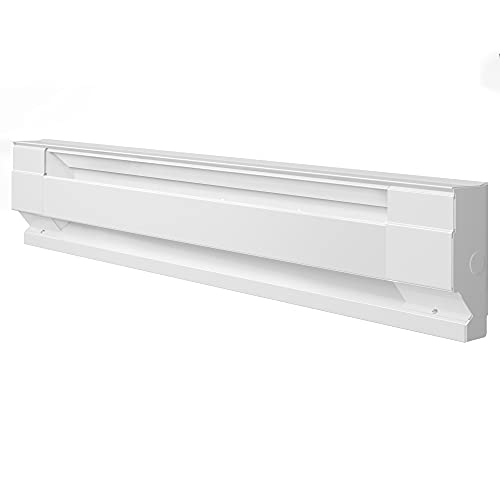
Pros
- Delivers 2560 or 1925 BTU depending on the 240V or 208V setting
- Multi-watt capability of 750 or 563 watts for flexible output
- Convection heat design circulates warm air through the room
- Simple setup with universal wiring and pre-punched knockouts
- Backed by a limited lifetime warranty
Cons
- No thermostat, timer or remote control is listed for this model
- Runs on 240/208 volt wiring, so professional installation may be needed
- Fixed 36 inch baseboard unit cannot be moved between rooms like portable heaters
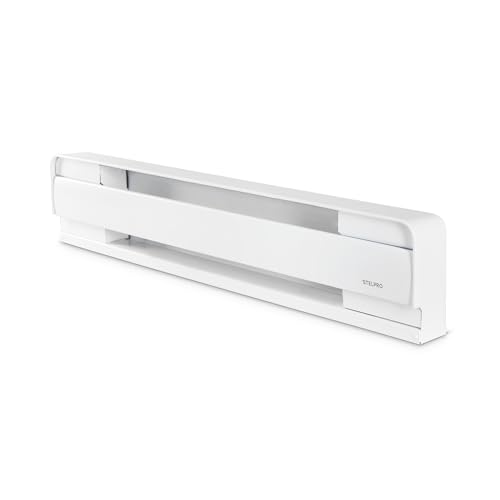
Pros
- 500W output covers up to 50 sq ft of space
- One-piece steel cabinet reduces ticking and popping noise
- Overheat protection cuts power if airflow is blocked
- Rounded corners help protect children and pets
- Backed by a 5-year warranty plus lifetime element coverage
Cons
- Requires a separately sold thermostat since none is included
- Hardwired installation only, not a plug-in unit
- Needs a dedicated 120V circuit and professional wiring setup

Pros
- 1500/1125-Watt output at 240/208 Volt for zone heating
- 72-Inch length baseboard design for broad room coverage
- 25 Gauge steel construction with powder coated junction box
- UL Listed heater for added assurance
- 20 Gauge all metal junction box with ground
Cons
- Requires a separate thermostat, not included with the unit
- Hardwire installation needed, not a plug in unit
- No stated tip-over or overheat protection in the listing

Pros
- 48 inch wide convection design heats spaces up to 400 sq. ft.
- Three adjustable heat settings for customized warmth
- LED touch panel plus full-featured remote control
- Tip-over protection and child lock for added safety
- 12-hour timer allows scheduled heating sessions
Cons
- No listed wattage or BTU rating, so actual heat output is unclear
- 48 inch length needs a long stretch of wall or floor space
- No mention of oscillation, so heat may stay directional

Pros
- 1,500W convection baseboard heater for medium-sized rooms
- Two heat settings with an adjustable thermostat
- Tip-over switch shuts off heater if knocked over
- Overheat protection sensor shuts off heater if too hot
- Stay-cool body and dent-proof end panels, 4.78 pounds
Cons
- Designed for a single medium-sized room, not whole-house heating
- No digital display, remote, or timer mentioned
- Low-profile design means limited heat settings versus a full thermostat range

Pros
- 1500-watt convection heating element for medium-sized rooms
- Two heat settings plus digital adjustable thermostat with clear display
- Safety tip-over switch automatically shuts off the unit if knocked over
- Overheat protection sensor monitors temperature during use
- Stay-cool body and dent-proof end panels for durable, safe operation
Cons
- No remote control or timer feature is mentioned for scheduling
- Only two heat settings limit fine-tuned temperature control
- Fixed baseboard design offers less placement flexibility than portable heaters
How We Chose These Baseboard Heaters for Single-Room Heat
A baseboard heater often stays on the same wall for years, so the circuit, the control and the clearance around it matter more than they do with a heater you can return on a whim. We weighed each model against six points, in this order.
- Wattage and room size: Among our picks, rated output runs from 500 to 1,500 watts, which is the difference between warming a bathroom and warming a bedroom. The Cadet 1,925 BTU Baseboard Heater sits near the low end, drawing 563 watts on a 208-volt circuit. Wired to 240 volts, the same 36-inch unit rises to 750 watts, so it suits a small bedroom or office rather than a large living room. For scale, our 500-watt alternative pick is rated for up to 50 square feet, or about 10 watts per square foot.
- 120V versus 240V wiring: Two of our picks are hardwired Cadet units built for 240 or 208 volts. Our alternative pick is the 120-volt version of a line that also comes in 208-volt and 240-volt models. The voltage printed on the heater has to match the circuit in the wall, and the same element gives noticeably less heat on a lower voltage, as the drop from 750 to 563 watts on our top pick shows.
- Thermostat accuracy and controls: Two of our hardwired picks have no built-in control at all and need a separately sold wall or add-on thermostat. The Comfort Zone CZ650B goes the other way, pairing 1,500 watts with a digital adjustable thermostat and a temperature display. A readout lets you set a number instead of guessing with a dial, which helps when the heater runs overnight. Among the freestanding picks, heat settings run from 2 to 3, and one adds a remote and a 12-hour timer.
- Installation type: Three of our picks are hardwired and three stand on the floor. The hardwired units run from 36 to 72 inches long and come with pre-punched knockouts, and our alternative pick adds cable clamps and wiring on both ends for a left or right feed. Freestanding models weigh as little as 4 pounds and move between rooms, but they depend on an outlet and a cord.
- Safety protections: According to the U.S. Consumer Product Safety Commission, electric heaters are required to have an automatic cut-off that turns them off if they tip over. The Comfort Zone CZ600 covers that with a tip-over switch and adds an overheat sensor, all in a 4.8-pound, 1,500-watt body. Four of our picks list a tip-over or overheat cut-off, and one hardwired model is UL listed. That matters because, according to the U.S. Fire Administration, portable heaters caused only 3 percent of home heating fires but 41 percent of the fatal ones.
- Surface temperature: Two of our freestanding picks list a stay-cool body, and our alternative pick recesses its front grille and rounds its corners to protect children and pets. The Centers for Disease Control and Prevention recommends heaters with non-glowing elements, and all six of our picks use convection rather than an exposed glowing coil. Even so, keep curtains, bedding and furniture at least 3 feet away, as all three safety agencies advise.
We left out central furnaces and whole-house systems because they need professional installation and solve a bigger problem than one cold room. Water heaters and heated blankets do a different job, so they were never in the running. We also excluded unvented fuel heaters without an indoor rating, since they carry a carbon monoxide risk indoors. If none of the listed models fits your room, the next group is worth a look.
Other Baseboard Heaters Worth Considering
These are other baseboard heaters we looked at but did not put on our main list.
If you need more output than our top pick, the Winado Baseboard Heater draws 1,500 watts against its 563 watts. It is rated for up to 200 square feet and adds a 12-hour timer. Its tip-over protection signals a floor-standing unit, though, so it will not replace a wired heater on the wall.
That same 1,500-watt ceiling is shared by the shinic Baseboard Heater, which also offers a 750-watt low setting for milder days. At 5.5 pounds, it carries an adjustable thermostat plus tip-over and overheat protection, which puts it close to the freestanding units on our list.
Want the simplest control possible? The Fofojôy Baseboard Heater pairs 1,500 watts with an adjustable thermostat and little else. No tip-over or overheat cut-off is mentioned, which is why it ranks behind the four picks on our list that name at least one of those protections.
And if lab certification is the deciding point, the VYEMOYo Baseboard Heater is ETL certified, in line with the CPSC advice to buy a heater certified by a nationally recognized testing laboratory. It runs at 1,500 watts, nearly triple the draw of our top pick, with an adjustable thermostat plus tip-over and overheat protection.
FAQs
How many watts does a baseboard heater need for one room?
Our picks range from 500 to 1,500 watts. A 500-watt unit is rated for about 50 square feet, so a small bathroom or office sits at the low end, while a bedroom or den calls for something closer to 1,500 watts.
Should I choose a 120V or 240V baseboard heater?
Match the heater to the circuit you already have or plan to run. A heater wired to 208 volts instead of 240 volts gives less heat, dropping from 750 to 563 watts in one of our picks. If you are not sure which circuit the room has, have an electrician check before you buy.
Do hardwired baseboard heaters need a separate thermostat?
Many do. Two of our three hardwired picks require a wall-mounted or add-on thermostat sold separately, while all three freestanding picks have controls built in, with 2 or 3 heat settings.
How far should furniture be from a baseboard heater?
The CPSC, the U.S. Fire Administration and the CDC all advise keeping anything that can burn at least 3 feet away. The U.S. Fire Administration also recommends turning space heaters off when you leave the room or go to bed.
Sources
- CPSC Offers Tips to Prevent Home Fires From Space Heaters, U.S. Consumer Product Safety Commission. Fire-safety tips and required safety features for space heaters.
- Heating Fire Safety, U.S. Fire Administration. Home heating fire statistics and prevention messages.
- Safety Guidelines: During & After a Winter Storm, Centers for Disease Control and Prevention. Winter heating safety for space heaters, kerosene heaters and carbon monoxide.




Write Your Review
No reviews yet. Be the first to share your experience!