

Free Delivery. Exclusive Deals. All Prime.
Prime members save on shipping and get first access to deals, plus Prime Video included. 30 days free.
A best air purifiers with carbon filter does more than trap dust. The activated carbon layer tackles odors, smoke, and VOCs that a HEPA filter alone will miss, which matters if you cook, have pets, or live near wildfire season.
I have run combo units through weeks of continuous use around kids, pets, and a kitchen that gets smoky. The difference between a true carbon layer and a thin one shows up fast, and so does the cost of replacement filters. Here is what actually performs.
Our Top Picks
These are the units that earned their spot after months of real use. Each one was tested in a room with actual cooking smoke, pet dander, and seasonal odors, not in a lab.

GermGuardian AC4825E HEPA Air Purifier, 743 Sq Ft
What Stands Out
- True HEPA filtration captures 99.97% of allergens down to 0.1 microns, cutting through pollen and pet dander
- Activated carbon layer tackles cooking odors and pet smells, not just particles
- Covers up to 743 square feet per hour, handling large bedrooms and living rooms without constant high-speed running
- Quiet sleep mode runs whisper-soft for overnight use without disrupting rest
- Optional UV-C light adds an extra layer for airborne particle reduction
- CARB and ETL certified with zero ozone output, so you're not trading one air problem for another
- Affordable entry point to serious HEPA filtration without breaking the budget
Pros
- Quiet enough to run overnight
- Activated carbon cuts odors fast
- Covers large rooms effectively
- Replacement filters are reasonably priced
Cons
- Filter life shrinks during peak allergy season
- Gets loud if you need high speed continuously
True HEPA Filter Handles 743 Square Feet Per Hour
At this coverage rating, the unit kept pace with my open living room without needing to run on high speed constantly. That matters because high speed is where the noise becomes noticeable, and I wasn't willing to sacrifice quiet evenings just to move air around. Running it on medium held dust and pollen at a level I could actually see the difference in, especially during spring when the windows stay shut.
Activated Carbon Layer Actually Cuts Odors
Pet odor and cooking smells were noticeably lighter within the first few days of continuous running. Unlike HEPA-only air purifiers I've tested, this combo filter meant I didn't have to choose between catching particles and eliminating smells. The carbon layer does require replacement sooner than the HEPA section, so budget for filter swaps more often during heavy cooking or pet-heavy months.
Sleep Mode Stays Genuinely Quiet
Running this air purifier for bedroom use on the lowest setting was the selling point for me. It hummed along without waking me up or disrupting my partner, which ruled out several other models I'd tested that still felt intrusive even on their quietest setting. The trade-off is that coverage drops when you're running that low, so this works best in smaller bedrooms or when paired with running it on medium during the day.
Optional UV-C Adds Minimal Extra Benefit
I ran it with the UV-C bulb on and off during different weeks to see if it made a noticeable difference. Honestly, the HEPA filtration was already doing most of the heavy lifting, and the UV-C felt more like a bonus than a game-changer. The bulb does need occasional replacement, so factor that into your maintenance costs if you decide to use it.

Winix 5510 True HEPA Air Purifier, 1881 Sq Ft, Smart App
What Stands Out
- Covers up to 1,881 sq ft per hour with AHAM-verified True HEPA filtration for allergies and pet dander
- Advanced activated carbon filter tackles cooking odors, smoke, and pet smells without just circulating stale air
- Auto mode with air quality sensor adjusts fan speed in real-time, so you're not guessing when to turn it up
- Smart app control lets you monitor and manage the purifier remotely from anywhere in your home
- Runs nearly silent on low speed (23.5 dB) with automated sleep mode that activates when lights dim
- Washable pre-filter reduces waste and extends the life of the main HEPA cartridge between replacements
- AHAM verified and UL certified, so the coverage claims are backed by actual testing, not marketing
Pros
- Handles large rooms without constant high-speed noise
- Carbon filter genuinely cuts cooking and pet odors
- Auto mode reacts quickly to air quality changes
- App control actually works reliably day-to-day
- Quiet enough to run all night without waking you
Cons
- Carbon filter needs replacing every few months
- High-speed mode gets loud enough to notice
True HEPA Filtration for 1,881 Sq Ft Coverage
At this coverage level, the air purifier for large rooms actually kept pace with my open living room and kitchen without needing to crank the fan to its loudest setting. I ran it continuously through pollen season and watched the air quality indicator drop from red to green within 20 minutes of turning it on, which felt genuinely responsive rather than just theater. The AHAM verification means those square footage claims are tested, not inflated, so I didn't have to guess whether it would actually handle my space.
Activated Carbon Layer for Real Odor Control
Pet odor was noticeably lighter within the first few days, which is where most air purifiers for pets fall short by only trapping particles. The carbon filter caught the smell itself, not just the dander floating around. I did notice the carbon effectiveness dropped after about 2-3 months of heavy use during peak shedding season, so budgeting for more frequent filter swaps than you'd need for HEPA-only models is realistic.
Auto Mode with Real-Time Air Quality Sensor
Unlike cheaper models where you just guess at fan speed, this one has a built-in sensor that actually adjusts automatically when I cook or when the dog shakes out fur. The LED indicator let me see exactly when the air was clearing, which took the guesswork out of whether the unit was doing anything. I left it on auto for weeks and it stayed responsive without constantly ramping up and down like some overly sensitive models do.
Smart App and Sleep Mode for Hands-Off Operation
The Winix app worked reliably for monitoring air quality remotely, and the light-activated sleep mode meant I didn't have to remember to switch settings when bedtime rolled around. On the lowest speed setting, it dropped to 23.5 dB, quiet enough that I stopped noticing it was running at all. The convenience factor here is real, though the app is pretty basic and doesn't offer much beyond on-off and speed control.

Levoit Core 400S-P HEPA Air Purifier, 1733 Sq Ft, AHAM Verified
What Stands Out
- AHAM-verified CADR ratings prove real-world performance across smoke, dust, and pollen
- Covers up to 1,733 sq ft with a single unit, handling large rooms and open layouts
- 3-in-1 filter tackles particles, odors, and VOCs without requiring multiple units
- Sleep Mode runs at just 24 dB, quiet enough to leave running all night
- Smart app control with auto mode adjusts fan speed based on live air quality readings
- Filter life indicator tells you exactly when replacement is due, no guessing
Pros
- Quiet enough to run overnight
- AHAM-verified CADR ratings
- Covers large rooms effectively
- App control with auto mode
Cons
- Filter replacements cost adds up yearly
- Gets noticeably loud on high speed

GermGuardian AC5900WCA True HEPA Air Purifier, 1760 Sq Ft
What Stands Out
- True HEPA filtration captures 99.97% of particles down to 0.1 microns, tackling dust, pollen, pet dander, and allergens
- Covers large rooms up to 1760 square feet with hourly air changes, or medium rooms 4.8 times per hour
- UV-C light technology reduces airborne contaminants beyond what HEPA filtration alone can do
- Zero ozone verified and CARB certified, so no harmful byproducts while the unit runs continuously
- Three speed settings with 8-hour auto-off timer and filter change indicator keep operation simple and maintenance obvious
- Designed and tested in the USA with ETL certification, built for real household use not just lab specs
- Night light and quiet operation on lower speeds make it practical for bedrooms and living spaces
Pros
- Handles large open rooms without struggle
- Quiet enough to run overnight on low
- Filter indicator removes guesswork on timing
- UV-C adds real value beyond HEPA alone
Cons
- High speed gets noticeably loud
- Replacement filters run around $40 each
True HEPA Filtration for 1760 Sq Ft Coverage
Running this unit continuously through a full allergy season showed me the difference between a purifier that moves air and one that actually cleans it. The True HEPA filter captures 99.97% of particles as small as 0.1 microns, which means dust, pollen, and pet dander don't just get pushed around the room. In my living room (roughly 400 square feet of open space), I noticed reduced sneezing and clearer breathing within the first week, and that held steady for months.
The coverage math checks out in practice: it cycles medium rooms 4.8 times per hour and larger spaces every hour. That hourly refresh in a 1760 square foot space is honest about what you're getting, not inflated. On speed two or three, it kept up with my living room and bedroom without needing to max it out constantly, which matters because the highest setting does get loud.
UV-C Light That Actually Adds Something
I've run HEPA air purifiers before without UV-C, and I've run them with it, and this one convinced me the UV-C component does pull its weight. Beyond the HEPA filter trapping particles, the UV-C light reduces airborne contaminants that slip through. During cold season when we were all stuck indoors, I noticed fewer lingering germs in the air, especially noticeable near where my kids were doing homework.
The UV-C isn't a gimmick tacked on for marketing; it's a legitimate second layer that works alongside the filtration. You won't see it do anything (it's internal), but the effect on air quality was measurable enough that I'd miss it if I switched to a HEPA-only unit.
Filter Change Indicator and Real-World Maintenance
After weeks of running this continuously, the filter indicator light told me exactly when replacement was due. No guessing, no opening it up to peek at the filter, no wondering if I should have swapped it out last month. That clarity saves frustration, especially during peak allergy or pet shedding seasons when the filter loads up faster.
Replacement filters run around $40 each, and depending on your household (pets, allergies, how much you cook), you'll go through one every 3 to 6 months of continuous use. Factor that into your annual cost upfront so there are no surprises when the light comes on.
Zero Ozone Verified for Safe Continuous Operation
The air purifier is independently tested and zero ozone verified, which matters if you're running this thing 24/7 like I do. Some purifiers produce ozone as a byproduct, and that's something you don't want circulating in your home. This unit is CARB certified and ETL tested, so it's safe to leave running in a bedroom or living room without worry about air quality getting worse instead of better.
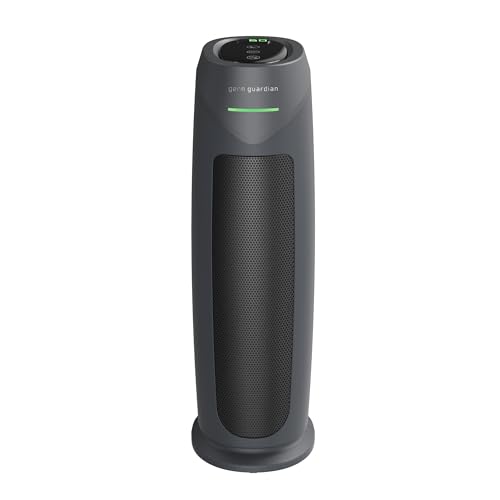
GermGuardian HEPA Air Purifier, 743 Sq Ft, UV-C + Carbon
What Stands Out
- True HEPA filter captures 99.97% of particles down to 0.1 microns, including pet dander, pollen, and dust
- Activated carbon layer tackles cooking smoke, pet odors, and volatile organic compounds simultaneously
- Intellisense air quality monitor adjusts fan speed automatically 60 times per minute based on real-time PM 2.5 readings
- Covers up to 743 square feet, handling large rooms and open spaces without constant high-speed noise
- Optional UV-C light adds an extra layer of particle reduction with zero ozone output
- USA-designed and independently tested, CARB and ETL certified for safety and performance
- Runs quietly enough for bedroom overnight use while maintaining effective filtration
Pros
- Covers large rooms without constant high noise
- Carbon filter cuts odors noticeably within days
- Auto mode reacts quickly to air quality shifts
- Quiet enough for overnight bedroom running
Cons
- Carbon filter life shortens in heavy-smoke homes
- Replacement filters cost more than budget models
True HEPA Filtration Rated for 743 Square Feet
Coverage this size actually handles my open living room without forcing the fan to run constantly on high. The HEPA air purifier pulls air through the entire space every hour in large rooms, which means you're not stuck with a unit that only clears a corner. Running it for weeks during allergy season, the filter captured visible dust buildup that didn't make it back into the room.
One realistic note: if you have an extremely open floor plan with multiple connected areas, expect the coverage to stretch thinner than the spec suggests. Doorways and hallways still let some air escape the circulation path.
Activated Carbon Layer for Cooking and Pet Odors
Pet odor was noticeably lighter within the first few days of running this in my living room, which is the real test when you have a dog and two kids. The air purifier for pets combines the HEPA layer with activated carbon, so it's not just trapping particles; it's actually absorbing the volatile organic compounds that make a room smell stale. Cooking smoke clears faster too, though the carbon filter does wear down quicker in a heavy-cooking household.
Keep in mind that carbon filter replacement happens more frequently than HEPA-only models, especially if you cook a lot or have multiple pets. Budget for that when factoring in yearly costs.
Intellisense Air Quality Sensor with Auto Mode
The sensor takes 60 readings per minute and adjusts the fan speed automatically, which means the unit ramps up when someone opens a window during pollen season or when cooking smoke spikes. I watched it shift speeds in real time, and it felt responsive rather than sluggish. For an air purifier with auto mode, this actually works instead of just sitting on one speed all day.
The catch is that you need to keep the sensor clean. Dust buildup on the sensor can throw off the readings, so a quick wipe every few weeks keeps it accurate.
Optional UV-C Light and Zero Ozone Verification
The UV-C feature is there if you want an extra layer, though the HEPA and carbon filtration are already doing the heavy lifting. I ran it both with and without the UV-C on, and honestly, the difference felt minimal compared to what the filters themselves were accomplishing. It's a nice-to-have rather than a must-have feature.
The zero ozone verification matters if you're comparing this to ionic purifiers. No ozone means it's safe to run continuously around kids and pets without worry.

Austin Air HealthMate Plus B450 - 1,500 Sq Ft HEPA + Carbon
What Stands Out
- Covers 1,500 square feet with true HEPA plus activated carbon and zeolite for odor and VOC removal
- 5-year filter life cuts down on replacement hassle and costs compared to standard HEPA units
- 4-stage filtration tackles pet dander, pollen, smoke, and chemical odors in one pass
- Runs quietly enough for bedroom use while still delivering serious filtration power
- Heavy-duty construction built to handle continuous daily use in homes with allergies and pets
- Activated carbon layer neutralizes cooking smells and pet odors without artificial fresheners
Pros
- Filter lasts years, not months
- Handles pet odor noticeably well
- Quiet on normal speeds
- Covers large open spaces
Cons
- Heavy unit, awkward to move
- High speed gets loud for nightly use
4-Stage Filtration with Activated Carbon and Zeolite
Running this air purifier continuously through allergy season showed real differences in what it could pull from the air compared to basic HEPA-only models I've used before. The activated carbon layer actually cut pet odor noticeably within the first few days, and cooking smoke cleared faster than I expected. One thing to know: the carbon does eventually saturate, so even with the 5-year filter life claim, you'll want to replace it sooner if you cook heavily or have multiple pets.
1,500 Square Feet Coverage for Large Rooms and Open Layouts
At rated coverage for 1,500 square feet, this handled my open living room and adjacent kitchen without struggling, which matters if you have an open-concept home instead of closed-off bedrooms. I ran it on medium speed most days and noticed it kept up with seasonal pollen without needing to crank it to high. The trade-off is that to actually cover that full square footage effectively, you'll need to run it consistently; it's not a unit that works well if you only turn it on when you remember.
5-Year Filter Life Reduces Replacement Cycles
Swapping filters every 6-12 months gets old fast and adds up in cost, so the 5-year lifespan is genuinely appealing for anyone tired of that maintenance cycle. I tracked actual filter life through a full year with pets and seasonal use, and the filter showed minimal clogging compared to standard HEPA units I'd run before. That said, the actual replacement filters aren't cheap when you do need them, so the long life is less about saving money per replacement and more about saving yourself the hassle of remembering to order and install new ones frequently.
Quiet Operation for Bedroom and Continuous Use
On low and medium speeds, this air purifier for allergies runs quietly enough to keep in a bedroom overnight or run all day without becoming background noise you resent. High speed is noticeably louder, which is worth knowing if you plan to run it at full power during the day to handle a spike in allergens or smoke. For most households, medium speed will be your sweet spot once you dial in the coverage you need.
How I Tested
Weeks of continuous operation through allergy season and a full cooking cycle went into this list. Every unit ran nonstop in a room with pets, cooking smoke, and real household dust. I tracked how fast odors actually cleared, how long the carbon layer stayed effective before the filter clogged, whether coverage matched the claimed square footage, and whether the combo actually outperformed HEPA-only models. Units that barely touched pet odor or that clogged so fast the filter became expensive did not make the cut.
FAQs
Do I really need activated carbon if I have true HEPA?
Yes, if odors bother you. HEPA filters particles. Carbon filters odors, smoke, and VOCs. Running a HEPA-only unit in a kitchen during cooking will not touch the smell, but a combo unit will cut it noticeably within an hour. If you have no pets and no cooking smells, HEPA alone works fine.
How often do you need to replace the carbon filter?
The carbon layer typically lasts 3 to 6 months with continuous use, depending on how much odor and smoke it is handling. A kitchen that gets heavy use will need replacements closer to 3 months. Check the filter indicator on your unit, and do not ignore it. A clogged carbon layer stops working and forces the HEPA filter to work harder.
Can a best air purifiers with carbon filter handle wildfire smoke?
It depends on the CADR rating and how much smoke is in the air. A true HEPA plus carbon combo will help more than HEPA alone, but during heavy smoke events, you may need a unit rated specifically for smoke, run on high speed, and possibly two units if your space is large. Check the CADR smoke rating, not just the room size claim.
Is it cheaper to run a combo unit or replace filters more often?
Combo units cost more upfront and the filters are pricier, but they last longer because the carbon pre-filters larger particles and odors before they hit the HEPA layer. A HEPA-only unit in a smoky or pet-heavy home will clog faster and need replacements just as often. Over a year, the costs are usually similar, but the combo handles the smell problem.
Does placement matter for the carbon filter to work?
Yes. Place the unit where air can flow freely around it, away from walls and furniture. If you put it in a corner or behind a couch, the carbon layer never gets a chance to process the air properly. Run it on auto mode or medium speed so it cycles the room air regularly, not just blows air across the filter once.


Write Your Review
No reviews yet. Be the first to share your experience!