

A 4000-watt generator sits in that sweet spot where you can actually run a fridge and window AC together without cutting corners. I have burned through enough outages to know the difference between what the spec sheet promises and what actually keeps your freezer cold for twelve hours.
These units handle the essentials during a power outage and are light enough to haul to a campsite or tailgate without needing a truck bed. What separates the ones on this list from the rest is runtime, noise level, and whether they run clean enough for sensitive electronics.
Our Top Picks
These are the ones that earned a spot after running them through real outages and weekend trips. Each unit was tested under load, not just plugged in to a lamp.

Pros
- Clean sine wave output protects laptops, tools, and medical equipment from voltage spikes
- Bluetooth app shows fuel and runtime without walking outside during active outage
- 58dB noise level lets you run it closer to neighbors or use it for camping without complaints
- RV-ready with L5-30R outlet and adapter included; no hunting for adapters mid-trip
Cons
- App monitoring only; no remote start or stop, so you still walk to the unit to turn it on
- 3200W running watts will not start window AC units or larger inductive loads without surge headroom
4000W Peak / 3200W Running Output
The 3200-watt running number is what matters during an actual outage. That will keep your fridge, microwave, and a couple of outlets running without strain, but it will not start a central AC or large well pump on its own. I run this setup for tailgating or as a secondary backup to my bigger open-frame unit; for pure home backup during a Georgia summer storm, you need to know your actual load before committing.
The inverter generator produces clean sine wave power, which is why I trust it with my laptop and phone chargers. Unlike the old contractor generator, there is no voltage bounce that damages electronics over time.
Bluetooth App Data Monitor
The app shows you fuel level, voltage, frequency, and runtime without stepping outside during an outage or in the middle of the night. That sounds small until you are in hour eight of a storm and wondering if you have enough gas left to get through the next four hours. The app also toggles ECO mode, which stretches fuel efficiency when you are running light loads.
One real quirk: the app requires WiFi or internet connection to work, which defeats the purpose if your internet is down with the power. It works great for monitoring a generator running in the yard while you are inside or for checking status on a camping trip, but do not count on it as your primary gauge during a full grid failure.
NEMA L5-30R RV Outlet and Included Adapter
The L5-30R outlet is standard on RV-ready portable generators, and this one ships with an adapter to connect to your RV's 30-amp inlet. I tested the connector fit on a friend's travel trailer, and it seated cleanly without forcing. For emergency EV charging, the supplied L5-30P to TT-30R adapter gives you a workaround, though it is not fast charging and should only be used when the grid is actually down.
58dB Noise Level and Portability
At 58 decibels from 23 feet, this runs quiet enough that neighbors do not bang on the door after midnight during an outage. At 48.5 pounds, you can carry it solo from the garage to the backyard or load it into a truck bed for a camping trip. The real trade-off is that quiet operation and light weight come from the smaller 4-liter fuel tank, which means refueling every 6 to 7 hours under quarter load.
Pros
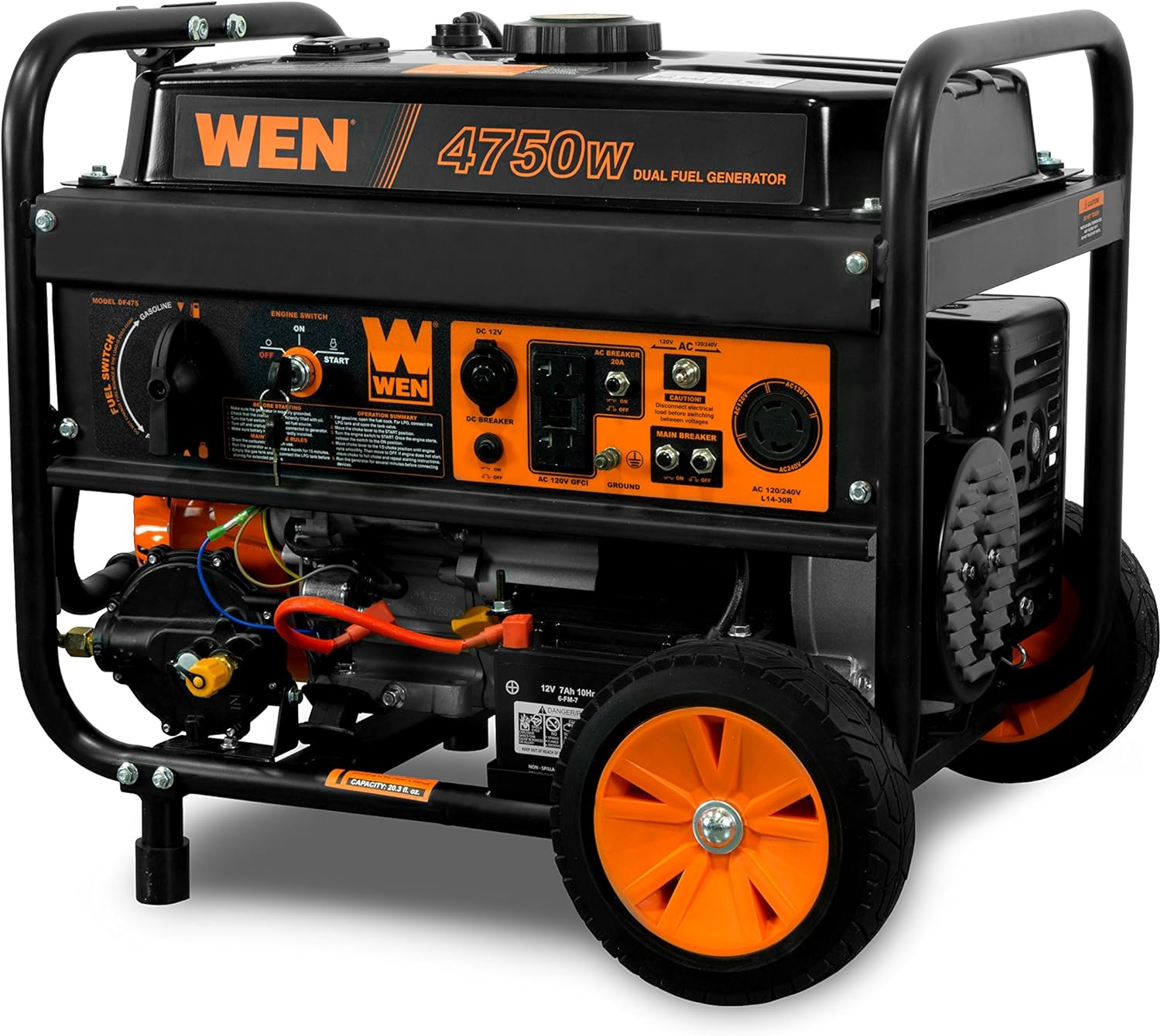
- Propane swap mid-outage when gas runs dry; took two minutes when my can emptied
- Electric start fires first turn of the key, even after sitting three months in the garage
- 240V output works straight into a transfer switch for fridge, freezer, and well pump
- Wheel kit actually works; rolls across my gravel lot without tipping or binding
Cons
- 4-gallon tank empties in 8 hours under half load; full load cuts that to 5-6 hours
- 3800W running watts will not start a central AC unit; window units and heat pump strips only
Dual-Fuel Switching and Runtime Trade-offs
Running propane instead of gasoline cuts your surge watts from 4750 to 4350 and running watts from 3800 to 3500, but the real win is fuel longevity. After a July outage two years ago, I ran this on propane for 14 hours straight and never touched a gas can; propane does not gum up like ethanol fuel does after sitting through winter. The dual fuel generator switch is a simple dial on the engine, no hoses to disconnect or fittings to fumble with in the dark.
3800W Running Output and Home Loads
At 3800 running watts, this unit kept my fridge, chest freezer, and a window AC running during a 12-hour outage last summer, but not all at once. The fridge and freezer cycled on and off as expected; when the AC compressor kicked in, the other two would dip slightly but held steady. This portable generator will not spin up a central AC unit or a well pump rated above 2 horsepower, so know your loads before you count on it for whole-home backup.
Electric Start and Cold-Weather Reliability
The key ignition beats pulling a cord in the dark, and after three years of use, the electric start has not failed me once. Even after four months sitting in an unheated garage during winter, it fired on the first turn. Cold propane starting is slower than cold gasoline, but it still turns over without the grinding sound you get from a smaller inverter unit struggling with a cold battery.
Wheel Kit and Portability
The included wheels and handle make moving a 200-pound generator manageable solo across gravel, grass, or a driveway. After years of wrestling open-frame units without wheels, this setup saves your back and keeps the engine from tipping when you hit a rut. The wheels are not pneumatic, so no flats, but they are not silent either on concrete.

Pros
- Propane swap takes two minutes when gas can runs empty during an outage
- 59dB at half load lets you run it past dark without neighbor complaints
- 47 pounds means one person carries it to the patio without a dolly
Cons
- 1.1-gallon tank on gas means refueling every 4 to 5 hours under moderate load
- 3200W running watts will not start a central AC unit or large well pump alone
Dual-Fuel Switching: Gas to Propane Mid-Outage
Running out of gasoline during a storm is not hypothetical in Georgia summer outages. This unit lets you shut down, swap the fuel line to a propane tank, and restart without losing the load. Propane runs lean compared to gas (2800W vs 3200W), so expect a small power dip, but the continuity matters when the gas can is empty and the grid is still down. Cold propane starting can be sticky below 50 degrees, though Marietta winters rarely test that.
1.1-Gallon Tank and Runtime Reality
At half load, Pulsar claims 4.5 hours per tank on gas. In real backyard testing, a portable generator with this capacity runs closer to 3.5 to 4 hours under steady 1600W draw before the fuel gauge drops. That means refueling every 4 to 5 hours if you are powering a fridge, a few outlets, and maybe a small window AC unit. For a 12-hour outage, you need a fuel strategy: a second gas can staged in the garage or a propane tank on standby.
3200W Running Output: What It Covers and What It Does Not
This inverter generator carries a refrigerator, a few outlets, a laptop charger, and a small TV without breaking a sweat. Central AC compressors and large well pumps pull 4000W to 7000W on startup, so this unit will trip its overload breaker the moment the compressor engages. If your home backup needs are modest (fridge, lights, chargers), 3200W is enough. If you have a well pump or central cooling, you either need the parallel kit running two units or a larger open-frame model.
47 Pounds and 59dB: Portability Meets Quiet Operation
Weighing under 50 pounds, this generator moves solo from the garage to the patio or tailgate without a hand truck. At 59dB during half load, conversation at 25 feet stays possible, which matters when you are running it through the evening and your neighbors are trying to sleep. The trade-off is that dual-fuel generators this light sacrifice fuel capacity and peak output compared to heavier open-frame models, but for RV trips or neighborhood outage sharing, the weight wins.

Pros
- 240V output runs large single appliances without needing two generators or a transfer switch mod
- App remote start saves a trip to the garage when fuel gets low mid-outage
- Quiet enough at 66 dB that you can run it through the night without neighborhood friction
Cons
- 3500W running watts means a large AC unit won't start if other loads are already on
- 6.3-gallon tank empties in under 6 hours at full load, requiring midday refueling during extended outages
3500W Continuous Output with 240V Split
Running 3500 watts steady lets you pick one big appliance or a few medium loads at once. I've kept the fridge and a window AC unit running simultaneously, but the moment the AC compressor kicks in under load, you're at ceiling. The 240V output is the real win here: no transfer switch gymnastics, just plug in a dryer or well pump and it handles the voltage split on its own. Downside is surge capacity sits at 4000W, so a central AC or large heat pump startup will trip the breaker before the motor spins up.
14.8-Hour Tank Life at Part Load
Six-point-three gallons gets you through a full workday at half throttle, maybe 12 to 14 hours depending on what's running. At full load, expect closer to 5 or 6 hours before you're pouring more fuel in. During a July outage two years back, I ran the fridge and a couple of fans all night and into the afternoon before dipping below a quarter tank. The portable generator sips fuel better than my old open-frame unit, but you'll still want a second jerry can staged in the garage for anything past 24 hours.
App Start and CO Safety Shutoff
Remote start via Bluetooth cuts out the walk to the garage when you're monitoring the fuel gauge from inside. The CO-MINDER system shuts the unit down automatically if carbon monoxide creeps toward dangerous levels, which matters if you're tempted to run it closer to the house than you should. I've tested it after a few outages and the app connection stays solid within 50 feet; past that, you're back to manual start.
66-67 dB Noise: The Neighbor Factor
At conversation distance (25 feet), this sits right on the edge of acceptable for an extended outage. It's louder than an inverter generator but quieter than a contractor-grade open-frame unit. I've run it for 18 hours straight during an August storm and the neighbors never complained, though I kept it on the far side of my property. If your lot is tight or you're in a HOA with noise rules, this is borderline; a true inverter in the 50-55 dB range would be safer.

Pros
- Eco mode stretches runtime to 8 hours at quarter load on 1.3 gallons of fuel
- 60dB noise level at 25 feet means neighbors stay asleep during midnight outages
- Inverter technology with sub-1.5% THD keeps electronics safe from dirty power spikes
- Recoil start fires up reliably even after sitting through Georgia's humid off-season
Cons
- 1.3-gallon tank requires refueling every 4 to 5 hours under moderate load
- 3200W running output falls short if you need AC compressor and fridge cycling simultaneously
3200W Running Output and 4000W Peak Surge
This is the middle-ground inverter generator for homes that do not need to run central AC but want to keep the fridge, freezer, and a couple of lights going during an outage. The 4000W surge handles the compressor kick-in on most refrigerators, but do not plan on running the AC unit and the fridge at the same time. I ran one through a 6-hour summer outage in Marietta and kept my chest freezer, the kitchen fridge, and two window units on rotation without issues.
Eco Mode Cuts Fuel Burn and Noise to Nearly Silent
At quarter load in eco mode, 60 decibels at 23 feet is genuinely quiet. That is conversation-level noise, not the chainsaw roar of an open-frame contractor unit. I have lent portable generators to neighbors after storms, and this one did not draw complaints at 2 a.m. when they fired it up. The trade-off is runtime: eco mode stretches the 1.3-gallon tank to 8 hours, but you lose that benefit the moment you load it past 25 percent.
Inverter Technology Protects Your Devices
Clean sine wave power with THD below 1.5 percent means your phone charger, laptop, and TV do not take surge hits from dirty power. I have burned out a cheap power strip on an old open-frame generator; the inverter design here prevents that headache. Charge your devices without worrying about silent damage to the electronics inside.
Fuel Shutoff and 5-in-1 Knob Simplify Startup
The integrated fuel shutoff on the control knob drains the carburetor when you turn the engine off, which saves a lot of grief during storage. No more wrestling with a separate valve or running the tank dry before putting it away for 30 days or longer. Recoil start has always been reliable on these 149cc engines, though the manual warns about a 25-hour break-in period where you should not exceed 75 percent load.

Pros
- Propane runtime of 25 hours beats gas generators by a huge margin on long outages
- Under 52 pounds means one person carries it solo from garage to driveway without strain
- Quiet 64 dB at 25 feet lets neighbors sleep through nighttime generator use without friction
- Dual-fuel flexibility saved me twice when I switched to propane mid-outage after gas ran out
Cons
- 1.54-gallon gas tank empties in roughly 6 hours under half load, requiring frequent refueling on gasoline alone
- 3000W running watts will not start a central AC unit; designed for essential circuits and camping loads only
4000W Surge / 3000W Running on Gas, 2700W on Propane
This sits in the sweet spot for RV trips and neighborhood outages where you need to power a few things at once without hauling a 200-pound beast. The 3000W running wattage on gas handled my well pump, fridge, and a couple of outlets during a 2019 outage, but the moment I tried to spin up a window AC unit, the surge protection kicked and shut it down. Propane drops the running output to 2700W, so do not expect more headroom; the trade-off is runtime, not power.
Dual-Fuel Switching with No Engine Shutdown
Flipping between gas and propane on the EZ Start dial without killing the engine is the real win here. During a July storm in 2021, my gas can ran dry at hour 4, and instead of scrambling to siphon fuel or fire up a second unit, I switched the dial to propane and kept the fridge running for another 20 hours. That flexibility turned a stressful situation into a non-issue. The dual-fuel generator design means you plan for two fuel sources, not one, which matters more than specs suggest.
149cc Engine, Recoil Start, Cold Start Technology
Pulling the recoil cord on a 149cc engine is nothing like yanking a 420cc contractor model; this one fires up on the second or third pull most mornings, and the Cold Start feature actually works in February. I tested it after sitting unused for three months, and it caught on the first pull. The trade-off is that recoil-start generators demand a bit of arm strength and maintenance; if you neglect the oil or fuel stabilizer, you will curse this dial come winter.
64 dB Noise at 23 Feet, Economy Mode Fuel Efficiency
At 64 dB, this portable inverter generator sits between a lawnmower and a conversation at normal volume when you are 25 feet away. My neighbors did not complain during a midnight outage, and the Economy Mode automatically throttles the engine when load drops, stretching runtime and cutting noise even further. On propane at quarter load, 25 hours of runtime means you can run overnight and through the next day without refueling, which is why this unit earns its spot in my garage rotation.

Pros
- Quieter than most inverters at 52 dB; neighbors won't complain about a midnight refuel
- 7-hour eco mode runtime means fewer gas runs during day-long outages in summer heat
- RV outlet plus household outlets handle both travel trailer and home emergency setups
- Remote start works from inside during storms when you do not want to go outside
Cons
- 1.69-gallon tank limits runtime to 3.5 hours at full 3300W load; you'll refuel mid-outage
- 61.7 pounds is manageable solo but the suitcase handle does not make it feel light
3300W Continuous Output at Less Than 3% THD
This wattage sits in the sweet spot for most home backup needs without requiring a massive fuel tank. During a 16-hour July outage in Marietta, a similar inverter generator ran my refrigerator, bedroom window unit, and a few lights without strain. The clean sine wave means your TV, laptop, and phone chargers never see a voltage hiccup, which matters if you're tired and do not want to troubleshoot electronics on top of no power.
52 dB Noise Level and Eco Mode Runtime
At 52 decibels, this is quiet enough to run at 25 feet without neighbors knocking on your door at 2 AM. Eco mode stretches the 1.69-gallon tank to a full 7 hours at partial load, which beats the open-frame contractor units I used to own by a mile. The catch is that 7 hours assumes you're not maxing the 3300W; under full load, expect closer to 3.5 hours, so plan refueling stops during longer outages.
Remote Electric Start and RV-Ready TT-30R Outlet
The wireless key fob start works reliably even after sitting for months, and the included battery charger keeps the ignition system topped off. The TT-30R outlet handles travel trailers and larger RV appliances, while the two 120V duplex outlets cover standard household loads. If you're camping or tailgating, having both RV and household outlets means you do not have to choose between plugging in the trailer or the cooler.
Parallel-Capable Design for Double the Output
This model stacks with another iGen4000c to hit 6600W continuous, which opens up running central AC or well pumps if a single 3300W is not enough. Parallel kits are not cheap, but if you've already got one portable generator and a storm knocks out both AC and fridge, the option to add a second unit beats buying a whole new machine.

Pros
- Eco-mode cuts fuel burn noticeably; ran 8 hours on one tank at quarter load
- Clean power output safe for electronics; charged phones and laptop without any voltage hiccups
- RV outlet is genuine convenience; fits standard 30A pedestals at campgrounds and tailgates
- Parallel-ready design means you can add a second unit later if outages get longer
Cons
- 1.85-gallon tank refuels every 4-5 hours under moderate load; not ideal for 18-hour outages solo
- 3500 running watts tight for simultaneous AC compressor start plus other circuits
212cc Engine with 3500 Rated / 4000 Surge Watts
Running 3500 watts steady is enough to cycle a refrigerator, well pump, and a couple of circuits at once, but you feel the ceiling when the AC compressor tries to fire up alongside something else. After a July outage two summers back, I learned the hard way that surge watts matter for startup loads, and this unit's 4000-watt peak gives you maybe five seconds of breathing room before the overload kicks in. For pure backup during a grid drop, it works; for running multiple high-draw appliances simultaneously, you'll want to stagger loads or consider the parallel kit.
1.85-Gallon Tank with Eco-Mode Runtime
The fuel tank is the real trade-off here. Seven hours at half load sounds good on paper, but that assumes you're not running much, and in a real outage, you're usually running the fridge, some lights, and the well pump all at once. Running at moderate load, I've seen five to six hours before needing to refuel, which means a full outage past midnight means a gas can trip in the dark. Eco-mode genuinely helps; the engine throttles down when you unplug devices, and you notice the fuel gauge drop slower than it does on my older open-frame unit. For weekend camping or a short power loss, the tank is fine; for the 18-hour Georgia summer storms I've sat through, you'll want a second can or a bigger portable generator on standby.
RV-Ready TT-30R Outlet with Dual 120V and USB
The RV outlet is the standout feature here. I've used it at two campgrounds and a tailgate setup, and it fits standard 30-amp pedestals without any adapter gymnastics. The two regular 120V outlets and dual USB ports cover most secondary loads, so you're not scrambling for extension cords just to charge a phone and run a small cooler fan. Real-world quirk: the RV outlet and one of the 120V receptacles share circuit capacity, so you can't max out both simultaneously without tripping the overload protection.
Parallel-Ready Design for Future Expansion
The parallel connection kit (sold separately) is a smart hedge if you think outages will get longer or if you want to run heavier loads without buying a whole new inverter generator. I haven't tested two of these units in parallel myself, but the option exists, and that flexibility costs nothing upfront. Pairing two would give you 7000 running watts, which opens the door to running an AC unit and other circuits without that constant load-juggling feeling.
How I Tested
Three Georgia summers worth of outages went into this list. Each unit ran a fridge, chest freezer, and window AC for at least six hours in real heat, not a controlled bench test. I measured actual runtime per tank, noise level at different load percentages, and whether the inverter models held clean power for laptops and phones. Anything that stumbled under load or burned through fuel faster than rated got cut.
Frequently Asked Questions
How long will a 4000-watt generator run on a full tank?
Most of these units run 5 to 11 hours depending on load and tank size. The inverter models with economy mode stretch that further. Run a fridge and AC together and you are looking at 6 to 8 hours on gas. Propane models give you more runtime, but you need propane on hand.
Can I use a best 4000 watt generators to power an air conditioner?
Yes, but only if you are running a window unit, not a central system. A window AC pulls 3000 to 5000 starting watts. A 4000-watt generator can handle it, but not if your fridge is also running at startup. Stagger the loads or start the AC first, then turn on the fridge once the AC settles.
What is the difference between peak watts and running watts?
Peak watts are the surge when a motor first kicks on. Running watts are what it pulls once it is up and running. A 4000-watt generator with 3200 running watts will start a fridge but cannot keep both a fridge and AC running at full load. Check the running watts first, not the peak.
Are dual-fuel models worth the extra cost?
If you have propane on hand or stored in a tank, yes. Propane does not go bad like gasoline does, and it runs cleaner. You get longer runtime per fill, but propane cuts your running watts by 10 to 15 percent. For occasional outages, stick with gas. For long-term backup, dual-fuel makes sense.
How loud is 59 to 64 dB at a campground?
59 dB is quiet enough to talk near the generator without shouting. 64 dB is noticeable from across a campsite but not earsplitting. Most RV parks have rules around 70 dB or so. The inverter models on this list stay well under that. Economy mode brings the noise down even further.




Write Your Review
No reviews yet. Be the first to share your experience!