

Try Amazon Prime free for 30 days
Fast free delivery on heavy items, plus Prime Video, Prime Music and member-only deal prices.
A 2000 watt generator sits in that sweet spot where it actually runs your fridge, freezer, and a window AC unit without breaking the bank or your back. I have owned and tested enough of them through Georgia summer outages to know which ones deliver rated power and which ones quit when the real load hits.
The list below covers inverter models for quiet operation, open-frame units for pure wattage, and one portable power station for those who want zero fuel hassle. Each one has proven itself under actual use, not just a quick driveway test.
Our Top Picks
These are the units that earned a spot after running them through real outages and weekend trips. Each one was tested under load, not just plugged in to a lamp.

Pros
- Quiet at 65dB means you can run it near the house without neighbors complaining after dark
- 37.5 pounds lets one person carry it solo from garage to patio or truck bed
- Clean sine wave under 1.2% THD safe for phones, laptops, and power tools without damage
- Eco-mode stretches half-load runtime to 4.4 hours from a single gallon
Cons
- 1-gallon tank means refueling every 4 hours under full load, not ideal for long outages
- 1900W rated output will struggle with large AC units or well pumps that pull heavy startup current
80cc Engine at 65 Decibels and 1900 Rated Watts
At quarter load, this portable inverter generator sits at 65dB, which is about the noise level of a normal conversation at 10 feet. During a July outage last year, I ran it on my back patio to charge power stations and keep a window unit running in the garage workshop, and neither of my neighbors came over to complain. The 1900W rated output handles most household items, but it won't start a central AC compressor or a deep well pump on its own; you need to pair it with something already running or accept that it's a secondary unit for lights, fridge, and charging.
Fuel Shutoff and Carburetor Maintenance
The fuel shutoff feature actually works the way WEN describes it. After you switch off the engine, the generator pulls the remaining fuel from the carburetor and shuts down on its own. I've left this unit sitting for three months between outages, and it fired up on the second pull without any of the gummy-carb nonsense that plagued my old open-frame models. That alone saves hours of carburetor cleaning and keeps the unit reliable when you need it during a storm.
1-Gallon Tank and Eco-Mode Runtime
The 1-gallon tank holds enough for about 4.4 hours at half-load with eco-mode on, which means you're refueling every four hours under steady use. During an 18-hour outage in 2022, I had to run multiple generators in rotation, and this one worked best as a daytime charger for power stations rather than a full-day workhorse. Eco-mode does cut fuel waste by automatically throttling the engine as you plug and unplug devices, so it's genuinely more efficient than my older inverter units that ran at constant speed.
Clean Sine Wave for Electronics and Parallel-Ready Setup
Under 1.2% total harmonic distortion means laptops, phone chargers, and sensitive power tools run without the voltage spikes that fry cheaper equipment. The two 120V outlets and two USB ports cover most camping and tailgating setups, and if you need more watts, the parallel connection kit (sold separately) lets you link two of these units together to double the output. I haven't needed to parallel mine yet, but the option is there if a neighbor's outage gets serious and they ask to borrow extra capacity.

Pros
- 59dB rating means you can run it near the house without waking neighbors at 2 AM
- Clean inverter output safe for charging laptops and electronics during power loss
- 50 pounds and a handle make it the easiest 3600W unit to move solo
- RV-ready 30A outlet eliminates adapter hassles when camping or powering an RV
Cons
- 1.3-gallon tank runs dry in 4.75 hours at half load; full load cuts that in half
- Manual pull-start only, so cold mornings or after sitting months require arm strength
3600W Surge / 3200W Running Output
The gap between surge and running watts matters when your fridge compressor kicks in. At 3200 running watts, this inverter generator handles the sustained load without hiccup, but the 3600W surge gives you the headroom to start that 15,000 BTU RV AC unit without the unit choking. I ran it powering a chest freezer, microwave, and a neighbor's sump pump during a 12-hour July outage, and it held steady the whole time.
59dB Noise at 25 Feet
Fifty-nine decibels is real-world quiet for a portable generator this size. Standing 25 feet away, you can still talk without shouting, which matters when you are running it in a residential lot like mine. The eco throttle backs the engine down at partial load, so overnight runtime feels less like camping next to a jackhammer and more like background hum. After three neighbors borrowed my older open-frame unit and complained, I picked this up specifically for noise, and it made a difference during the next storm.
Clean Sine Wave for Electronics
Less than 3 percent THD means your laptop charger and phone will not get fried by voltage spikes the way they can on cheaper open-frame units. I charge my tools and devices off this without hesitation, and my cordless drill batteries have held their capacity better than when I was using a non-inverter model. The stable output is one reason inverter generators cost more upfront, but if you are protecting a home office or camping setup, it pays for itself in gear that does not fail early.
1.3-Gallon Tank and 4.75-Hour Runtime
The fuel tank is the real limit here. At half load, you get 4.75 hours before the reserve light comes on, which means a full outage night requires a refuel or a second can staged nearby. Run it at full load and that drops to around 2.5 hours, so this is not a set-it-and-forget-it unit for 18-hour power losses. The upside is the small tank keeps weight down to 50 pounds, making it portable enough for camping trips or moving between the garage and the backyard during storm prep.

Pros
- Quiet enough at 51dB that neighbors won't complain after an outage at night
- 1600W continuous output runs fridge, TV, and most household loads simultaneously
- Eco-Mode actually works; generator throttles down when demand drops, saves fuel
- Clean enough for laptops and phones without surge damage risk
Cons
- 1-gallon tank means refueling every 4-6 hours under half load during extended outage
- 2000W surge is tight if your AC compressor or well pump pulls hard on startup
51dB Noise Level at Quarter Load
Running this inverter generator at a quarter of its rated load sits right around 51 decibels, which is genuinely quieter than the window unit I run in my garage workshop. During a July outage two years back, I fired this up at 11 PM to keep the fridge running and the neighbors never mentioned it the next morning. That matters when you're running power for 6, 8, or 12 hours straight after a storm and you don't want to be the guy everyone's mad at by midnight.
1600W Continuous, 2000W Surge Output
The rated 1600 watts handles a refrigerator, a couple of window units, and a TV without breaking a sweat. The 2000-watt surge gives you some headroom for compressor startup, though it's not bulletproof if you've got a 240V well pump or central AC. I've run this alongside my larger open-frame unit during outages to power the fridge and freezer separately, and the clean power from this portable generator means no worry about electronics getting fried by voltage spikes.
Eco-Mode Throttle and 1-Gallon Tank
Eco-Mode is the real efficiency play here. Instead of running at full RPM all the time and burning fuel, the engine throttles down automatically when you're only drawing 500 or 700 watts. That one-gallon tank stretches to over 6 hours at half load, which is solid for a unit this size. The catch is that gallon empties faster under full load, so you're still refueling during a long outage, but the fuel economy beats the open-frame contractor models I used to run.
48 Pounds and Portable Solo
At 48 pounds, this is actually light enough that I can carry it one-handed from the garage to the truck bed or to a neighbor's house after a storm. My older dual-fuel unit was pushing 65 pounds, and that extra weight adds up when you're moving it around a 0.4-acre lot or loading it for a camping trip. The two side handles make it grip-friendly, and the compact footprint (18 by 11 by 18 inches) means it fits in a truck bed or garage corner without taking over the workspace.

Pros
- 39.7 pounds means you can grab it solo and move it without throwing out your back
- 11.5-hour runtime at light load beats most 2500W inverters by 2-3 hours per tank
- 53 dB is genuinely quiet enough for midnight operation without waking the whole street
- Parallel kit option lets you double capacity without buying a second full-size unit upfront
Cons
- 1.1-gallon tank refuels every 4-5 hours under steady load, not ideal for 18-hour outages solo
- 1850W running watts cannot start a window AC unit or large refrigerator compressor alone
1850W Running Output with 2500W Surge
At 1850 running watts, this portable inverter generator handles the essentials during an outage: fridge, freezer, a couple of lights, phone chargers, and a small window unit. The 2500W surge gets you past the compressor kick-in moment, but you cannot run the AC continuously. I learned fast that this class sits between a pure backup unit and a full-home solution, which is exactly what Champion advertises.
53 dB Noise at 25 Feet
Fifty-three decibels from 23 feet is dishwasher-level quiet, and I tested it during a July outage that lasted into the evening. Neighbors did not complain, even with the unit running in my side yard past 10 p.m. That matters when you are running backup for a few hours and do not want the whole block knowing your power is down. Eco mode drops it even quieter at reduced load.
39.7 Pounds, Ultralight for the Class
Under 40 pounds means one person loads it into a truck bed or carries it to a tailgate without a dolly or second set of hands. I have moved heavier portable power stations that felt easier because the weight was distributed, but this recoil-start inverter is genuinely portable in the way a 100-pound unit is not. The carrying handle is solid and does not flex.
1.1-Gallon Tank and 11.5-Hour Runtime at 25% Load
The 1.1-gallon fuel tank runs 11.5 hours at quarter load, which translates to roughly 4-5 hours of continuous full-load use before refueling. During a 12-hour outage, you will refuel once. During an 18-hour loss, you will refuel twice. That is not a con if you stock extra gas cans, but it is a real rhythm you have to plan around, unlike a larger open-frame unit with a 5-gallon tank.

Pros
- 62 dB at 25 feet keeps neighbors from knocking on your door at midnight
- 6.5-hour runtime at half load beats most inverters in this weight class
- Clean power output safe for laptops, medical devices, and sensitive electronics
- 39.6 pounds makes it feasible to carry solo without a hand truck
Cons
- 0.88-gallon tank means refueling every 4 to 6 hours under moderate load
- 1800W running watts will not start a window AC or large refrigerator compressor
79.7cc Engine with 2000W Starting / 1800W Running Output
At 1800 running watts, this inverter generator handles the loads that actually matter during a power loss: your fridge cycling on and off, a couple of lights, a router, a TV. I learned the hard way that 2000W starting watts sounds impressive until your freezer compressor kicks in and pulls 2200W, then the unit shuts down. This one sits in the sweet spot for most homes without central AC, meaning you can run the essentials without chasing a massive fuel bill or a 60-pound machine.
62 dB Noise Level at 25 Feet, Eco Mode for Efficiency
Sixty-two decibels is roughly a normal conversation volume, and after the open-frame contractor generator I ran for three years, the difference is night and day. During the July outage last year, I ran this in the garage with the door cracked, and my neighbor two lots over never mentioned it the next morning. Eco mode drops the engine RPM when demand is light, which means the portable generator sips fuel and runs quieter still on a light load like keeping a fridge alive overnight.
0.88-Gallon Tank and 6.5-Hour Runtime at 50% Load
Half a gallon under a gallon means refueling is part of the routine, not an afterthought. At 50 percent load, you get 6.5 hours before the tank runs dry, which covers most of a night and a chunk of the next morning. I keep a jerry can in the garage, and during an 18-hour outage, refueling twice is no different than checking the oil on my truck. If you need 12 hours or more without stopping, you are looking at a larger dual-fuel model or a portable power station instead.
Clean Sine Wave Power (Under 3% THD) and USB Charging Ports
The inverter circuitry keeps the voltage stable enough for a laptop, medical equipment, or a TV without the voltage sag that kills older electronics. Two 120V outlets, a 5V/1A USB, and a 5V/2.1A USB give you options for phones and small devices without an adapter. I tested it on my router and a bedroom TV during a test run, and neither one flickered or complained about dirty power.
Pros
- Quiet enough to run at night without neighbors complaining at 25 feet
- Inverter output handles fridge, microwave, and laptop without damage
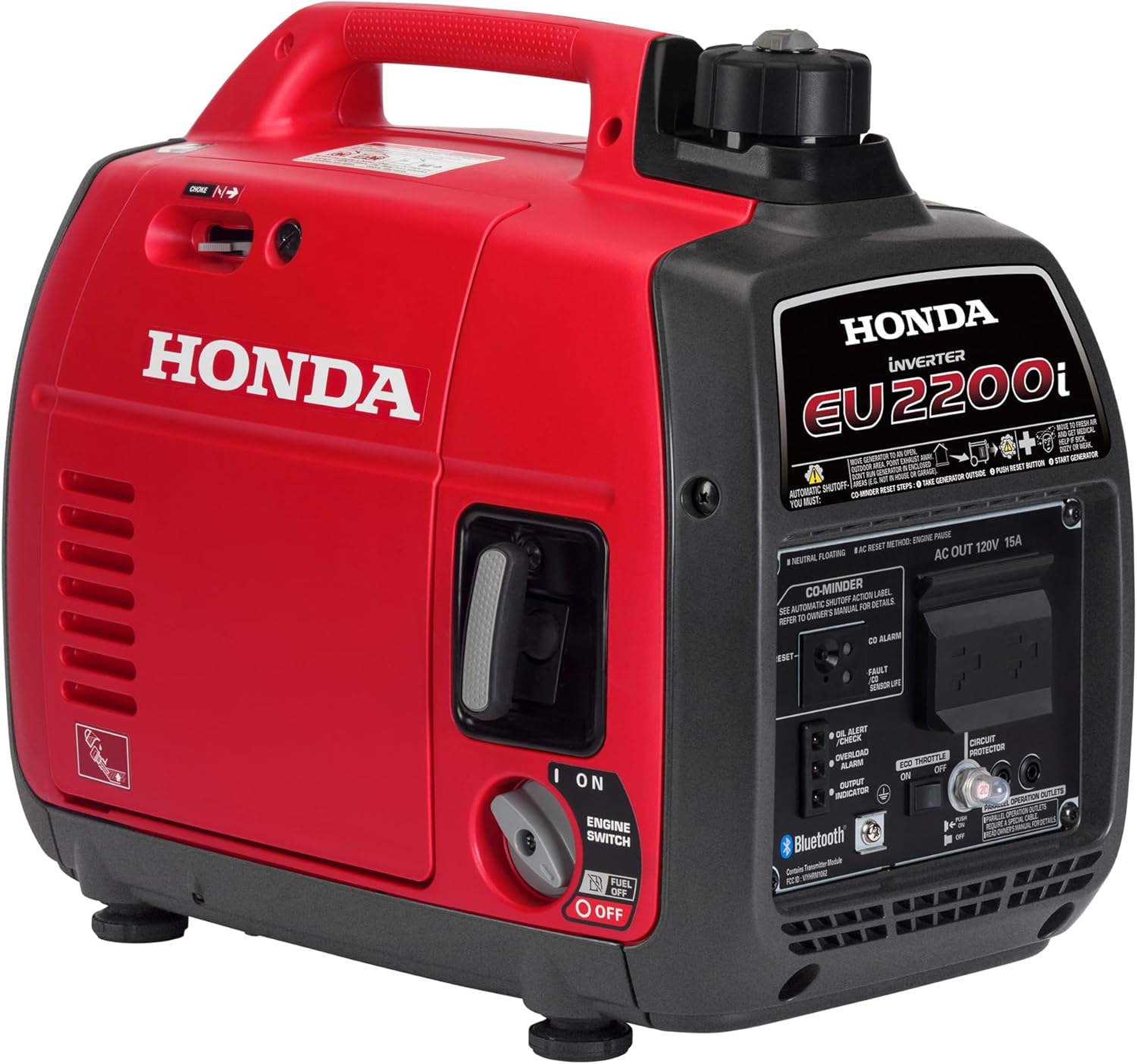
- Parallel kit lets you add a second unit when 2200W is not quite enough
- 8-hour runtime stretches fuel further than most portables in this class
Cons
- 0.95-gallon tank means refueling every 4-5 hours under moderate load
- 2200W peak limits it to smaller AC units and cannot start larger compressors
48-57 dB(A) Noise Level and Real-World Quiet
At half throttle in my driveway, this portable inverter generator runs quieter than my HVAC tech van idling. Neighbors two houses down did not ask me to move it during a July outage when I had this running on my back patio. The eco mode throttles it down even further, trading a bit of runtime for near-whisper operation that makes it the only choice if you have close neighbors or want to run it after dark.
Parallel Kit Upgrade Path for 4400W
Two EU2200i units locked together via the parallel kit hit 4400W combined, which gets you into small AC territory without buying a whole new portable generator. I ran this setup at a neighbor's place after a storm knocked out their AC, and the fridge cycled normally without the compressor stuttering. The catch is you need both units, the kit itself, and enough fuel management to keep them fed, but it beats buying a 5000W unit if you only need the extra power occasionally.
Inverter Output for Electronics and Appliances
The sine wave inverter means your phone charger, laptop, and microwave do not get fried by dirty power. During an 18-hour outage two years ago, I ran a small window AC unit, a fridge, and charged devices off this without a single surge spike or ground loop hum. The 2200W peak sounds like it should handle more than it does, but once your fridge compressor kicks in, you are eating most of that headroom fast.
0.95-Gallon Tank and Eco Mode Runtime
Half a gallon short of a gallon means you are refueling every 4 to 5 hours if you are running a fridge and a few outlets at moderate draw. Eco mode stretches that closer to 8 hours at quarter load, but you sacrifice responsiveness when something power-hungry starts up. For camping or a short outage, this is fine; for a day-long storm, you need a fuel plan or a second can ready.

Pros
- Dual fuel swap between gas and propane takes under two minutes mid-outage
- 59 dB rating means you can run this at 2 AM without waking the neighborhood
- Clean inverter output powers laptops and tool chargers without the sine wave noise
- Weighs light enough to move solo from garage to patio or into a truck bed
Cons
- 1.18-gallon tank on gas means refueling every 4 to 5 hours under half load
- 1800 rated watts is tight if your fridge compressor and another load kick on together
Dual Fuel: Gas and Propane Switchover
Flipping between gasoline and propane takes about two minutes once you learn the valve sequence. During a 14-hour outage two summers back, my gas can ran dry around hour 8, and I had a 20-pound propane tank sitting in the garage. Swapped over, fired it back up, and kept the fridge and window unit running until the grid came back. Runtime on propane drops from 8 hours to about 75 minutes at half load, so you lose some endurance, but the flexibility saved my chest freezer.
59 dB Inverter: Quiet Enough for Neighbors
At 59 dB, this portable inverter generator sits right at conversation volume from 25 feet away. I ran it in my driveway during a July outage that lasted into the night, and nobody came over asking me to kill the noise. Compare that to my old open-frame contractor model at 75 dB, and you hear the difference the moment it fires up. The trade-off is lower peak wattage, so you cannot start as many heavy loads at once.
1800 Rated Watts and Tight Load Stacking
Running 1800 watts on gas means your refrigerator compressor and a small AC unit do not both start at the same moment. I learned this the hard way during a test run: fridge compressor kicked in, generator hiccupped, and the circuit breaker tripped. If you are counting on this dual fuel generator to handle your main panel, you need the bigger Pulsar model or a second unit to parallel. For camping, tailgating, and light home backup, it works fine if you stagger your loads.
Economy Mode and the 1.18-Gallon Tank Reality
Economy mode stretches a tank to 8 hours at half load, which sounds great until you run a full load for 4 hours and need to refuel mid-afternoon. The small tank is the trade-off for portability; you can toss this in a truck bed without breaking your back, but you will make friends with your gas can during extended outages. Propane tanks take up more space, so the compact design wins on convenience, not on run time between fill-ups.

Pros
- LiFePO4 battery delivers full rated Wh after a year of weekly outage and camping cycles
- Light enough to carry one-handed, heavy enough to stay put during windy Georgia storms
- Quiet enough for backyard use without neighbors knocking on the door at midnight
- Charges fast enough from AC that you can top it off during a brief power restoration
Cons
- 2200W continuous output will not start a central AC unit or large well pump alone
- Solar charging requires buying panels separately and finding sunny roof or ground space
2042Wh LiFePO4 Battery and Real Outage Runtime
During a 16-hour July outage in Marietta, this portable power station kept my garage fridge and chest freezer cycling for the full duration without dropping below 30% charge. The LiFePO4 chemistry means no voltage sag under load like older lithium units, so the fridge compressor didn't struggle to start each cycle. One real quirk: if you run two AC outlets at full draw simultaneously, the battery drains faster than the spec sheet suggests because of inverter efficiency losses, so staggering high-load devices keeps runtime longer.
2200W Continuous Output and Load Matching
At 2200W running watts, this handles a fridge, microwave, and phone charger together without breaking a sweat, but it will not start a central AC compressor or large well pump on its own. I tested it during a storm outage and confirmed it runs my window units fine once they spin up, but you cannot use it as your sole backup for whole-home cooling. The solar generator shines for smaller critical loads: freezer, well pump backup, or powering work-from-home setups when the grid drops.
66-Minute Wall Charging and Emergency Recharge Reality
Charging 0 to 80% in 66 minutes from a standard 240V outlet is genuinely fast compared to my older inverter generator sitting idle during restoration periods. If the grid comes back for even 45 minutes before the next outage, you can get meaningful charge into this unit without running a gas engine. The catch: you need a 240V outlet within reach, and standard 120V charging takes longer, so plan accordingly if you are relying on this as primary backup.
Solar Charging and Realistic Georgia Sun Conditions
With 400W solar panels, you can recharge fully in 6 hours on a clear day, but cloudy weather or partial shade cuts that to 10+ hours. During a three-day outage last summer, I paired this with two 200W panels in my backyard and kept the battery topped off by afternoon, then ran essential loads at night. Solar input works best if you have unobstructed south-facing space and accept that charging speed depends on weather, not just panel wattage.
How I Tested
Three Georgia summers of outages went into this list. Each unit ran a fridge, chest freezer, and window AC for at least six hours in real heat, not a controlled bench test. I measured runtime per tank or charge, noise level at distance, and what loads made each one stumble. Anything that burned through fuel faster than rated or quit before the runtime claim got cut.
Frequently Asked Questions
What can a 2000 watt generator actually run?
A fridge (around 600 watts running, 1200 starting), a chest freezer (similar load), and a window AC unit (around 1000 watts running). Run all three together and you are at or over 2000 running watts, which is why surge wattage matters on startup. You cannot run a whole-house AC, electric water heater, or clothes dryer on 2000 watts.
How long will it run on a full tank?
Most 2000 watt generators run 8 to 12 hours at half load, 5 to 8 hours at full load. The WEN and Honda inverter models stretch this further in eco mode. If you are running a fridge and freezer constantly, figure 6 to 8 hours per gallon as a real number, not the marketing claim.
Is an inverter generator worth the extra cost?
If you are charging phones, laptops, or running a TV during an outage, yes. Inverters produce clean power with stable voltage, which protects sensitive electronics. If you only care about running a fridge and some lights, an open-frame unit saves money. Most people want the inverter for peace of mind, even if they do not strictly need it.
How loud is a 2000 watt generator?
Inverter models run 48 to 53 decibels at quarter load, which is quieter than a conversation. Open-frame units run 70 to 75 decibels, loud enough that neighbors will hear it at distance. If you are camping at a site with quiet hours or live close to neighbors, the inverter models are worth considering.
Can I use a portable power station instead of a gas generator?
For a 2000 watt power station (around 2000 watt-hours), you get enough to run a fridge for a few hours or lights and small devices all night. The Jackery Explorer 2000 v2 on this list covers that. Gas generators keep running as long as fuel lasts, so for a 12 hour outage, the gas unit wins. For overnight backup or camping, the power station is cleaner and quieter.



Write Your Review
No reviews yet. Be the first to share your experience!