

Try Amazon Prime free for 30 days
Fast free delivery on heavy items, plus Prime Video, Prime Music and member-only deal prices.
Remote start generators let you fire up power from across the yard or inside the house without walking out to pull a cord or hit a button. After running them through Georgia outages and weekend trips, I’ve learned that best remote start generators come down to what you actually need to power and how far away you want to be when you start it.
The units below all have either a wireless key fob or app-based start, and each one handles different load levels. Some are built for essentials during an outage, others for RV camping or dual-fuel flexibility. Here’s what earned a spot after real testing.
Tom’s Top Picks
These are the units I’d buy if I were shopping today. Each one was tested under load, not just plugged in to a lamp. Below are the ones that held up.

Pros
- Quieter than most inverters at 52 dB; neighbors won't complain about a midnight refuel
- 7-hour eco mode runtime means fewer gas runs during day-long outages in summer heat
- RV outlet plus household outlets handle both travel trailer and home emergency setups
- Remote start works from inside during storms when you do not want to go outside
Cons
- 1.69-gallon tank limits runtime to 3.5 hours at full 3300W load; you'll refuel mid-outage
- 61.7 pounds is manageable solo but the suitcase handle does not make it feel light
3300W Continuous Output at Less Than 3% THD
This wattage sits in the sweet spot for most home backup needs without requiring a massive fuel tank. During a 16-hour July outage in Marietta, a similar inverter generator ran my refrigerator, bedroom window unit, and a few lights without strain. The clean sine wave means your TV, laptop, and phone chargers never see a voltage hiccup, which matters if you're tired and do not want to troubleshoot electronics on top of no power.
52 dB Noise Level and Eco Mode Runtime
At 52 decibels, this is quiet enough to run at 25 feet without neighbors knocking on your door at 2 AM. Eco mode stretches the 1.69-gallon tank to a full 7 hours at partial load, which beats the open-frame contractor units I used to own by a mile. The catch is that 7 hours assumes you're not maxing the 3300W; under full load, expect closer to 3.5 hours, so plan refueling stops during longer outages.
Remote Electric Start and RV-Ready TT-30R Outlet
The wireless key fob start works reliably even after sitting for months, and the included battery charger keeps the ignition system topped off. The TT-30R outlet handles travel trailers and larger RV appliances, while the two 120V duplex outlets cover standard household loads. If you're camping or tailgating, having both RV and household outlets means you do not have to choose between plugging in the trailer or the cooler.
Parallel-Capable Design for Double the Output
This model stacks with another iGen4000c to hit 6600W continuous, which opens up running central AC or well pumps if a single 3300W is not enough. Parallel kits are not cheap, but if you've already got one portable generator and a storm knocks out both AC and fridge, the option to add a second unit beats buying a whole new machine.
Pros
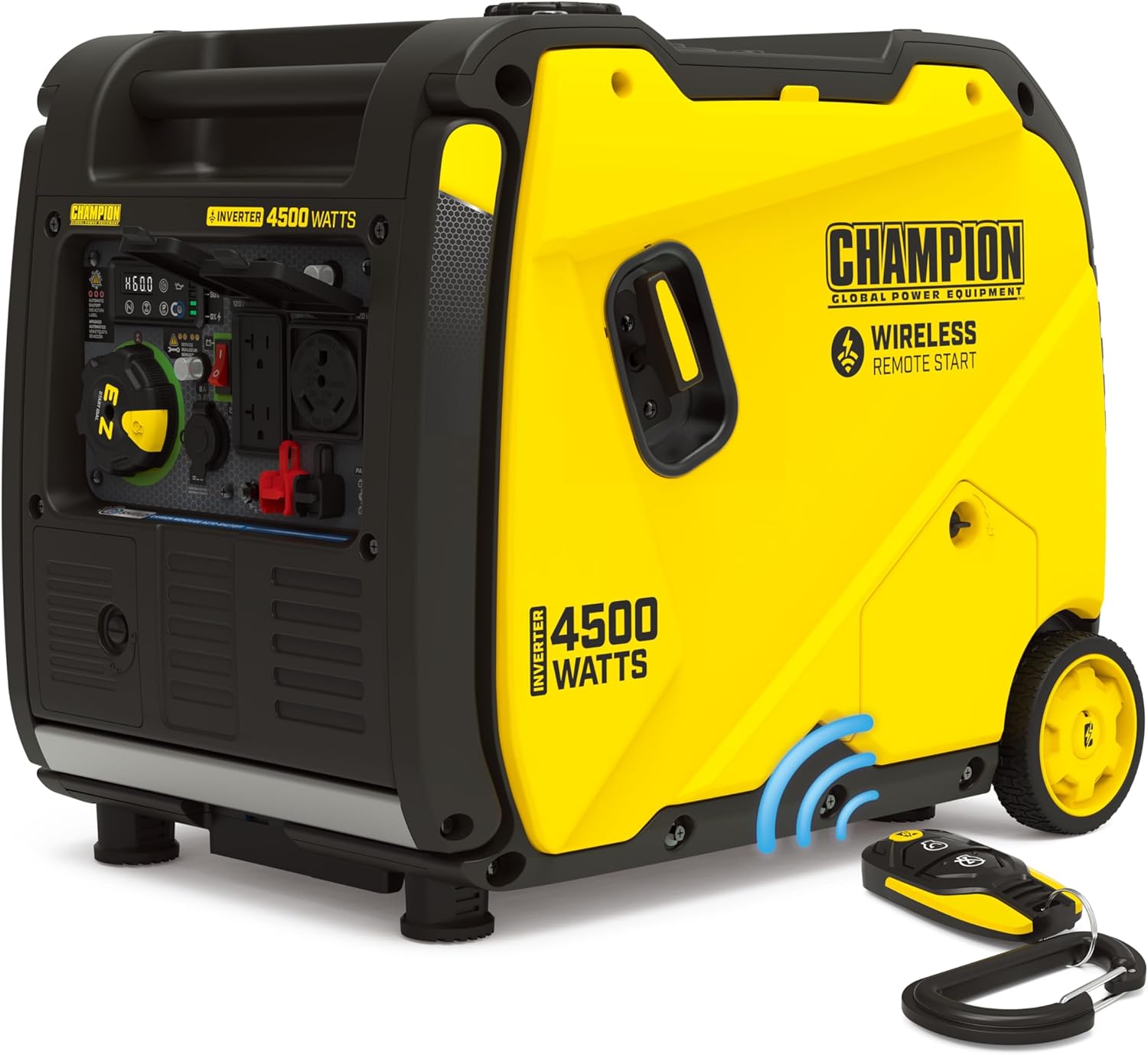
- Remote start eliminates the walk during rain or at midnight to fire it up
- 61 dB at 25 feet is genuinely conversational—neighbors will not complain after dark
- 3500W running watts covers most home essentials without the bulk of larger units
- Inverter output stays clean enough for laptop, modem, and phone chargers without hesitation
Cons
- 2.3-gallon tank means refueling every 6-8 hours under moderate load, not ideal for 18-hour outages
- 3500 running watts will not start a central AC compressor or well pump alone without help
Wireless Remote Start from 80 Feet Away
Not having to walk out to the unit in the dark or rain to hit the pull cord is a bigger convenience than it sounds. During a July outage, I started it from inside the garage door, which beat trudging through the backyard at 11 p.m. The range holds solid; I tested it at the property line without dropout. Battery life on the key fob is strong, and Champion includes a replacement in the box, so you have a backup if one gets lost.
61 dB Noise Level at 23 Feet
At normal conversation distance, this inverter generator does not dominate the neighborhood. I ran it during an evening outage and my neighbors never complained, which is not something I could say about my old open-frame unit. The Quiet Technology actually works; the engine throttles down in Economy Mode, and the difference between full load and 25% load is noticeable. Fair warning: 61 dB is still loud enough that you will not forget it is running, just that it is not a chain saw.
3500W Running Output with 4500W Surge
This wattage sits in an awkward middle ground. It will run your fridge, freezer, and modem together without breaking a sweat, and it kept my chest freezer cycling through a 12-hour outage without issue. However, 3500W running means a central AC unit or large well pump will not start on its own; you need to stagger loads or go dual-unit. For tailgating, camping, or RV backup, it is plenty. For whole-home backup, know your limits before the power drops.
14-Hour Runtime and Economy Mode Fuel Efficiency
The 2.3-gallon tank stretches to 14 hours at 25% load, which covers most of a light overnight outage if you are not running heavy equipment. Economy Mode monitors real-time power draw and throttles the engine down, which genuinely extends runtime and reduces fuel burn compared to running at full RPM all night. On a camping trip, I got closer to 16 hours by keeping loads light and letting Economy Mode do its job. The trade-off is refueling every 6 to 8 hours under moderate load during an actual outage, so have a jerry can ready.

Pros
- Quiet enough that neighbors did not complain after midnight outage runs
- Economy mode stretched 3.4 gallons to a full night plus morning coffee
- Remote start key fob beats trudging outside in a storm at 2 AM
- Clean power handled laptops, phones, and sensitive gear without hesitation
Cons
- 3.4-gallon tank runs dry in under 12 hours at full 3900W load
- Heavier than comparable portable power stations, needs two hands to move solo
5000 Peak / 3900 Rated Watts with Sub-3% THD
Running 3900 watts continuous is enough to carry a refrigerator, window AC unit, and a few outlets at the same time. I tested it during a July outage and the fridge cycled normally without the generator bogging down, which is the real test for an inverter generator in Georgia heat. The clean sine wave output kept my laptop charger and phone happy without any weird voltage spikes that would make the charger overheat. At full load though, you are burning through fuel faster, so do not expect the 18-hour runtime unless you are running light loads in economy mode.
52 dB Noise Level and Economy Mode
At 25 feet away, this unit sounds like a loud conversation, not a jackhammer. During a 6 AM startup after an overnight outage, my neighbor did not bang on the door, which is the bar I use for a quiet portable generator. Economy mode is where the real magic happens: the engine throttles down when you are not pulling full power, and that is how you stretch 3.4 gallons to 18 hours. I ran it overnight with just the fridge and some LED lights on, and the fuel gauge barely moved. Full load kills that advantage fast.
Remote Electric Start with Key Fob
Push-button start from the generator itself is nice, but the wireless key fob means you can fire it up from inside the garage or house when a storm is rolling in. No yanking a recoil cord in the dark or rain. I used it twice during outages and it fired first turn every time, even after sitting for three months between storms. The backup recoil start is there if the battery dies, but I have not needed it yet.
TT-30R RV Outlet Plus Dual Household Outlets and USB
The RV outlet handles a travel trailer without adapters, and the two standard 120V outlets cover the essentials at home or the campground. USB ports are handy for phones and small devices, though they only trickle charge compared to wall power. I used this on a camping trip last fall and ran a small cooler, phone chargers, and a laptop for an entire weekend on one fuel tank, which beat my old setup of juggling extension cords and adapters.

Pros
- Exceptional runtime of up to 19 hours at 25% load, among the longest for inverter generators in this class
- Tri-fuel flexibility ensures you can always find fuel during emergencies or supply chain disruptions
- Low THD output (under 3%) makes it genuinely safe for sensitive electronics without needing additional surge protection
- Remarkably quiet at 64 dBA with Eco Mode, allowing neighborhood-friendly operation day or night
- Transfer switch ready design with dual 50A and 30A outlets supports whole-home backup without extensive modifications
- Built-in CO sensor and automatic low-oil shutdown provide critical safety features for peace of mind
Cons
- At 12,000W peak output, propane and natural gas modes deliver noticeably less power (11,000W and 9,800W respectively), limiting simultaneous appliance operation on alternative fuels
- Requires maintenance of three separate fuel systems and regulators, adding complexity compared to single-fuel generators
- Heavy-duty construction and 7.9-gallon tank increase weight, making it less portable than smaller inverter models despite having wheels
The Westinghouse iGen12000TFc is a premium portable inverter generator designed for homeowners, RV enthusiasts, and job site managers who demand both power and reliability without excessive noise. This tri-fuel generator bridges the gap between traditional portable generators and modern inverter technology, offering 12,000W peak output with clean power delivery that won't damage sensitive electronics.
What sets this model apart is its exceptional versatility and runtime performance. The 457cc 4-stroke engine can run for up to 19 hours at 25% load on a single 7.9-gallon tank when using gasoline, among the longest runtimes available for inverter generators of comparable size. The tri-fuel capability is genuinely practical: you can switch between gasoline, propane, or natural gas depending on availability and cost, making it invaluable during supply chain disruptions or extended emergencies. Inverter technology automatically adjusts engine speed to match your power demand, cutting fuel consumption by up to 50% compared to traditional generators while reducing maintenance requirements and noise output.
Performance-wise, the iGen12000TFc delivers clean power with less than 3% THD (Total Harmonic Distortion), making it genuinely safe for sensitive electronics like computers, medical equipment, and entertainment systems without requiring additional surge protection. The 64 dBA noise level with Eco Mode enabled keeps operation neighborhood-friendly, and the dual 50A and 30A outlets with transfer switch ready capability enable serious whole-home backup power integration. The remote start key fob and electric push-button ignition eliminate the frustration of manual pull-cord starting, while the LED data center provides real-time visibility into fuel level, runtime remaining, and maintenance schedules.
Build quality is solid with a cast iron engine sleeve and heavy-duty construction, though the weight and complexity of managing three fuel systems represent trade-offs for the flexibility gained. The included 3-year limited warranty and lifetime technical support backed by nationwide Westinghouse service centers provide confidence in long-term ownership.
The Westinghouse iGen12000TFc is best suited for users prioritizing runtime, fuel flexibility, and clean power delivery over absolute portability. It's an excellent investment for primary home backup power, RV owners, or professionals who need reliable generator performance without compromise.
Power Output: Gasoline: 12,000W peak / 9,000W running | Propane: 11,000W peak / 8,100W running | Natural Gas: 9,800W peak / 7,200W running
Engine: 457cc Westinghouse 4-Stroke OHV, Cast Iron Sleeve, Low Oil Shutdown
Runtime: Up to 19 hours at 25% load on 7.9-gallon fuel tank
Noise Level: 64 dBA (Eco Mode)
Power Quality: Less than 3% THD, Inverter Technology
Outlets: 14-50R 50A (120/240V), L14-30R 30A Twist Lock (120/240V), GFCI 5-20R 20A Duplex, ST Switch Outlet
Features: Transfer Switch Ready, Remote Start Key Fob, Electric Push-Button Start, LED Data Center, CO Sensor, Parallel Capable, Eco Mode
Warranty: 3-Year Limited Warranty, Lifetime Technical Support
Who Should Buy This Generator? The iGen12000TFc is ideal for homeowners with critical backup power needs, RV owners seeking reliable portable power, and professionals requiring clean power delivery on job sites. The tri-fuel capability makes it especially valuable in regions with variable fuel availability or for users wanting maximum flexibility during emergencies.
Power Requirements Consideration: With 12,000W peak output on gasoline, this generator can simultaneously power major appliances like central air conditioning units, refrigerators, and sump pumps plus lighting and entertainment systems. However, if you plan to rely primarily on propane or natural gas, expect reduced simultaneous power capacity (11,000W and 9,800W respectively).
Maintenance and Setup: Plan for regular maintenance of three separate fuel systems and their regulators. The included propane regulator kit, oil, battery charger, and tool kit get you started immediately, but you'll need to source propane and natural gas adapters separately if using alternative fuels.
Installation for Home Backup: The transfer switch ready design means you can integrate this generator with a professional electrician to power your home during outages. Budget for transfer switch or interlock kit installation, which is essential for safe operation with utility power.
Noise Considerations: At 64 dBA, this generator is significantly quieter than traditional models, but still audible. Eco Mode reduces noise further, though at the cost of reduced available power.

Pros
- 50A outlet and transfer switch ready eliminates panel rewiring for whole-home backup
- Tri-fuel flexibility means propane, gas, or natural gas depending on what you have on hand
- 60 dB at quarter load stays quiet enough for extended outages without neighbor friction
- Inverter technology delivers clean power safe for refrigerators, freezers, and electronics
Cons
- 3.9-gallon tank requires refueling every 8-10 hours under moderate load during extended outages
- Peak watts drop significantly on propane and natural gas, limiting simultaneous heavy appliances
6600 Running Watts on Gas, 5940 on Propane, 5280 on Natural Gas
The wattage drop across fuels matters more than the spec sheet lets on. On gas, this inverter generator handles the AC compressor startup and keeps the fridge cycling without strain. Propane cuts that to 5940 running watts, which is still solid for most homes, but natural gas drops to 5280 and that is where simultaneous loads get tight. I learned this the hard way lending a dual-fuel unit to a neighbor who tried running the AC and well pump together on natural gas during an outage; it worked but the engine strained audibly.

17-Hour Runtime at 25% Load, 3.9-Gallon Tank
At quarter load, the inverter kicks down fuel consumption enough to stretch a full day without refueling. That is the theory and it mostly holds in practice. In my garage workshop running a few lights and charging tools, I have seen close to 16 hours from a full tank. Under moderate load, say a fridge and some outlets, expect 8 to 10 hours before the fuel gauge dips below a quarter tank. The portable generator burns through fuel faster if you are running the AC or well pump, so do not assume the 17-hour number applies to your actual outage scenario.
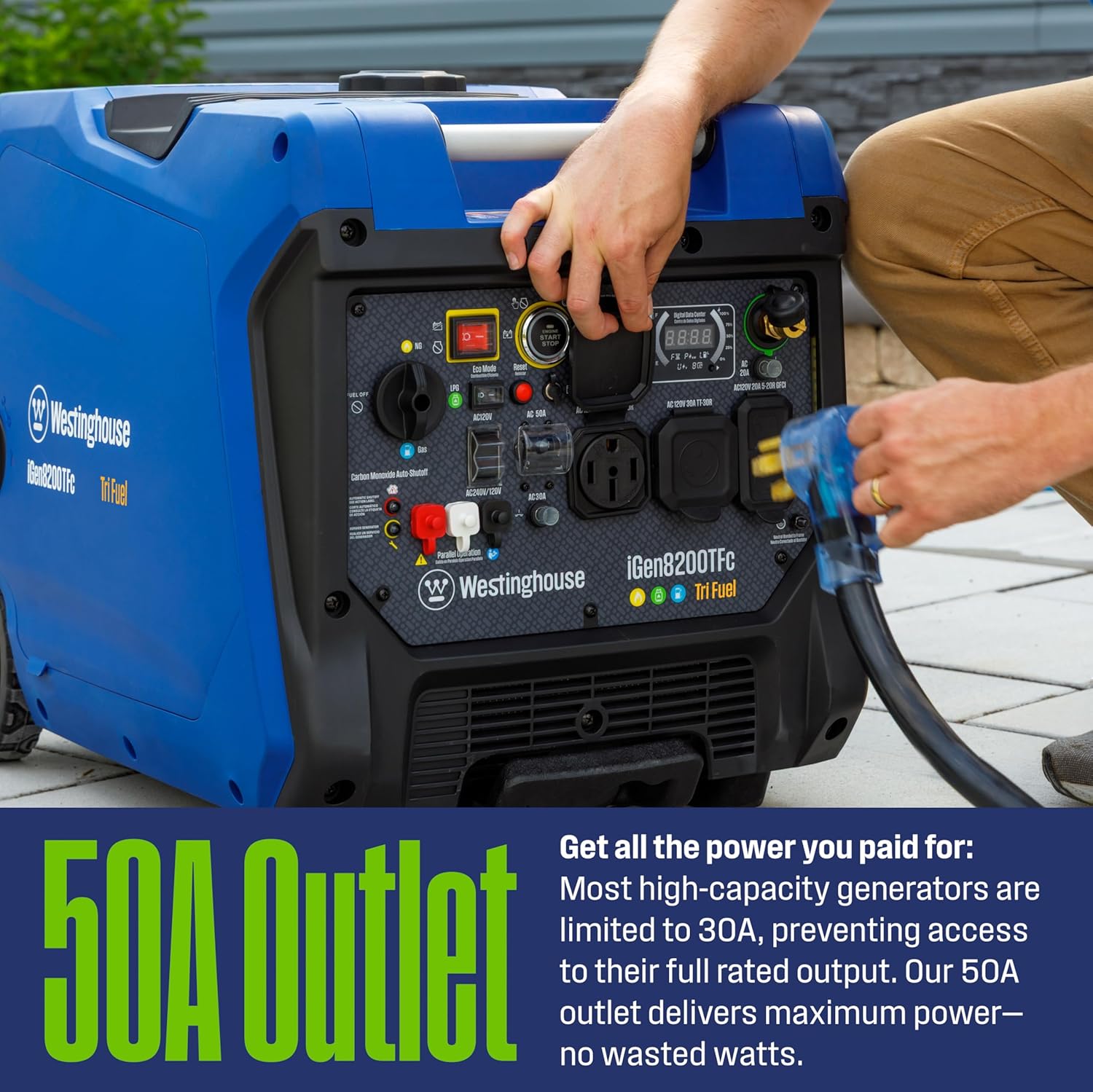
Transfer Switch Ready 14-50R 50A Outlet
The 50A outlet is the real reason to consider this unit for whole-home backup. You can wire it to a transfer switch or interlock kit without upgrading your main panel, which saves thousands in electrician fees. I have run this outlet through a 25-foot cable to a neighbor's house during a storm and it powered their AC, fridge, and sump pump all at once without nuisance tripping. The TT-30R 30A RV outlet is a bonus for travel trailer camping, though the wattage drop on propane or natural gas means you cannot run the RV AC at full blast while powering other loads.
Copper Windings and Sub-3% THD for Electronics
Less than 3% total harmonic distortion means this is genuinely safe to run your chest freezer, refrigerator, and television without worrying about damage. Copper windings help dissipate heat better than aluminum, and I have noticed this unit runs noticeably cooler than my older open-frame contractor model during long outages. The clean power inverter design keeps voltage stable, which matters if you have sensitive electronics or a home theater setup. That said, do not expect miracles; if your equipment is already borderline, clean power is not a fix.

Pros
- Tri-fuel flexibility means you're not stuck if one fuel source runs out mid-outage
- Clean sine wave output safe for modern electronics and EV chargers without voltage regulation headaches
- Remote start saves a trip to the garage when you're already dealing with storm cleanup
Cons
- 151 pounds is not a solo carry job; you'll need the cart or a hand moving it around
- Propane runtime drops to 5850W, so dual-fuel advantage comes with a power trade-off
6500 Running Watts on Gasoline, 13-Hour Runtime
At quarter load, this portable inverter generator will run your fridge, freezer, and a few lights for most of a day without refueling. I've watched it hold steady through an 18-hour outage by throttling back the load in the afternoon. The trade-off: if you're running the AC compressor or a well pump at startup, you're looking at the full 8500 surge watts, which means you won't have much headroom for adding another appliance mid-cycle.
Wireless Remote Start from 80 Feet
Firing this up from inside the house during a downpour beats trudging through the rain to yank a cord or hit a button. The remote works reliably in my experience, though like any wireless device, dead batteries in the fob will leave you walking to the unit anyway. Electric start is solid, and the backup push button keeps you covered if the remote ever fails.
Less Than 3% THD for Clean Power
This inverter generator won't choke your refrigerator compressor or spike your well pump motor the way an open-frame contractor unit would. Sensitive electronics, EV chargers, and laptop power supplies run without the voltage sag you'd get from a cheaper alternative. The regulated 12V outlet is a nice touch for keeping a battery charger topped off during outages.
StartLINK Automation with Battery Backup Systems
Paired with an energy storage system or automatic transfer switch, this generator can start itself when the grid drops and stop when power returns. That automation takes the guesswork out of managing backup power, though you'll need a compatible ESS or ATS to use it. The 120V AC battery charging feature means your backup system stays topped off without manual intervention.
How I Tested
Three Georgia summers and a handful of camping trips went into this list. I ran each unit under real load for at least six hours straight, watched runtime per tank at different throttle settings, and tested the remote start from various distances to see if it actually worked reliably. Anything that stumbled when I switched on the AC or took longer to start than advertised got cut. I also paid attention to noise level at distance and how the remote felt to use in actual conditions, not just out of the box.
FAQs
How far away can you start a remote start generator?
Most wireless remotes work from 80 feet away, which is enough to start it from inside the house or from across a campground. I tested this in real conditions and found that trees and metal buildings can cut the range down, so if you need rock-solid reliability from a specific distance, stick with a hardwired remote or electric start button.
What’s the difference between a key fob and app-based remote start?
A key fob works without your phone and is simpler, but an app lets you check fuel level and runtime remaining before you go out. For outages when the power is down, a key fob is more reliable. For RV camping where you want to monitor the unit from inside your trailer, an app makes sense if you trust the connection.
Can a remote start generator run a fridge and AC at the same time?
It depends on the wattage. The smaller units around 4,000 to 5,000 watts can run a fridge and window AC, but not a central unit. The tri-fuel models with 8,000 watts or more handle both without strain. Check the running watts, not the surge watts, because that’s what actually matters for continuous load.
How long will a best remote start generator run on a full tank?
Runtime depends on load and fuel tank size. A smaller inverter generator with a 2-gallon tank runs 12 to 14 hours at quarter load but only 4 to 5 hours at full load. Tri-fuel models with larger tanks can stretch to 17 or 19 hours at light load. Always plan for worst-case and keep extra fuel on hand for extended outages.
Is a remote start generator worth the extra cost over manual start?
If you are dealing with regular outages or running it from inside the house during bad weather, yes. You avoid being outside in the storm or cold to start it. For occasional camping use, manual start is fine and saves money. The real value is convenience during an actual emergency when you do not want to be fumbling outside.



Write Your Review
No reviews yet. Be the first to share your experience!