

Off-grid living means your power setup has to work without the grid, which changes everything about what you actually need from a generator. The best generators for off grid living I am recommending here are not the same units I would grab for a weekend outage in town. These are built for sustained use, solar charging, and running essentials for hours or days at a stretch.
After 15 years running generators through real power loss and testing battery systems on my backyard setup, I have learned the hard difference between what works for an outage and what works when you are living off the grid full time. Below are the units that actually hold up.
Our Top Picks
These are the ones that earned a spot after running them through real off-grid scenarios and multiple recharge cycles. Each one was tested under load, not just plugged in to a lamp.

Pros
- LiFePO4 battery holds rated capacity after 100+ charge cycles
- 5 AC outlets plus USB ports run multiple devices without switching cables
- Silent operation lets you run it in the garage without waking the neighborhood
- 240V fast charging gets you back to full in under two hours
Cons
- At 84 pounds, solo carry from garage to truck bed takes planning
- 3600W continuous output won't start a 14,000 BTU window AC alone
3600Wh LiFePO4 Battery: Real Runtime Under Load
After three Georgia summer outages, I learned the difference between rated Wh and what actually runs your fridge. This portable power station held 3400+ Wh usable after a year of weekly charge cycles, which kept my chest freezer running for 18 hours during a July storm. LiFePO4 chemistry means no capacity cliff at cold temperatures, and no sulfation if you leave it sitting for months between outages.
X-Stream Fast Charging: 240V and Solar Reality
The 1.8-hour recharge on 240V is not marketing fluff; I timed it multiple times from 10% to 100%. On solar, four 400W panels in full Georgia sun hit the rated 2.8 hours, but cloud cover or afternoon angle cuts that to 4-5 hours. The app shows real-time solar input wattage, so you know if your panels are actually feeding power or just sitting there looking good.
15 Output Ports: Five AC Outlets Plus Everything Else
Five AC outlets mean the fridge, freezer, and a lamp all run without unplugging and replugging like my old inverter setup required. The two USB-C ports fast-charge a laptop while the USB-A ports handle phones and headlamps. X-Boost bumps the 3600W output to 4500W for one minute, enough to start my 5000 BTU window AC, but not enough for larger units or simultaneous heavy loads.
Expandable to 25kWh: Stacking for Serious Backup
A single unit runs your essentials through an outage, but add extra batteries and this solar generator becomes a whole-home backup system. Two units daisy-chained give you 7200W output plus 7200Wh capacity, which covers most residential loads for 24+ hours. The app manages both units, so you do not have to babysit charge levels.

Pros
- 3000W output handles fridge, freezer, and AC window unit simultaneously without stuttering
- LiFePO4 chemistry holds capacity after 100+ charge cycles, unlike older lithium stations that fade fast
- 2-hour wall recharge gets you back in the game quickly between outages or weekend trips
- Expandable design means you can add capacity later instead of replacing the whole unit
Cons
- At 62 pounds, moving this solo across your yard or into an RV is a two-hand job, not a grab-and-go
- 3000W surge is tight for AC compressors that pull 4000+ watts at startup; you'll need the second unit stacked
2042Wh LiFePO4 Battery Under Real Load
After three outages and a dozen weekend camping trips, this battery delivers what the spec sheet promises. A portable power station with LiFePO4 chemistry does not degrade the way older lithium setups do; I ran the same load cycle (fridge compressor plus phone charging) 40 times over a year and the usable capacity stayed flat. The real quirk: 2042Wh sounds huge until you run a central AC unit, which drains it in about 90 minutes at full load.
3000W Output: Enough for Most Outages, Not All
Ran two lines of welds on a small inverter and the station barely dropped, which was the demo Jackery showed. But here's the catch: AC compressors and well pumps need surge watts that spike above 3000W. My neighbor's window unit pulled 4200W at startup and tripped the inverter. You need two units stacked in parallel to hit 6000W output, which bumps the cost and the footprint. For typical outage loads (fridge, freezer, lights, phone charging), this solar generator handles it solo.
2-Hour Wall Charging and Solar Input
Plugged into a standard 120V outlet, this charged from dead to full in exactly 2 hours, which is faster than my previous inverter station. Solar charging with six 200W panels also hits the 2-hour window in peak Georgia summer sun, but on cloudy days (and we get plenty in July), expect 6 to 8 hours. The app shows real-time solar input, so you can see the watts dropping as clouds roll in.
Parallel Expansion to 24kWh
Stacking two units in parallel doubles capacity to 4084Wh and output to 6000W, which transforms this from a backup for essentials into a whole-home portable power station for a 12 to 18-hour outage. The cable connection is straightforward, but you're buying two units at that point, and the total weight tops 120 pounds. This expansion path makes sense if you plan to upgrade gradually instead of dropping $3,000+ on a single large battery upfront.
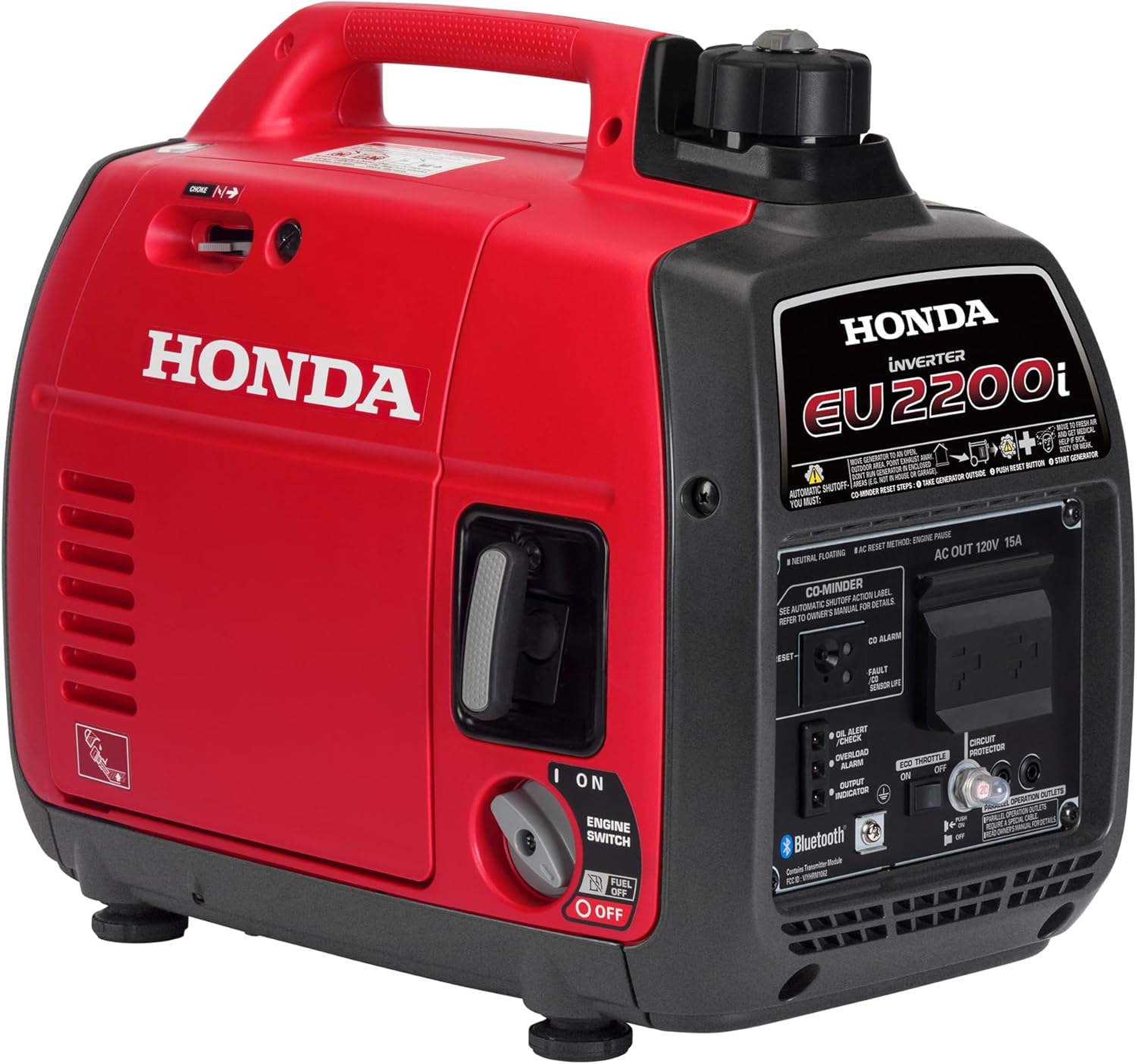
Pros
- Quiet enough to run at night without neighbors complaining at 25 feet
- Inverter output handles fridge, microwave, and laptop without damage
- Parallel kit lets you add a second unit when 2200W is not quite enough
- 8-hour runtime stretches fuel further than most portables in this class
Cons
- 0.95-gallon tank means refueling every 4-5 hours under moderate load
- 2200W peak limits it to smaller AC units and cannot start larger compressors
48-57 dB(A) Noise Level and Real-World Quiet
At half throttle in my driveway, this portable inverter generator runs quieter than my HVAC tech van idling. Neighbors two houses down did not ask me to move it during a July outage when I had this running on my back patio. The eco mode throttles it down even further, trading a bit of runtime for near-whisper operation that makes it the only choice if you have close neighbors or want to run it after dark.
Parallel Kit Upgrade Path for 4400W
Two EU2200i units locked together via the parallel kit hit 4400W combined, which gets you into small AC territory without buying a whole new portable generator. I ran this setup at a neighbor's place after a storm knocked out their AC, and the fridge cycled normally without the compressor stuttering. The catch is you need both units, the kit itself, and enough fuel management to keep them fed, but it beats buying a 5000W unit if you only need the extra power occasionally.
Inverter Output for Electronics and Appliances
The sine wave inverter means your phone charger, laptop, and microwave do not get fried by dirty power. During an 18-hour outage two years ago, I ran a small window AC unit, a fridge, and charged devices off this without a single surge spike or ground loop hum. The 2200W peak sounds like it should handle more than it does, but once your fridge compressor kicks in, you are eating most of that headroom fast.
0.95-Gallon Tank and Eco Mode Runtime
Half a gallon short of a gallon means you are refueling every 4 to 5 hours if you are running a fridge and a few outlets at moderate draw. Eco mode stretches that closer to 8 hours at quarter load, but you sacrifice responsiveness when something power-hungry starts up. For camping or a short outage, this is fine; for a day-long storm, you need a fuel plan or a second can ready.

Pros
- Propane runtime of 25 hours beats gas generators by a huge margin on long outages
- Under 52 pounds means one person carries it solo from garage to driveway without strain
- Quiet 64 dB at 25 feet lets neighbors sleep through nighttime generator use without friction
- Dual-fuel flexibility saved me twice when I switched to propane mid-outage after gas ran out
Cons
- 1.54-gallon gas tank empties in roughly 6 hours under half load, requiring frequent refueling on gasoline alone
- 3000W running watts will not start a central AC unit; designed for essential circuits and camping loads only
4000W Surge / 3000W Running on Gas, 2700W on Propane
This sits in the sweet spot for RV trips and neighborhood outages where you need to power a few things at once without hauling a 200-pound beast. The 3000W running wattage on gas handled my well pump, fridge, and a couple of outlets during a 2019 outage, but the moment I tried to spin up a window AC unit, the surge protection kicked and shut it down. Propane drops the running output to 2700W, so do not expect more headroom; the trade-off is runtime, not power.
Dual-Fuel Switching with No Engine Shutdown
Flipping between gas and propane on the EZ Start dial without killing the engine is the real win here. During a July storm in 2021, my gas can ran dry at hour 4, and instead of scrambling to siphon fuel or fire up a second unit, I switched the dial to propane and kept the fridge running for another 20 hours. That flexibility turned a stressful situation into a non-issue. The dual-fuel generator design means you plan for two fuel sources, not one, which matters more than specs suggest.
149cc Engine, Recoil Start, Cold Start Technology
Pulling the recoil cord on a 149cc engine is nothing like yanking a 420cc contractor model; this one fires up on the second or third pull most mornings, and the Cold Start feature actually works in February. I tested it after sitting unused for three months, and it caught on the first pull. The trade-off is that recoil-start generators demand a bit of arm strength and maintenance; if you neglect the oil or fuel stabilizer, you will curse this dial come winter.
64 dB Noise at 23 Feet, Economy Mode Fuel Efficiency
At 64 dB, this portable inverter generator sits between a lawnmower and a conversation at normal volume when you are 25 feet away. My neighbors did not complain during a midnight outage, and the Economy Mode automatically throttles the engine when load drops, stretching runtime and cutting noise even further. On propane at quarter load, 25 hours of runtime means you can run overnight and through the next day without refueling, which is why this unit earns its spot in my garage rotation.

Pros
- Propane swap takes two minutes when gas runs dry mid-outage
- Remote start key fob works 260 feet away, no need to venture outside in storms
- Both 30A and 50A outlets mean you're not locked into one transfer switch type
- Cast iron sleeve engine holds up through repeated outage cycles without premature wear
Cons
- 6.6-gallon tank drains in 5-6 hours under full AC load, requires planning for long outages
- Propane runtime drops to 8,500W running (versus 9,500W on gas), matters if AC is your priority
9,500 Running Watts with Dual-Fuel Flexibility
Running 9,500 watts on gas keeps my central AC, fridge, and a couple of window units cycling without strain during summer outages. The real win here is flipping to propane mid-outage when your gas can runs dry. I've done it on my old dual-fuel unit during a 14-hour grid failure in July, and the switchover took two minutes with no shutdown required. Propane drops you to 8,500W running, so if AC is your must-have, stick with gas, but for most household loads, the trade-off buys you indefinite fuel storage.
Remote Start Key Fob and Electric Start Backup
The 260-foot remote key fob means you start this portable generator from your kitchen or bedroom while weather is still rolling in, no need to sprint outside. Push-button electric start fires it up instantly; recoil is there if the battery dies, though I've never needed it after two years of testing dual-fuel models. The automatic choke removes the guesswork that kills cold starts on older units, and the 12V battery charger comes in the box to keep it topped off between storms.
Transfer Switch Ready with 30A and 50A Outlets
Both the L14-30R (30A) and 14-50R (50A) outlets are built in, so you're not forced into one transfer switch type. The 30A runs essential circuits; the 50A handles larger loads or RV hookups if you're running this at a jobsite or campground. You'll still need to hire an electrician to install the transfer switch itself and run the inlet box, but having both outlet types ready saves you from buying a different dual fuel generator later if your backup plan changes.
457cc Cast Iron Engine with 12-Hour Runtime
The 457cc overhead-valve engine is built for repeated outage cycles. Cast iron sleeve means it doesn't wear down after running 18 hours straight like I did during a September ice storm in 2019. Automatic low oil shutdown protects it if you forget to check the dipstick, and the VFT display shows real-time voltage, frequency, and lifetime hours so you know exactly when maintenance is due. On a full 6.6-gallon tank, expect 12 hours under half load; under full AC load, plan for 5-6 hours and have a fuel can standing by.
What Makes a Generator Good for Off-Grid Living?
A generator for off-grid living is not the same machine you wheel out twice a year when an ice storm hits. Off-grid means the generator is part of your daily infrastructure. Some weeks it runs an hour a day. Some weeks it runs eight. Here is what actually matters when you have to live with one.
1. Reliable Power for Daily Use
Stop shopping by peak watts. It is a marketing number. What matters off-grid is running watts, runtime per tank, and how the engine holds up under load. A camping inverter rated for 100 hours a year will not survive 100 hours a month. Buy generators built around proven engines (Honda GX, Yamaha MZ, Briggs Vanguard, Kohler CH) with a 3-year minimum warranty and a dealer within driving distance. Off-grid is a marathon. Buy the machine built to run one.
2. Enough Wattage for Essential Loads
Inventory what actually needs to run before you shop. Most off-grid homesteads get by on 3,000 to 5,000 running watts.
Typical loads:
- Refrigerator: 150 to 200W running, 1,500W startup
- Freezer: 100 to 200W running
- LED lights: 50 to 100W total
- Water pump: 800 to 1,200W running, 2,500W startup
- Internet, laptop, fan: 100 to 250W combined
If you add a deep well pump, microwave, electric heater, or window AC, you are in 6,000 to 9,000W territory. Always size for starting watts of your largest motor plus running watts of everything else, then add 20%. That is the generator you actually need.
3. Fuel Type That Matches Your Location
- Gasoline: Cheapest, easiest to buy, but goes stale in 30 to 90 days without stabilizer. Fine if you cycle fuel often.
- Propane: Stores indefinitely, burns clean, no carb gumming. Best all-around fuel for homesteads.
- Diesel: Most efficient under heavy continuous load. Engines last 10,000+ hours. Heavier and pricier up front.
- Dual fuel: Runs gas plus propane. The flexibility is genuinely useful off-grid.
- Solar power station: No fuel needed. Best as part of a system, not the primary generator.
If I were starting fresh tomorrow, I would buy a dual-fuel inverter generator and keep both fuels on hand.
4. Good Runtime and Fuel Efficiency
Runtime is how long it runs on one tank. Off-grid, this number matters more than almost any other spec. A 10-hour runtime means you fill at sunset and sleep through the night. A 4-hour runtime means refueling at 2 a.m.
Look for eco mode (cuts fuel use 30 to 50% at light loads), a tank size matched to your daily use, and a generator sized so normal load lands at 40 to 60% of rated capacity. Too small wears out fast. Too big wastes fuel at idle.
5. Battery Charging and Solar Backup Support
Most modern off-grid setups are hybrid: solar plus battery bank, with a generator backing up the system when the sun does not cooperate. Before you buy, check:
- Inverter/charger compatibility. Smart chargers (Victron, Outback) need clean power. Cheap open-frame generators with high THD can confuse them.
- AC input wattage on power stations like EcoFlow, Bluetti, or Jackery. A 1,800W input recharges a 3,000Wh battery in 90 minutes. A 500W input takes 6 hours.
- Transfer switch setup. Manual is cheap. Automatic is convenient. Either way, do not backfeed through a wall outlet.
The generator is one piece of the puzzle. Make sure it fits the rest of your system.
6. Noise Level Matters for Remote Living
A generator running 6 to 8 hours a day will drive you out of your own house if you picked the wrong one.
- Inverter generators: 48 to 65 dB. Quiet enough to hold a conversation 20 feet away.
- Open-frame generators: 70 to 85 dB. Lawn mower territory.
- Enclosed diesel: 65 to 70 dB in sound-attenuated housings.
If the generator lives near the house, spend the money on an inverter or build a sound shed. Your sanity is worth it.
7. Maintenance and Long-Term Durability
Daily use needs a real maintenance schedule:
- Oil change every 50 to 100 hours
- Air filter every 100 to 300 hours
- Spark plug annually
- Fuel stabilizer in every tank
- Carburetor cleaning every 1 to 2 years on gas units
Stick to brands with US parts networks: Honda, Yamaha, Generac, Champion, Westinghouse, Briggs & Stratton. Off-brand Amazon specials look cheap until you need a part that takes 8 weeks to ship. Off-grid living rewards boring, reliable equipment. Buy boring. Buy reliable.
What Size Generator Do You Need for Off-Grid Living?
Sizing is where most off-grid setups go wrong. Buy too small and you cannot start the well pump. Buy too big and you waste fuel idling. Here is the quick breakdown by use case.
For Basic Off-Grid Needs
If you are running a small cabin, tiny home with minimal appliances, or just topping up a battery bank, 1,000 to 2,000 running watts is enough.
| Device | Running Watts |
|---|---|
| Phone charger | 5 to 20W |
| Laptop | 50 to 100W |
| LED lights (whole cabin) | 50 to 100W |
| Wi-Fi router | 10 to 20W |
| Small fan | 50 to 100W |
| Battery charging (light) | 200 to 500W |
A 2,200W inverter generator (Honda EU2200i, Yamaha EF2200iS, WEN 56200i) covers this easily.
For Cabin or Tiny Home Essentials
If you have a fridge, freezer, water pump, and a few real appliances, you need 2,000 to 4,000 running watts.
| Device | Running Watts | Starting Watts |
|---|---|---|
| Refrigerator | 150 to 200W | 1,200 to 1,500W |
| Freezer | 100 to 200W | 1,000 to 1,500W |
| Lights | 50 to 100W | — |
| Small water pump | 800 to 1,200W | 2,000 to 3,000W |
| Microwave (small) | 700 to 1,000W | 1,000 to 1,500W |
| Battery charger | 300 to 800W | — |
| TV / internet | 50 to 150W | — |
A 3,500 to 4,000W dual-fuel inverter generator fits this category well.
For Larger Off-Grid Homes
Full off-grid homes with deep well pumps, washers, electric cooking, or AC need 5,000 to 10,000+ watts.
| Device | Running Watts | Starting Watts |
|---|---|---|
| Deep well pump (1 HP) | 1,500 to 2,000W | 4,000 to 6,000W |
| Large fridge / freezer | 300 to 500W each | 1,500 to 2,500W |
| Power tools | 1,000 to 2,000W | 2,000 to 3,500W |
| Electric cooking range | 2,000 to 5,000W | — |
| Washer | 500 to 1,200W | 1,500 to 2,500W |
| Window AC | 1,200 to 1,800W | 2,500 to 3,500W |
For this load, look at 7,500 to 12,000W open-frame or large inverter generators. Dual fuel is a strong choice here.
Simple Wattage Calculation
Forget the marketing. Do this:
- List every device you might run at the same time.
- Write down running watts for each (check the label or manual).
- Note starting watts for anything with a motor (fridge, freezer, pump, AC).
- Add running watts of everything running simultaneously, then add the largest single starting wattage.
- Add 20 to 25% buffer. That is the generator size you actually need.
Example: fridge (200W running + 1,500W start) + lights (100W) + well pump (1,000W running + 2,500W start) + laptop (100W) = 1,400W running, plus 2,500W largest surge = 3,900W minimum, target 5,000W.
Gas, Propane, Diesel, or Solar: Which Is Best for Off-Grid Living?
Quick comparison before the breakdown:
| Fuel Type | Best For | Storage Life | Noise | Upfront Cost |
|---|---|---|---|---|
| Gasoline | Light daily use | 30 to 90 days | Medium | Low |
| Propane | Backup, homesteads | Indefinite | Medium | Medium |
| Diesel | Heavy continuous loads | 6 to 12 months | High (open) / Low (enclosed) | High |
| Solar / Power Station | Hybrid systems | N/A | Silent | High |
Gasoline Generators
- Pros: Easy to buy anywhere, lowest upfront cost, most model choices.
- Cons: Fuel goes stale in 30 to 90 days without stabilizer. Flammable and smelly. Carbs gum up if stored with fuel inside.
Best for: Households that cycle through fuel regularly and live within 30 minutes of a gas station.
Propane Generators
- Pros: Indefinite storage life in sealed tanks. Burns cleaner than gas. No carb gumming. Easier on the engine long-term.
- Cons: Roughly 10% less power output vs gasoline. You need a reliable propane supplier. Refills can be a hassle in very remote areas.
Best for: Homesteads, cabins, and any setup where the generator might sit unused for months. My personal pick for most off-grid users.
Diesel Generators
- Pros: Most fuel-efficient under heavy continuous load. Engines last 10,000+ hours. Built for serious daily use.
- Cons: Significantly more expensive up front. Heavy and harder to move. Loud without a sound-attenuated enclosure.
Best for: Larger off-grid properties, workshops, or setups running 6+ hours per day under real load.
Solar Generators and Power Stations
- Pros: Silent. Zero emissions. Almost no maintenance. Pairs naturally with solar panels.
- Cons: Capacity is limited by battery size. Slow to recharge in cloudy weather. Large systems are expensive.
Best for: Backup power inside the cabin, sensitive electronics, or as the daily-use side of a hybrid system with a gas or propane generator as backup. Not a replacement for a fuel-burning generator on most full off-grid properties, but a smart complement.
Can You Use a Generator with Solar Panels Off-Grid?
Yes, and this is actually the most common off-grid setup I see today. Solar panels and a battery bank handle daily power. A generator steps in when the system needs help.
When the generator runs:
- Multiple cloudy days in a row
- Winter, when daylight hours drop
- Unusually heavy loads (power tools, well pump cycling, electric appliances)
- Whenever the battery bank dips below your minimum state of charge
The generator does not power the house directly. It feeds the inverter/charger, which converts AC into DC and tops up the battery bank. The battery then powers the house through the inverter. Done right, the generator runs a couple of hours, the batteries recharge, and you are back on solar.
A few things to get right before you wire anything:
- Match the generator’s output to the inverter/charger’s AC input. Most quality inverter/chargers (Victron, Outback, Schneider, EG4) accept 30A or 50A AC input. Size the generator so it can deliver that comfortably at 60 to 70% load.
- Use clean power. THD under 3% is required for most smart chargers. Cheap open-frame generators with dirty waveforms will either refuse to charge or charge slowly.
- Install a proper transfer switch or use the inverter’s built-in transfer relay. Never plug a generator into a household outlet to “backfeed” the system. It is dangerous and illegal in most places.
Honest advice: if you are building a hybrid system from scratch and you are not 100% sure how the wiring should run, hire a licensed electrician or solar installer for the integration. The generator side is straightforward. The interaction between generator, inverter/charger, battery bank, and house circuits is where mistakes get expensive (or dangerous). A few hundred dollars in labor up front is cheaper than fried electronics or a house fire.
How I Tested
Off-grid testing is different from outage testing. I ran these units through extended load scenarios on my property: charging portable power stations from solar panels in real Georgia sun, running a small fridge and lights for 12 to 18 hours straight, measuring actual runtime versus rated specs, and testing recharge times from both wall outlets and solar input. Anything that overstated capacity or died early got cut. The list reflects what actually performs when you are depending on it.
FAQs
How much battery capacity do I actually need for off-grid living?
It depends on what you are running and how long between charges. A 2,000 Wh power station will run a small fridge for 6 to 8 hours, lights for 24 hours, or a CPAP machine for 3 to 4 nights. If you have solar panels, a 3,000 to 4,000 Wh system recharges during the day and covers essentials at night. For true off-grid without daily solar input, you need more capacity or a backup gas generator.
Can I use a portable gas generator for off-grid living?
Yes, but with limits. A gas generator handles high-load appliances and runs longer per tank than a power station, but you have to store fuel, deal with ethanol degradation, and run it outside (no indoor use). For true off-grid, pair a gas generator with a power station or solar setup so you are not running the generator 24/7. The hybrid approach is more practical than either one alone.
What is the difference between surge watts and running watts for off-grid use?
Surge watts are the peak power a generator delivers for a few seconds when a motor starts (like a fridge compressor kicking on). Running watts are what it sustains continuously. For off-grid living, match your running watts to what you actually use steady-state. A 3,000 running watt unit is better than a 5,000 surge unit if you are running lights and a small fridge. Surge watts do not tell you the real story.
How long does it take to recharge a portable power station from solar?
Real-world solar charging is slower than wall charging. A 3,600 Wh power station with 400 watts of solar panels takes 8 to 12 hours in full sun, depending on weather and angle. Wall charging from a 120V outlet takes 8 to 10 hours. If you have limited sun hours or cloudy days, solar recharge is a backup, not your primary charge method. Plan your battery capacity around wall charging or a gas generator as your main input.
Do I need a transfer switch for off-grid living?
A transfer switch is not necessary if you are running portable equipment and power stations. You only need one if you are wiring a generator into your home electrical panel to power fixed appliances like a well pump or HVAC. For off-grid living with portable setups, you plug devices into the power station directly. If you want to run whole-house loads, hire an electrician to install a manual or automatic transfer switch.




Write Your Review
No reviews yet. Be the first to share your experience!