

Free Delivery. Exclusive Deals. All Prime.
Prime members save on shipping and get first access to deals, plus Prime Video included. 30 days free.
When sleet starts tapping the fly at dinner and someone is still hunting for dry socks, 3 man 4 season tents start to feel less optional. A winter-ready shelter helps block wind, shed moisture and give cold-weather campers room to manage wet gear. After comparing 6 models, the Forceatt 4-Season Tent stands out for its 70D polyester, 200T waterproof coating and 88.4 by 72.7-inch floor. The Bisinna 4-Season Tent is the alternative pick, with 210T polyester and a PU 3000mm coating.

Pros
- 88.4 x 72.7 x 47.2 inch interior fits 3 people
- Packs to 43 x 18 cm for transport
- Weighs 3.3 kg or about 6.57 lb
- 70D polyester with 200T waterproof coating
- Sets up in 3 minutes and packs down in under 2 minutes
Cons
- No temperature rating is listed for cold weather use
- No included stake or pole details are provided
- 47.2 inch peak height limits standing room

Pros
- 4-season design with snow skirt for cold weather protection
- Lightweight at 6.4 lbs, compact 18x7x7 inch packing size
- 2 doors and 2 windows with double-layer mesh reduce condensation
- Freestanding design with aluminum poles sets up easily
- Spacious 2-person capacity with waterproof foyer storage
Cons
- PU 3000mm coating may not match higher-end waterproof standards
- Inner and outer tent contact can cause condensation issues
- Requires careful ventilation management to prevent moisture buildup

Pros
- PU 3500mm rainfly and 4000mm bathtub floor
- Inner size is 6.89 ft x 5.91 ft x 4.27 ft
- Double doors and 3 ventilation windows
- 2 crossing aluminum poles for quick setup
- Packed carry bag is 7.09 x 20.48 inches
Cons
- Listed weights conflict: 8.07 lb and 3.70 lb
- Only khaki color is listed
- No warranty information provided
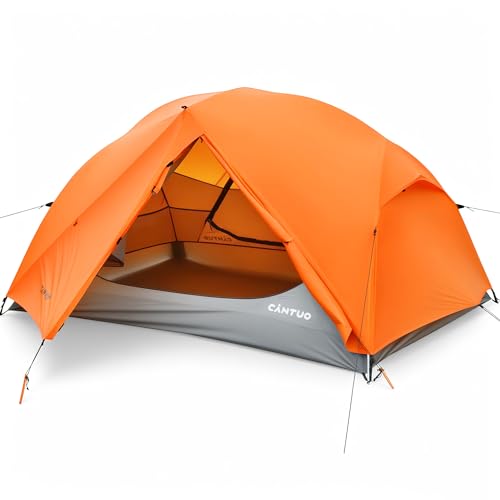
Pros
- 4.12 lb packed weight for backpacking
- PU 4000mm rainfly and floor coating
- 31.64 sq ft interior fits two 25 in pads
- 8 vents and B3 mesh for airflow
- Includes footprint, 12 stakes, and carry bag
Cons
- No listed temperature rating for winter comfort
- 43.3 in peak height is for sitting, not standing
- Title says 2/3 person, but size is listed as 2 person

Pros
- Lightweight at 4.4 lb, easy to transport for backpackers
- 3000mm waterproof rating handles various weather conditions
- 4-season design with mesh inner tent and quality construction
- Straightforward setup with flexible poles and 10 stakes included
Cons
- Compact interior at 6.9ft x 4.1ft may feel tight for two people
- Single-layer silicone coating may require maintenance over time
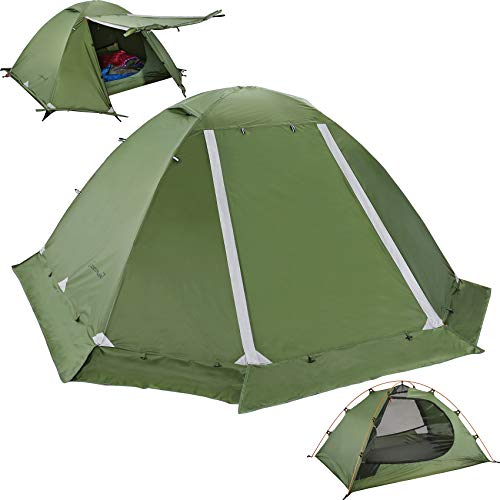
Pros
- Lightweight at 6.28 lbs total, or 5.33 lbs minimum trail weight
- Spacious interior of 7'3" x 4'11" x 3'10" for a 2-person tent
- Freestanding design with two aluminum poles sets up quickly by one person
- Sealed seams and PU 5000 coating provide weatherproof protection
- Includes 14 aluminum stakes, 2 doors, 2 vestibules, and repair kit
Cons
- One-year warranty covers only material and workmanship defects
- Packed size of 16.5" x 5.9" x 5.9" still requires significant backpack space
- No temperature rating provided for cold weather conditions
How We Chose 4-season tents for winter camping
Cold-weather camping asks more of a tent than a warm-weather weekend at a lake. Capacity, fabric, pole design and airflow all matter because snow, wind and trapped moisture can turn a cramped shelter into a long night.
- Season rating and capacity: We prioritized shelters described as 4-season or 3 to 4-season models, then checked whether the floor area matched the stated sleeping capacity. The Forceatt 4-Season Tent gives a listed interior of 88.4 by 72.7 inches, with a 47.2-inch peak height. Its 70D polyester and 200T waterproof coating make it a better fit for wet cold-weather trips than summer-only mesh-heavy gear.
- Stove jack for a wood-burning stove if applicable: None of the main picks list a stove jack, so they should not be treated as hot-tent shelters. That matters because the U.S. Consumer Product Safety Commission says carbon monoxide is a colorless, odorless gas produced by burning fuel, including wood and charcoal. If a camper plans to use a wood-burning stove, the tent needs proper ventilation and a design intended for that use, not just a 4-season label.
- Pole structure and wind resistance: We looked for aluminum pole systems, reinforced fly attachment points and stated windproof construction. The camppal 4-Season Tent uses 2 crossing aluminum poles, anti-tearing rip-stop fabric and a 300D oxford bathtub floor with 4000mm water resistance. Its fly also has inside hook-and-loop tabs that attach to the poles, which is useful when gusts pull against the fabric.
- Weight and pack size: Winter campers often carry more insulation, so tent weight can decide whether a shelter is practical for backpacking. Among our picks, listed weights run from 4.12 pounds to 8.07 pounds. Packed sizes range from a compact 15.7 by 5.5-inch bundle to a larger 20.48 by 7.09-inch carry bag, so the lightest options make more sense for long approaches while the heavier ones trade packability for room and tougher floor materials.
- Ventilation to avoid condensation and carbon monoxide buildup: Winter tents need airflow because breath, wet clothing and cooking mistakes can create dangerous conditions. The Cantuo 4-Season Tent lists 8 vents, B3 mesh and dual vestibules, giving it more managed airflow than a single-door shelter. According to the CPSC, symptoms of carbon monoxide poisoning include headache, dizziness and confusion, so ventilation should never be an afterthought around fuel-burning gear.
We excluded summer or three-season-only gear not rated for freezing temperatures, home space heaters used inside a tent without ventilation because of carbon monoxide risk, and children’s toy tents and sleeping bags. Those products may solve other problems, but they do not address winter shelter needs for adults carrying real camping gear.
Other 4-season tents Worth Considering
These are other 4-season tents we looked at but did not put on our main list.
If you would rather start with an aluminum build than a polyester shell, the Underwood Aggregator 4-Season Tent is the outside alternative to consider. Its water-resistant constr uction fits the broad weather, but our top pick gives more concrete shelter dimensions, including an 88.4 by 72.7-inch floor, so it is easier to judge sleeping room before packing.
For shoppers drawn to a familiar camping brand, the Coleman 4-Season Tent has a listed 1-year warranty. That is useful support information, but it does not match this keyword’s winter need as closely as the main list because the main picks provide specific figures such as 3000mm, 3500mm or 4000mm waterproof ratings.
Prefer to keep Kelty in the conversation? The Kelty 4-Season Tent is marked as a listing-dependent option, so the key details need to be checked at the point of purchase. Compared with our alternative pick, which lists a 6.4-pound weight and PU 3000mm coating, that lack of a fixed number makes it harder to rank for snow and wind planning.
And if a simple polyester build is the main appeal, the Amazon Basics 4-Season Tent is another not-picked option with water-resistant construction. It still sits behind the main picks because several of them state packed sizes, including 16.5 by 5.9 inches and 19.7 by 5.9 inches, which helps backpackers plan space in a winter load.
FAQs
How much room should a 3-person winter tent have?
For winter camping, floor width matters because bulky sleeping pads, insulated bags and wet gear take up space quickly. Our picks range from about 49.2 inches wide to 72.7 inches wide, so the roomiest shelters are better for 3 people while narrower ones are more comfortable for 2 people plus gear.
Is a 4-season tent safe for a wood stove?
A 4-season rating alone does not make a tent safe for a wood stove. The CPSC warns never to use a fuel-burning camping stove, heater or wood stove inside a tent or enclosed space without proper ventilation, and none of the main picks lists a stove jack.
What waterproof rating is useful for snow and cold rain?
Among our picks, waterproof ratings range from 3000mm to 5000mm where a rating is listed. A higher number can add confidence in sustained wet conditions, but ground protection and sealed seams also matter because the National Park Service notes that getting wet can contribute to heat loss even above freezing.
How heavy are these 4-season tents for backpacking?
The listed weights run from 4.12 pounds to 8.07 pounds. A lighter tent helps on longer approaches, while a heavier shelter may offer a larger floor or tougher floor fabric for camps where comfort matters more than pack weight.
Sources
- Carbon Monoxide Questions and Answers, U.S. Consumer Product Safety Commission. CPSC guidance on carbon monoxide hazards from fuel-burning devices.
- Hypothermia, National Park Service. NPS guidance on preventing hypothermia outdoors.




Write Your Review
No reviews yet. Be the first to share your experience!