

Free Delivery. Exclusive Deals. All Prime.
Prime members save on shipping and get first access to deals, plus Prime Video included. 30 days free.
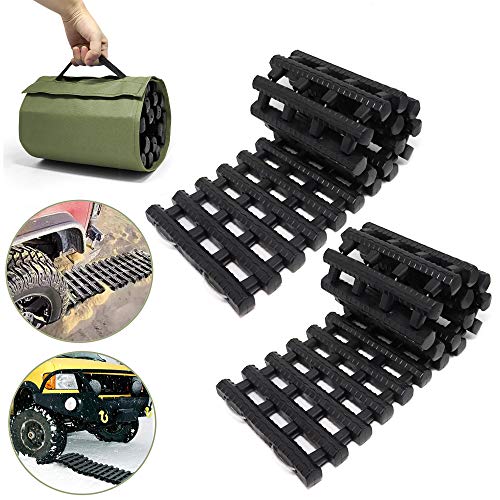
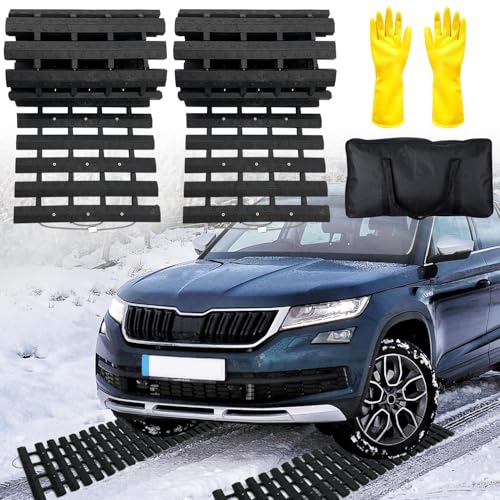
Getting buried up to the sidewall in slushy driveway snow is funny for about 4 seconds. Traction boards give tires a ramp of grip when ice, mud or packed snow has taken away momentum. After comparing 6 models, the Usyato Traction Board stands out with a 41-inch length, 10-ton support rating and 5.2 kg pair weight. The Rhino USA Traction Board is the alternative pick because its 2-pack includes retrieval leashes for digging boards back out.

Pros
- Supports up to 10 tons while weighing only 5.2 kg per pair
- Bends 120 degrees without breaking; stays warp-free in mud, snow, or sand
- Works from -30°F to 140°F across multiple terrains and vehicle types
- Built-in jack base fits most 4x4 farmer jacks for vehicle lifting
- Includes storage bag and 2 heavy-duty nylon retrieval straps
Cons
- Spade-shaped end design may require technique to use effectively as shovel
- Requires compatible farmer jack for built-in jack base functionality
- 10 locking holes for mounting may limit placement flexibility on some racks

Pros
- 2-pack includes camo carrying case for storage and transport
- Reinforced wheel studs and contoured ends prevent wheel spin
- Works on sand, mud, and snow without towing assistance
- Off-road jack base provides stability during recovery
- Industry standard 270 MM mounting holes fit roof racks
Cons
- Weighs 12 pounds per pair, requiring effort to place and retrieve
- Large 43.3 x 13.9 inch size limits storage in smaller vehicles
- Requires driver skill to position boards correctly under tires

Pros
- Built-in jack lift base fits most 4x4 farmer jacks for emergency recovery work
- Reinforced nylon construction withstands high-strength impact and resists corrosion
- Tooth-bite surface reduces wheel spin wear across sand, mud, and snow terrain
- Includes mounting kit with screws and nuts for secure rack attachment
- Two-pack with carry bag keeps boards portable and organized
Cons
- 10.5 pounds per board set may require significant storage space in vehicle
- Mounting kit compatibility depends on existing roof rack hole configuration
- Tooth-bite design requires regular cleaning to maintain traction effectiveness

Pros
- Compact size of 46 x 13 inches fits in most vehicle storage spaces
- Lightweight at 16.9 pounds for one person to carry and deploy
- Designed for multiple terrain types including sand, snow, and offroad conditions
- Black color resists showing dirt and wear over time
Cons
- No weight capacity or load rating specified in available product information
- Requires a pair for most vehicle recovery situations, doubling the investment

Pros
- Jack base design accommodates both round and square jack models for lifting
- Dual non-slip surfaces with criss-cross grip on bottom for traction in mud or snow
- Four handles per board and spade-shaped ends provide handling and digging capability
- Temperature rated from -22°F to 140°F for year-round use
- Premium nylon construction with 8 fixing holes for secure positioning
Cons
- 41.7-inch length may be difficult to store in compact vehicles
- No weight capacity rating provided for vehicle recovery applications
- Requires two separate boards at 11.8 inches wide for typical tire coverage

Pros
- 41.1-inch length provides substantial tire contact surface for maximum grip
- Bright red color aids visibility during low-light emergency recovery situations
- Durable construction designed to withstand heavy vehicle weight and extreme weather
- Versatile use as both tire ladder and traction mat for multiple stuck scenarios
Cons
- Two-piece set may require storage space in your vehicle or garage
- 11-inch width limits effectiveness for wider tires on larger vehicles
- No weight capacity rating provided for reference before use
How We Chose Traction Boards for Snow, Ice and Mud
A recovery board has to do more than look rugged on a roof rack. For winter use, the useful details are the numbers that tell you whether the board is long enough to bridge soft ground, light enough to drag through snow and shaped well enough for a tire to bite.
- Working load and break strength: Recovery boards see their hardest loads when a tire spins, drops and grabs all at once. Among our picks, the clearest capacity figure is a support rating up to 10 tons, which gives a useful benchmark for SUVs, trucks and larger vehicles. Where a listing did not give a load number, it had to make its case with dimensions, material and included recovery hardware instead.
- Material and length: Length matters because a longer board gives the tire more room to climb out instead of digging one deeper hole. The Usyato Traction Board is listed at 41 inches and uses high-strength polypropylene, with a pair weight of 5.2 kg. Its stated temperature range runs from -30 degrees F to 140 degrees F, which is the kind of spread that matters when a board may sit frozen in a cargo area and then get pressed into mud or snow.
- Ease of use with cold hands or gloves: A board that is hard to grab becomes a problem when your hands are wet, cold or gloved. The Nilight Traction Board includes 2 boards, 1 carry bag and 1 mounting kit, so the storage and mounting pieces are accounted for in the package. Its built-in jack base is designed for 4×4 farmer jacks, which can help when a tire needs lift before the board can be placed.
- Storage size and weight: Boards in the main list cluster around the 41-inch class, so the real storage question is thickness and how neatly a pair stacks. One pick measures 41.7 inches long and 11.8 inches wide, and its paired thickness is listed at 4.3 inches. Another pick measures 41.1 inches long and 11 inches wide, which is slightly narrower for cargo-area storage.
- Hooks, loops or traction pattern design: Retrieval straps, mounting holes and tread shape all matter after the tires have buried the boards. The Ouleme Traction Board has 8 fixing holes per board and 4 side handles, which helps with roof-rack placement and gloved handling. Its criss-cross grip design appears on the bottom as well as the top, so the board is meant to resist sliding under the tire.
- Vehicle or trailer fit: The best fit depends on the vehicle weight, tire size and where the board will be carried. Among our picks, compatible use is described for 4WD vehicles, SUVs, cars, trucks, RVs and large RVs. Several boards are built around 4×4 recovery use, and 1 pick also lists industry-standard 270 mm mounting holes for rack attachment.
We excluded jump starters and battery chargers because those solve electrical problems, not tire traction problems. We also left out permanent vehicle-mounted accessories that usually require shop installation, and cargo tie-down straps because securing a load is a different job than recovering a stuck vehicle.
The Competition
These are other traction boards we looked at but did not put on our main list.
If nylon construction is your main filter, Bunker Indust Tire Traction Mat belongs in the conversation. It was not picked because the main list gives clearer recovery details around the 41-inch class, including stated capacity, included bags or mounting hardware on several picks.
For shoppers comparing broad utility rather than one standout recovery number, Vevor Tire Traction Mat is another not-picked traction board. It did not match the keyword need as closely because our main picks give more directly comparable winter-use details, including lengths from 41 to 41.7 inches.
Donext Tire Traction Mat also falls into the capable-but-not-picked group. The reason is not that it lacks the basic idea of a traction board, but that the main list gives more specific numbers for cold-weather decisions, including a -30 degrees F low-temperature claim on one pick and a -22 degrees F low-temperature claim on another.
And if nylon build is the main reason you are shopping, X-Bull Product is worth recognizing before moving on. It still stayed off the main list because the selected picks give more complete recovery packages, including examples with 2 boards, retrieval straps, carry bags or mounting kits.
FAQs
How long should traction boards be for snow and mud?
For the boards compared here, the stated lengths sit around 41 to 41.7 inches. That size gives a tire more ramp than a short mat, while still being realistic to carry on a roof rack or inside a cargo area.
What material details matter in winter conditions?
Look for a stated temperature range and a named material. Among our picks, listed temperature ranges include -30 degrees F to 140 degrees F and -22 degrees F to 140 degrees F, which is useful for cold storage and frozen roadside use.
Do traction boards replace a jack or shovel?
No. Some boards include a jack base, and some have spade-shaped ends that can clear snow or mud, but those features do not make them full replacements for dedicated tools. A built-in jack base can help stabilize lifting on soft ground when used with the right 4×4 jack.
What should I check before trying to drive out of snow?
Before driving, the CDC says to make sure the vehicle tailpipe is clear of snow. If the tailpipe is blocked, carbon monoxide can build up quickly inside the vehicle, and the gas is odorless, colorless and deadly.
Sources
- Clear Snow from Tailpipes, Centers for Disease Control and Prevention. CDC warning about snow-blocked vehicle tailpipes.
- Safety Guidelines: During & After a Winter Storm, Centers for Disease Control and Prevention. Winter heating safety for space heaters, kerosene heaters and carbon monoxide.





Write Your Review
No reviews yet. Be the first to share your experience!