

Free Delivery. Exclusive Deals. All Prime.
Prime members save on shipping and get first access to deals, plus Prime Video included. 30 days free.
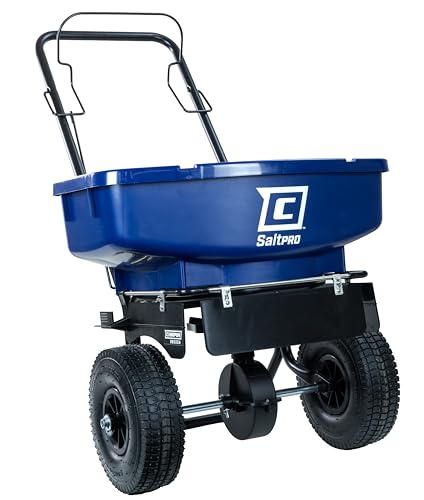
When the front walk turns into a skating rink before coffee, flinging salt from a coffee can gets old fast. Salt spreaders help put ice melt where it belongs, with less bending and less waste. After comparing 6 models, the Chapin Walk-Behind Salt Spreader stands out for its 80 lb hopper, 10-inch pneumatic tires, and 2-year warranty. The Scotts Handheld Salt Spreader is the easier alternative for small areas, with coverage listed at 1,500 sq. Ft.
Pros
- 80 lb rust-resistant poly hopper
- Fixed front and adjustable side baffles
- 10 inch pneumatic tires for snow and icy ground
- Rain and snow cover helps protect hopper
- 2-year limited warranty
Cons
- Recommended for small and pelletized particulates
- Residential size may not suit larger commercial jobs
- 31.5 x 23.5 x 34.5 inch frame needs storage space

Pros
- Hand-held design for small yards
- Adjustable arm support for comfort
- Holds up to 1,500 sq. ft. of Scotts lawn products
- Works with seed, fertilizer, salt and ice melt
- Engineered for smooth, even coverage
Cons
- Capacity is stated only for Scotts lawn products
- Hand-held format may be limited for larger areas
- No spread width listed

Pros
- No assembly required and pre-calibrated
- Holds up to 5,000 sq. ft. of product
- Can spread salt or ice melt for snow
- EdgeGuard helps keep product off sidewalks
- Fold-down handle for storage
Cons
- Capacity is aimed at smaller areas
- Primarily described as a lawn spreader
- No spread width listed

Pros
- 100 lb hopper for seed, fertilizer, salt, or ice melt
- Spread pattern up to 24 feet wide
- Adjustable poly deflectors help direct material
- 13 inch pneumatic tires for varied terrain
- Includes hopper screen and nylon rain cover
Cons
- Spinner set screw must be tightened before use
- Corrosive residue should be rinsed away after use
- 40 x 26.5 x 32 inch size needs storage space

Pros
- 64 oz bottle for salt, seed, fertilizer and more
- 3 lid openings for different particulate sizes
- Wide opening and screw top for refilling
- Large handle works with or without gloves
- Portable enough for shelf, closet or car storage
Cons
- Intended for steps, sidewalks and small paths
- Spread width is not listed
- Manual hand shaker, not a wheeled spreader
Pros
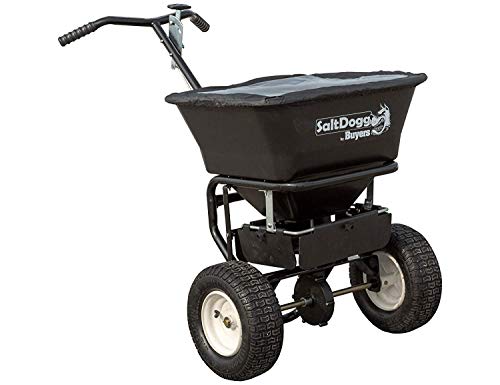
- 100 lb capacity for salt spreading
- Walk behind broadcast spreader design
- Steel frame listed in title
- Dimensions are 21 x 27 x 30 inches
Cons
- Spread width is not listed
- Product weight is not listed
- Warranty terms are not listed
What Matters Most in Salt Spreaders for Ice Melt and Rock Salt
A salt spreader has to move abrasive, corrosive material in cold weather, so capacity alone is not enough. The better match depends on how much pavement you treat, how tightly you need to control the spread pattern, and whether the frame and hopper are suited to winter use.
- Spreader type: The 6 picks cover handheld and walk-behind designs, which fit most home sidewalks, steps, short paths, and driveways. A handheld unit is easier to store, while a walk-behind model carries far more material per fill. The Chapin Salt Spreader is the compact end of that range, with a 64-ounce poly bottle and 3 lid openings for salt, sand, seed, or pelletized products.
- Hopper capacity: Capacity determines how often you stop to refill, and the spreaders here range from a 64-ounce hand shaker to 100 lb walk-behind hoppers. The Buyers Products Company Walk-Behind Salt Spreader is built around a 100 lb poly hopper, which suits longer walks or repeated passes better than a small handheld container. For a short stoop or a few steps, a smaller container can be easier to control than pushing a loaded cart.
- Spread width and flow control: Flow control matters because salt landing in garden beds or piled along edges is wasted. Among the main picks, controls include 3 lid openings on one handheld model, a full bar gate lever on one walk-behind model, and adjustable deflectors on another. One walk-behind pick lists a spread pattern up to 24 feet wide, which is useful for open pavement but still needs deflectors when working near curbs or landscaping.
- Wheels and frame: Wheels matter most once the hopper gets heavy, especially on packed snow or uneven driveway edges. The Chapin Walk-Behind Salt Spreader uses 10-inch pneumatic tires, a powder-coated steel frame, and an ergonomic U-shaped handle with full bar gate control. Its 80 lb hopper gives it more capacity than handheld picks without reaching the 100 lb size of the largest walk-behind models here.
- Rust resistance: Salt is hard on metal, so poly hoppers and covered drive components are worth noting. Among the picks, poly construction appears in both handheld and walk-behind designs, and one walk-behind model adds enclosed acetal gears for weather resistance. Another includes an enclosed gearbox with a grease fitting, which is a useful detail when corrosive residue is part of the job.
- Power source for 12V models: None of the main 6 picks is a 12V powered spreader, which keeps the list focused on hand-powered and push-powered tools. That matters if you are treating residential walks rather than loading a truck or utility vehicle. For 12V units, capacity can jump into the hundreds of pounds, but the size and setup are a different category than a small sidewalk spreader.
We excluded snow blowers and snow shovels because they are covered in other guides, and they solve a different part of winter cleanup. Vehicle-mounted plows are a separate job and budget, and kitchen ice crushers or shavers are not made for snow and ice.
Other Salt Spreaders Worth Considering
These are other salt spreaders we looked at but did not put on our main list.
If you need a vehicle-style setup rather than a push spreader, SaltDogg Tailgate Salt Spreader moves into a different class with a 331 lb capacity. Its poly construction and 12V power make it better suited to larger properties or truck-based work than our top pick, which is built around an 80 lb walk-behind hopper.
For people who want to stay farther from the ground, Snow Joe Handheld Salt Spreader takes a different approach with a 75-inch handle. That long-handle layout is not the same as a walk-behind hopper, but the ergonomic handle and built-in glove may appeal if bending is the main problem.
At the larger push-spreader size, Vevor Walk-Behind Salt Spreader offers a 100 lb capacity. The tradeoff is carbon construction, while our top pick emphasizes poly construction in the hopper area, a useful distinction when rock salt and ice melt are involved.
Steel is the defining difference with Amazon Basics Walk-Behind Salt Spreader. Steel construction can be appealing if you prioritize a metal frame feel, but it is less aligned with the poly-heavy approach used by several main picks for handling corrosive winter material.
FAQs
What size salt spreader is right for a driveway?
For a few steps or a short walkway, a handheld spreader with a 64-ounce container or 1,500 sq. Ft. Listed coverage can be enough. For longer driveways, an 80 lb or 100 lb walk-behind hopper reduces the number of refills.
Is a handheld or walk-behind salt spreader better for ice melt?
A handheld spreader is easier to store and carry for small patches, steps, and narrow paths. A walk-behind spreader is better when you want more capacity, with the main walk-behind picks ranging from 80 lb to 100 lb hoppers.
How important is spread control near lawns and beds?
Spread control is important because salt and ice melt should stay on the pavement you are treating. Among the main picks, control features include 3 lid openings, adjustable deflectors, and gate levers that change material flow.
Can a salt spreader replace shoveling?
A salt spreader helps manage ice and light accumulation, but it does not remove deep snow the way a shovel or blower does. According to Nationwide Children’s Hospital, an average of 11,500 snow shoveling-related injuries and medical emergencies were treated in US emergency departments each year, so reducing unnecessary lifting is still a practical goal.
Sources
- New National Study Finds 11,500 Emergency Department Visits, Nearly 100 Deaths Related to Snow Shoveling Each Year, Nationwide Children’s Hospital. Study of snow shoveling injuries treated in US emergency departments from 1990 to 2006.
- Falls and Other Hazards to Workers Removing Snow from Rooftops and Other Elevated Surfaces, Occupational Safety and Health Administration. OSHA hazard alert on removing snow from roofs.




Write Your Review
No reviews yet. Be the first to share your experience!