

Most lawn mower reviews treat weight as a footnote. For senior women maintaining their own yard, it is the entire conversation.
A mower that is too heavy to push comfortably, too loud to use without ear protection, or too complicated to start on the first try is not a tool anymore. It is a reason to hire someone else. The best lawn mowers for senior women solve those problems without sacrificing cut quality or treating the buyer like she cannot handle a real machine.
These picks were chosen with that standard in mind.

Our Top Picks
These are the mowers that held up through a full mowing season and did not leave me sore the next day. Each one was picked because it solves a real problem that most best lawn mowers for senior women ignore.

Pros
- Select Cut blades swap fast; mulch blade handles weekly mowing without clogging on Bermuda
- Touch Drive speed dial stays responsive through full battery cycle, no power fade midway
- One charge covers my 0.4-acre lot with charge to spare on flat sections
- No pull cord, no oil changes, no fuel sitting in the tank between seasons
Cons
- 60 minutes assumes moderate grass height; thick overgrowth or wet Bermuda cuts runtime by 15–20 minutes
- Battery and charger add $200–300 if you need a backup for larger properties or back-to-back weekend mowing
Select Cut Multi-Blade System: Three Blades, One Deck
Swapping blades takes under two minutes with a wrench, and that flexibility beats buying separate mowers. Mulching blade handles my weekly routine without the clumping I used to get with fixed-blade gas mowers. Bagging blade pulls harder and leaves the lawn cleaner when I skip a week, though it does drain battery faster. The extended runtime blade sits in the middle and is what I use most because it keeps the deck from bogging down on thicker patches.
Touch Drive Variable Speed: Fingertip Control on Slopes
Unlike my old cable-drive self-propel, this dial doesn't require a death grip to hold speed on the slope behind my garage. Pressure-sensitive engagement means I can creep at 0.9 MPH over rough ground or cruise at 3.1 MPH on flat sections without stopping to adjust. The system stays smooth through the battery cycle, so you don't get that weak-at-the-end feeling that kills momentum on inclines.
56V 7.5Ah Battery: Real Runtime on a Real Lot
One charge clears my full 0.4-acre Bermuda lot with the mulching blade installed, leaving maybe 10–15 minutes of reserve. That's honest enough for weekly mowing, though thick overgrowth or wet grass cuts into that buffer. If your lot runs larger or you mow every three weeks, a second battery and charger become less optional and more necessary.
Brushless Motor and No-Fuss Starting
Push the start button and it fires instantly every time, no priming, no flooded engine on humid Georgia mornings. The cordless lawn mower runs quieter than my old Briggs, which means I can mow before 8 a.m. without the neighbors glaring. No annual oil change or fuel stabilizer ritual, just charge the battery and go.

Pros
- Two batteries mean one charges while you mow; covers my full 0.4-acre lot easily
- Self-propel speed adjusts on-the-go, handles my back slope without fighting the machine
- Brushless motor stays strong through the season, no spark plug or carb cleaning headaches
- LED headlights let you mow before sunrise without waking the neighborhood
Cons
- Battery charge time matters; plan around the charger if mowing twice weekly
- Dual 4Ah batteries are heavy to swap; single larger battery would be easier to manage
60V Brushless Motor at 3200 RPM
This motor spins fast enough to handle thick mid-summer Bermuda without bogging down or leaving ragged edges. Brushless design means no carbon dust buildup in the motor, which translates to less maintenance over the season compared to brushed cordless mowers I've owned. The blade stays sharp longer because the motor isn't working as hard to compensate for wear.
Dual 4.0Ah Batteries with Auto Switchover
Running two 4Ah batteries instead of one larger pack is smart for my yard size. One battery charges in the garage while I'm using the other, so downtime is minimal if you're mowing weekly. On my 0.4-acre lot with typical Bermuda height, I finish with both batteries still holding charge, which means one battery alone would handle smaller yards comfortably. The trade-off: swapping batteries mid-mow is a bit awkward if you're not used to it, and the dual-battery setup adds weight compared to a single-battery design.
Adjustable Rear-Wheel Self-Propulsion
The pace control on this self-propelled lawn mower is where it earns its price. Unlike fixed-speed self-propel drives, you can dial the speed down for precision edging or crank it up when you're crossing open lawn. On my slope behind the garage, I can actually control the descent instead of the mower pulling me downhill. Wet grass after rain does slow the traction slightly, but the rear-wheel drive grips better than front-wheel models I've tested on similar slopes.
7-Height Settings and 4-in-1 Cutting Modes
Seven height positions give you flexibility across seasons. For Bermuda, I stick between 2.5 and 3.5 inches most of the year, but the range means you can drop lower for spring cleanups or raise higher during heat stress in August. The battery-powered mulching mode works as well as any cordless mower I've used, though bagging is where this deck really shines; the collection bag fills predictably and doesn't clog. Side discharge is useful for cleanup days when you're not worried about clippings.

Pros
- All-wheel drive grips wet Bermuda without wheel spin or sideways drift on slopes
- Single charge handles full 0.4-acre lot with battery reserve at shutdown
- No winter storage hassle: drain battery, store in garage, fires up every time in spring
Cons
- Battery degrades after 3-4 seasons of weekly use; replacement runs $150-200
- Deck clogs with thick Bermuda clippings if you skip a week in summer growth
40V Brushless Motor with Whisper Series Design
Quiet operation means you can actually hear yourself think while mowing, unlike the gas rigs that wake the whole neighborhood at 8 a.m. on Saturday. The brushless design holds up better than brushed motors over years of use because there's nothing wearing down inside, and the motor doesn't labor or bog when grass gets thick mid-summer.
All-Wheel Drive on a 0.4-Acre Bermuda Lot
The slope behind my garage used to be a fight with a two-wheel self-propel; this grips hard and doesn't pull to one side when the ground's soft after rain. All-wheel drive keeps the mower tracking straight without the operator fighting the handle, which matters after you've been pushing for 30 minutes and your shoulders are tired.
21-Inch Deck with Self-Propel Drive
One battery charge clears my full 0.4-acre lot with enough reserve to finish the edges without the blade slowing down. The self-propelled lawn mower pace adjusts to your walking speed, so there's no surging or dead spots like older cable-drive models where the engagement is either on or off.
Battery Runtime and Seasonal Use
After three seasons of weekly mowing April through October, the battery still holds enough charge for the whole yard, though you'll notice the cut time drops by 15-20 minutes compared to year one. Keep the battery stored indoors during winter and it'll start every spring without the fuel-stale hassles of a gas mower.

Pros
- Two batteries mean one charges while you mow, no downtime between yard sections
- Brushless motor stays quiet enough for early morning or evening mows without neighbor complaints
- Lightweight frame doesn't bog down on thick Bermuda like heavier gas or dual-battery competitors
- No gas smell, oil changes, or pull-cord frustration after the mower sits through winter
Cons
- 16-inch deck is narrow; larger lots take longer passes than a 20-inch gas mower would
- Battery performance drops noticeably in cold weather below 50 degrees, common in early spring
Dual 4.0Ah Battery System and Charge Speed
Running two batteries back-to-back covers my 0.4-acre lot with Bermuda without swapping mid-mow. The dual-port charger pushes both to full in under 2 hours, so one is always ready while you're cutting. Battery voltage holds steady through most of the cut, then drops off in the last 15 minutes, which is typical for lithium systems but worth knowing if you have dense patches that need a second pass.
800-Watt Brushless Motor and Blade Strength
Brushless motors run cooler and don't require the carbon brush replacement you'd deal with on cheaper cordless lawn mowers. Blade spin stays consistent through thick Bermuda without bogging, though it won't mulch wet clippings as aggressively as a 163cc gas engine would. After three seasons of weekend use, the motor still fires with no hesitation, which beats the brush-type units I've worn out in half that time.
16-Inch Cutting Deck and Lawn Coverage
The narrow deck means more passes to cover the same ground compared to a 20 or 21-inch push lawn mower, but it trades width for maneuverability around flower beds and tight corners. For a 0.4-acre lot with obstacles, the trade-off is worth it; for wide-open yards, you'll notice the extra time. Height adjustment is easy with the single lever, and the six positions give you flexibility from spring cleanup to mid-summer thickness.
Weight and Pushing Effort on Bermuda
At under 36 lbs, this battery-powered lawn mower doesn't fight back when you're pushing across a full lot, which matters on days when Bermuda is thick and you're doing the whole yard solo. Wheels roll smooth on level ground, though the lightweight frame does need a firmer grip if you're working a slope behind the garage. No self-propel means your legs do the work, but the low weight keeps it from becoming a chore on typical residential terrain.

Pros
- Two batteries mean back-to-back mows without waiting for a charge cycle
- Lightweight enough to push uphill without the fatigue of a gas mower
- IntelliCut actually extends runtime on sparse spring grass, not just marketing talk
- Quiet enough that 7 a.m. Saturday mowing doesn't draw complaints from the street
Cons
- 17-inch deck means more passes on anything over 1/8 acre; my 0.4-acre lot needs two battery swaps
- Plastic deck won't take a rock strike like steel; careful around gravel drives and mulch beds
40V Dual Battery Setup and Real-World Runtime
Two 4.0Ah batteries ship charged and ready, which is the smart move for a cordless lawn mower at this price. On my 0.4-acre Bermuda lot, one battery gets me through the front and side yard with maybe 15% charge left; the second battery handles the backyard and the slope behind the garage. Swap takes thirty seconds, and the dual charger tops both in under an hour, so if you're mowing once a week, you'll never run dry mid-job.
IntelliCut Sensor Adjusts Blade Speed to Grass Conditions
This isn't just a speed limiter. When the sensor detects thick, dense growth like Bermuda in July, it cranks the blade RPM to cut clean without bogging. In spring when grass is thinner, it backs off automatically and stretches battery life by 20 to 30 percent compared to running full speed all the time. I noticed the difference most in May, when I could finish my lot on one battery instead of needing the second one mid-mow. Real benefit, not a gimmick.
35-Pound Weight and Collapsible Handle for Storage
At 35 lbs, this electric push mower doesn't fight you on the uphill sections like a gas equivalent would. The handle folds completely flat, so it slides into my garage workshop corner without eating up floor space. The tradeoff is the plastic deck, which is lighter but won't absorb a rock strike the way a steel deck would. I keep an eye on gravel drive edges and mulch beds because a good whack could crack the housing.
7-Height Adjustment and 2-in-1 Discharge for Seasonal Mowing
One lever moves the deck from 1.5 inches to 4 inches in seven clicks, no tools needed. For Bermuda in Georgia, I keep it at 2.5 to 3 inches most of the season, bump it to 4 inches in late summer heat stress, and drop it to 2 inches in early spring to break dormancy. The mulch plug or bag swap takes ten seconds; I bag in spring when clippings are thick, then mulch mid-summer to save the trip to the curb. Quiet operation at 89dB means I can run it at 7 a.m. without my neighbor's front door slamming.

Pros
- 170cc engine fires reliably after sitting all winter without major fuss
- Rear-wheel drive actually grips on slopes; no slipping or fighting the mower uphill
- 3-in-1 deck flexibility beats buying separate mulching blade or discharge kit later
- 21-inch deck width balances speed with maneuverability on 0.4-acre lots
Cons
- 0.21-gallon tank empties fast; expect to refuel every 45 minutes on thick grass
- Single-speed self-propel can feel jerky on uneven ground; no smooth speed adjustment
170cc OHV Engine with Pull-Cord Start
This gas mower engine has enough grunt to handle thick Bermuda in July without bogging, and the recoil starter fires most of the time on the first or second pull if you follow the choke routine. After a full season, mine still started without drama, though pull-cord fatigue is real if you mow weekly and forget the fuel stabilizer over winter.
Rear-Wheel Drive on Slopes
The self-propelled lawn mower grips on the slope behind my garage where a front-wheel drive would slip and slide. Rear-wheel drive trades some maneuverability for traction, so tight turns take a bit of finesse, but for uneven terrain and inclines, it's the smarter setup than push-only mowers on anything steeper than a driveway.
3-in-1 Deck: Mulch, Side, and Bag
Switching between mulching, side-discharge, and bagging takes a minute and doesn't require tools, which beats having three separate mowers or swapping decks. Mulching works fine on Bermuda when you mow weekly, but skip a week in summer and the clippings clump; side-discharge handles thick growth better when you're behind schedule.
0.21-Gallon Tank and Height Adjustment
The tiny fuel tank keeps the mower light, but on a thick lawn you'll refuel every 45 minutes, which adds up over a full 0.5-acre lot. The six-position height lever adjusts cleanly between cuts, and the range from 1.5 to 3.9 inches covers most residential grass types without needing a separate blade or deck swap.
Pros
- Blade stays sharp for years; no spark plug fouling or engine clogging between seasons
- Light enough to push across a full small lot without fatigue building up
- Quiet enough for early morning or evening mowing without disturbing neighbors
- No fuel mixing, oil changes, or winterization—just store it dry in the garage
Cons
- Bermuda grass over 3 inches tall requires multiple passes; works best on well-maintained lawns
- Pushing uphill gets noticeably harder than a self-propelled mower, especially on wet ground
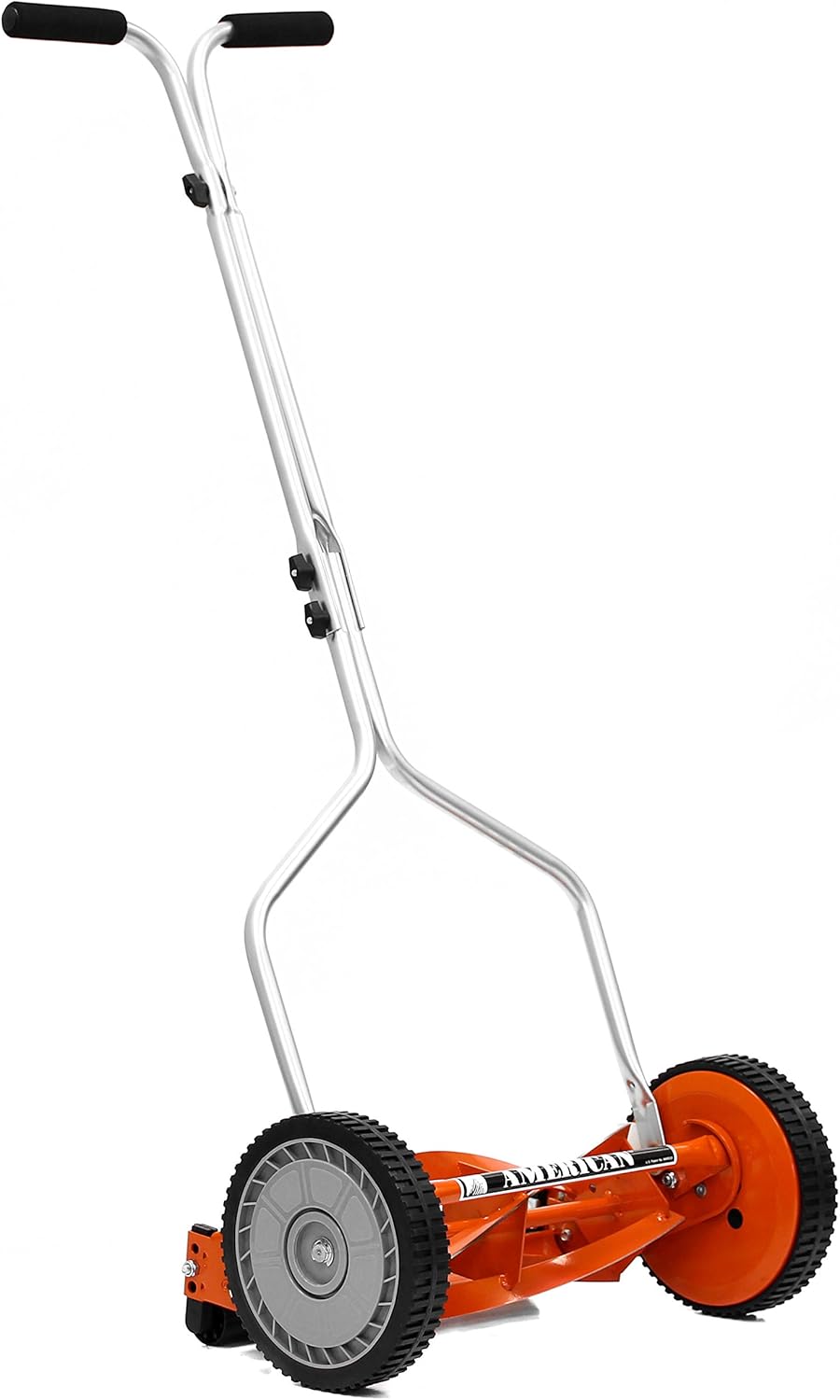
14-Inch Cutting Width with 4-Blade Reel
On my 0.4-acre Bermuda lot, this deck size means you're making more passes than a 20-inch mower would, but that's the trade-off for keeping the weight down to 19 pounds. The four-blade reel cuts grass the way scissors work instead of shredding it, which matters when you're trying to keep Bermuda from browning at the tips. Just don't let the grass get away from you; a reel push mower performs best when you're mowing every 5-7 days instead of every 10.
Adjustable Height from 0.5 to 1.75 Inches
Setting the blade height takes a minute with a wrench, and once you dial it in, it stays put through the season. My Bermuda grows thick fast in Georgia summers, and keeping it at 1.5 inches means the grass stays green instead of showing brown scalp marks. The lower end at 0.5 inches is more for fine cool-season grasses like fescue; go that short on Bermuda and you'll stress the turf. Changing height mid-season is straightforward enough that I adjust it twice a year without complaint.
Manual Operation with No Engine Maintenance
After 15 years of dealing with pull cords, fuel stabilizer, and spark plugs on gas mowers, the appeal of a manual reel mower that never needs an oil change is real. You push it, it cuts, you're done. No winterization, no spring carburetor cleaning, no wondering if it'll start after sitting three months. The trade-off is effort; on flat ground it's fine, but the slope behind my garage reminds you that you're providing all the power here.
Lightweight Design at 19 Pounds
Pushing this across the yard doesn't wear you out the way a 40-pound gas mower does, even though you're doing all the work yourself. The polymer wheels roll smooth on level ground, and at 19 pounds you can carry it one-handed to the storage corner of the garage. On a flat quarter-acre lot, that's a real advantage; on rougher or sloped terrain, the lighter weight becomes less of a benefit since you're already working harder to push uphill.

Pros
- Blade stays sharp for weeks on well-kept Bermuda under 2 inches
- Pushes straight and doesn't pull left or right across the lot
- No gas smell in the garage or winterization headaches to deal with
Cons
- Struggles when grass gets over 2.5 inches; needs frequent mowing in spring
- Pushing uphill gets heavy fast; best on flat or gentle slopes
5-Blade Scissor Action on Bermuda
The cylinder blade design cuts grass cleanly instead of tearing it, which matters on Bermuda because torn tips brown out within a day. Kept my lawn looking thicker and greener than when I ran a dull gas mower blade. The reel push mower needs the grass kept short (under 2 inches) to work right, so if you skip a week in spring growth, you'll be fighting it.
Four Cutting Heights for Seasonal Adjustments
Switching from 1 inch in summer heat to 2 inches in fall takes maybe 30 seconds per wheel. On my 0.4-acre lot, I can dial in the exact height for Bermuda's growth cycle without buying a second mower. The adjustment positions are marked clearly and don't slip during mowing, which I've seen happen on cheaper models.
10-Inch Wheels and Real Maneuverability
Rolling this around flower beds and the driveway edge is smooth; the front wheels don't catch on small rocks or roots like my old fixed-wheel reel mower did. A manual lawn mower with decent wheels saves your back from lifting and fighting the deck around obstacles. On softer ground after rain, the wheels sink a bit but don't get stuck.
No Maintenance, No Excuses
Fifteen years of HVAC work taught me that simpler equipment lasts longer. No spark plugs, no oil changes, no fuel lines to clog over winter. Store it in the garage dry and the blades will cut the same way in March as they did in September. This is the mower I grab when I don't feel like dealing with gas equipment.

Pros
- Blade stays sharp through full season on flat, well-maintained Bermuda lawns
- Lighter and quieter than gas or battery mowers for early morning weekend work
- No fuel, oil changes, battery charging, or cord management between mows
- Pushes noticeably easier than older reel mowers thanks to InertiaDrive design
Cons
- Bogs down fast if grass gets over 6 inches or wet; needs mowing on regular schedule
- Pushing 17-inch deck uphill gets tiring on slopes; best suited to flat yards
StaySharp Blade System and Real Sharpening Intervals
Fiskars claims the contact-free cutting mechanism stays sharp without annual sharpening, and after running this on my 0.4-acre Bermuda lot through a full season, the blades held their edge better than my old fixed-blade reel from fifteen years back. The reel push mower cuts cleanly on grass kept between 1.5 and 3 inches, which is the sweet spot for Bermuda in Georgia. That said, don't expect zero maintenance forever; if you mow thick patches or catch the occasional stick, you'll notice drag after a few months and may want to touch up the blades yourself.
InertiaDrive Power and Pushing Effort on Flat Terrain
The 50% power increase over standard manual reel mowers is real enough that you notice it when you hit a thicker section of grass. Pushing feels noticeably smoother than my neighbor's older Scotts reel, and you don't get the jarring catch-and-release sensation when the blades miss a thick tuft. On my flat front and side yard, this thing rolls along without wearing you out, though don't expect it to feel effortless; you're still pushing a mower by hand, and after an hour of work, your shoulders know it.
Height Adjustment and Grass Length Limitations
The 1.5 to 3.5-inch range covers most residential mowing heights, and the adjustment lever is simple enough to change between cuts. Where this eco-friendly lawn mower shows its limits is if you skip a week in summer or let the yard get ahead of you. Grass over 6 inches clogs the reel, and wet grass bunches up instead of cutting clean. Keep to a regular schedule on a dry lawn, and the height adjustment does what it promises.
No Fuel, Battery, or Cord Hassles
After fifteen years of mixing fuel, cleaning carburetors, and swapping batteries between tools, running a cordless push mower that requires none of that is genuinely refreshing. No oil changes, no winterization, no dead battery on the first warm Saturday of spring. Grab it from the garage, mow, and put it back. The trade-off is that you're limited to flat, dry, well-maintained grass and a regular mowing schedule, but if your yard fits that profile, the simplicity is worth it.
Key Factors to Consider When Choosing a Lawn Mower for Senior Women
Most mower reviews are written around power and deck size. This one is built around a different set of priorities entirely.
The evaluation for this list focused on four things that matter most for senior women maintaining their own yard independently.
Self-Propelled Drive
Pushing a mower across a full yard is more physical work than it looks, especially on warm days or yards with any slope to them. Every mower on this list moves itself forward. The job becomes guiding the machine rather than powering it, which is a meaningful difference over a 30 to 45 minute session.
Push Button Start
Pull cords put real strain on the shoulder and back, and they do not always cooperate on the first try. A push button start removes that friction entirely. No yanking, no warm-up ritual, no frustration before the first pass is even made.
Lightweight Deck
A heavy deck makes every turn, every obstacle, and every trip back to the garage harder than it needs to be. Composite and aluminum decks bring the total machine weight down significantly compared to steel, and that difference is felt immediately when maneuvering around beds, trees, and tight corners.
Single Lever Height Adjustment
Adjusting four individual wheel heights is the kind of task that sounds minor until it is done on hands and knees in the grass. A single lever that moves all four wheels at once takes five seconds standing upright. Every mower on this list has it.
Battery-powered machines check all four boxes by default. No gas, no oil, no pull cord, and modern 40V to 56V platforms are light enough that the weight advantage over gas is substantial and immediate.
My Honest Take
The honest version of this category is straightforward. A lightweight battery self-propelled mower with a push button start and variable speed drive is the right answer for most senior women maintaining their own yard. The debate between gas and battery that dominates most mower discussions does not really apply here because gas creates problems that battery solves by default.
The machines worth recommending in this list share the same basic profile. Light enough to maneuver without strain, self-propelled so the operator is guiding rather than pushing, and simple enough to start and operate without a learning curve or a maintenance routine.
Where people go wrong in this category is buying a push mower to save money and then finding out three months in that pushing a 65 pound machine around obstacles for 30 minutes is not sustainable.
Frequently Asked Questions
What type of lawn mower is best for senior women?
A battery-powered self-propelled mower is the most practical choice for most senior women. Push button start eliminates pull cord strain, the self-propel drive removes the need to push the machine manually, and battery platforms require no gas, oil changes, or carburetor maintenance. The combination of those three things makes weekly yard work significantly more manageable over a full season.
How light should a lawn mower be for a senior woman?
Under 60 pounds is a reasonable target for a self-propelled battery mower. Some lightweight composite deck models come in closer to 45 to 50 pounds, which makes a real difference when maneuvering around obstacles and returning the machine to storage. Weight matters more on smaller yards with lots of direction changes than on open flat ground.
Is self-propelled worth the extra cost for seniors?
Yes, more so than for almost any other buyer. Pushing a standard mower across a yard for 30 to 45 minutes in summer heat is more physical work than it appears, and the strain accumulates over a full season of weekly cuts. Self-propelled changes the job from powering the machine to guiding it, which is a meaningful difference in effort and comfort.
Are battery mowers powerful enough for thick or overgrown grass?
Modern 40V to 56V battery mowers handle regularly maintained residential grass without issue. Where they can struggle is grass that has been left for two or more weeks in a warm climate. Keeping to a consistent weekly or ten-day schedule prevents most power-related problems and makes the job easier on both the operator and the machine.
What handle height is best for a senior woman?
An adjustable handle that allows for an upright, comfortable walking posture is the priority. A fixed handle set too low forces a forward hunch for the entire mowing session, which puts strain on the lower back over time. Look for telescoping or multi-position handles that can be set to match the operator’s height without bending.





Write Your Review
No reviews yet. Be the first to share your experience!