

Free Delivery. Exclusive Deals. All Prime.
Prime members save on shipping and get first access to deals, plus Prime Video included. 30 days free.
The toast burns, the dog sneezes, and suddenly everyone is blaming the HVAC filter. PM2.5 air quality monitors help turn that guessing into readings you can act on. After comparing 6 models, the Temtop Air Quality Monitor is the top pick because it tracks CO2 and PM2.5, supports app control, and claims up to 60 days of battery life. The qingping Air Quality Monitor is the alternative pick for shoppers who want CO2, HCHO, PM10 and PM2.5 readings with app control.

Pros
- Tracks CO2, PM2.5, TVOCs, temperature and humidity
- Up to 60 days of battery life
- E-ink display helps reduce frequent recharging
- Muted adjustable alarm for bedrooms or nurseries
- Bluetooth app supports history, calibration and OTA updates
Cons
- Bluetooth monitoring requires staying nearby
- Data is automatically logged once every hour
- App is needed for historical data and calibration

Pros
- Tracks 7 metrics including CO2, PM2.5, PM10 and humidity
- 4 inch IPS touchscreen with 254 PPI clarity
- Supports 2.4GHz and 5GHz Wi-Fi for app monitoring
- Exports up to 30 days of historical data in the app
- Replaceable PM sensor for easier future maintenance
Cons
- Does not measure formaldehyde
- USB power adapter is not included
- Battery works up to 3 hours after a full charge
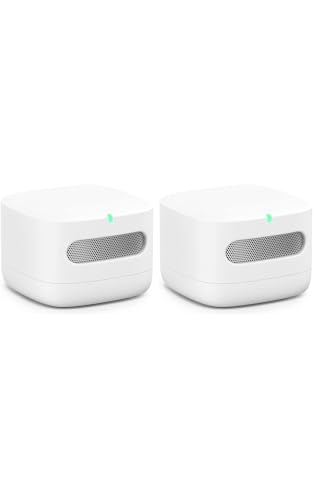
Pros
- Tracks 5 factors: PM2.5, VOCs, CO, humidity, temperature
- Color-coded LED shows current air quality status
- Alexa app provides air quality score and details
- Phone and Echo alerts when air quality drops
- Can trigger Alexa Routines for compatible devices
Cons
- Requires Alexa app for detailed air quality information
- Only works with compatible Alexa devices for automations
- No accuracy specifications provided in the product data

Pros
- Tracks 9 parameters including CO2, PM2.5, TVOC and humidity
- 7-inch LED display with 3 brightness settings
- 7 AQI alert buzzer functions plus mute button
- USB-C charging with up to 8 hours of runtime
- Includes AC adapter, USB-C cable and 12-month warranty
Cons
- 8-hour runtime may require recharging for full-day use
- Sensors should not be touched or exposed to strong odors
- No app or smart home features listed

Pros
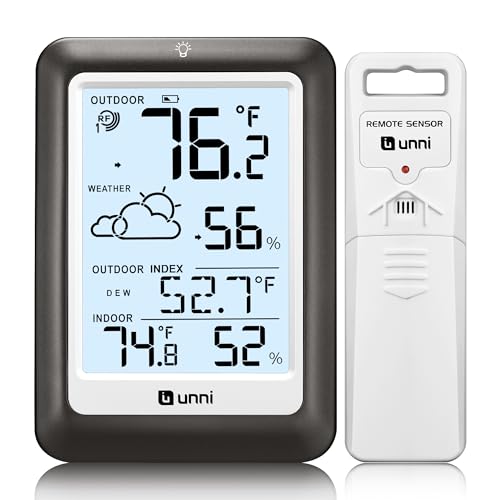
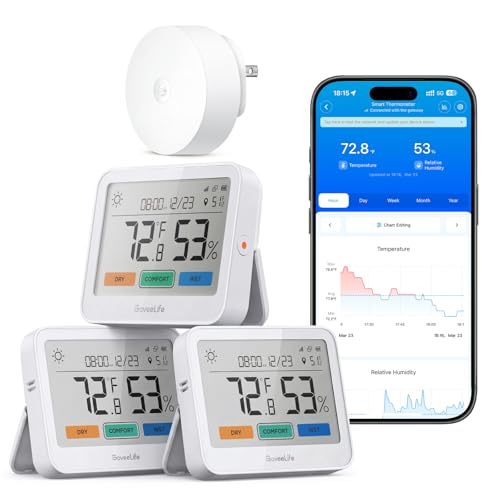
- Measures PM2.5, temperature, and humidity
- PM2.5 accuracy listed as ±15 µg/m³
- Temperature accuracy listed as ±0.54°F
- Refreshes correction data every 2 seconds
- Exports up to 2 years of data
Cons
- Needs a power source, with no built-in battery
- 2.4G Wi-Fi required to display the time
- Only supports listed GoveeLife devices

Pros
- Tracks CO2, PM1, PM2.5, PM10, TVOC, HCHO, temp and humidity
- Stores up to 90 days of app history with data export
- Up to 6 hours of portable use on the rechargeable battery
- Uses NDIR CO2 and laser particle sensing
- Compact 1.4 x 2.8 x 3.3 inch design
Cons
- App connection requires 2.4 GHz Wi-Fi
- Continuous monitoring requires USB-C power
- Battery life is limited to up to 6 hours
What We Looked For in Air Quality Monitors for Indoor PM2.5 Tracking
Indoor air changes quickly when you cook, clean, run a humidifier or close up a bedroom for the night. A useful monitor should show the particle reading clearly, but it should also give enough context to explain what else is changing in the room.
- What it measures: The most useful models here pair PM2.5 with comfort readings or gases, rather than treating particles as the whole story. The Temtop Air Quality Monitor measures CO2 and PM2.5, and it also includes temperature and humidity tracking. That mix matters because a closed room can have rising CO2 even when particles look low.
- Stated accuracy: Accuracy claims were most helpful when they were attached to a specific reading. The GoveeLife Air Quality Monitor states PM2.5 accuracy of ±15 µg/m³ and humidity accuracy of ±3%RH. It also refreshes correction data every 2 seconds, which is useful when cooking smoke or a purifier changes conditions quickly.
- Display and readability: The displays range from compact e-ink and LED layouts to a 7-inch screen and a 4-inch touchscreen. We favored monitors that make the current reading readable without forcing you to open an app first. Color indicators also helped, especially on models that show 4 air-quality levels or use color below each metric.
- Data history and app or smart-home support: App features vary a lot, from 13-day graphs with 2-year export to 90-day history and export. The Amazon Air Quality Monitor measures CO, PM2.5, VOCs, temperature and humidity, then shows a score in the Alexa app. It can also trigger Alexa routines for compatible purifiers, dehumidifiers and fans.
- Power source and battery life: Battery life is a real divider in this group. One pick claims up to 60 days, while other portable models list up to 8 hours, up to 6 hours or up to 3 hours after a full charge. One wired model has no built-in battery, which is less flexible but avoids recharge planning.
- Number of sensors or rooms: Most of these are single-room monitors, so the practical question is where the sensor will live. One package is sold as a 2-pack, which makes it easier to watch 2 areas through the same smart-home system. For many homes, comparing a bedroom with a kitchen tells more than watching only one central hallway.
We excluded dehumidifiers because they remove moisture rather than measure air pollutants. We also left out essential oil diffusers, which have too little output to humidify a room, and medical or meat thermometers, which are built for a different job.
Other Air Quality Monitors Worth Considering
These are other air quality monitors we looked at but did not put on our main list.
If you want a broad pollutant readout, Qxzfff Air Quality Monitor is an alternative that measures CO2, HCHO, PM1.0 and PM10. It also has app control, but compared with our top pick, the listed strengths focus less on battery life and more on the number of pollutant categories.
For shoppers who want PM2.5 called out alongside larger particles, zemeollo Air Quality Monitor is another alternative with CO2, HCHO, PM10 and PM2.5 readings. It includes app control, but our alternative pick adds a more fully described screen experience with a 4-inch touchscreen and app history.
Prefer a simpler particle-and-comfort mix? Sonoff Air Quality Monitor measures PM10, PM2.5, temperature and humidity, and it lists ±3% humidity accuracy. That makes it comparable to the main picks on humidity precision, though it does not claim the same gas mix as our top pick or our alternative pick.
And if gas readings are a priority, sainlogic Air Quality Monitor is an alternative that measures CO2, HCHO, PM1.0 and PM10. It also lists ±3% humidity accuracy and app control, but the main list includes options with more clearly described display sizes, battery runtimes or smart-home automations.
FAQs
What should an indoor PM2.5 monitor measure besides particles?
PM2.5 is the key particle reading, but temperature and humidity help explain comfort and moisture conditions. Several picks also add CO2, VOCs or CO, which can point to ventilation, household chemicals or combustion-related concerns.
How much app history is useful for indoor air tracking?
Short history helps you see what happened during cooking or cleaning, while longer history is better for spotting weekly patterns. Among our picks, stated app history includes 13-day graphs, 30-day history and 90-day history, with some export options.
Do battery-powered air quality monitors make sense?
Battery power helps when you want to compare rooms, but runtimes vary widely. In this group, stated portable runtime ranges from up to 3 hours to up to 60 days, while one wired pick has no built-in battery.
Why does humidity matter when shopping for a PM2.5 monitor?
Humidity affects comfort and can relate to mold risk. The EPA says indoor relative humidity should be kept below 60 percent, ideally between 30 and 50 percent, so a monitor with humidity readings can help you watch that range.
Sources
- Use and Care of Home Humidifiers, U.S. Environmental Protection Agency. EPA guidance on humidifier types, minerals, cleaning and safe humidity levels.
- A Guide to Mold, Moisture and Your Home, U.S. Environmental Protection Agency. EPA guide to controlling indoor moisture and mold.



Write Your Review
No reviews yet. Be the first to share your experience!