

Free Delivery. Exclusive Deals. All Prime.
Prime members save on shipping and get first access to deals, plus Prime Video included. 30 days free.
When the toaster gets ambitious or wildfire haze sneaks under the door, guessing with your nose gets old fast. The right air quality monitor turns smoke concern into numbers you can act on. After comparing 6 models, the Qxzfff Air Quality Monitor is the best fit for air quality monitors for smoke because it tracks CO2, HCHO and PM1.0, plus PM10. The YNAK Air Quality Monitor is the alternative pick with CO2, HCHO and PM1.0 readings, plus temperature and humidity.

Pros
- Tracks CO2, HCHO, TVOC, benzene, AQI, PM1.0, PM2.5 and PM10
- Also shows real-time temperature and humidity
- Large HD color screen with abnormal reading color changes
- Voice alert can be turned on or off
- 2000mAh rechargeable battery supports up to 20 hours
Cons
- No listed app, Wi-Fi or smart home connectivity
- Requires calibration mode for sensor maintenance
- Compact screen may show many readings at once
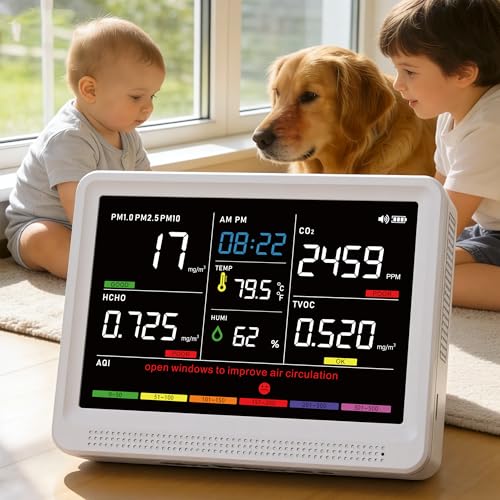
Pros
- Tracks CO2, PM2.5, PM1.0, PM10, HCHO, TVOC, temp and humidity
- 5.5-inch HD LED display with 3 brightness levels
- Up to 10 hours of runtime per full charge
- USB-C charging with cable and AC adapter included
- 7 AQI alert buzzers plus mute button
Cons
- Sensors should not be touched or exposed to strong odors
- Battery runtime is limited to up to 10 hours
- Made for indoor environments, vehicles and campsites

Pros
- Tracks AQI, CO2, PM2.5, PM1.0, PM10, TVOC and HCHO
- 2.4GHz WiFi with Smart Life and Tuya Smart app support
- 3000mAh battery rated for about 7 to 15 hours
- HD LCD shows color coded air quality status bars
- Wall mount option plus temperature and humidity display
Cons
- WiFi 6 plus routers may need compatibility mode
- Only one phone can be connected at a time
- Long term data recording is recommended while plugged in

Pros
- 10-in-1 monitor tracks CO2, HCHO, TVOC, particles and more
- Color screen shows real-time readings
- 3-color display changes when thresholds are exceeded
- Portable design for home, car, office or basement use
- Bluetooth time calibration with MT13S connection
Cons
- No coverage area is listed
- Bluetooth details are limited to time calibration
- No warranty terms are provided

Pros
- Tracks 5 factors: PM2.5, VOCs, CO, humidity, temperature
- Color-coded LED shows current indoor air quality
- Sends phone or Echo alerts when air quality drops
- Can trigger Alexa Routines for compatible devices
- Easy setup through the Alexa app
Cons
- Detailed air quality info is viewed in the Alexa app
- Automations require compatible Alexa devices
- Plug-in design needs a nearby outlet

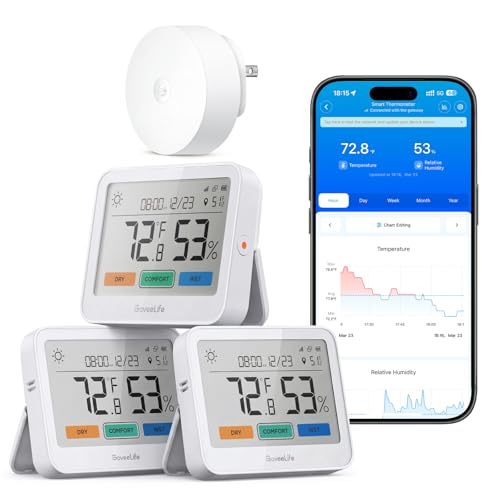
Pros
- Measures PM2.5, temperature, and humidity
- PM2.5 accuracy listed as ±15 µg/m³
- Temperature accuracy listed as ±0.54°F
- Refreshes correction data every 2 seconds
- Exports up to 2 years of data
Cons
- Needs a power source, with no built-in battery
- 2.4G Wi-Fi required to display the time
- Only supports listed GoveeLife devices
How We Chose Air Quality Monitors for Smoke
Smoke is not just one reading on a screen. A useful indoor monitor should make small particles easy to see, while also giving enough context from humidity, temperature or gas readings to know whether ventilation, filtration or a room change is needed.
- What it measures: Smoke concerns make particulate readings especially important, so we favored monitors that include PM2.5 or nearby particle sizes such as PM1.0 and PM10. The Qxzfff Air Quality Monitor covers CO2, HCHO, PM1.0 and PM10, giving it a broad set of readings for everyday indoor troubleshooting. Across our picks, some models measure 3 core indexes, while others list 9 core substances or more.
- Stated accuracy: We gave extra credit to monitors that publish specific accuracy claims instead of vague language. The GoveeLife Air Quality Monitor states PM2.5 accuracy of ±15 µg/m³, humidity accuracy of ±3%RH and temperature accuracy of ±0.54°F. That is useful if you want to watch short term changes after cooking, running a purifier or opening a window.
- Display and readability: A smoke related spike should be obvious from across a room, not hidden in a menu. Among our picks, displays include color coded bars, a 3 color visualization system and a 5.5 inch HD display. We preferred models that show multiple readings at once and use color changes or status bars when thresholds are exceeded.
- Data history and app or smart home support: A single reading is helpful, but history shows whether a room recovers in minutes or keeps getting worse. The Amazon Air Quality Monitor measures CO, PM2.5, VOCs, temperature and humidity, and it sends details to the Alexa app. It can also trigger routines for compatible devices when sensors detect changes, which matters if you want a purifier or fan to react without checking the screen.
- Power source and battery life: Battery life matters if you want to move a monitor from a kitchen to a bedroom during a smoky day. Among our picks, rechargeable models list about 7 to 15 hours, up to 10 hours or up to 20 hours of continuous use. Other picks are wired and avoid battery limits, which can be better for a fixed room where smoke or cooking particles are a recurring issue.
- Number of sensors or rooms: We treated each product as a single room monitor, because the product information does not list multi room sensor bundles. Several picks can be moved between rooms, and 2 models include app based remote viewing. If you need to watch a bedroom and living room at the same time, plan on more than 1 unit rather than assuming 1 monitor represents the whole home.
We excluded dehumidifiers because they remove moisture instead of measuring smoke related particles. We also excluded essential oil diffusers, which have too little output to humidify a room, and medical thermometers or meat thermometers, which do a different job.
Other Air Quality Monitors Worth Considering
These are other air quality monitors we looked at but did not put on our main list.
If app control is the main feature you want, zemeollo Air Quality Monitor stays relevant because it measures CO2, HCHO, PM10 and PM2.5. It did not move ahead of our top pick because the main list includes broader combinations with temperature, humidity or additional particle readings.
For a similar particle focused setup, AirWhisper Air Quality Monitor measures HCHO, PM1.0, PM10 and PM2.5, plus it includes app control. That 4 reading group is helpful for smoke watching, but our main picks give clearer reasons to choose among display, smart home support and battery life.
Prefer a simpler set of readings around small particles and room conditions? Temtop Air Quality Monitor measures PM2.5 and adds temperature and humidity readings, with app control as another point in its favor. Compared with our alternative pick, it has fewer named gas readings, which matters if you also want CO2 or HCHO on the same device.
And if humidity control is part of why you are shopping, LifeBasis Air Quality Monitor adds a built in humidistat while measuring CO2, HCHO, PM1.0 and PM10. That 4 reading pollutant set is competitive, but the main list gives more clearly separated choices for battery life, smart home routines and display size.
FAQs
What readings matter most for smoke indoors?
For smoke, PM2.5 is the clearest target because fine particles can rise during cooking, fireplace use or outdoor smoke events. Several of our picks also measure PM1.0 or PM10, which adds context around smaller and larger particles.
Do I need humidity readings when I am mainly worried about smoke?
Humidity does not measure smoke, but it helps explain indoor comfort and moisture risk while you are managing air. The EPA says indoor humidity should stay below 60 percent relative humidity, and ideally between 30 and 50 percent.
Is app control necessary for a smoke air quality monitor?
App control is not required, but it helps if the monitor is in another room or you want to check changes over time. Among our picks, app and smart home features range from remote viewing to routines that can turn compatible devices on or off.
Should I choose a wired monitor or a battery powered one?
A wired monitor is better for one fixed room because it can stay on without watching the battery. Battery powered picks in this group range from about 7 to 20 hours, which is useful when you want to move the monitor during a smoke event.
Sources
- Use and Care of Home Humidifiers, U.S. Environmental Protection Agency. EPA guidance on humidifier types, minerals, cleaning and safe humidity levels.
- A Guide to Mold, Moisture and Your Home, U.S. Environmental Protection Agency. EPA guide to controlling indoor moisture and mold.



Write Your Review
No reviews yet. Be the first to share your experience!