

Free Delivery. Exclusive Deals. All Prime.
Prime members save on shipping and get first access to deals, plus Prime Video included. 30 days free.
If the living room feels like a terrarium but the bedroom feels like a cracker, guessing from the thermostat is not enough. Indoor digital thermometers give room-level readings so you can adjust a humidifier, dehumidifier or open window with better information. After comparing 6 models, the TempPro Thermometer Hygrometer is our top pick because it reads temperature and humidity, has ±2% humidity accuracy and refreshes every 10 seconds. The Vocoo Thermometer Hygrometer is our alternative pick with temperature and humidity readings and ±5% humidity accuracy.

Pros
- Large 4-inch display with bold digits
- +/-1°F and +/-2% RH stated accuracy
- Updates readings every 10 seconds
- 24-hour and all-time max/min records
- Tabletop, wall mount, or magnetic placement
Cons
- Indoor use only
- No humidifying or air purifying function
- No remote sensor or app features listed
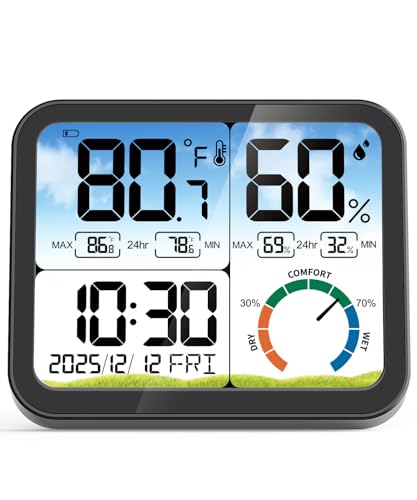
Pros
- 5.8 inch HD LCD screen with backlight
- Updates temperature and humidity every 10 seconds
- Shows daily max and min records, clock, and calendar
- USB powered with 3 AAA battery backup included
- Calibration feature for temperature and humidity readings
Cons
- USB power plug is not included
- Display is dim when running on battery backup only
- Humidity accuracy is ±5% RH

Pros
- Measures indoor temperature and humidity
- Shows daily high and low readings
- Compact 3 x 2.5 x 1.3 inch size
- Pairs with humidifiers or dehumidifiers
- AcuRite is based in Lake Geneva, WI
Cons
- Accuracy rating is not listed
- Warranty terms are not listed
- Only indoor measurements are described

Pros
- 3.5 inch LCD display for easy reading
- Measures temperature from -40 F to 158 F
- Measures humidity from 10% RH to 99% RH
- Color humidity indicator shows dry, comfort, or wet
- Table, wall hanging, and stick-on mounting options
Cons
- Humidity accuracy is listed as ±5% RH
- Uses CR2032 batteries rather than a plug-in power source
- No smart app or data logging features listed

Pros
- 3-pack covers multiple rooms or small spaces
- Refreshes readings every 10 seconds
- Shows 1-hour trend arrow plus DRY, OK, WET icons
- Includes kickstand and 3M adhesive mounting pads
- Pre-installed CR2032 batteries included
Cons
- Readings may fluctuate for 3 minutes after power-on
- No app, hub or pairing for remote monitoring
- Compact display may be harder to read from across a room

Pros
- 2-pack for monitoring more than one room
- Measures -58 to 158 F and 10% to 99% humidity
- Temperature accuracy listed as +/-2 F
- Humidity accuracy listed as +/-5% RH
- Kickstand and magnets give flexible placement
Cons
- Readings may fluctuate for 3 to 5 minutes after startup
- Designed for home use, not professional calibration
- Uses a CR2032 button battery
How We Chose Indoor Thermometers for Room Air Conditions
A useful room thermometer should do more than show a number that is hard to interpret. For indoor air, the most helpful models pair temperature with humidity, make the display readable at a glance and give enough context to decide whether to run a humidifier or dehumidifier.
- What it measures: Every pick here measures temperature and humidity, the 2 readings most directly tied to everyday room comfort. The AcuRite Thermometer Hygrometer keeps that focus simple with indoor temperature and humidity readings plus daily high and low records. None of the main picks measure PM2.5, CO2, VOCs or radon, so shoppers who want air-pollution data should look at a dedicated air-quality monitor.
- Stated accuracy: Accuracy matters because the EPA says indoor humidity should stay below 60 percent relative humidity, ideally between 30 and 50 percent. The TempPro Thermometer Hygrometer stands out on paper with ±1°F temperature accuracy and ±2% RH humidity accuracy. Among the rest of the main picks, stated humidity accuracy reaches ±5% RH, which is still aimed at home monitoring rather than lab use.
- Display and readability: Displays among the picks range from compact LCD screens to a 5.8-inch screen with backlight. The Thlevel Thermometer Hygrometer uses a 3.5-inch LCD and adds color indicators for dry, comfort and wet air conditions. That kind of visual cue is useful when the difference between 30 percent and 50 percent relative humidity matters more than the exact digit.
- Data history and app or smart-home support: The main picks favor local readouts over connected features. Two of the picks record daily or 24-hour high and low readings, while another includes all-time max and min records. None of the 6 main picks list app control or smart-home support, so shoppers who want phone alerts should consider the connected alternative below.
- Power source and battery life: Power setups vary across the group, with several using CR2032 cells and one model using 3 AAA batteries for backup. One pick is designed for USB-C power and uses batteries to preserve clock settings during an outage. Because listed battery-life durations are not provided, we prioritized whether the power source was clearly stated and whether batteries were included.
- Number of sensors or rooms: Most picks are single-room monitors, which is fine for a nursery, bedroom or basement where conditions can differ from the central thermostat. One pick includes 2 units, and another includes 3 units, giving broader room coverage without an app or hub. If you want to compare a damp basement with a dry bedroom, a multi-pack can show the difference room by room.
We excluded dehumidifiers because they remove moisture rather than just measure it, and essential oil diffusers because their output is too small to humidify a room meaningfully. We also excluded medical thermometers and meat thermometers because they are built for a different job.
Other Thermometers Worth Considering
These are other thermometers we looked at but did not put on our main list.
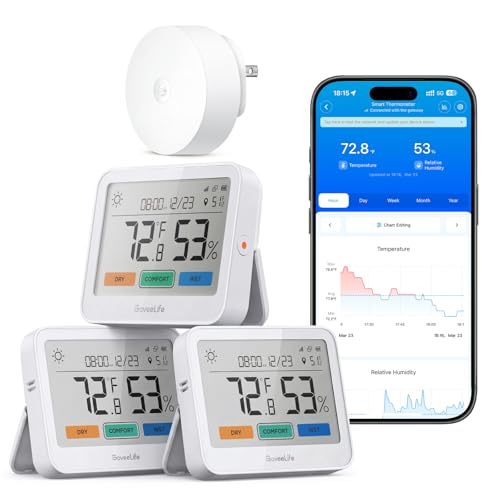
If phone access matters more than a simple countertop display, the Govee Thermometer Hygrometer adds app control while still measuring temperature and humidity. Its stated humidity accuracy is ±3%, which sits between our top pick and our alternative pick on paper, but app dependence may be unnecessary if you only need a bedside or nursery readout.
For shoppers comparing display layouts, the Secrui Thermometer Hygrometer also covers temperature and humidity readings. It may make sense if its size and controls suit a specific shelf or wall spot, but our main list gives clearer numeric reasons to compare, including a 5.8-inch display on one pick and a 3.5-inch display on another.
Prefer a non-connected model with tighter stated humidity accuracy? The Doqaus Thermometer Hygrometer lists temperature and humidity readings with ±2% humidity accuracy, matching our top pick on that figure. It stayed off the main list because the main group already covers simpler single-room monitors, 2-unit coverage and 3-unit coverage.
FAQs
What should an indoor thermometer measure besides temperature?
For most homes, humidity is the key second reading. The EPA says indoor relative humidity should be kept below 60 percent, ideally between 30 and 50 percent, so a temperature-only display gives an incomplete picture of room comfort.
How accurate do indoor digital thermometers need to be for home use?
For the models here, stated temperature accuracy ranges from ±1°F to ±2°F where provided, while stated humidity accuracy ranges from ±2% RH to ±5% RH. That is enough to guide practical decisions like whether to run a humidifier, but it is not a substitute for specialized measurement equipment.
Do I need app control for indoor room monitoring?
Not necessarily. The main picks use local displays, with refresh rates as frequent as 10 seconds on several models. App control is more useful if you want remote checking, alerts or a history view away from the room.
How many indoor thermometers should a home have?
Start with the rooms where conditions differ most, such as a nursery, basement, greenhouse or bedroom. Among our picks, package sizes include 1, 2 and 3 units, so you can monitor one problem room or compare several spaces without changing product type.
Sources
- Use and Care of Home Humidifiers, U.S. Environmental Protection Agency. EPA guidance on humidifier types, minerals, cleaning and safe humidity levels.
- A Guide to Mold, Moisture and Your Home, U.S. Environmental Protection Agency. EPA guide to controlling indoor moisture and mold.



Write Your Review
No reviews yet. Be the first to share your experience!