

Free Delivery. Exclusive Deals. All Prime.
Prime members save on shipping and get first access to deals, plus Prime Video included. 30 days free.
When last night’s takeout smell is still arguing with the laundry soap by breakfast, VOC air quality monitors can give you numbers instead of guesses. These devices solve that problem by tracking gases, particles, humidity and ventilation clues in real time. After comparing 6 models, the sainlogic Air Quality Monitor stands out for CO2, HCHO, PM1.0 and PM10 readings, plus ±3% humidity accuracy and app control. The AirKnight Monitoring Air Quality Monitor is the alternative pick, with CO2, HCHO, PM10 and PM2.5 coverage.

Pros
- Tracks CO2, PM2.5, PM10, PM1.0, AQI, HCHO and TVOC
- 7 user-defined alert thresholds with tri-color LED alerts
- 7.2-inch display with 3 brightness levels
- Refreshes readings every 1 to 2 seconds
- Built-in 2500mAh battery runs up to 8 hours
Cons
- No app or WiFi connectivity listed
- Wireless use is limited to up to 8 hours per charge
- Display may be large for very small spaces
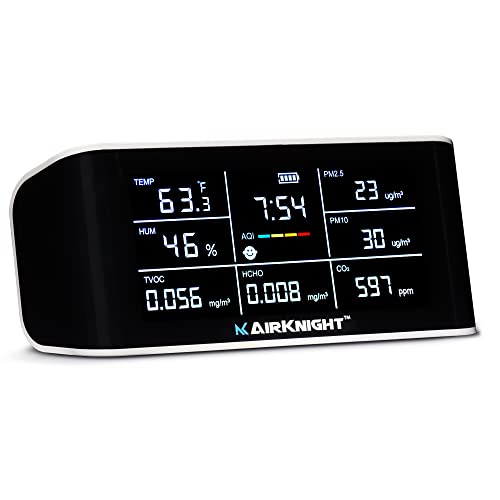
Pros
- 10-in-1 monitor tracks CO2, PM2.5, PM10, TVOC and HCHO
- Large LCD screen shows real-time air readings
- 3000 mAh rechargeable battery for portable use
- Includes instructional video and written user manual
- US-based customer phone support
Cons
- Accuracy specifications are not listed
- No app connectivity or smart home features listed
- Extended warranty term is not specified
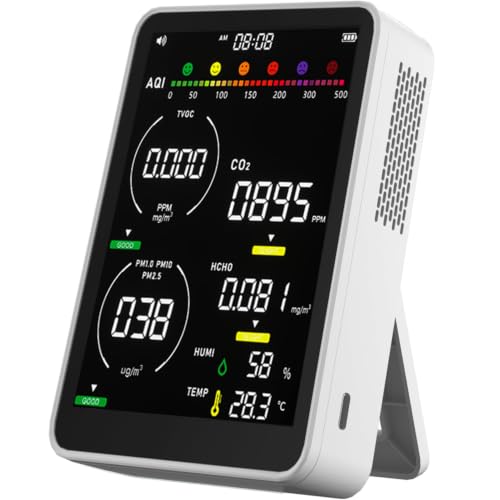
Pros
- Tracks PM1.0, PM2.5, PM10, CO2, TVOC, HCHO, temp and humidity
- Updates air data every 1.5 seconds
- HD color screen with color-coded air level readings
- Type-C charging with cable and AC adapter included
- Portable 0.9 lb design for rooms, cars and offices
Cons
- Cordless run time is limited to 4-5 hours
- No app or data logging feature is listed
- Audio prompt must be turned off manually

Pros
- Tracks PM1.0, PM2.5, PM10, CO2, TVOC, HCHO, temp and humidity
- Samples and updates air data every 1.5 seconds
- One-button control with ℃/℉ switching
- Adjustable audio prompt for quieter use
- Includes Type-C cable and AC power adapter
Cons
- Full charge supports only 4-5 hours of continuous sampling
- No app, Wi-Fi or data logging features listed
- 16-in-1 label, but description names 7 core indicators

Pros
- Tracks CO2, VOCs, humidity, temperature and air pressure
- Also monitors noise and light levels
- Battery-powered design allows cable-free placement
- Touch sensor gives a color-coded air quality indicator
- Includes 2 AA batteries and a Quick Start Guide
Cons
- Complete readings are accessed in the app
- Bluetooth-connected, so phone setup is part of use
- AA batteries will need replacement over time
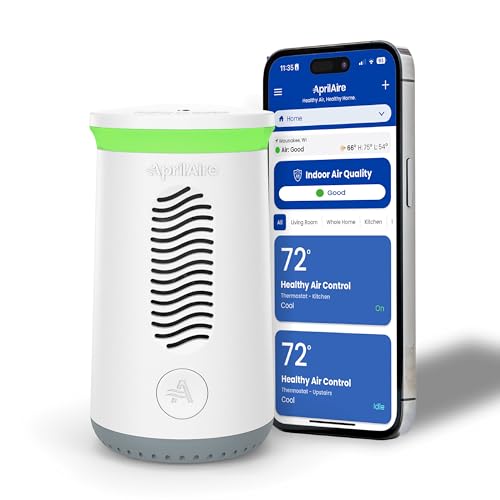
Pros
- 5-in-1 monitor tracks CO2, VOCs, PM2.5, humidity and temperature
- Wi-Fi app control with instant notifications
- Color status display for at-a-glance readings
- 3 light options: default, always on and always off
- Can integrate with select AprilAire systems
Cons
- Requires the AprilAire Healthy Air App to function
- Healthy Air Mode needs a separate compatible thermostat
- AprilAire filtration or ventilation solutions sold separately
How We Chose Air Quality Monitors for VOC Tracking
Indoor air is not one number. A useful monitor should separate particle readings, gas readings and comfort readings so you can tell whether to ventilate, filter or simply adjust humidity.
- What it measures: We gave priority to monitors that report more than one kind of indoor condition, because VOCs alone do not tell the whole story. The sainlogic Air Quality Monitor covers CO2, HCHO, PM1.0 and PM10, which helps distinguish ventilation issues from particle spikes. Across the main list, core readings include TVOC, CO2, PM2.5, temperature and humidity.
- Stated accuracy: Accuracy claims matter most for readings that people act on often, especially humidity. One main pick states ±3% humidity accuracy, while another states ±2% to ±3% RH. Temperature accuracy among the listed claims runs from ±1°F to ±3°F, which is specific enough to judge room comfort trends.
- Display and readability: A monitor should make the current condition obvious without forcing you to open an app. The largest stated screen in the main list is 7.2 inches, and several models use color-coded air level readings or tri-color alerts. One model also offers 3 brightness levels, which matters in bedrooms and nurseries.
- Data history and app or smart-home support: App support is most useful when it turns readings into trends and alerts. The AirWhisper Air Quality Monitor is listed with CO2, HCHO, PM1.0 and PM10 coverage, plus app control, which fits shoppers who want more than a glance at the screen. Among the connected picks, app features include notifications, trend review and remote monitoring.
- Power source and battery life: Battery life affects whether a monitor can move from kitchen to bedroom to car without being tethered. Stated portable run times in the group range from 4 hours to 8 hours. USB-C charging appears on multiple models, which is useful if you already keep that cable type around the house.
- Number of sensors or rooms: A single monitor is most useful when its sensor set is broad enough to justify moving it between rooms. The AQItech Air Quality Monitor is described as a 16-in-1 model that covers CO2, HCHO, PM1.0 and PM10, plus app control. Across the list, sensor counts and reading sets range from 5 always-on air quality sensors to 16-in-1 coverage.
We excluded dehumidifiers because they remove moisture rather than measure a broad set of pollutants. We also left out essential oil diffusers, which are not air monitors, and medical or meat thermometers, which measure a different thing entirely.
Other Air Quality Monitors Worth Considering
These are other air quality monitors we looked at but did not put on our main list.
If you want a monitor that folds humidity control into the same general idea, LifeBasis Air Quality Monitor is the one to note. It measures CO2, HCHO, PM1.0 and PM10, and it also includes temperature and humidity readings. It adds a built-in humidistat, while our top pick keeps the focus on air readings and stated ±3% humidity accuracy.
For a simpler particle-and-gas comparison, zemeollo Air Quality Monitor covers CO2, HCHO, PM10 and PM2.5. That gives it the same 4 named pollutant categories highlighted for our alternative pick. It is less clearly separated from the main list, though, because the top choices already cover those gases and particles with broader display or battery details.
YNAK Air Quality Monitor is more compelling if humidity precision is your main concern. It measures CO2, HCHO, PM1.0 and PM10, and it states ±2% humidity accuracy. That is a tighter humidity claim than the ±3% figure called out for our top pick, but the main picks offer a stronger mix of display, alert and power details.
And if smart-home style app viewing is the reason you are shopping, Amazon Air Quality Monitor is worth a look. It measures CO, PM2.5 and VOC, along with temperature and humidity readings. The catch is that it lists 3 pollutant categories, while several main-list models cover CO2, formaldehyde or multiple particulate sizes.
FAQs
What readings matter most for VOC tracking?
For VOC concerns, TVOC or VOC readings are the starting point, but CO2, PM2.5 and humidity add useful context. CO2 can point to poor ventilation, while PM2.5 and PM10 help show whether particles are part of the same indoor air problem.
How important is humidity when choosing an air quality monitor?
Humidity matters because it affects comfort and mold risk. According to the EPA, indoor relative humidity should stay below 60 percent and ideally between 30 and 50 percent. A monitor with stated humidity accuracy, such as ±2% or ±3%, gives you a clearer basis for action.
Do I need an app for an indoor VOC monitor?
An app is helpful if you want alerts, trend history or remote checks, but it is not required for basic room-by-room reading. Some picks rely on a screen with color alerts, while others use app notifications and trend views. If you only need a quick status check, a large display may matter more.
What battery life should I look for?
For portable use, our picks list run times from 4 hours to 8 hours. A shorter run time can still work for spot checks, while 8 hours is better for following a room across a full workday. USB-C charging also makes frequent recharging less annoying.
Sources
- Use and Care of Home Humidifiers, U.S. Environmental Protection Agency. EPA guidance on humidifier types, minerals, cleaning and safe humidity levels.
- A Guide to Mold, Moisture and Your Home, U.S. Environmental Protection Agency. EPA guide to controlling indoor moisture and mold.



Write Your Review
No reviews yet. Be the first to share your experience!