

Free Delivery. Exclusive Deals. All Prime.
Prime members save on shipping and get first access to deals, plus Prime Video included. 30 days free.
The basement smells a little like wet cardboard, the nursery feels dry, and somehow everyone blames the thermostat. Smart hygrometers solve that by showing indoor humidity and temperature before a small comfort problem becomes a mold or storage problem. After comparing 4 models, the GoveeLife Thermometer Hygrometer stands out for temperature and humidity readings, ±2% humidity accuracy, and app control. The Govee Thermometer Hygrometer is the alternative pick, with temperature and humidity readings and ±3% humidity accuracy.
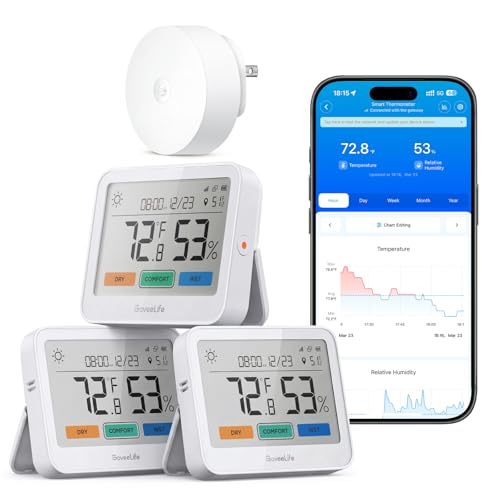
Pros
- 3-pack with gateway for whole-home monitoring
- Up to 1640 ft open-air range via gateway
- ±0.36°F and ±2% RH stated accuracy
- 2-second refresh for temperature and humidity
- Large 3.7-inch LCD with color comfort indicator
Cons
- Local weather forecast requires H5044 gateway
- Battery life drops to 1 year when used with gateway
- Uses two AA alkaline batteries per monitor

Pros
- 3-pack for monitoring multiple locations
- Bluetooth range up to 262 ft with no obstacles
- Temperature accuracy is ±0.54°F
- Humidity accuracy is ±3%RH
- Exports up to 2 years of data as CSV
Cons
- Not a WiFi version
- 262 ft range applies only with no obstacles
- App is needed for alerts and data export

Pros
- Bluetooth monitoring up to 260 ft with no obstructions
- App does not require user registration
- 2-year data storage and export function
- Accuracy listed at +/-0.9°F and +/-2% RH
- 10-second refresh with backlit display
Cons
- 260 ft range is stated only with no obstructions
- No warranty information listed
- Small display housing at about 2.72 inches tall

Pros
- Includes 3 sensors and 1 YoLink Hub
- LoRa range up to 2034 feet in open air
- Tracks temperature from -4°F to 129°F
- Humidity accuracy of ±3% from 10% to 90% RH
- AA battery life up to 5 years
Cons
- Alexa supports temperature queries only, not humidity
- Alexa routines are not supported
- Free SMS alerts are limited per device and hub
How We Chose These Smart Hygrometers for Indoor Air Conditions
Indoor humidity is not just a comfort number. According to the Environmental Protection Agency, indoor relative humidity should stay below 60 percent, and the ideal range is between 30 and 50 percent, so a useful hygrometer needs clear readings and alerts you can act on.
- What it measures: Every main pick measures temperature and humidity, which are the 2 readings most people need for bedrooms, basements, nurseries, greenhouses, humidors and storage spaces. Some indoor air monitors also track PM2.5, CO2, VOCs or radon, but those measurements are not included across these 4 picks. For this list, we prioritized humidity and temperature because the EPA specifically notes that relative humidity can be measured with a moisture or humidity meter.
- Stated accuracy: Accuracy matters because the difference between 50 percent and 60 percent relative humidity can change what you do next. The GoveeLife Thermometer Hygrometer lists temperature and humidity readings with ±2% humidity accuracy, which is the tightest humidity figure among the main picks. Across the list, stated humidity accuracy runs from ±2% to ±3% RH, and temperature accuracy ranges as low as ±0.36°F on some models.
- Display and readability: A readable display is useful when the sensor sits in a nursery, wine area, greenhouse or basement and you do not want to open an app for every glance. Among the main picks, 2 models include an onboard display, and one uses a 3.7 inch high contrast screen with a color comfort indicator. Another has a large backlit display and a face icon comfort indicator, which helps when checking conditions in low light.
- Data history and app or smart-home support: App control is important when you want alerts before humidity drifts outside your chosen range. The YoLink Thermometer Hygrometer measures temperature and humidity, lists ±3% humidity accuracy, includes 3 sensors, and supports app control with text, email or push notifications. Among the main picks, Bluetooth or gateway ranges span from 260 feet to 2034 feet in open air, so the right choice depends on whether you are monitoring one room or a detached space.
- Power source and battery life: Battery life affects where you can place a sensor, especially in a freezer, crawlspace, greenhouse or cabinet. Two of the main picks use AA batteries, with stated battery life reaching up to 5 years for one model and up to 2 years on Bluetooth for another. The shorter figure can still be practical if the sensor is easy to reach, but long battery life matters more for hard-to-access locations.
- Number of sensors or rooms: Multiroom coverage can be more useful than a single premium sensor if humidity problems vary by floor. The TempPro Thermometer Hygrometer measures temperature and humidity and supports app control from up to 260 feet away with no obstructions. Among the main picks, bundles range from 1 sensor to 3 sensors, so one buyer can monitor a single cigar cabinet while another can cover a basement, bedroom and freezer.
We excluded dehumidifiers because they remove moisture instead of simply measuring it. We also left out essential oil diffusers because their output is too limited for room humidification, and medical thermometers or meat thermometers because they measure a different thing.
The Competition
These are other hygrometers we looked at but did not put on our main list.
If you are considering the AcuRite Humidifier mainly for app control, it can be a capable unit for watching indoor conditions. It was not placed on the main list because it does not match this keyword’s need as closely as the 4 main picks, which are centered on dedicated temperature and humidity monitoring rather than humidification.
FAQs
What humidity level should a smart hygrometer help me watch for?
The EPA says indoor relative humidity should stay below 60 percent, with an ideal range between 30 and 50 percent. A smart hygrometer is most useful when it lets you spot when a room is drifting outside that range before moisture or dryness becomes obvious.
Do I need app alerts, or is a display enough?
A display is enough for quick checks in a room you pass often, especially if the screen is large or backlit. App alerts are more useful for a basement, freezer, greenhouse or storage area, where one of our picks can send notifications when custom thresholds are crossed.
How much accuracy matters for indoor humidity?
Among our picks, stated humidity accuracy ranges from ±2% to ±3% RH. That spread is meaningful when you are trying to stay below 60 percent relative humidity, because a small difference can affect whether you run a humidifier, dehumidifier or fan.
Should I choose one sensor or a multi-sensor setup?
Choose one sensor if you only care about a single bedroom, humidor, nursery or instrument room. Choose a multi-sensor setup if you need to compare 2 or 3 areas, because humidity can vary sharply between a basement, main floor and storage space.
Sources
- Use and Care of Home Humidifiers, U.S. Environmental Protection Agency. EPA guidance on humidifier types, minerals, cleaning and safe humidity levels.
- A Guide to Mold, Moisture and Your Home, U.S. Environmental Protection Agency. EPA guide to controlling indoor moisture and mold.


Write Your Review
No reviews yet. Be the first to share your experience!