

Free Delivery. Exclusive Deals. All Prime.
Prime members save on shipping and get first access to deals, plus Prime Video included. 30 days free.
When the dinette feels like a sauna but the bunk area needs a sweatshirt, guessing gets old fast. RV indoor outdoor thermometers help you track cabin comfort and outside conditions before condensation, heat or cold ruins the mood. After comparing 6 models, the U Unni Indoor Outdoor Thermometer stands out for support for 3 sensors, a 330 ft wireless range and updates every 30 seconds. The TempPro Indoor Outdoor Thermometer is the alternative pick for its longer 500 ft range.

Pros
- Swiss-made Sensirion sensor
- Temperature accuracy is +/-0.5°F
- Humidity accuracy is +/-2%
- Wireless range up to 330 ft
- Updates data every 30 seconds
Cons
- Only one outdoor sensor is included
- Always-on backlight requires USB power
- Warranty does not include batteries

Pros
- 500 ft wireless range for remote monitoring
- Weather-resistant, waterproof outdoor sensor
- Temperature accuracy listed as +/-2°F
- Humidity accuracy listed as +/-2 to 3%RH
- 3.3 inch backlit display with bold digits
Cons
- Temperature accuracy is limited to +/-2°F
- Humidity accuracy varies by +/-2 to 3%RH
- Uses batteries, though they are included

Pros
- Large color display with big numbers
- Supports 3 outdoor sensors; 1 included
- High and low temperature alerts
- WWVB atomic clock with auto DST
- 5 backlight brightness levels
Cons
- Backup batteries are not included
- Battery-only mode lights for 10 seconds
- Extra outdoor sensors are not included

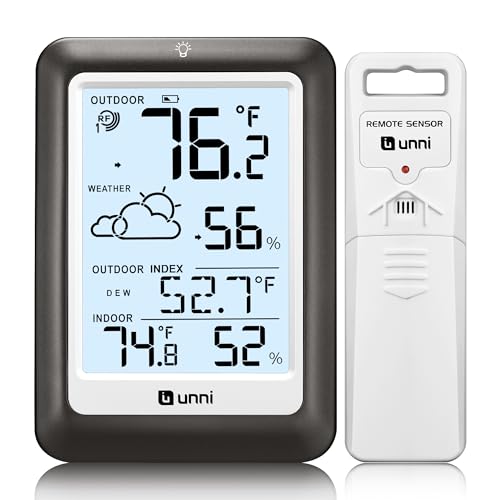
Pros
- Swiss-made Sensirion sensor with +/-0.5°F temperature accuracy
- Humidity accuracy listed at +/-2% from 1% to 99%
- Wireless transmission up to 330 ft, updates every 30 seconds
- Shows forecast, heat index, dew point, and mold index
- Backlit display lights for 10 seconds
Cons
- Batteries are not included
- Includes one outdoor sensor, though it supports up to 3
- Backlight requires tapping and lasts 10 seconds
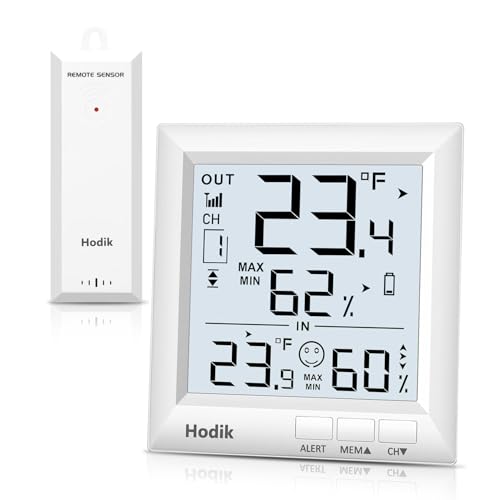
Pros
- Large color LCD with extra-large bold digits
- Custom temperature alert sounds up to 90 dB for 1 minute
- 330 ft wireless range with updates every 30 seconds
- Accuracy listed at ±0.5°F and ±2% humidity
- Shows comfort index, 24-hour max/min, and trend arrows
Cons
- Only 1 wireless sensor is included
- Batteries are not included
- Constant backlight requires the included USB cable

Pros
- Displays both Fahrenheit and Celsius
- Temperature range is -22 F to 122 F
- Mounts to glass with 2 included suction cups
- Colorful RV map design
- Durable plastic construction
Cons
- No humidity reading listed
- Mounting is limited to window or glass surfaces
- Temperature range tops out at 122 F
How We Chose Thermometers for RV Indoor and Outdoor Use
An RV can have real temperature swings between the cab, sleeping area and storage bays. For that reason, the strongest thermometers here are not just outside temperature displays, they also make indoor humidity and sensor placement easy to understand.
- What it measures: For RV comfort, temperature alone is not enough, because humidity affects condensation, bedding and stored gear. The U Unni Thermometer Hygrometer tracks temperature and humidity, and it can support up to 3 sensors. None of the main picks claim PM2.5, CO2, VOC or radon readings, so those air quality features were not treated as tie breakers.
- Stated accuracy: Stated accuracy matters because a few degrees can change whether you open a vent, run heat or protect stored water lines. Among the main picks, temperature accuracy ranges from plus or minus 0.5°F to plus or minus 2°F. Humidity accuracy is stated as plus or minus 2% on some models and plus or minus 2 to 3%RH on another, which is useful for deciding whether a reading is close enough for everyday cabin decisions.
- Display and readability: RV displays need to be legible from a bed, dinette or entryway, not just from a desk. The main picks include screens from 3.3 inches to 4.5 inches, plus one larger color weather display with a 7.9 inch length. Backlighting also varies, from a 10 second tap light to multiple brightness levels when USB or adapter power is used.
- Data history and app or smart-home support: The strongest basic displays give you at least a short trend, even without an app. Some main picks show 24 hour maximum and minimum records, while others show barometric history or a 12 to 24 hour forecast after a 7 day calibration. No main pick lists app control or smart-home support, so this group is better for glanceable local readings than phone-based logging.
- Power source and battery life: RV owners should pay attention to what stays lit on battery power and what needs a cord. Some displays use USB or adapter power for a constant backlight, while battery-only operation may limit lighting to 10 seconds. The main picks do not state battery life in days or months, so power flexibility counted more than unsupported runtime claims.
- Number of sensors or rooms: Multiroom support is especially useful in a trailer or motorhome because the front cab, bedroom and exterior storage area can behave differently. The U Unni Indoor Outdoor Thermometer supports up to 3 sensors and transmits within a 330 ft radius. The DreamSky Indoor Outdoor Thermometer also supports 3 outdoor sensors and adds a built-in clock, which helps if you want weather and time on one display.
We excluded dehumidifiers because they remove moisture instead of measuring it. We also excluded essential oil diffusers because their output is too small for room humidification, and medical or meat thermometers because they are built for a different job.
Other Thermometers Worth Considering
These are other thermometers we looked at but did not put on our main list.
If you would rather compare another display style, Newentor Indoor Outdoor Thermometer may be worth a look for a different size and feature mix. It did not replace our main list because our top pick supports 3 sensors, which is the clearer match for monitoring more than one RV zone.
For shoppers who mainly want a different layout, OBET Indoor Outdoor Thermometer is another alternative. The main list gives more specific numbers to compare, including wireless ranges up to 500 ft and update intervals as often as every 30 seconds.
Prefer a thermometer that also keeps time? Taylor Indoor Outdoor Thermometer includes a built-in clock, but one of our main picks also combines weather readings with a clock and supports 3 outdoor sensors. That extra sensor support matters more in an RV with separate sleeping, living and outside areas.
And if humidity control is the reason you are shopping, Lichi Thermometer Hygrometer adds a built-in humidistat and includes temperature and humidity readings. It also lists support for 3 sensors, but the main picks provide more complete comparison points around stated accuracy, display behavior and sensor range.
FAQs
What should an RV thermometer measure besides temperature?
Humidity is the most useful second reading because it helps you manage condensation and comfort. According to the EPA, indoor relative humidity should stay below 60 percent, and ideally between 30 and 50 percent.
How much wireless range do you need in an RV?
For most RV layouts, the listed ranges of 330 ft to 500 ft are more than the vehicle itself requires. The extra range can help when the outdoor sensor is separated by walls, storage compartments or a campsite setup.
Are app features necessary for RV indoor and outdoor monitoring?
Not necessarily. The main picks focus on local displays, with features such as 24 hour maximum and minimum records, barometric history or a 12 to 24 hour forecast. If you need long-term phone logging, none of these main picks states app or smart-home support.
Where should the outdoor sensor go on an RV?
Choose a protected spot that reflects outside air rather than direct sun or exhaust heat. A weather-resistant sensor is helpful, and the main picks list outdoor temperature ranges as low as minus 58°F and as high as 158°F.
Sources
- Use and Care of Home Humidifiers, U.S. Environmental Protection Agency. EPA guidance on humidifier types, minerals, cleaning and safe humidity levels.
- A Guide to Mold, Moisture and Your Home, U.S. Environmental Protection Agency. EPA guide to controlling indoor moisture and mold.


Write Your Review
No reviews yet. Be the first to share your experience!