

Try Amazon Prime free for 30 days
Fast free delivery on heavy items, plus Prime Video, Prime Music and member-only deal prices.
When the living room feels like a walk-in cooler and everyone is arguing over the one blanket, indoor propane heaters for large room use can add heat without relying on an outlet. After comparing 6 models, the Paulinn 18,000 BTU Propane Heater leads with 18,000 BTU, coverage up to 450 square feet and an oxygen depletion sensor. The Bilt Hard 30,000 BTU Propane Wall Heater is the alternative pick for 30,000 BTU and coverage up to 1,400 square feet.

Pros
- 6,000, 12,000, and 18,000 BTU heat modes
- Heats spaces up to 450 sq. ft.
- Up to 69 hours runtime on low at 6,000 BTU
- ODS low oxygen shutoff and tip-over protection
- Noise level no more than 32 dB
Cons
- 450 sq. ft. coverage may not suit larger spaces
- Propane heater needs proper ventilation
- No thermostat listed in product data

Pros
- 30,000 BTU output heats up to 1,400 sq. ft.
- High, Medium, and Low thermostat settings
- ODS safety shutoff for low fresh air levels
- 99.9% fuel efficiency, no external vent required
- Wall mount hardware and base feet included
Cons
- Requires liquid propane fuel
- Heating coverage is limited to 1,400 sq. ft.
- 30,000 BTU may be more than some small rooms need

Pros
- 30,000 maximum BTU output
- Heats up to 1,400 sq. ft.
- 3 manual heat settings, Low, Medium, High
- No electricity required for operation
- Oxygen Depletion Sensor with automatic shut-off
Cons
- Propane only, not for natural gas
- Blower sold separately
- Manual control, 3 heat settings only
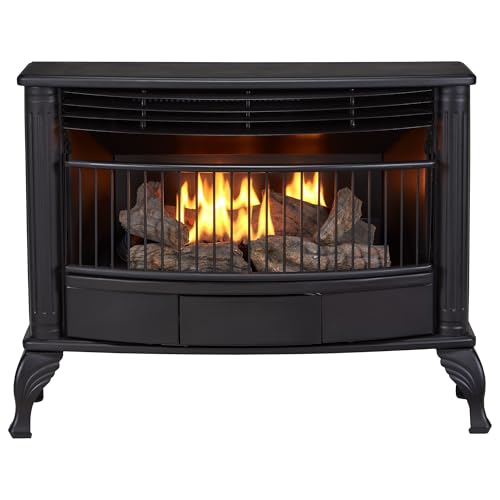
Pros
- 25,000 BTU output heats up to 1,100 sq ft
- Thermostat cycles stove on and off
- 99.9% efficient vent-free design
- Oxygen Depletion Sensor with auto shut-off
- Battery-assisted Piezo ignition
Cons
- Requires liquid propane fuel
- 56 lb weight limits easy repositioning
- Heating coverage tops out at 1,100 sq ft

Pros
- 3 heat settings, 6000, 12000, and 18000 BTU
- Heats spaces up to 450 sq ft
- Runs up to 69 hours on low with a 20 lb propane tank
- ODS and tip-over protection shutoffs
- Folds to 15 cm thin with 4 swivel casters
Cons
- For outdoor and well-ventilated indoor use only
- Requires a standard 20 lb propane tank
- Disconnect gas hose before folding for storage

Pros
- 10,000 BTU output for spaces up to 500 sq. ft.
- High, medium and low thermostat control
- No electricity required for operation
- Wall mount hardware and base feet included
- ODS shutoff and ANSI certification
Cons
- Limited to areas up to 500 sq. ft.
- Requires liquid propane fuel
- At 15.9 lb, it is not an ultra-light portable heater
How We Chose Propane Heaters for Large-Room Backup Heat
A large room asks more from a propane heater than a small bedroom or tent corner. BTU output matters, but so do oxygen sensors, fuel limits and the distance you can keep between the heater and anything that can burn.
- Heat output and coverage: Among our picks, maximum output runs from 10,000 BTU to 30,000 BTU. Claimed coverage runs from 450 square feet to 1,400 square feet, which is the first filter for a large den, cabin room or garage bay. The Duluth Forge QSL250T sits in the middle with 25,000 BTU and coverage up to 1,100 square feet, plus an adjustable thermostat for cycling heat around a set room temperature.
- Indoor rating and oxygen depletion sensing: We prioritized models that list indoor use or ventless indoor operation and include an oxygen depletion sensor. The Paulinn 18,000 BTU Propane Heater combines 18,000 BTU with coverage up to 450 square feet, an oxygen depletion sensor and tip-over protection. That balance matters in a heated workspace where people may be moving around the unit.
- Ventilation and carbon monoxide precautions: Vent-free does not mean care-free. The U.S. Consumer Product Safety Commission says unvented gas heaters should have an oxygen depletion sensor, and the Centers for Disease Control and Prevention advises a battery-operated carbon monoxide detector when using fuel-burning heat. The U.S. Fire Administration also says anything that can burn should stay at least 3 feet from a space heater.
- Fuel type, tank size and run time: All of our main picks are propane heaters, and several are designed for liquid propane only. Two portable cabinet-style picks list use with a standard 20 lb propane tank and claim up to 69 hours on the 6,000 BTU low setting. The CDC advises using only the type of fuel the heater is designed to use, which rules out swapping in another fuel because it happens to be nearby.
- Ignition and safety shut-offs: The main list includes push-button or Piezo-style ignition across several models, with safety features centered on oxygen depletion sensing. The ProCom ML100TBA is the smallest featured example, at 10,000 BTU for up to 500 square feet, and it pairs an adjustable thermostat with an oxygen depletion sensor. For larger rooms, that lower BTU rating makes it more of a zone heater than a whole-room answer.
- Size and portability: Portability differs sharply across the group. Two cabinet-style picks have 4 casters, while several wall-style picks include base feet and wall-mount hardware. If the heater will move between a garage, workshop and emergency spot, wheels matter more than a wall bracket; if it will live in one room, base feet or wall mounting can keep the floor plan simpler.
We excluded central furnaces and whole-house systems because they require professional installation. We also left out water heaters and heated blankets because they do a different job, and outdoor-only patio heaters because they are not rated for enclosed spaces.
The Competition
These are other propane heaters we looked at but did not put on our main list.
If raw output is the draw, Mr. Heater 30,000 BTU Propane Radiant Heater reaches 30,000 BTU and is rated for up to 1,000 square feet. It also lists an adjustable thermostat and a 26.2-pound weight, but it did not match the large-room indoor focus of our main list as closely as our alternative pick, which claims coverage up to 1,400 square feet.
For a smaller emergency kit, Mr. Heater Buddy is easier to think about carrying at 7.1 pounds. Its 9,000 BTU output and 225-square-foot coverage are much lower than every main-list model, so it makes more sense for a compact area than for a large room.
That same 18,000 BTU ceiling appears on the Gasland MHA18B, which is rated for up to 450 square feet. It includes tip-over protection and CSA certification, but our top pick pairs the same stated output and coverage class with the safety emphasis we wanted for this specific large-room search.
And if a thermostat is high on your list, Mr. Heater 30,000 BTU Space Heater includes one while covering up to 1,000 square feet. At 26.1 pounds, it is nearly the same weight as the radiant model above, but it still falls short of the largest coverage number among our main picks.
FAQs
How many BTUs should a propane heater have for a large room?
Our picks range from 10,000 BTU to 30,000 BTU, with stated coverage from 450 square feet to 1,400 square feet. For a large room, start with the stated square-foot rating, then leave margin for high ceilings, leaky doors or garage-style concrete floors.
Are ventless propane heaters safe indoors?
They require the right safety features and careful use. The U.S. Consumer Product Safety Commission says unvented gas heaters should have an oxygen depletion sensor, and the CDC recommends a battery-operated carbon monoxide detector around fuel-burning heat.
Do indoor propane heaters need ventilation?
Yes, fuel-burning heaters still need attention to fresh air and carbon monoxide risk. The CDC says to make sure there is proper ventilation if using a kerosene heater, and the same caution is relevant when weighing any combustion heater for an enclosed room.
Where should a propane heater sit in a large room?
Keep it on a level, hard, nonflammable surface rather than on rugs or carpet. The CPSC and U.S. Fire Administration both advise keeping anything that can burn at least 3 feet from space heaters.
Sources
- CPSC Offers Tips to Prevent Home Fires From Space Heaters, U.S. Consumer Product Safety Commission. Fire-safety tips and required safety features for space heaters.
- Safety Guidelines: During & After a Winter Storm, Centers for Disease Control and Prevention. Winter heating safety for space heaters, kerosene heaters and carbon monoxide.
- Heating Fire Safety, U.S. Fire Administration. Home heating fire statistics and prevention messages.




Write Your Review
No reviews yet. Be the first to share your experience!